At the Western Edge of Europe (1): The Cliffs of Moher

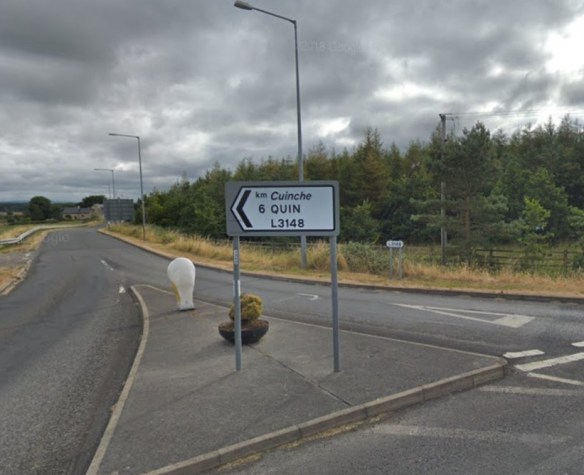
Burren Quin sign

Between Shannon Airport and the village of Liscannor, a roadside sign points to a trace of my Irish ancestry in the village of Quin.

It was my first visit to Ireland. Emmy and I went by taxi from Shannon Airport to the township Liscannor on the Atlantic coast about one hour away. We passed roadside signs pointing to the village of Quin. A strange feeling came over me. It wasn’t deja vue exactly, but rather a vague feeling of familiarity. Perhaps this is where my ancestors came from. I don’t know much about them except that they fled Ireland around 1870, initially settling in the lowlands of Scotland, then migrating to Canada and later to New Zealand where I was born. Quinn – with its variants Quin, O’Quinn, O’Coinn, Cuain, Cuinche and others – is a common Irish name found right across the island. It is especially common in County Clare where we saw it on several signs as we walked the Burren Way up the west coast. Unexpectedly, I found myself walking on what might have been my family’s ancient home ground.
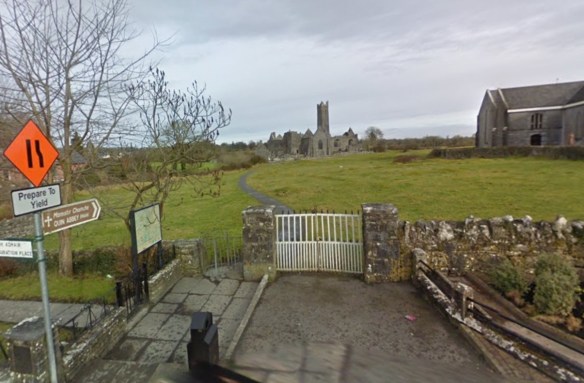
Burren Quinn Abbey

Quin Abbey in County Clare. This tumbledown ruin and me… we have a lot in common. (Google Earth image)

On the morning of July 22nd, with a blustery wind slapping at us from the chopped-up waters of the Atlantic Ocean, we shouldered our backpacks and headed out of Liscannor towards the southern end of the famous Cliffs of Moher. We were on a track called The Burren Way. Our destination for the day was the hamlet of Doolin, about twenty kilometres to the north. We walked into green pasturelands, criss-crossed by rough stone walls, that sloped down to a grey sea. Isolated white cottages crouched in the grass with beige-coated cows dotted around them. There were no trees, the roads were empty, and the homesteads too seemed deserted. We walked alone.

dsc01066.jpg

The famous, windswept Cliffs of Moher.

DSC01062

Emmy braces herself against the Atlantic wind with O’Brien’s Tower in the background.

dsc01067.jpg

Rough slate walls helped protect us at the edge of the cliff.

Our walking poles came out early. We levered our way up a long, gravelly asphalt road towards a ruined stone tower – O’Brien’s Tower – standing high above the sea. From there, looking north we saw a series of steep dark headlands diving almost vertically into the sea. The path narrowed and veered towards the edge of the cliff. Far below, the white breakers of the Atlantic boiled against the rocky teeth of the cliff base. In some places big slabs of slate had been placed like a low wall between the path and the edge of the cliff. We had to wobble over at least half-a-dozen stone stiles.
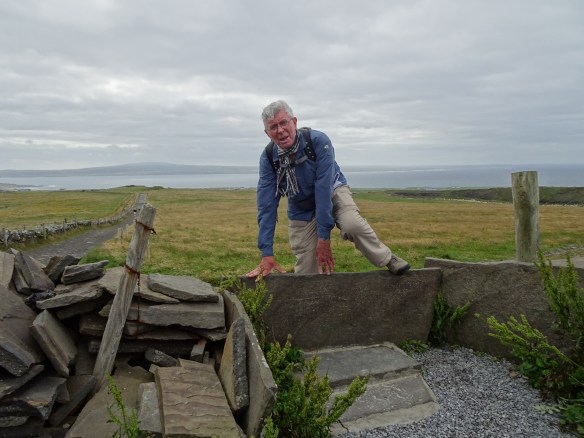
DSC01059

Stone stiles… my technique was to sprint up to the stile, leap high into the air, and soar over it in one youthful bound (as illustrated in this photo).

We met a few walkers coming south, and as we crept north more and more of them appeared. About twelve kilometres from our start-point in Liscannor – a bit over halfway through our walk to Doolin – the crowds thickened. Again and again we had to press ourselves against the side of the path to let them past. The path widened to accommodate a horde of day-trippers: howling toddlers in pushchairs, fat Americans wheezing and dipping into bags of potato crisps, teenagers daring one another to take selfies at the cliff’s edge, clusters of Spanish tourists talking among themselves earnestly, intently, rapidly and non-stop as they walked, indifferent to the natural spectacle around them.

dsc01068.jpg

Teenage day-trippers dare one another on the cliff’s edge.

Then, in the distance, we saw where they were coming from: the Cliffs of Moher Visitor Centre (called, I’m sorry to report, “The Visitor Experience”). To keep it unobtrusive, the Irish authorities have hidden it under the flanks of a grassy hill. But the parking area cannot be hidden. Its hundreds of cars and buses glisten like a bright, ugly, constantly mutating melanoma on the green skin of the landscape.
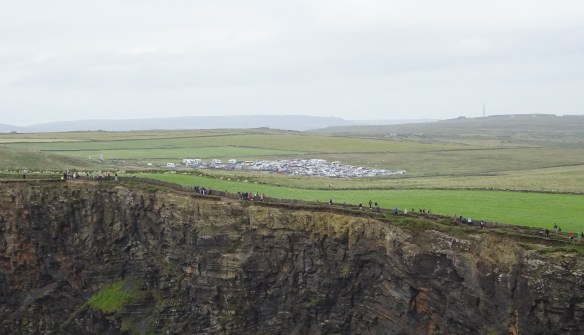
dsc01070.jpg

Like a melanoma on the skin of the landscape: the jam-packed parking area at the Cliffs of Moher Visitor Centre. Note the crowds of day-trippers walking the edge of the cliff.

The Cliffs of Moher are one of Ireland’s most popular tourist attractions. They bring in a clutter of mobile phones, baseball caps, over-sized sunglasses, and headphones whispering to the outside world the deafening thumps of music that fill the heads of their users. The cliffs are an interesting natural phenomenon, even spectacular in places, but most visitors scan them quickly, and with a curious indifference, before recording some photos and heading back to the Visitor Centre. The cliffs are a “celebrity location”, famous, above all, for being famous. You go there in order to say “I have been there.”

Travel, they say, broadens the mind. But modern mass tourism seems to do the opposite. It actually narrows the mind. It reduces, and tries to monopolise, options, flexibility and contact with local people. Travellers are whisked from site to site in buses or cars, given pre-digested “information” about each site, allowed photo-ops, then delivered to gift shops. This kind of travel is just another form of consumerism… you collect destinations and take them home in your mobile phone like selfies with sports stars and the autographs of media personalities.

What’s worse, because of tourism’s indifference to the celebrity locations it promotes, it ruthlessly exploits, and ultimately destroys, them. Mass tourism means getting close to the fame of a place – however fleetingly – without bothering yourself with the origins or meaning or authenticity of that fame. Barcelona, Venice, Amsterdam, Jerusalem’s Old City, the Eiffel Tower, the Tower of London, the Colosseum, the Parthenon, the Louvre – hundreds more – have become unbearable ant-hills of people, offering little more than glimpses of history, or greatness, or beauty amid a relentless crush of people, and a litter of souvenir shops and fast food outlets. Tragically, this is what many tourists expect, even what they want.

If you like hiking – long distance walking – it is probably because you enjoy solitude. How can the travel industry sell solitude to a mass market? It can’t, of course, except by redefining solitude to mean lots of people, but fewer than at the Cliffs of Moher. So real solitude is deleted from the mind-broadening options offered by the travel industry, even as simultaneously they broadcast (or imply) the slogan “travel broadens the mind”.

But back to the Burren Way. At the end of a long day’s walking – a bit stressed by the necessity to walk some segments along narrow roads between thick blackberry hedges, mixing it with long lines of cars and tourist buses that filled the whole width of the road – we trudged into the tiny hamlet of Doolin, famous for the traditional Irish music of its pubs. And yes, that night, as we tucked into a rack of lamb in O’Connors Pub, we listened to a harp and bauzouki duo in one corner of the dining room playing a selection of gentle traditional melodies. My stress and annoyance at the Cliffs of Moher’s “visitor experience” melted away. The mashed potatoes tasted especially good with a pinch of salt and a knob of rich Irish butter on them.
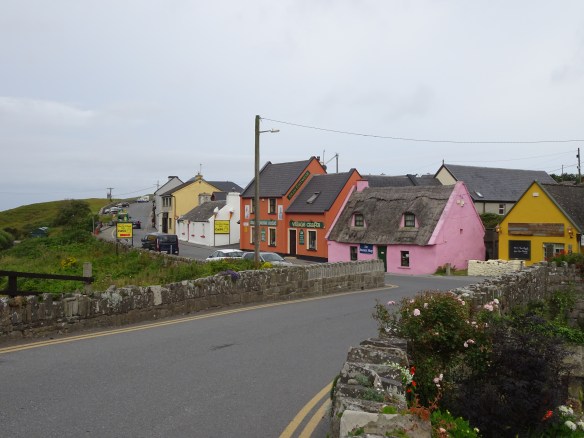
DSC01100

The tiny hamlet of Doolin, justly famous for the traditional Irish music played in its pubs. Our B&B accommodation was just past the left end of this strip of shops and pubs.
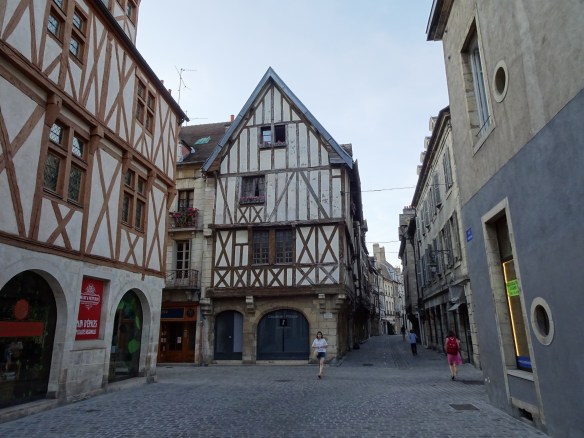
Burgundy in summer: We walk from Dijon to Beaune through the endless vineyards of the Cote d’Or

DSC00947

Old buildings and narrow streets in the centre of Dijon.

Our first surprise was the city of Dijon. For me Dijon used to mean just one thing: mustard. Dijon mustard goes on your barbie snags (that’s “barbequed sausages” for readers unfamiliar with Aussie idioms). You can get it at Woolworths. What punishment could possibly fit this ignorance? Dijon, we discovered, is a picturesque, historic city. Its centre is crammed with beautiful buildings: palaces, museums, churches, creaky old residences reminiscent of England’s Tudor heritage. It is a meditative pleasure simply to stroll the criss-crossing, zig-zagging pedestrian walkways of the city centre.

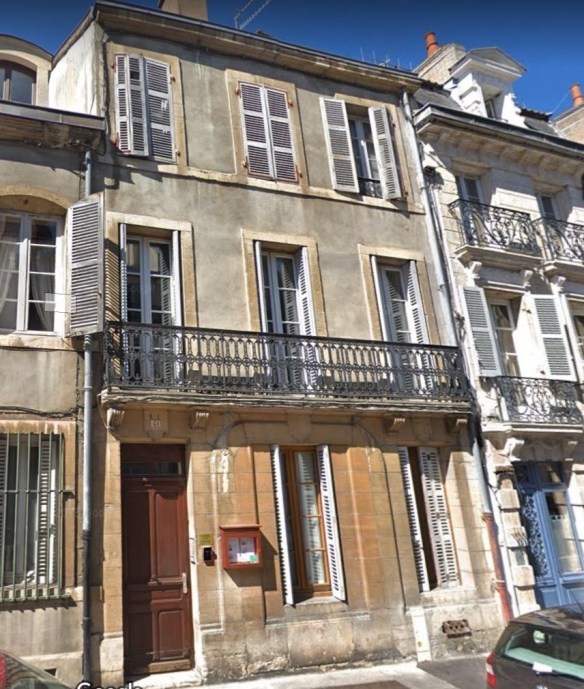
We got a taste of Dijon’s old-world character at the Petit Tertre Hotel, our night’s accommodation. “Hotel” doesn’t quite cut it as a term for a dark maroon door in a wall. No signage, just a street number. Behind the door we rolled our suitcases down a dark, stone-walled corridor with several doors on the right leading into (presumably) apartments of local residents. We emerged into the sunlit floor of a square well with a patch of blue sky far above us and bicycles leaning against its walls. We disappeared into another stone-walled corridor to emerge from its dimness into a tiny courtyard with a short narrow, stone staircase climbing the side of one of its walls. At the head of the staircase we found our room. It was as eccentric a “hotel” room as one could wish for.

Tertre1

The façade of our “hotel” in Dijon. Our comfortable, antique room was down two long stone-walled corridors behind that unassuming door.

In the centre of the room stood a dark, round, varnished dining table with a simple but exotic chandelier above it. Behind it was an upholstered chaise longue. Next to this stood a tall, antique, folding screen decorated with 18th century motifs. Partly hidden behind it was a bed heaped with cushions and blankets. At the foot of the bed stood the room’s piece de resistance, a “wardrobe” yet not a wardrobe. It was a 19th century traveller’s clothes trunk with huge hinges and iron latches. About a metre high, it stood on one end, its top-to-floor mouth partly prised open to reveal a space where clothes might be hung. Up some steep, rickety wooden stairs there was a mini-mezzanine loft with a double bed filling most of it under a gable-topped window looking out over slate-tiled roofs.

The next morning our host served us breakfast on the varnished dining table: deliciously flaky croissants, freshly baked bread rolls, jams and soft cheeses and fresh yoghurt. And of course, strong aromatic coffee. We were magnificently set up for a day’s walking.

Great grapes statue

And here’s where we began… beside a statue of the “Bearers of the Great Grape” just outside Dijon. It encapsulates the all-consuming role that wine has in the culture of Burgundy.

Following instructions by Macs Adventure (https://www.macsadventure.com/holiday-2231/burgundy-short-break-dijon-to-beaune) we were taken by taxi to the edge of Dijon where we started walking at a bronze statue labelled The bearers of the great grape. It was the morning of Monday July 16th 2019. Already the day was uncomfortably warm. Within hours, as we climbed up into the part-wooded slopes of the Cote d’Or, the temperature had topped 30 degrees. We looked out across a shimmering landscape of endless neatly combed, bright green ranks of grape vines punctured by spiky old churches, shuttered deserted villages, and turrets of the occasional chateau. We were walking on a surface that was part quiet country road, part asphalt path and part gravel track. We made sorties into hill-top woods with their crackling leaf-strewn tracks and shadows of cool. Macs Adventure had supplied detailed trail notes, maps and a mobile-phone app, and the route was reasonably well way-marked.

DSC00971

Vines, villages and vistas… our Burgundy walk in a nutshell.

dsc00955-e1564170632245.jpg

Colourful ceramic tiles decorate many church spires in Burgundy.

dsc00973.jpg

Exotic buildings dot the countryside. Our route passed close to this one, the Chateau Clos de Vougeot, near the village of Chambolle-Musigny. Centuries ago it was a Cistercian monastery producing wine that helped put Burgundy on the map as a centre of viticulture.

The end of a long day led us to the small town of Gevry-Chambertin. Tiny though it was, it seems every second shop was a “cave” – a cellar-shop selling wine. We dined in the evening warmth at the Chez Guy restaurant. When the proprietor asked: “And to drink, monsieur? What is your preference? Red or white?”

“Just water for us, thanks.”

His shock lasted less than a nano-second. Maintaining perfect courtesy in the face this foreign eccentricity he asked:

“Still or sparkling?”

Having tucked into a delicious fillet of Burgundy beef we sat in the quiet square opposite an old church with its bell clanking at quarter-hour intervals, sipping our austere ration of (still) water, and enjoying the long slow sigh of twilight as it breathed its warmth into the approaching night. I’m reluctant to say this, because it sounds so sentimental, but it was the perfect end to a perfect day’s walking.

DSC00964

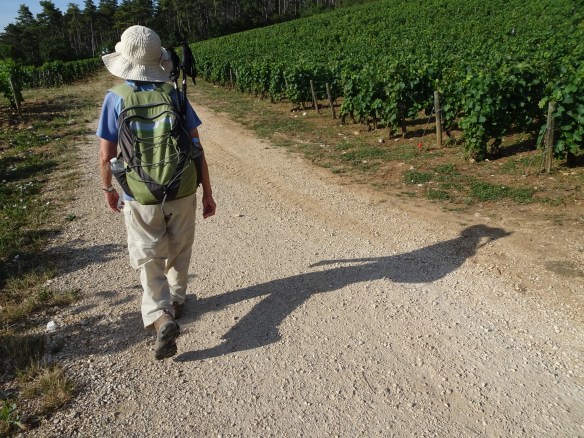
Emmy’s shadow stretches out beside her as we set off early in a futile attempt to avoid the 30 degree heat of the second day’s walk.

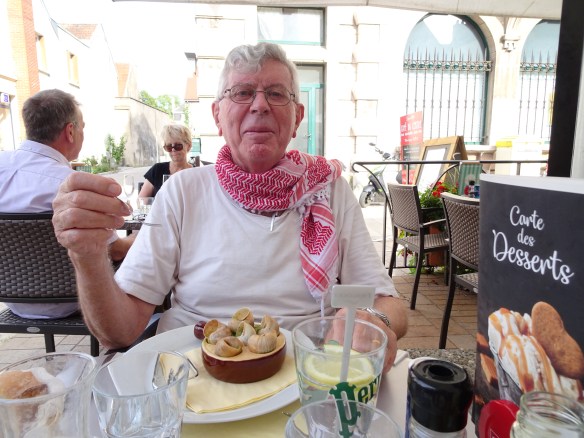
And Day Two was pretty much like Day One, only hotter. We left Gevry-Chambertin around eight o’clock in the morning, hoping to cover as much distance as possible in the cooler air of morning. And again, like riffling the pages of a souvenir calendar, we flashed past vineyards, turreted chateaux, church steeples ceramic-tiled in colourful patterns, villages with their shuttered town halls and their wine shops displaying sample bottles on upended barrels along the footpath. And this time, in the square of Nuit-Saint-Georges, I demolished an entree dish of six snails. The very ample lady at the next table made short work of sixteen.

DSC00985

Snails for your entrée, monsieur? Mais oui!

DSC01006

And roast duck to follow? With a glass of burgundy white? You bet!

DSC00982

Our accommodation in Nuit-Saint-Georges was cramped to say the least. I couldn’t stand upright in the loft bedroom.

The idyll couldn’t last, of course. It came to an abrupt end on Day Three. Heading out of Nuit-Saint-Georges, we got lost. Twice. Our trail notes told us to look for a small forest path, but developers had been into the forest. Raw earth and smashed trees lay heaped where our path was supposed to be. We tried to peer over the debris and walk around it, but saw no sign of any path. Half an hour of poking around led us back to the edge of the forest. I looked down the valley slope, over the endless ranks of grape vines, to a country road a couple of kilometres below us. It was our way out. Half an hour later we were inching cautiously along the side of the narrow road toward the village of Ladoix-Sevigny where (our map told us) we could reconnect with our planned route.

And yes, we managed to do that. But after just fifteen minutes of trekking through vineyards we were lost again. Maybe the configuration of the vineyards had changed, or our trail notes were not precise enough, or (no… this cannot possibly be the reason) I had forgotten to recharge my mobile phone and couldn’t access the route on Mac’s online app. Whatever… we found ourselves trudging the streets of a small town looking for a landmark. We walked past a middle-aged lady chatting on the footpath to a young man on a motorbike.

“You are visitors!” she called to us good English. “Where are you going?”

“I’ve no idea where we are going,” I called back. “We’re lost!”

“Come into my garden,” she said. “I’ll explain everything.”

DSC00988

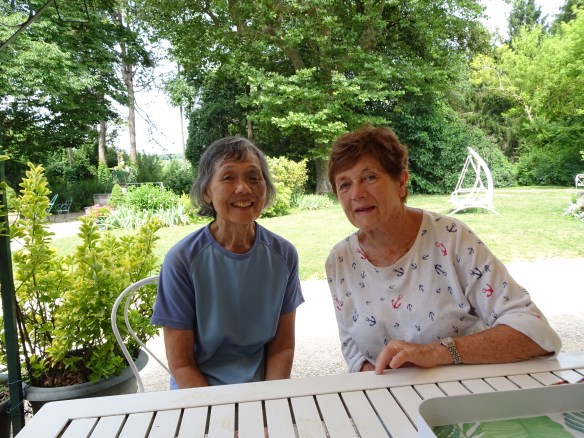
Emmy with our “Dame du Chemin”, Sabine, in the back garden of her house in the village of Ladoix near Beaune.

She pressed a button on a handheld remote, and behind her, in a high, grey wall, a tall slab of iron creaked slowly open. She ushered us onto the back verandah of a grand old house set amid trees in a lush garden with a tennis court and a glassed-in swimming pool. Three big dogs bounded up – each dribbling over a stick or pine-cone – demanding to play. Big glasses of icy water appeared before us as Sabine, our new-found guardian angel, launched into an epic account of her family, her late husband’s business interests, her house, her children, and her dogs. An hour later, as she paused to draw breath, I glanced at my watch and, half-rising to my feet, murmured our thanks.

“Where are you going?” she asked in astonishment.

“We are walking to Beaune.”

“You certainly are not walking! I will take you there in my car!”

And that’s what happened. Not only did she drive us the last five kilometres to Beaune, she also took us to the nearby chapel of Our Lady of the Road (Notre Dame du Chemin) which has been part of her family’s heritage from ancient times. Half the chapel dates from the 11th century. This was followed by a tour around the streets of Beaune before we were delivered to our accommodation at Beaune’s Belle Epoque hotel.

DSC00989

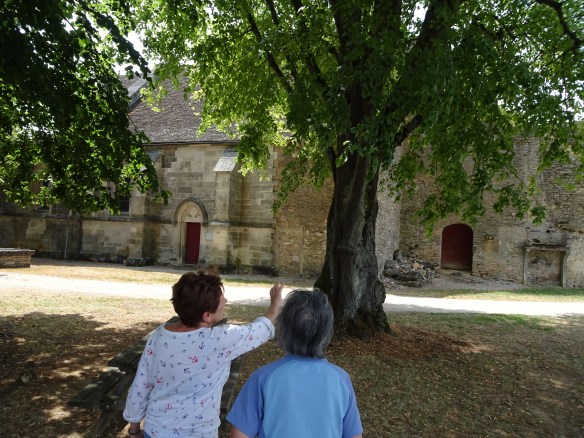
Sabine shows us the chapel of Our Lady of the Road (Notre Dame du Chemin).

That night, we drank a quiet toast of burgundy in thanks to Sabine, our dame du chemin. We were sitting in the Ecrit Vin restaurant (another family establishment recommended by Sabine) in the central square of Beaune, allowing the gentle rhythms of a jazz recital to wash over us from a nearby gazebo. Yet again we sank gratefully into the French institution of a long slow outdoor dinner, with long slow sips of wine, in the quiet warmth of a long slow summer twilight.

Have the French got it right? In Burgundy, in summer, yes, they have.

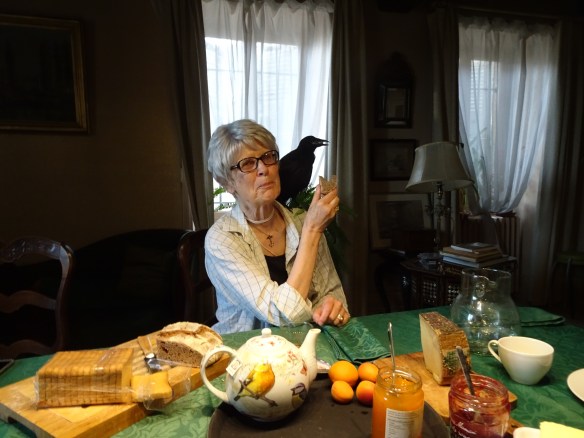
Postscript: A Perfect Stay with Friends in Charolles The following day we sailed south for an hour on a local train to the town of Macon where we were met by friends Lois Belton and Georges de Lucenay who live in the nearby town of Charolles, famous for its beef cattle. And again we luxuriated in the best of French hospitality: great food (I can still savour your Coronation Chicken, Lois), the warm quiet streets of Charolles, 17th century music from the town’s new church organ played with stately perfection by Lois, and a long, peaceful sleep under the 2nd floor roof of our friends’ big old house. Lois (originally from New Zealand) has adopted the splendid eccentricity of taking breakfast with a rook perched on her shoulder. Its intelligent, beady eye – like a guardian of all things Burgundian – kept a vigil over our meandering conversation and our slow enjoyment of croissants, local cheeses, local fresh eggs, and Georges’ delicious home-baked bread. It even forgave my swigging of Coca-Cola, a sin that must be kept secret in the wine country of Burgundy (wise bird!).

DSC01030

Lois takes breakfast with her dark guardian…

DSC01020

…before bringing to life the solemn faith of former times at the keyboard of the beautiful new organ in the town church of Charolles.

DSC01039

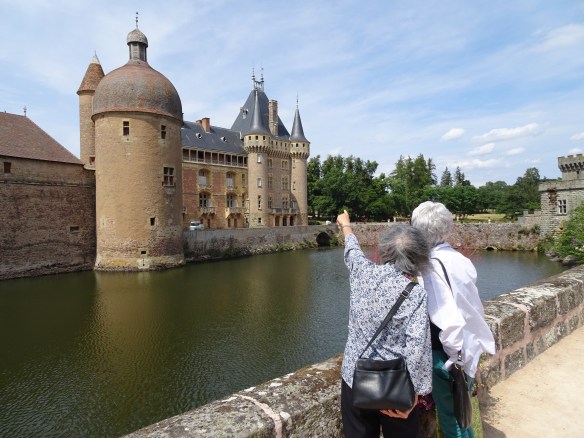
Emmy and Lois  check out a chateau with its moat in the small town of La Clayette, near Charolles.

Next Post: we walk the wild Atlantic coast of county Clare in Ireland.

Germany’s Romantic Road (Second Half): Dinkelsbuhl to Nordlingen

DSC00875

The view from our hotel window in Dinkelsbuhl, and below…

dsc00886.jpg

… the hotel itself (centre) with an open-air café in front of it.

Dinkelsbuhl is a remarkable town. Its walled centre preserves an astonishing array of wide-fronted, multistorey houses with peaked, steeply raked roofs dating from the 16th and 17th centuries. They stand in packed ranks along the town’s narrow streets. Most are neatly painted in pastel colours – creamy yellow, light orange, beige, moss green. Some stand out in scarlet, lemon yellow or brilliant white. Outwardly they are beautifully maintained with few concessions to the 21st century, but behind the neat facades everything is impeccably hi-tech and modern.

Somehow Dinkelsbuhl avoids being Disney-tacky. The locals are not decked out in faux-medieval costumes. The streets are narrow and cobbled as they were 500 years ago, with, in some cases, houses leaning over and looking down into them, each successive floor overhanging the one beneath. Public signage is in German gothic script. The Brothaus bakery – where we twice feasted on sweet pastries and cake-like bread rolls – tells customers it has been doing business in the same spot since 1616. A soaring 16th century stone church – St.George’s Minster – stands at the hub of the town.

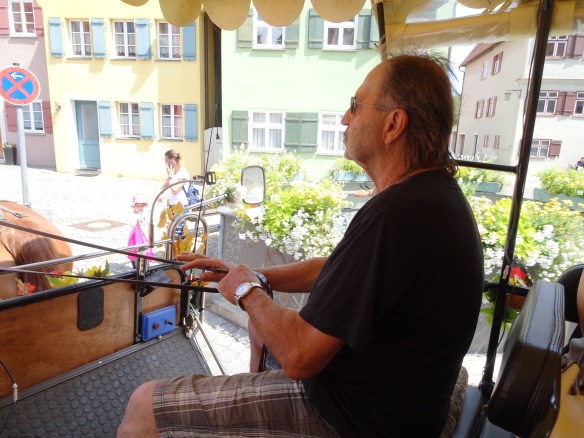
We took a tour of the town in a large roofed cart pulled by two giant horses. As the waggoner – who was also our guide – waited for his cart to fill with customers, from time to time he took a sip from a huge glass of beer, each time returning the glass to its storage place under his seat. Apparently the prohibition on drink-driving doesn’t apply to horse-and-cart drivers.

dsc00896.jpg

The narrow streets of Dinkelsbuhl seen from a horse-drawn cart.

An unpleasant incident occurred during the tour. As we clopped at walking pace through a web of alleys our guide gave us a lively commentary in German. Emmy and I didn’t understand a word of it, but following his outstretched finger we saw exotic sights we might not otherwise have noticed. We enjoyed his eccentric personality and the flow of his patter, and we joined in the outbreaks of laughter from the mostly German-speaking passengers. But a bookish-looking, grey-haired gentleman hugging an English-language guidebook was looking resentful. About twenty minutes into the hour-long tour he suddenly shouted “Stop!” The waggoner put his foot on the brake pedal and called out “Brrrrrr” to the horses. In the middle of a narrow street, with cars queueing behind us, the gentleman with his entourage of three crinkly ladies got off. “It’s all in German!” he announced indignantly (in English) to the German passengers. The waggoner’s eyebrows resumed their place over his eyes, and with the smallest hint of a smile he snapped the reins. The horses clopped forward. It had been a tiny but telling glimpse of English-language arrogance.

DSC00893

Our eccentric, beer-drinking and very personable waggoner-guide.

dsc00904.jpg

The picturesque hamlet of Raustetten. Our accommodation at the Waldeck Hotel is the building visible at the left edge of the village.

The fifth day of the Romantische Strasse took us from the hamlet of Raustetten south of Dinkelsbuhl, over a succession of easy paths 20 kms into the ancient town of Nordlingen. Walking conditions were perfect, with cool temperatures and motionless air under a hazy sky.

DSC00909

Easy walking on the morning of our last day…

DSC00930

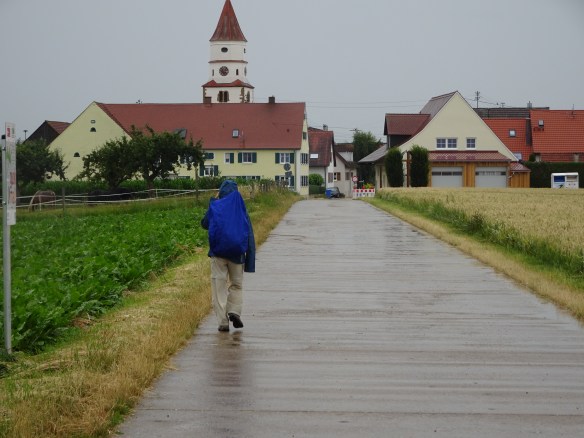
… but light rain joined us around 11:00 am and stayed with us for the rest of the day.

But around eleven o’clock small spots of rain began to tick against our faces. The hazy sky was still high and bright, but it cast a fine drizzle over us. We broke out our rain jackets and walked on, hunched under our backpacks like a couple of Quasimodos. The rain stayed with us until we reached the ancient, almost perfectly circular defensive wall around Nordlingen at three in the afternoon. We passed through an arched stone gate into the town’s glistening alleys. We had reached the end of the walk. We averaged 18 kilometres a day over five days.

DSC00906

The religious piety of former times is visible everywhere along the road between Dinkelsbuhl and Nordlingen. Here a forest sign reminds walkers that “God preserves the wilds and woods.” Or is it an entreaty? “God, preserve the wilds and woods!”

DSC00920DSC00917

DSC00922

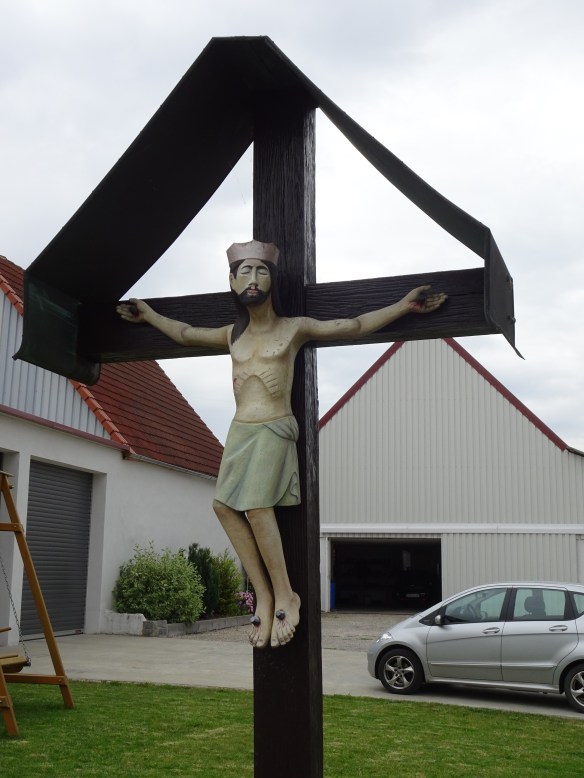
Here are just three of about a dozen wayside crucifixes on the path between Raustetten and Nordlingen. In the more secular 21st century, perhaps they are speaking to passing hikers. “You think you’re suffering? Look up here. You’ve got it easy, mate!”

Getting into Nordlingen was easy, but it proved hard to escape. The following day I went outside the town’s old walls to the railway station to buy tickets to our next destination, Zurich. The station was hard to find. Under a shroud of canvas behind temporary fencing, it was under reconstruction. It had been totally gutted. There was no ticket office behind the empty eyes of its windows. Amidst the scaffolding on the deserted platform stood an automatic ticket vending machine. Its instructions were all in German (abfahrt, fahrtkarten, bahnhof, gesamt) and I could not bring up Zurich on the screen. We trudged back into the centre of town and headed for the tourist information office.

“Can I go from Nordlingen to Zurich by train?”

The helpful matron behind the counter looked startled. She tapped at her computer.

“You can go by train from here to Aalen, then change to another train to Stuttgart, then change to another train to Singen, then change to another train to Zurich.”

I could see Emmy weighing our two big suitcases in her mind’s eye, then adding the heavy bulk of our backpacks. No way, she signalled to me.

The information officer looked at us with curiosity.

“Why don’t you just leave the same way you came?”

“We walked to Nordlingen from Rothenburg. It’s a long way. We’re not walking back!”

“You walked!?”

She was standing right beside a tall poster advertising the invigorating benefits of walking Germany’s Romantic Road. Evidently it was the first time she had seen a real Romantic Road walker. Perhaps she didn’t expect us to be grey-headed and wrinkled.

My solution was an expensive one. On Saturday, July 13th I hired a taxi to take us and our baggage the 100+ kilometres to Stuttgart Station where I was able to buy a train ticket direct to Zurich. Easy.

DSC00932

Arrival in Nordlingen. Emmy is thriving, while that shrivelled creature in the background is definitely struggling.

Germany’s Romantic Road (First Half): Rothenburg to Dinkelsbuhl

DSC00837

The exotic, beautifully preserved centre of Rothenburg ob der Tauber in Bavaria, western Germany. Our accommodation was a short walk from this square.

Anxious prologue (written July 5th 2019 in Rothenburg ob der Tauber). I’m a bit apprehensive about this walk. Just behind my eyeballs there’s a nagging voice saying “Are you ready for this?” It has been grating at my brain with three unanswerable reasons not to do the walk. First, it says, old age is withering your muscles. You don’t have what it takes to go up and down hills. Yes, it’s true. It’s a rude fact, and I was reminded of it yesterday when we checked into our hotel after a long and complicated trip from Amman in Jordan. The Gerberhaus Hotel is a traditional establishment in a large, picturesque 16th century house not far from the centre of Rothenburg. We were assigned a room under the roof, up three flights of stairs from street-side reception. After four months in Israel, Emmy and I have accumulated stuff, and yes… it’s mostly useless stuff. My suitcase weighs 26 kilos and hers 23 kilos. We also have heavy backpacks. The Gerberhaus has no lift, nor staff to help with luggage. So yesterday I had to haul my 26 kg bag, step by painful step, up to our attic room. Then Emmy’s. How many times did I go up and down those three flights of stairs? Five times, I think, and each time the stairs stretched up higher and steeper. My stringy old muscles were definitely not up to it. I’m feeling fragile. (This afternoon, we’ll pack up all our excess stuff and send it back to Canberra by DHL’s courier service.)

That small, grating voice is also reminding me: “You’re not fit, are you!?” Six weeks ago, we did a four-day hike through northern Israel (see my four reports on The Jesus Trail). Since then I have hardly exercised at all. Jerusalem’s summer heat put a stop to my daily walk from our apartment in the suburb of Katamon to my office at the Israel Institute for Advanced Studies, a return distance of about five kilometres. I had to go by bus. I have lost condition. I can feel that my walking range – my stamina – has taken a big hit. And there’s no time now to build it up again little by little. We start walking the Romantic Road tomorrow with an initial hike of 16 kms.

Then there’s the weather. A week ago, Europe went through an unusual heatwave. Temperatures in parts of Germany sailed up over 40 degrees. I’m looking at my mobile phone right now: tomorrow’s maximum will be around 30 degrees. That’s too hot for two easily dehydrated old people who don’t have the strength or the stamina to carry a big load of water.

The prognosis doesn’t look good. We will walk tomorrow, but we are going to suffer.

DSC00823

Emmy walks through an ancient gateway into the centre of Rothenburg town.

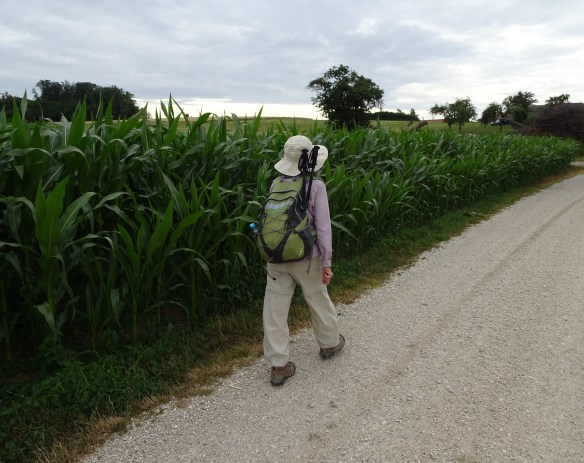
Report from Schillingsfurst, our first stop. As predicted, July 6th dawned dry and hot. As we walked out of Rothenburg at 9:00 a.m. the sun was already like a branding iron in the cloudless sky. Initially there wasn’t much shade. We walked through quiet fields of beige-yellow spelt-wheat and bright green corn. Luckily our trail notes (supplied by Macs Adventure: https://www.macsadventure.com/holiday-1479/germanys-romantic-road ) were detailed and clear, and the trail markers along the route were frequent and clearly visible.

DSC00844

Much of our route was on smooth minor roads through rich farmland.

But by the village of Bochenfeld, less than half-way through the day’s walk, attrition had climbed like a gorilla onto our shoulders. It was a relief to enter a stretch of shadowy woods and sit for half an hour on some fallen logs. We ate a little and drank a lot, enjoying the restorative quiet. Tiny waspish-looking flies traversed my outstretched legs, hovering like tiny helicopters on a reconnaissance mission over the ridges and gullies of my clothes, sniffing out my sunscreen lotion and salty sweat. There were a few lazy chirps in the trees, but otherwise all was silent. A church bell tolled from kilometres away, muffled in the heavy heat of late morning.

In the afternoon our stops became more frequent, but around 3:00 pm we managed to edge into the village of Schillingsfurst – wrapped in Saturday afternoon somnolence. From the terrace of our accommodation at the very welcoming Die Post Hotel, high on the slope of a valley, the countryside rolled out to the horizon: orange roofs of farmsteads amid a quilt of corn and wheat fields, belts of dark forest, small villages holding fast to the spikes of their church towers, high-tech ridge-top windmills slowly, gracefully waving their slender arms in the late afternoon breeze.

DSC00855

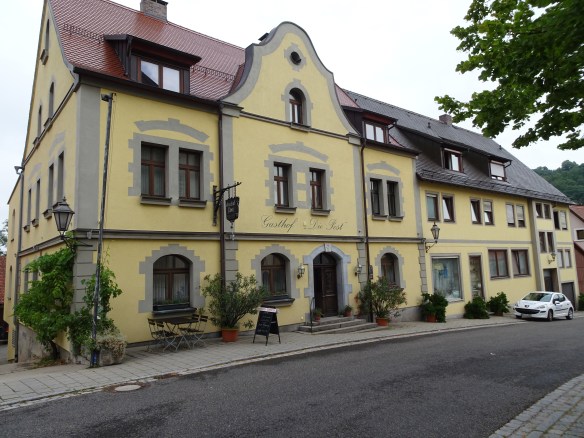
A typical country hotel along the Romantic Road: our accommodation in Schillingsfurst.

It was a relief to reach our destination, but in a kind of mild delirium I made a mistake. I drank a big stein-mug of Bavarian beer, then at dinner devoured slabs of beef that (the publican told me proudly) had been marinated in rich red wine for six days, and followed it with an ice-cream dessert dressed in a high-octane liqueur. The combination of alcohol and dehydration triggered an attack of gout in my right big-toe joint. The following morning I was yelping in pain and limping. The day’s walk to Feuchtwangen – 22 kilometres – grinned at me in evil anticipation of my suffering.

DSC00868

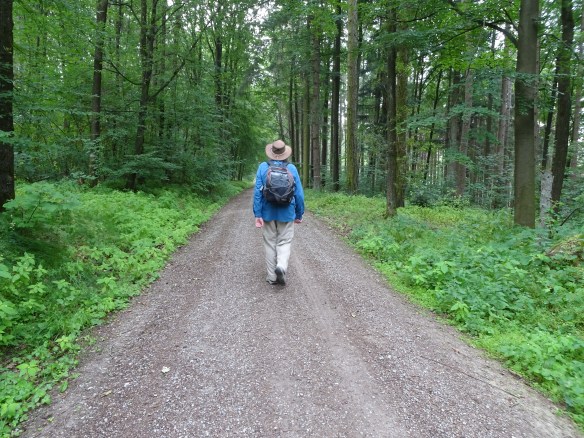
A selfie in the cool of the forest.

DSC00859

Ouch! Ow! You can’t see my face, fortunately, but my gout-ridden toe is killing me.

Dear reader, I won’t impose on your reserves of sympathy with details of my agony. Anyway, I don’t remember much of the day… I was walking through a paracetamol induced fog. Somehow the kilometres crept past like ghosts. At least the temperature had fallen to around 20 degrees. As we walked unsteadily into Feuchtwangen I swore a solemn oath: never again any alcohol of any kind in any quantity during this month of walking. And… success! I have strictly observed the oath for a whole two days.

dsc00867.jpg

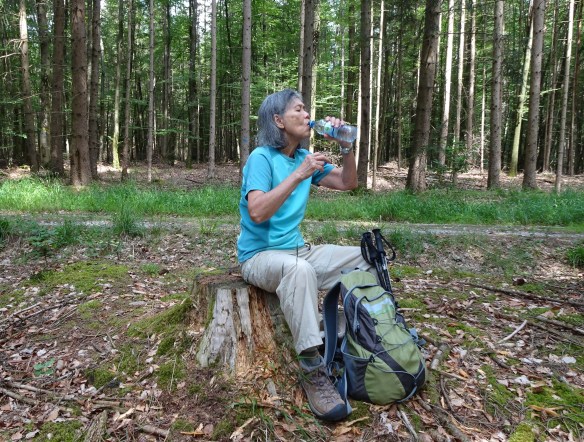
After our hot first day of walking, we are religious about keeping well hydrated.

We have found the Germans we have met to be warm and friendly, tolerant of our practically non-existent command of German, and wonderfully ready to help. We had two examples of this as we left Feuchtwangen. I asked our hosts at the Karpfen Hotel to prepare two packed lunches for us to eat on the road the following day. As we checked out, our lunches were handed to us.

“How much?”

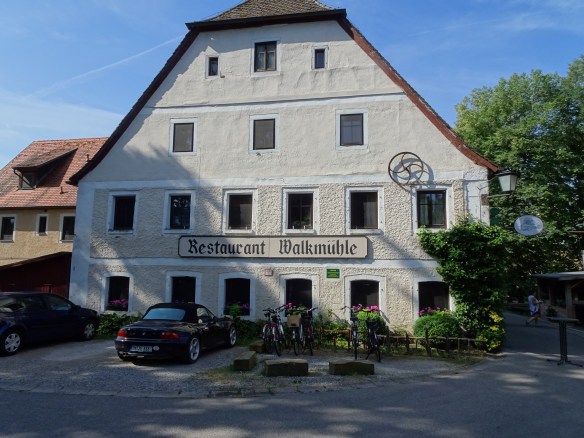
“Oh, no charge,” was the smiling reply. Inside each pack we found three freshly cut sandwiches (thick cheese and ham), a tomato and a boiled egg. Free! On the edge of town we stopped to buy water at an old mill that had been turned into a popular restaurant. The proprietor emerged with a big bottle of top-quality mineral water.

“How much?”

“Oh, no charge,” was the smiling reply. And we hadn’t even entered the restaurant!

DSC00863

Just outside Feuchtwangen, the converted old mill where we were given free mineral water.

This earthy generosity lent wings to our feet. My painful toe had settled down, the rich green fields and shade-filled forests flashed past, and by three o’clock in the afternoon we were passing under Dinkelbuhl’s tall, red, medieval clock tower. Survival is a kind of success, and we had survived the first half of the walk. Time for a day’s break in the exotic surrounds of “Germany’s most beautiful old city”.

DSC00873

On the outskirts of “The most beautiful old city in Germany”. (More on Dinkelsbuhl in the next post.)