Santiago, killer of Muslims: food for thought from the Camino pilgrimage

There is a dramatic effigy in a niche in the Cathedral of St.James in Santiago de Compostela. It depicts St.James in medieval military garb astride a horse, brandishing a sword above his head. Legend has it that St.James – Santiago – appeared to Christian troops during the semi-legendary Battle of Clavijo in 844 in which Spanish Christians defeated a much bigger Muslim army. During the following seven centuries of conflict between Christians and Muslims in the Iberian peninsula – from roughly 800 until 1492 – Santiago was adopted as the divine mentor of the Christian forces. He was given the name Matamoros, “Killer of Moors” i.e. killer of Muslims, and subsequently became the patron saint of Spain. “Santiago y cierra, España!” (St. James and attack, for Spain!) became the battle cry of Spanish armies as they slowly recovered the Iberian peninsula from its Moorish rulers. The cry persisted into modern times and was frequently used as a nationalistic slogan during Franco’s long years of Fascist rule.
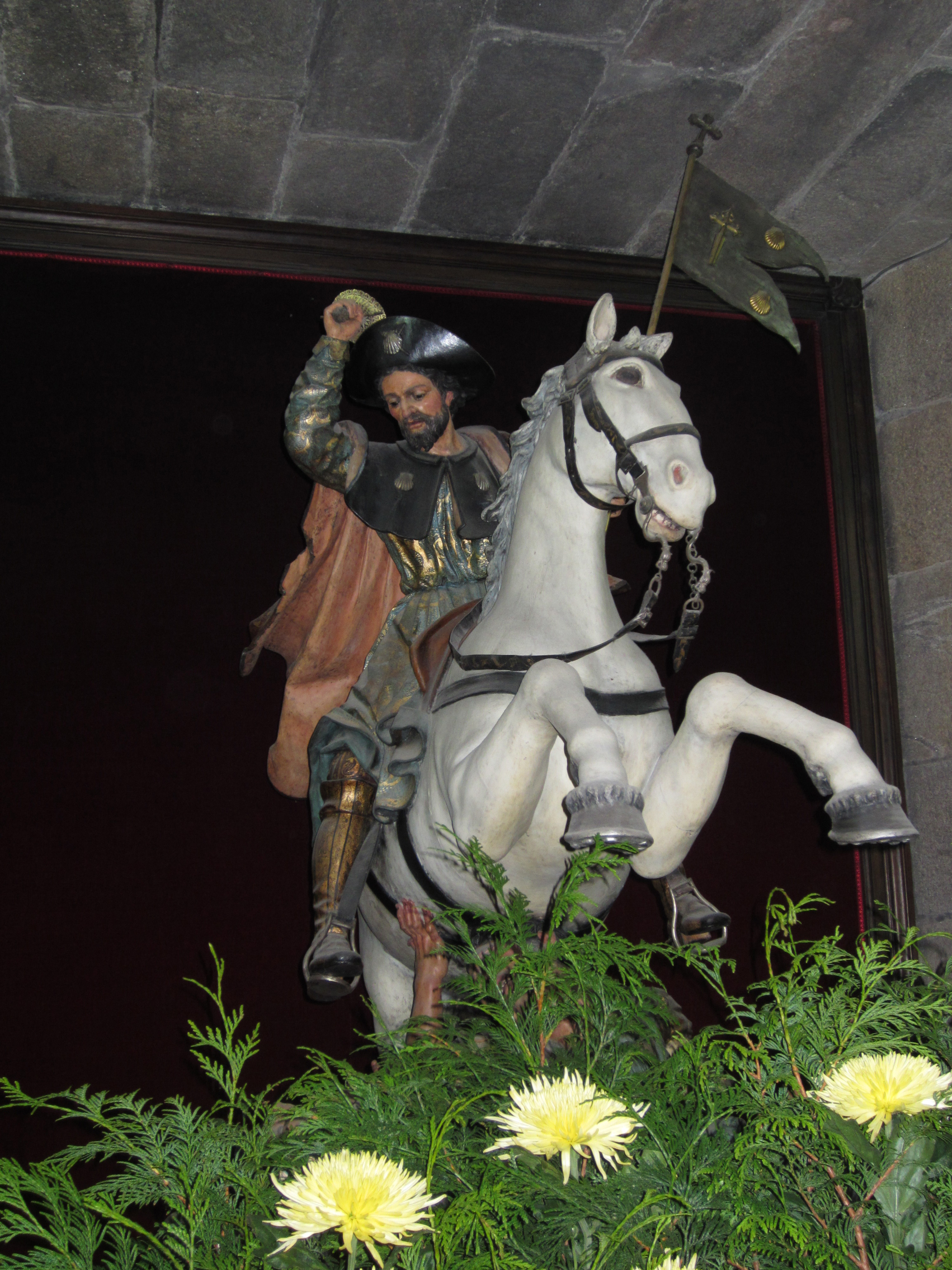
Santiago Matamoros as I photographed him in Santiago de Compostela Cathedral, late July 2011.

In the cathedral of Santiago de Compostela, the saint’s horse rears from behind an arrangement of fresh leaves and flowers. As even the quickest search of the internet will confirm, behind this fragrant corsage Santiago’s horse is actually trampling over Moorish soldiers and his sword is meting out death. There is even a severed Muslim head on the ground below him.
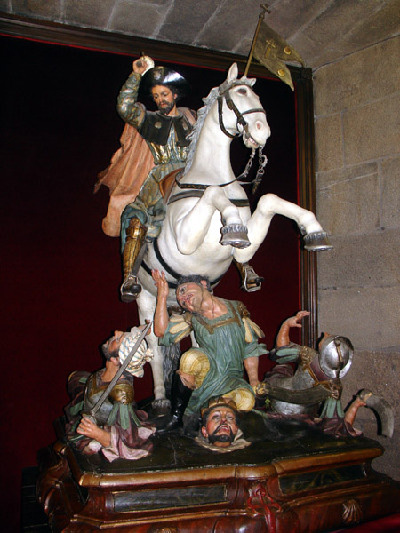
The “unedited” image of Santiago Matamoros (Wikipedia open access image)

It is, I suppose, to the credit of the cathedral that it seems to be squeamish about the image. Perhaps the mangled limbs are camouflaged out of politically correct consideration for the feelings of Muslims. Perhaps (and I hope this is the case) the church has awakened to the realisation that nothing could be more contrary to the teachings of Jesus Christ than this sympathetic, even admiring, representation of brutal murder. Whatever the case, the full barbarity of the image is something the Church no longer wants visitors to see. Someone on the cathedral’s staff regularly replaces the leaves and flowers, no doubt standing back each time to check that the true character of the image remains well hidden.

It is the purpose of a pilgrimage not just to present you with a challenge and deliver you to a destination but to set you thinking about life, faith and the practice of religion. In this spirit, the image of Santiago Matamoros triggered my curiosity about the intrusion of martial imagery into churches. Naively I wondered how widespread this was. So while walking through England I visited several cathedrals and churches. Without being systematic or obsessive about it, I kept an eye out for images of war and murder inscribed – as it were – inside these churches. I didn’t have to look very hard or very far. Every time I entered a church the images were immediately in my face. I found that – without exception – every one of the temples of Christian peace that I visited displayed eulogistic representations and commemorations of warriors and war. The churches, irrespective of denomination, seemed to be showcases for state-supported military mayhem.
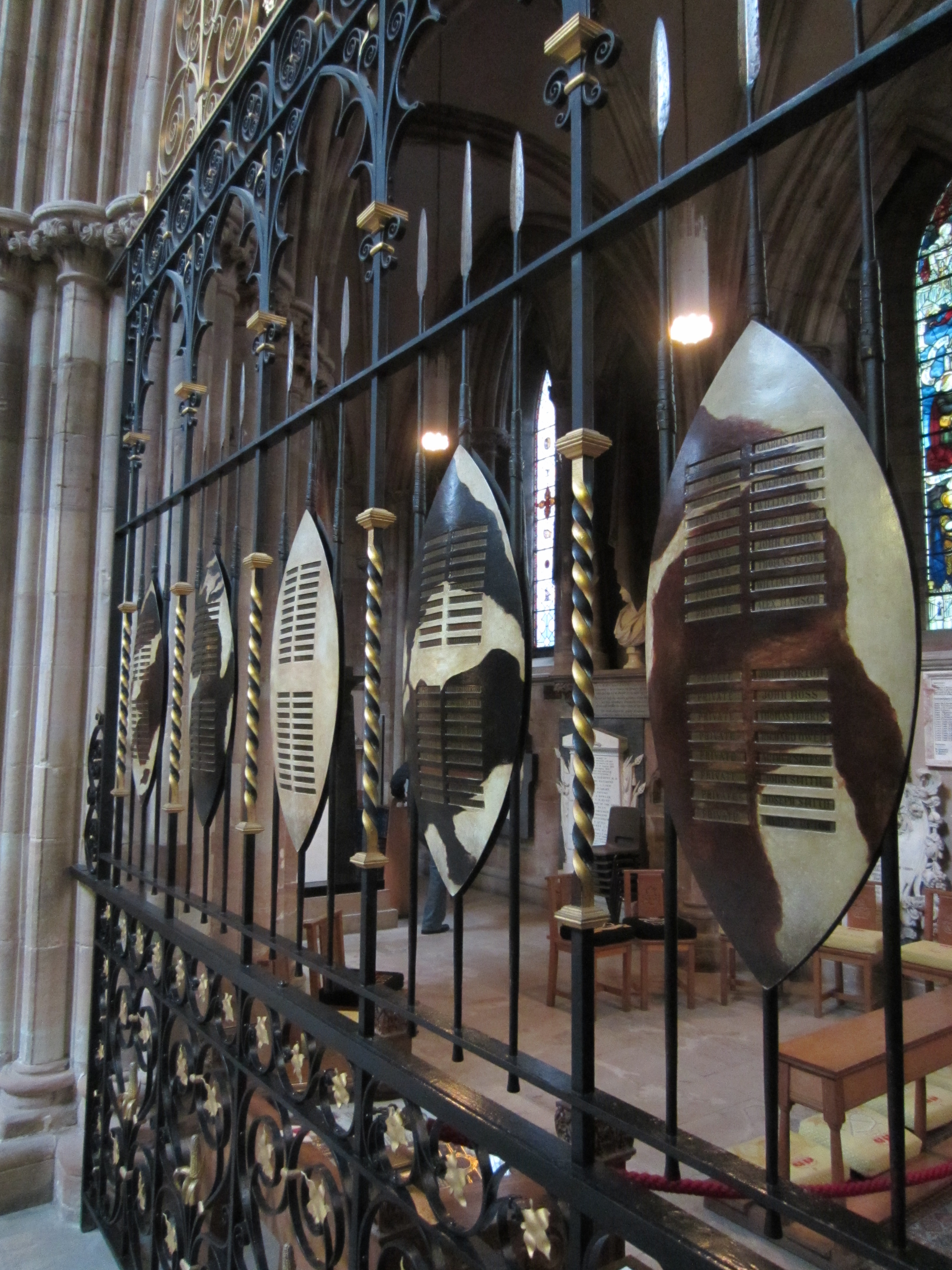
Zulu spears and shields: stylised war trophies in Lichfield Cathedral.

It would be a consolation if I could report that the images I saw only commemorated those who died resisting aggression by the enemies of freedom and peace. But I was struck by the many images – probably a majority – that commemorate Britain’s wars of aggression in distant lands. One of the most shocking is to be seen in Lichfield Cathedral. In one corner of the cathedral there is a prominent memorial to those who died during Britain’s wars of conquest against the Zulu people of South Africa (1878-1879). The memorial takes the form of a palisade of Zulu spears and shields – stylised war trophies, in effect. The names of the soldiers who died are inscribed on the shields.

The names of British war dead triumphantly inscribed on Zulu shields in Lichfield Cathedral.

Also in Lichfield Cathedral there is a memorial to members of the local Staffordshire Regiment who died during the first Anglo-Sikh War (1845-1846) in India, also known as the Sutlej Campaign. The brutal Sutlej Campaign was the very first for which medals were issued with metal bars or clasps that could be attached to a medal’s ribbon. In a bizarre touch, some of this purely military memorabilia is displayed in the “holy” precincts of the cathedral.
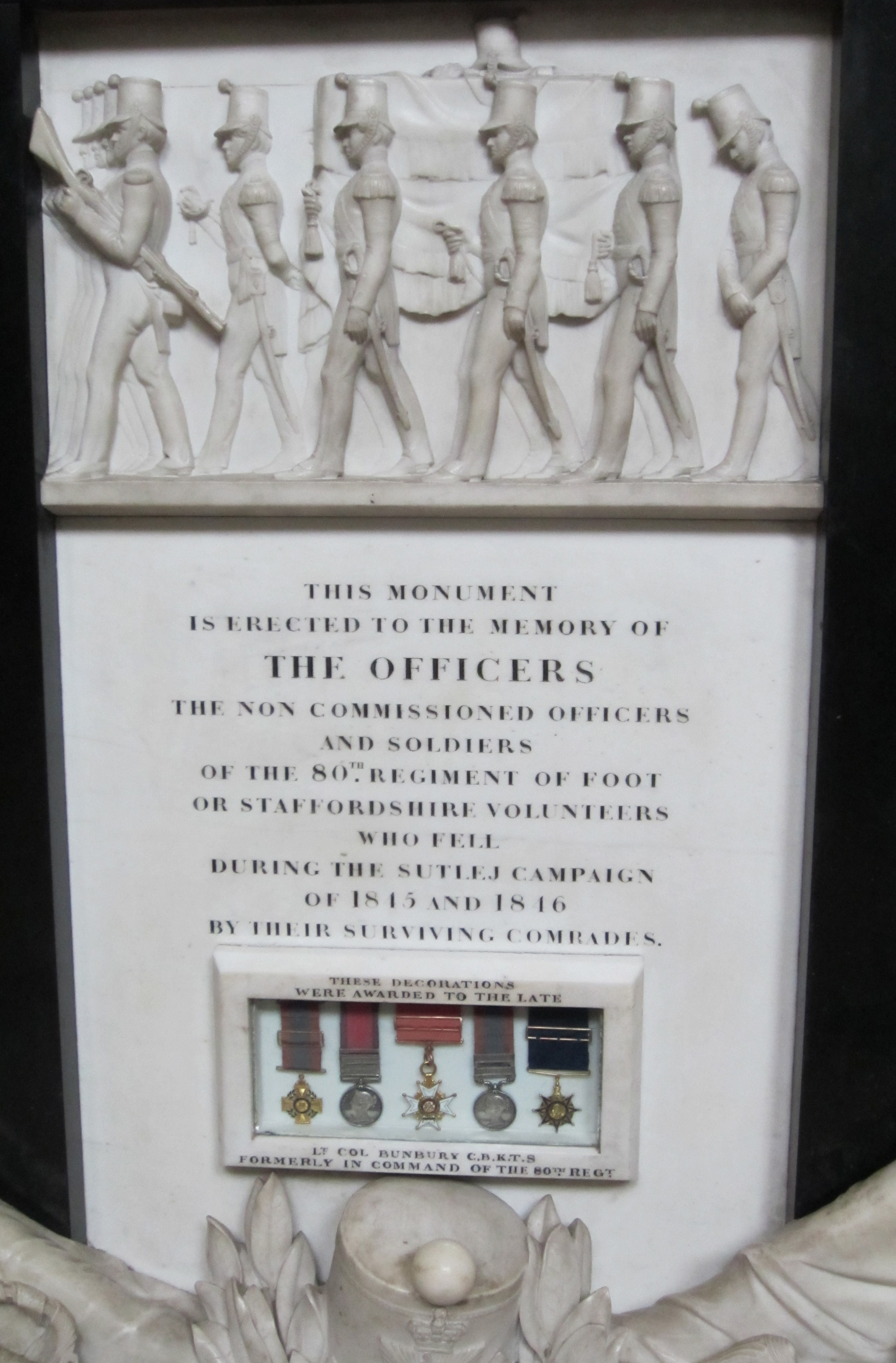
Medals from the Sutlej Campaign on display in Lichfield Cathedral.

Beyond the unfeeling crassness of such memorials there are many more subtle and more powerful tributes to war. For example, in Holy Trinity Church, Stratford-upon-Avon (where William Shakespeare is buried), there is a stained glass window depicting England’s national saint, St. George, providing succor to the Crusaders. There is also a stained glass image of medieval combat with soldiers clustered around a big crucifix.

St.George, patron saint of England, urges on the Crusaders (Holy Trinity Church, Stratford-upon-Avon).
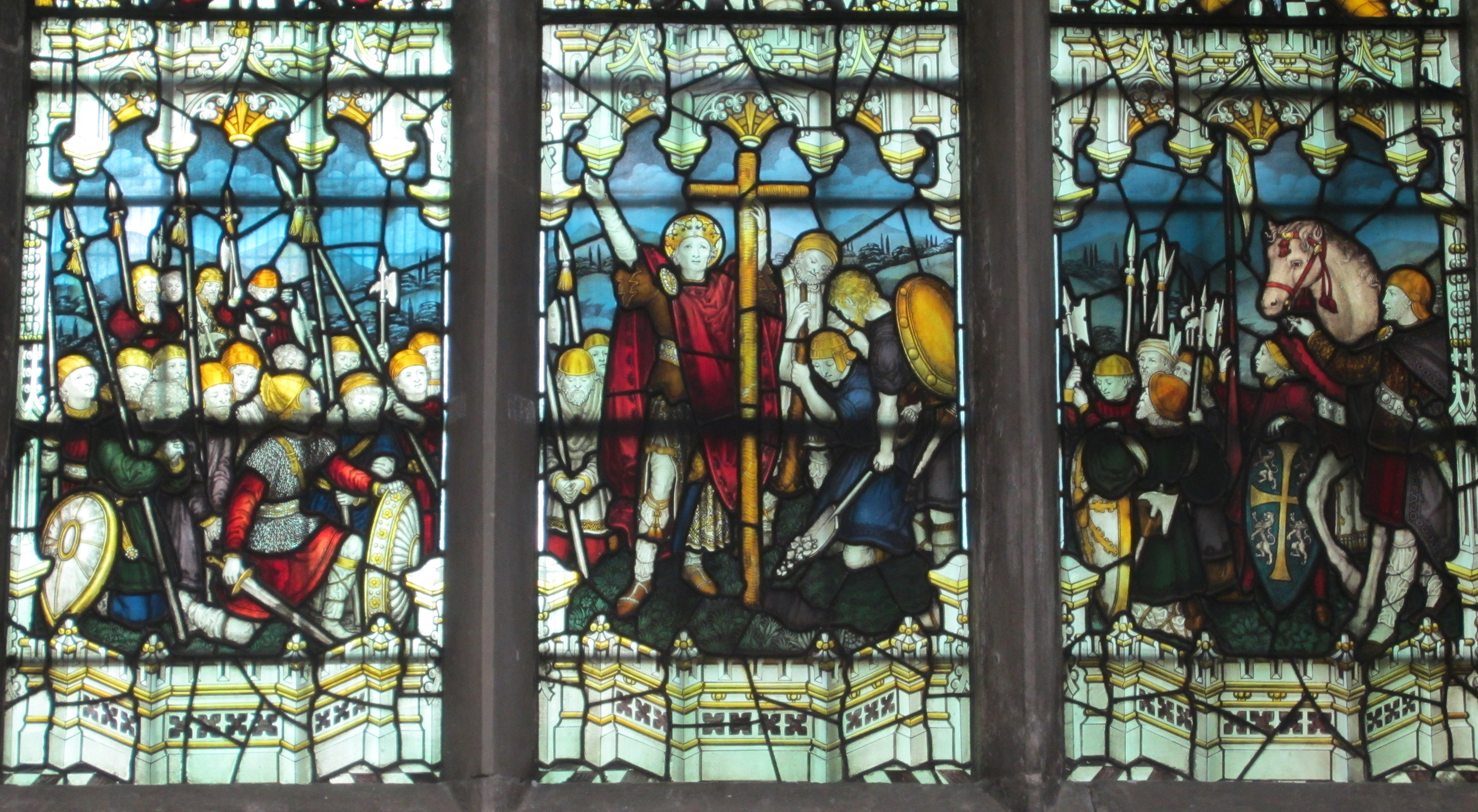
Medieval battle scenes with soldiers clustered around the Cross (Holy Trinity Church, Stratford-upon-Avon)

St.Oswald in full battle dress with the halo of Christian piety (Carlisle Cathedral).

In Carlisle Cathedral, St.Oswald appears in full battle armour carrying an enormous sword with a halo of Christian piety crowning his head. In Lichfield Cathedral a colourful stained glass window is dedicated to the memory of a certain Sir Horiatio Page Vance who fought at the sieges of Sevastopol in the Crimea (1854-1855) and Lucknow in India (1857). It depicts British sappers, complete with a large shovel, undertaking a siege some time in the Middle Ages. In St.Mary’s Church, Painswick, a model sailing boat is attached to the wall. Beside it a plaque likens the Christian Church to a boat, then draws a parallel between the boat of Christianity and a battleship of sixteenth century England that saw action against the Spanish Armada.
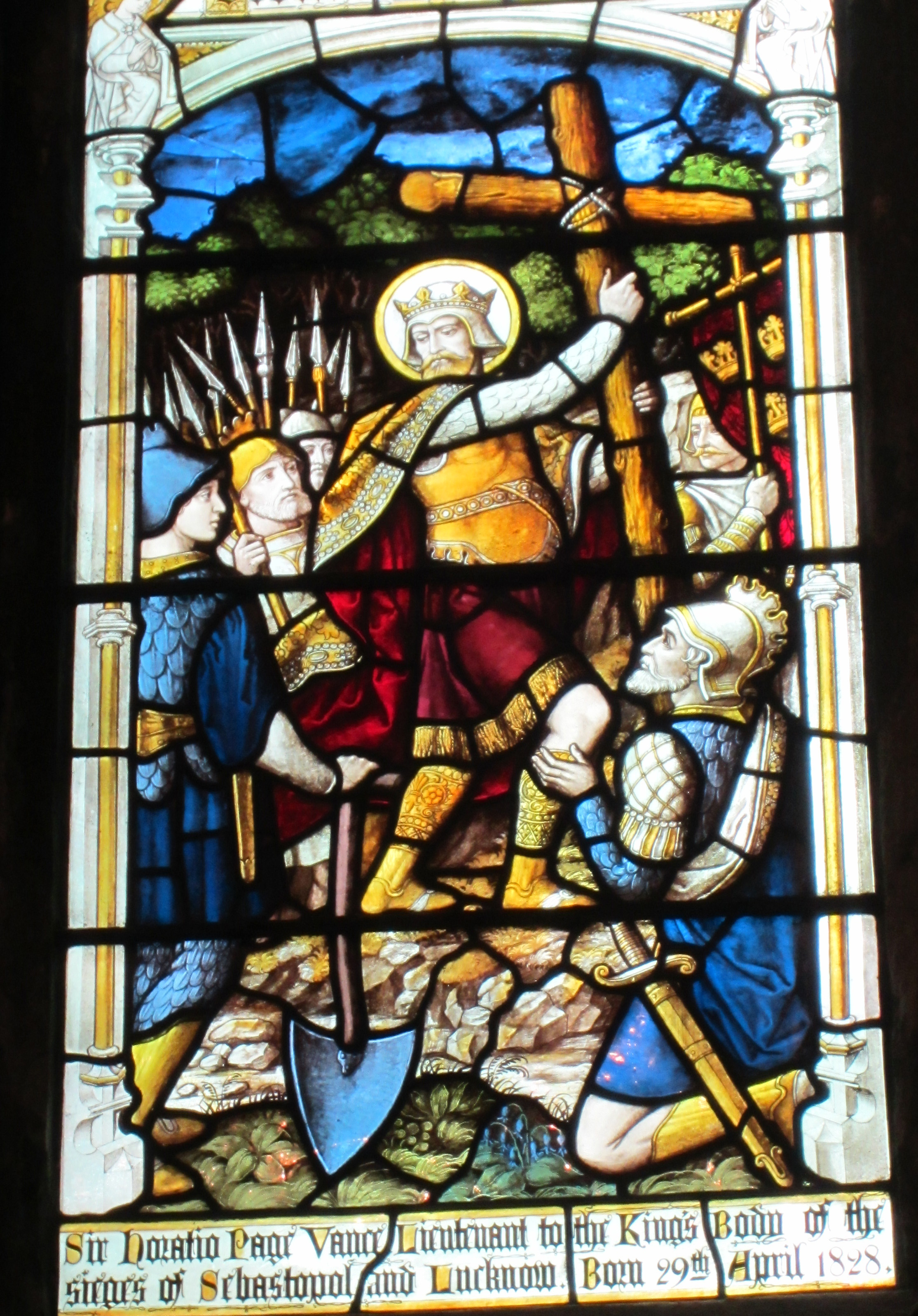
Besieging the enemy under the protection of the Cross (Lichfield Cathedral)

The Christian church is likened to a battleship (St.Mary’s Church, Painswick)

It is possible to see these images as mere curiosities, toothless survivals from a cruel past preserved like exotic museum-pieces in the more enlightened times we now live in. But in the churches I visited, none of the images are presented as violations of Christian values. On the contrary, they seem tailor-made to normalise the uncritical depiction of violence within the precincts of the church. All of the images I saw – and no doubt countless more I have not seen – make a subtle but very powerful point: there is a hand-in-gauntlet alliance between the Christian church and the practice of war, and this alliance continues into the present.

The Ten Commandments and the Sermon on the Mount lie at the heart of Christian doctrine, and neither could be more forthright: Thou shalt not kill and Love your enemies… whosoever strikes you on the right cheek, turn to him your other cheek as well. These are tough admonitions so it is not surprising that in everyday life and politics they are pretty comprehensively ignored. And theologians too, from St.Augustine to the padres of modern armies, have tried to water them down. But (to me at least) it is surprising that they also seem to be almost totally ignored, even trampled on, certainly compromised, in the iconography and worship of Christian churches where, of all places, they should be prominently and uncompromisingly affirmed.

In short, on the evidence of what I saw in Santiago de Compostela and in England, many Christian churches are little short of arsenals stuffed with iconographic weapons and iconographic flak jackets for use by the propagators of war and their apologists. 
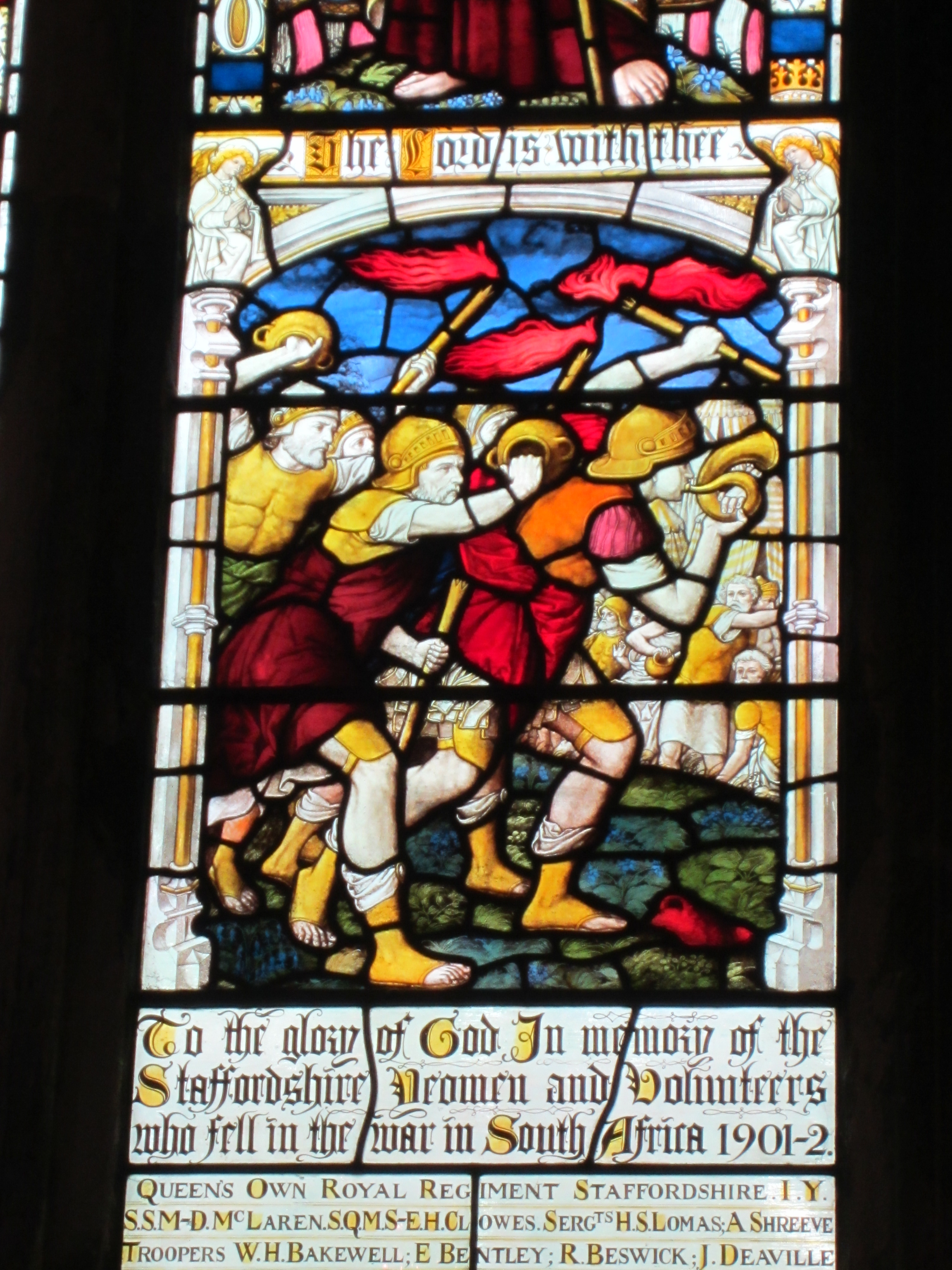
Images of soldiers charging into battle “to the glory of God” (from a war memorial window in Lichfield Cathedral)
					

Nine brief encounters, nine wry smiles

Walking is a good way to meet people, though often these meetings are fleeting. Here is a mini-album of encounters Emmy and I had during our walks in Portugal-Spain and the UK. Each was ultra-brief but images of the personalities involved have somehow stuck in my memory.

The Scottish shopkeeper

We spent a couple of hours in Dumfries in southern Scotland. I wanted to visit the house where poet Robert Burns once lived. It was somewhere near the centre of town but I couldn’t work out exactly where. I noticed a sign in a shop window: Streetmaps of Dumfries, £2.50. Inside, money changed hands and I turned to leave with a map.

“Hoo long are y’heer foor?” the helpful gentleman behind the counter asked in a thick Scottish accent.

“Just a couple of hours.”

“Och, y’dinna need a map then. Gie it back.”

I handed over the map. The kindly Scot turned to a photocopy machine and photocopied the part of the map that covered the centre of town. He pushed the £2.50 back into my hand, and, spreading the photocopy out on the counter, explained in detail how we could get to Robert Burns’ house.

I tried to pay for the photocopy.

“Och,” he said, “no charge. If you save money I’m happy.”

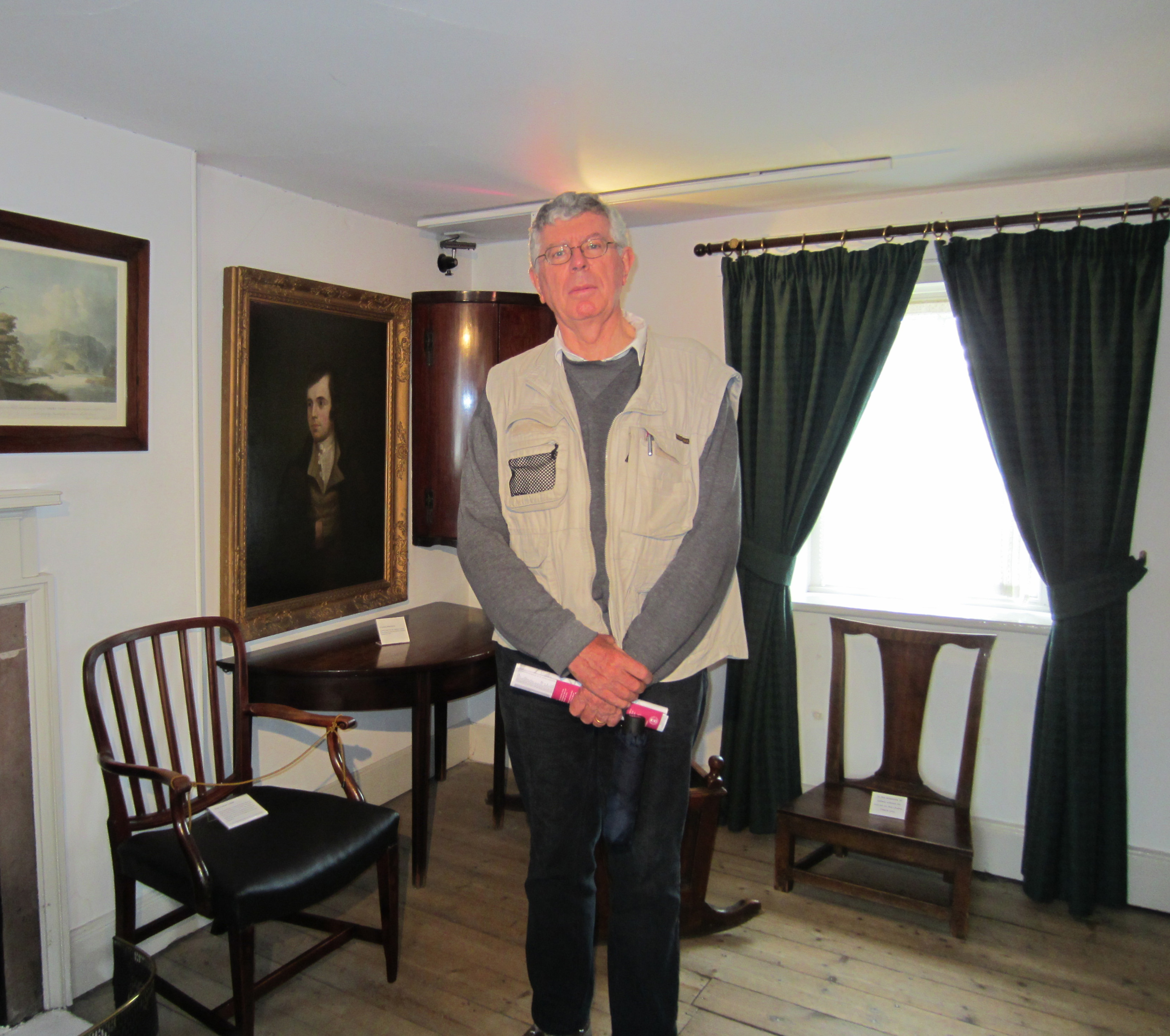
In the sitting room of Robert Burns’ house, Dumfries. I found the house with the help of a thrifty Scot and a photocopied map.

The “funny” taxi driver

Taxi drivers are talkative and funny, right? Sometimes talkative… yes, but not always funny. We took a taxi from Stratford-upon-Avon to Chipping Campden. I walked from our apartment to a taxi stand in a nearby Stratford street. The driver greeted me with a smarmy cheesy grin. I explained that I was going to Chipping Campden – about 20 kilometres away – but first we had to pick up my wife and two bags from our apartment.

“You’ve got three women in your life? How do you do it!?”

When we arrived at the apartment the driver lifted our two suitcases into the boot of the taxi.

“One’s heavy, the other’s light. I bet I know which one belongs to the missus, eh?” (nudge nudge)

I sat in the front seat, Emmy sat in the back.

“I’ll have to be on my best behaviour,” said our hilarious driver, jerking his thumb towards the rear. “Back seat driver, eh?”

The waitress with a midlands accent

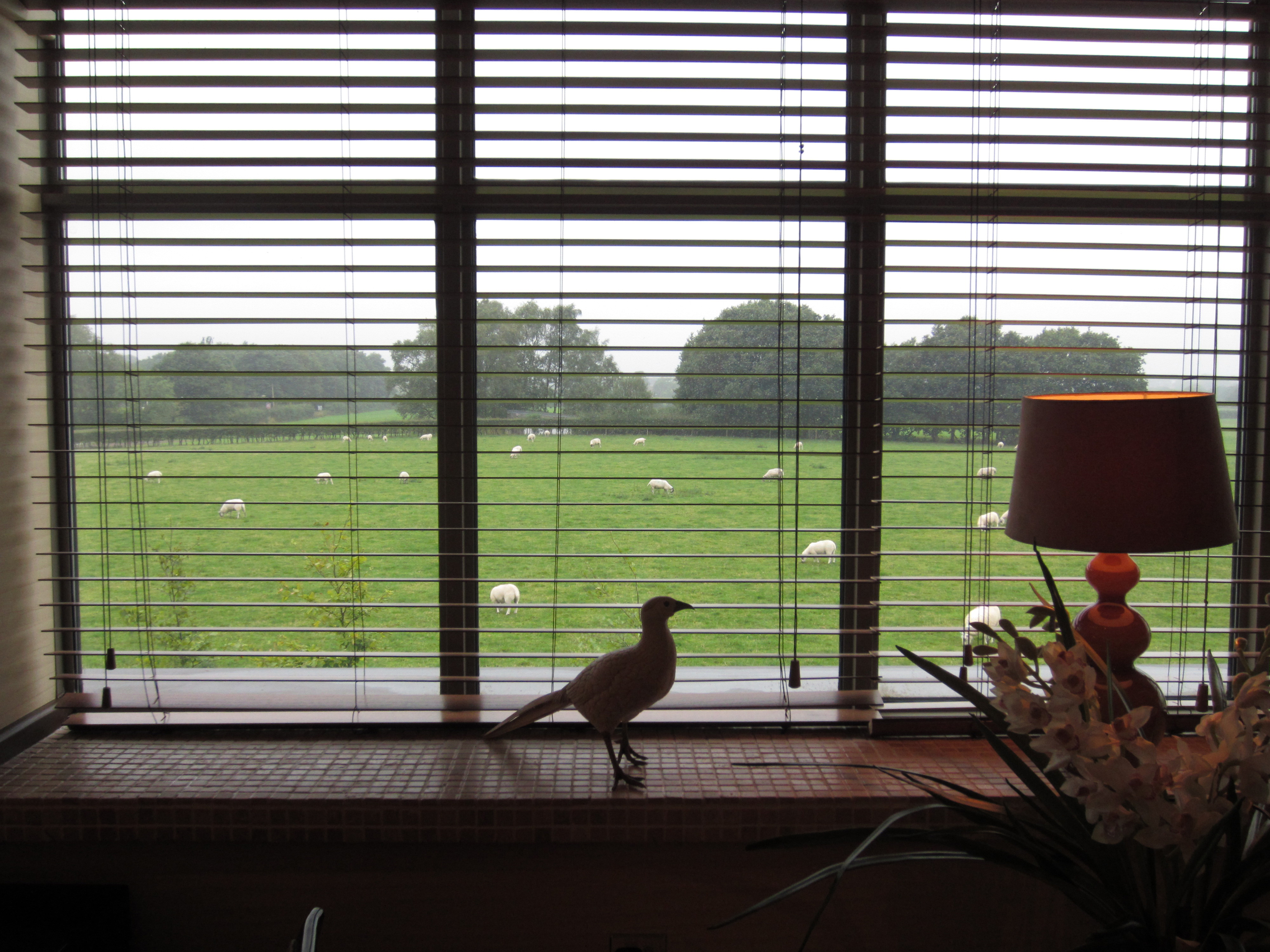
The restful view of sheep grazing outisde Bennet’s Restaurant, Wrightington, where I failed to understand the word “koof-fa”.

Driving down the M6 we stayed a night at the Wrightington Hotel and Country Club in the English midlands. Attached to the hotel, Bennet’s Restaurant has a restful view over a neighbouring meadow filled with grazing sheep. We enjoyed a very good meal there, pampered by an attractive and attentive young waitress. She was hovering over me as I finished my dessert.

“Would you like a koof-fa?”

“Excuse me… a what?”

“A koof-fa.”

I looked around bewildered hoping to see a koof-fa somewhere in the restaurant. Emmy (who is not a native speaker of English) intervened.

“She means a coffee,” she whispered.

The forgetful waiter

My dinner of fish steaks in Ponte de Lima. But where was the entree?

The restaurant in the Imperio do Minho Hotel in Ponte de Lima (northern Portugal) is not renowned for its food, so to attract customers they have installed a big TV screen tuned to a sports channel. We sat down not far from the screen. The waiter took our order.

“We’ll have soup first, please, followed by fish steaks with vegetables.”

The waiter was looking at the TV screen as he noted our order.

Fifteen minutes later the fish and vegetables arrived, but no soup. The restaurant staff were standing around the TV their backs to us.

“Excuse me! DESCULPE!”

The waiter turned, saw my waving arm and came to our table walking crab-like sideways so he could keep the football action in view from the corner of his eye.

“Where’s our soup?” I asked politely.

“Soup? Soup? Oh, sorry, sorry, sorry, I forgot the soup. But you have the fish, no? It’s enough.”

On the TV the crowd roared and the waiter hurried back to the game. As for Emmy and me, we ate an ordinary but very filling meal. The waiter was right… it was enough.

The know-it-all from Austria

At breakfast in the Ashton House B&B in Painswick we were joined by a couple from Austria. The husband looked remarkably like the composer Franz Schubert with small wire-frame glasses, pork chop sideburns and ruddy cheeks.

“You are from Australia? Australia is in the Far East, isn’t it. In fact the very word Australia means the land in the east.”

“Actually,” I said, “Australia comes from the Latin word australis meaning southern.”

“No! No!” he shouted excitedly in a heavy German accent. “You are wrong! Here’s proof. Austria is the English version of Österreich which means the land in the east. Austria and Australia are almost the same, so Australia must mean land in the east too!”

I was used to being the only know-it-all at the breakfast table and was about to defend my monopoly when I received a vigorous kick under the table from Emmy, so I kept quiet.

Jesus Christ

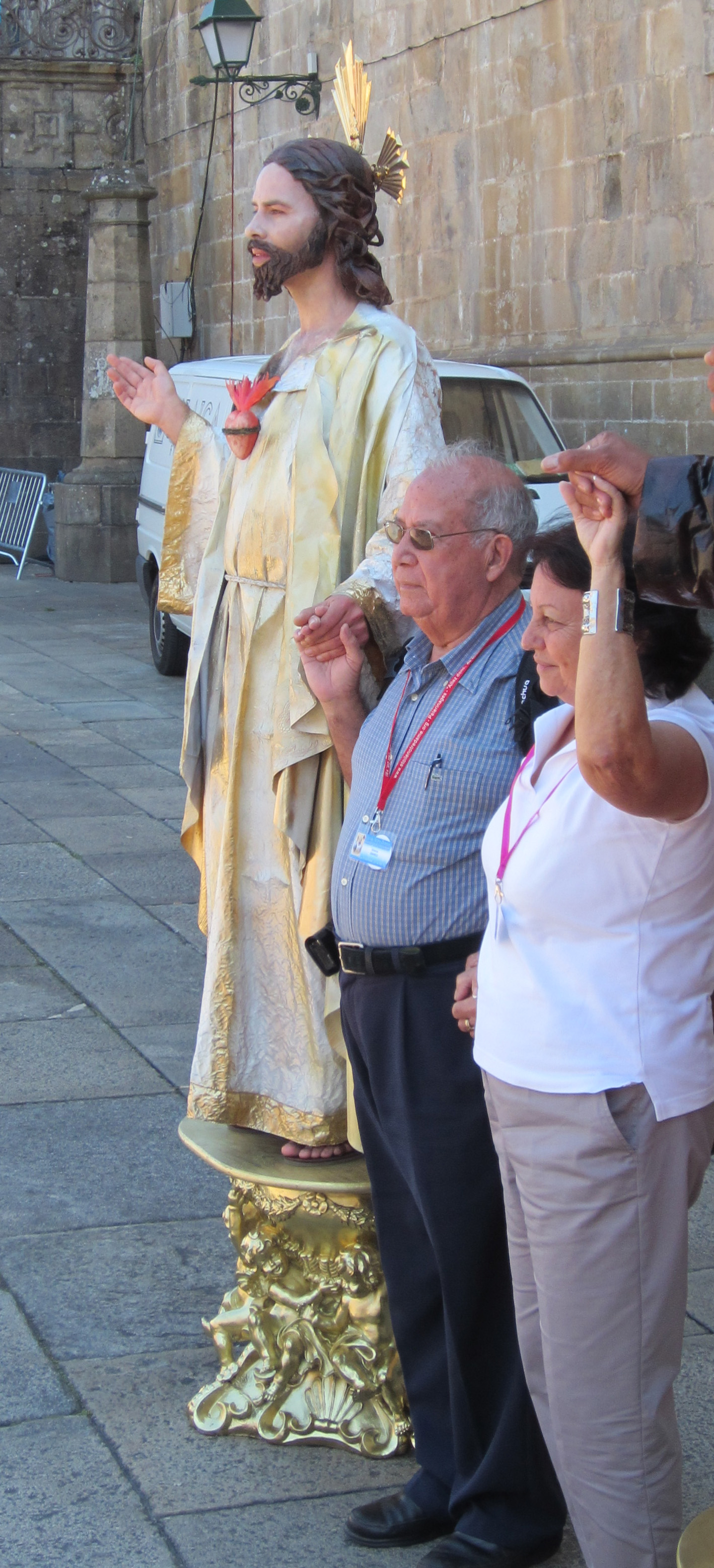
Tourists get a souvenir photograph with Jesus Christ in Santiago de Compostela.

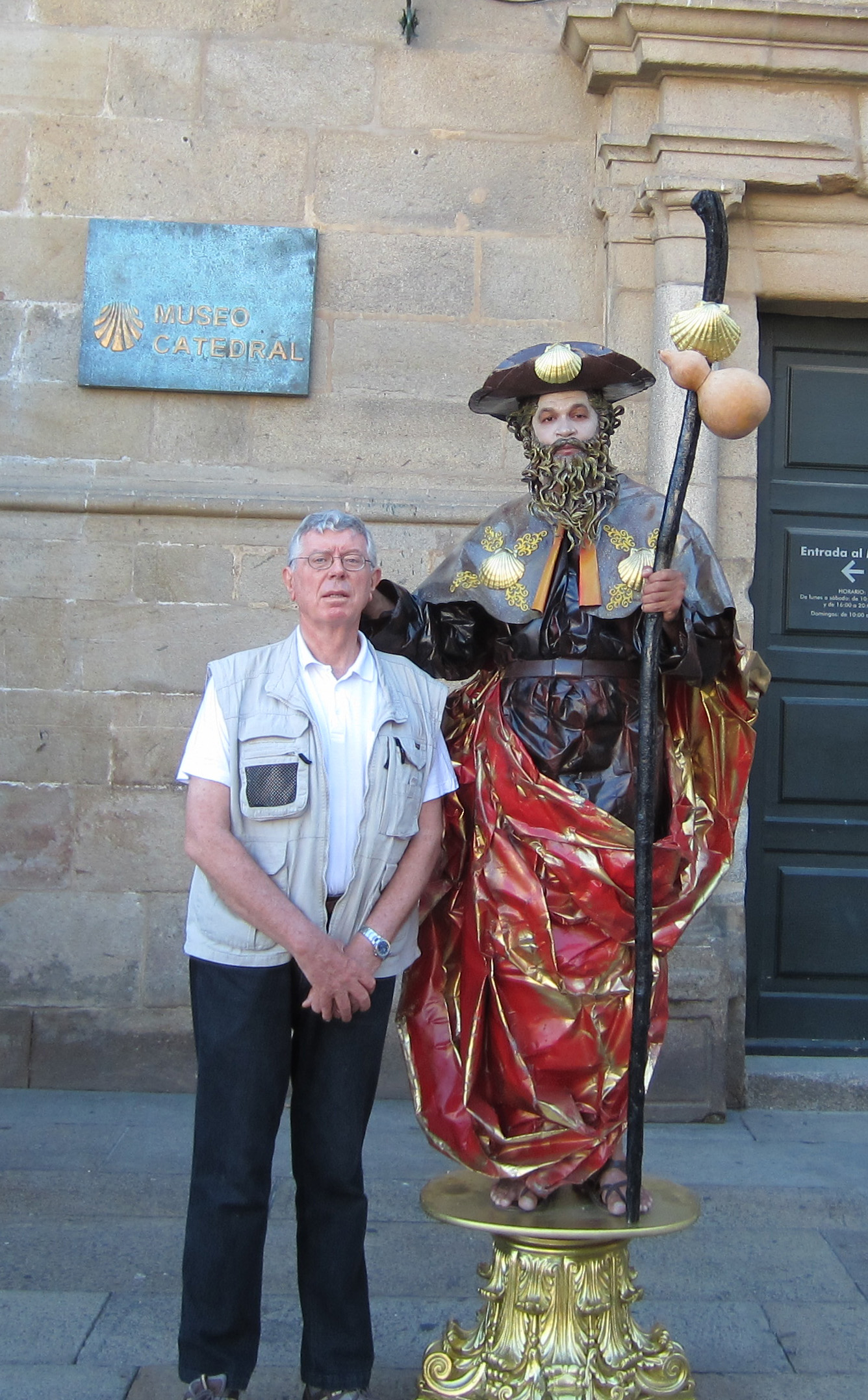
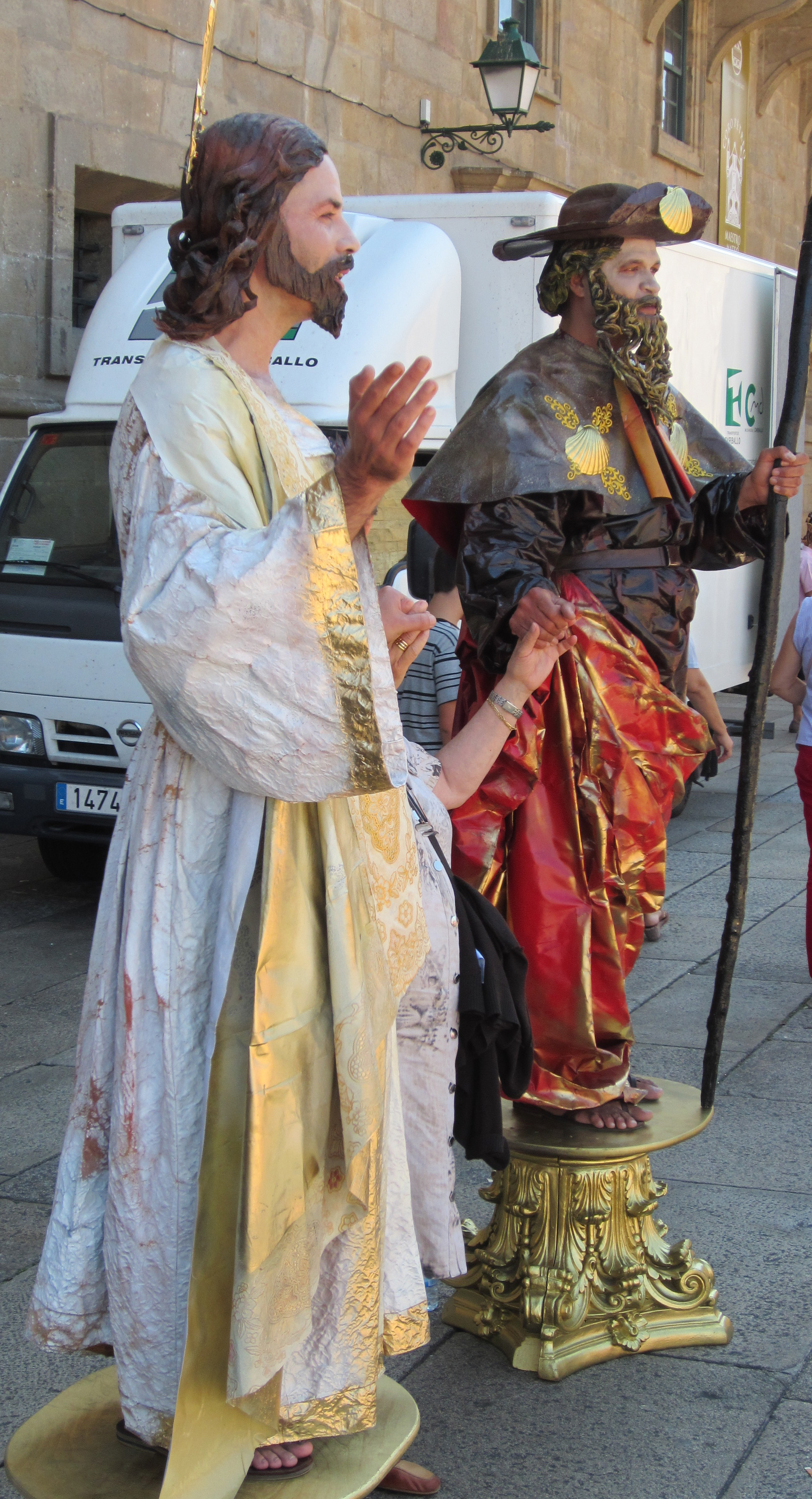
In the Praza do Obradoiro, the main square in front of the Cathedral of Santiago de Compostela, there are plenty of opportunities for pilgrims to part with their cash. For example, for a small “donation”, you can have your picture taken standing beside a meticulously costumed live figure of St.James. Even better, right beside him, Jesus Christ himself is waiting to be photographed (see pix).

Emmy took my picture receiving the benediction of St.James, but when I turned to Jesus Christ I found the Son of Man besieged by a long queue. I decided to come back later.

It was early evening when we returned to the Praza do Obradoiro. St.James was still there and still doing brisk business.

“Where is Jesus Christ?” I asked him.

St.James didn’t understand English, but a bystander helped me out.

“You’ll have to come back tomorrow,” she said. “Jesus Christ has gone home for dinner.”

I get the blessing of St.James (Santiago).

A meticulously costumed Jesus Christ (before he went home for dinner) and his apostle St.James.
Mark Webber’s Portuguese fan

As we negotiated the alleys of Fajozes Village north of Porto a four-wheel drive screeched to a halt beside me. The driver was a young man around twenty years old but already balding. He had seen the small Australian flag sewn to the side of my walking hat.

“You… from Australia?”

“Yes.”

“You know Mark Webber?”

Mark Webber? The name rang a distant bell somewhere on the horizons of my memory. Wasn’t he a Formula One racing car driver?

“You mean the Formula One racing driver?”

The young man was overjoyed.

“Yes! Yes! You know him!”

“No, I don’t know him.”

Despair. Then his eyes lit up.

“You live in Queanbeyan?”

(Queanbeyan is the nondescript New South Wales town where Mark Webber grew up.)

“No, sorry.”

Gloom again. Then I added:

“But I live in Canberra which is just ten minutes from Queanbeyan.”

Joy. His hands shot out of the car window and he clasped mine in a warm handshake.

“You live near Queanbeyan!? Amazing! I so happy! Mark Webber best man!”

He revved the engine of his car, lowered his head, and shot away behind a cloud of dust and diesel. He was a happy man. He had come closer to his idol than he ever thought would be possible.

The crossword puzzle fanatic

In London Emmy and I did a guided walk through the Notting Hill area. It was an entertaining walk, taking us along historic streets, past the houses of celebrities and into the travel bookshop that was the main location for the famous movie Notting Hill.

I noticed a woman in our group carrying a newspaper. As we gaped at the house once owned by Madonna she opened the newspaper, folded it a few times and began filling in a crossword puzzle. We walked on and she followed, head bowed, frowning, doing the crossword as she walked. She muttered to one of her companions.

“What’s bygone. Seven letters with a ‘q’ in it.”

The walk culminated in the crush of the Portobello Road market. Our guide let us loose to browse.

“Fruit and vegetables that way,” he said pointing up the street, “and antiques that way,” pointing in the opposite direction.

“That’s it!” said the crossword lady pulling the newspaper from her handbag. “That’s the answer. Antique. I’m so glad I came on this walk!”

The plainspeaking publican

The ivy-covered Major’s Retreat is the only watering hole in the hamlet of Tormarton, a day’s walk short of Bath on the Cotswold Way. On the evening we visited, Emmy sat at a table examining the pub’s menu while I put my elbows on the bar and ordered a pint of cider (for me) and a small glass of apple juice (for Emmy). The publican was talkative. He spoke with a plummy accent and had a vaguely military bearing consistent with the name of the pub. He recognised my Australian accent and we exchanged banter about the fortunes of our respective national cricket teams. As I put my hands around the two glasses I asked:

“Should I pay for these now, or later, together with our meal?”

“Oh, we’ll put the drinks on the tab for the time being.”

“How long can they stay on the tab?” I said, making a weak attempt at a joke. “Until after we get out the door?”

The publican laughed.

“I’ve got a shotgun under the bar here.”

He pointed at the front door.

“Before you could reach that door…” his eyes narrowed, the smile faded, his voice hardened and rose a little, “I’d put a barrel-full of buckshot up your arse!”

And I don’t think he was joking.

Tormarton’s ivy-cloaked pub, The Major’s Retreat.

A walker’s review of English fish and chips

In 1950s Wellington (New Zealand), Monday was fish and chips day for my family and many other families. Shops and bakeries closed over the weekend so for two days it was not possible to replenish supplies of bread. Like countless other children, instead of carrying a cut lunch from home on Mondays, I headed for school clutching two shillings for a lunch of fish and chips. When the lunchtime bell rang at South Wellington Intermediate School a swarm of black shoes would burst through the school gates and clatter down the street to the fish and chip shop of Mr Jurkovich.

It was always crowded and hot in the shop, even in winter. Mr Jurkovich worked fast. With one hand he would lift a wire basket full of fish, or a basket of chips, from a tub of boiling oil. With his other hand he would pinch a single sheet of greased paper, slap it down on top of a big pile of newspapers on the counter and dump the steaming fish and chips on it. The pile was given a quick shake of salt and deftly wrapped up.

“I serve from the back!” Mr Jurkovich would shout in a fruitless attempt to stop children from pressing forward against his flimsy counter. On the end of his big nose a bead of sweat would form. Eventually the drop would shake off. As often as not, it would fall into a serving of fish and chips on the counter. If this happened a cheer would go up. Mr Jurkovich’s eyebrows would crinkle and he would look suspiciously around the crowd of upturned faces.

“I serve from the back!” was his only grim comment. He didn’t know much English.

But the children rejoiced. They had something to talk about and someone to tease.

“Mr Jurkovich gave you extra salt. Free… and straight out of his nose!”

The Monday lunchtime ritual of tearing open the wrapping around a serving of fish and chips… somehow it has stayed with me. It was special, it was a luxury. Walking through England I ate several meals of fish and chips, each time hoping, I suppose, to relive the intensity of this childhood memory. It never happened, of course, but nevertheless I enjoyed English fish and chips. Here are my notes on these meals, ranked from unforgettably tasty to unforgettably forgettable. I should add that it is not just the flavour of the meals that I wish to record, but equally, a glimpse of the place where the meal was eaten. Flavour is a function – at least in part – of environment. Memory of food and memory of place go together.

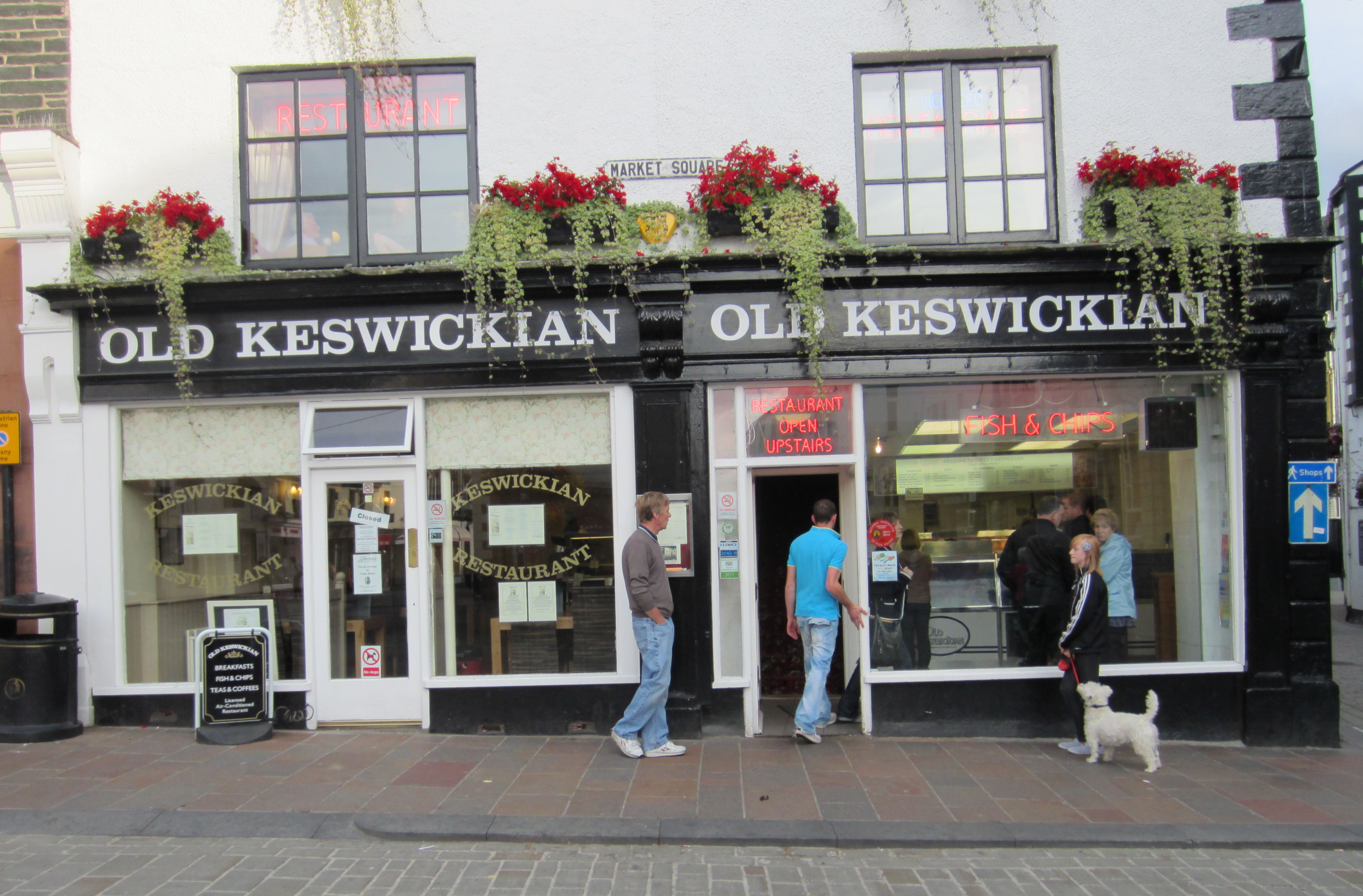
“The best fish and chips in the UK” so they say. The claim may well be true.

1. The Old Keswickian Restaurant, Keswick. August 7th

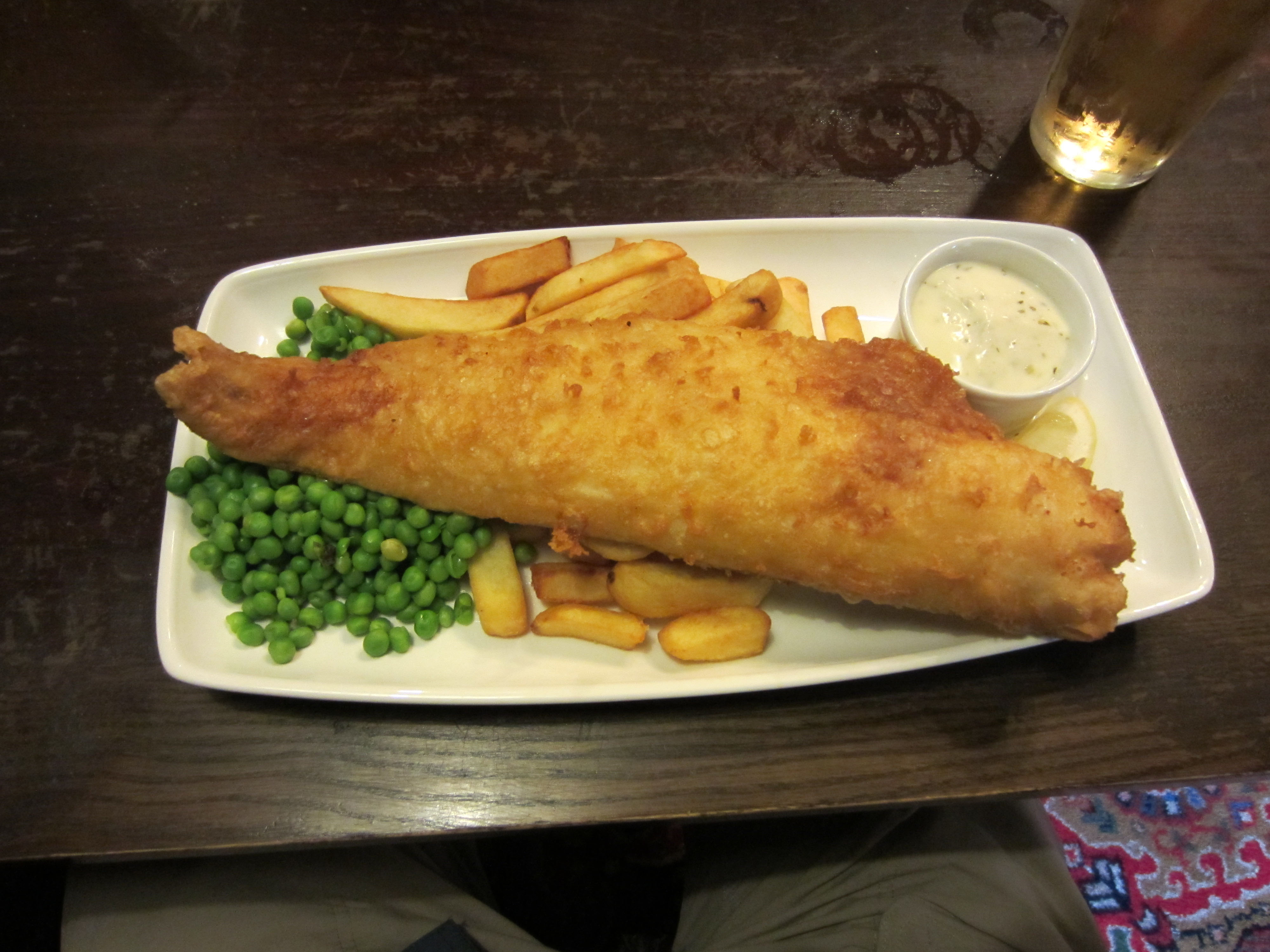
Emmy and I ate upstairs in the sit-down, table service section of the Old Keswickian Restaurant. (There is a take-away department downstairs at street level.) The Old Keswickian is especially proud of its reputation for fish and chips, but other dishes are available too. The chips were big, moderately crisp on the outside and fluffy on the inside. The fish tasted fresh. The batter on the fish was slightly oily but very crisp and not too thick. The dish came with an optional serving of “mushy peas” – a small bowl of peas, pureed to a thick consistency that tasted like pea soup. The whole meal was freshly cooked and served with a slice of lemon. Overall the meal was memorably tasty, though I’m still undecided about the merits of mushy peas.

Fish and chips at the Old Keswickian (bottom). Emmy’s meal of crumbed scampi and salad is at the top, and in the middle the serving of mushy peas.

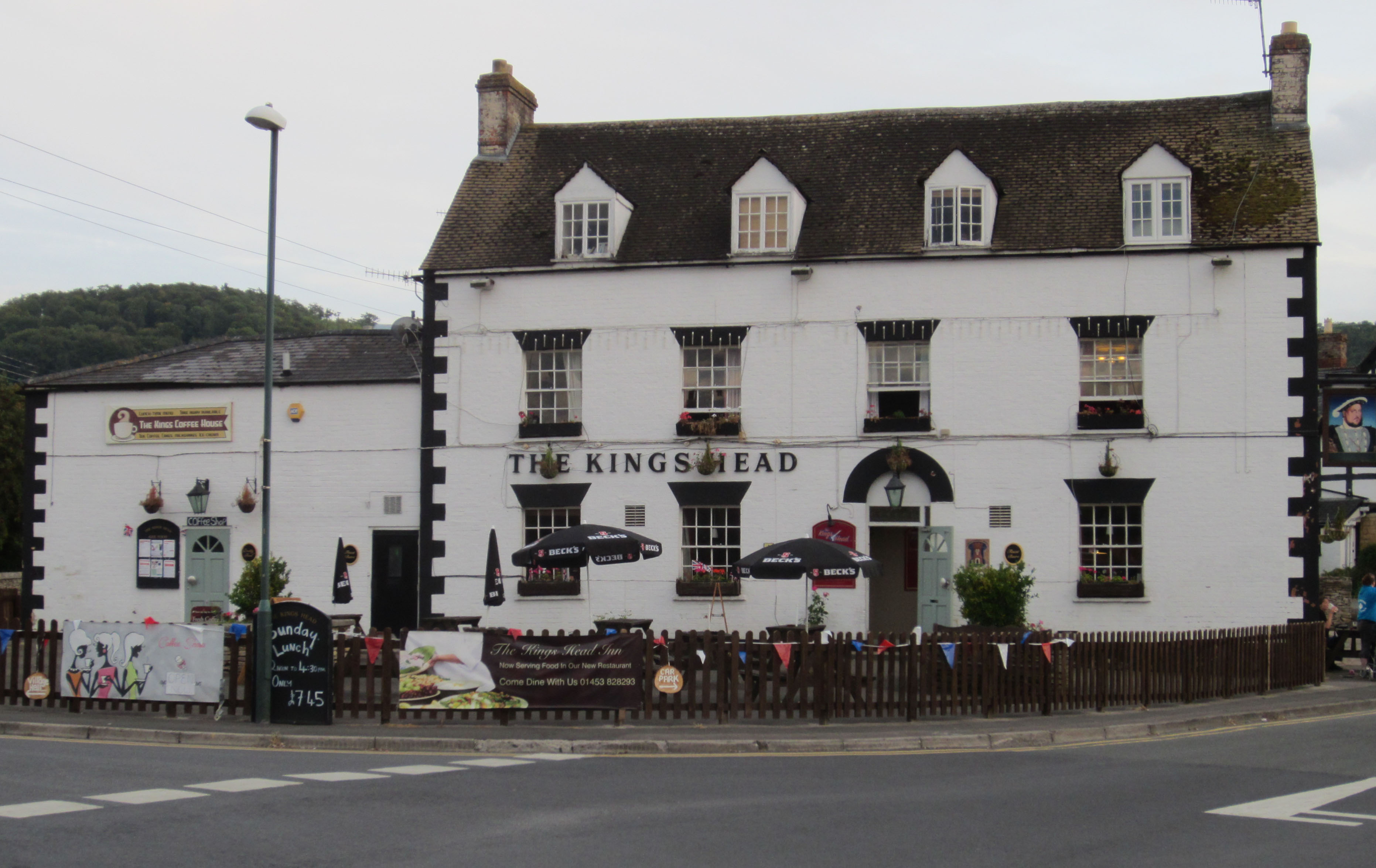
The Kings Head Inn, Kings Stanley. The restaurant is on the first floor. The annex on the left is a cafe open during the day.

2. Kings Head Inn, Kings Stanley. August 22nd

The fillet of fish was not particularly fresh and it was a bit grey in colour. The batter was extremely crisp, in fact it was quite crunchy all through and all over. The chips were well coloured, crisp on the outside and fluffy on the inside. The meal came with a flavoursome salad that included cherry tomatoes and slices of cucumber. The salad was fresh and crisp and not smothered in dressing or mayonnaise. There was also a tasty serving of peas. The meal was a “Monday special” costing £5.00 (the regular price is £9.95).

King Head’s tasty fish and chips with crisply battered fish and fresh salad.

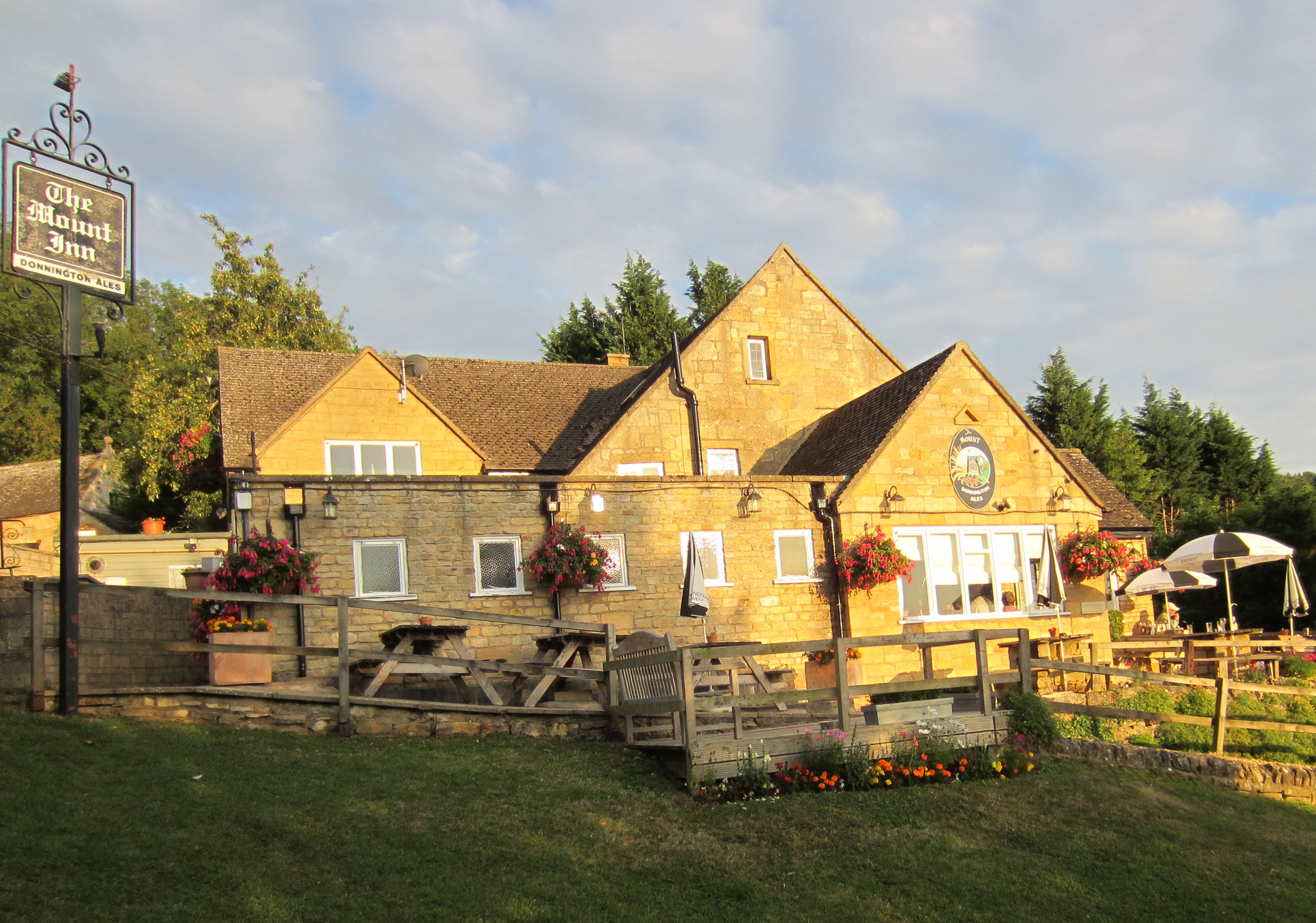
Mount Inn, Stanton, lit by the late evening summer sun.

3. Mount Inn, Stanton. August 17th

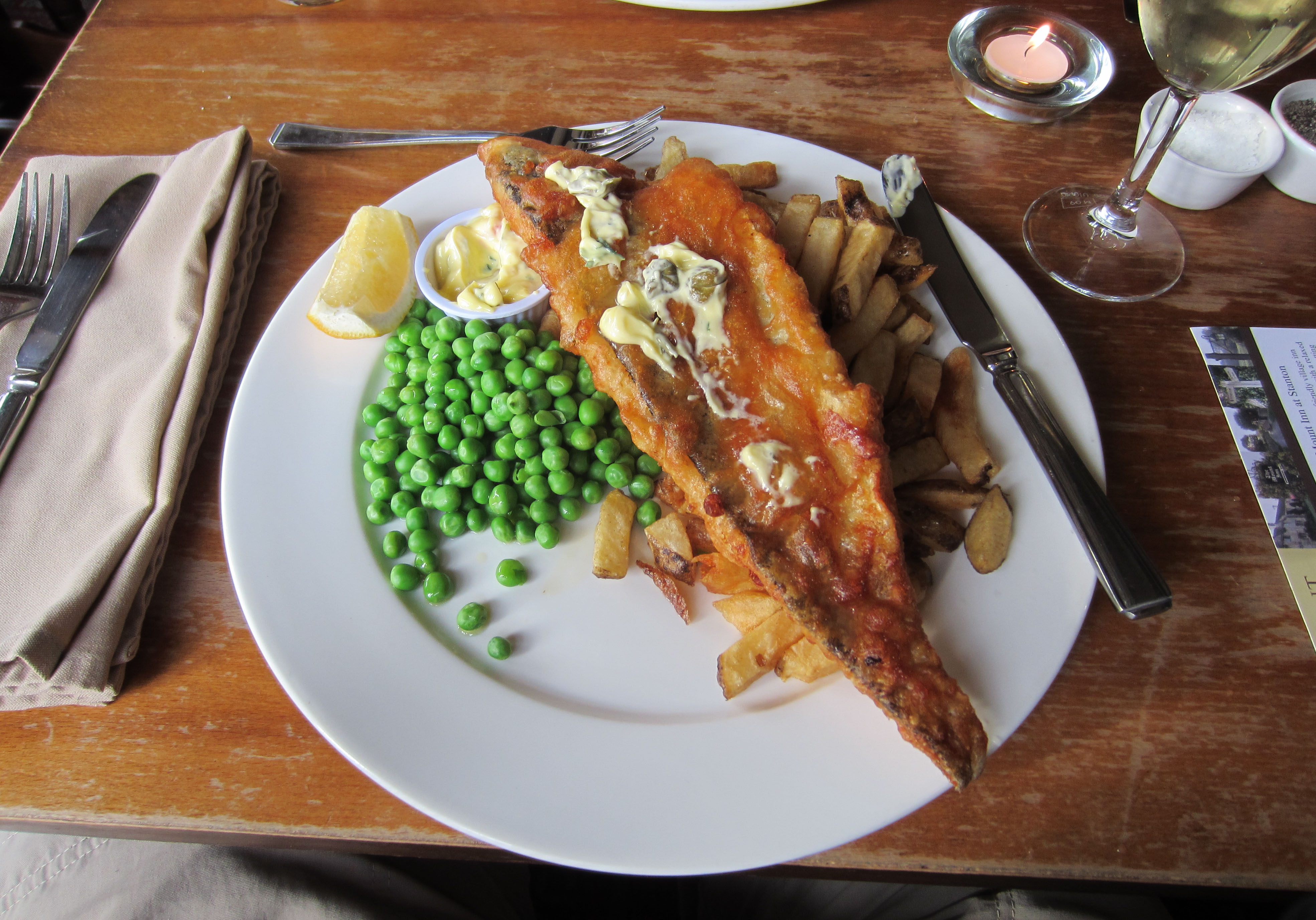
The blackboard menu identified the fish as haddock. It was cooked in crisp, locally-made beer batter but tasted rather bland. The chips were a bit limp but not too bad. The meal was unique for its extras. The basic fish and chips came with peas and tartare sauce garnished with capers and gherkins. The salt was sea salt and freshly ground pepper was sprinkled over the meal. The Mount Inn stands on a hill high over Stanton Village. The atmospheric summer evening view was a bonus that helped diners overlook the small shortcomings of the meal.

The view from Mount Inn.

Mount Inn’s fish and chips with caper and gherkin-flavoured tartare.

One of several kiosks selling fish and chips near the Tower of London. Salt and sauces are provided on the buffet to the left.

4. A fish and chips kiosk in the pedestrian plaza adjacent to the Tower of London. July 10th

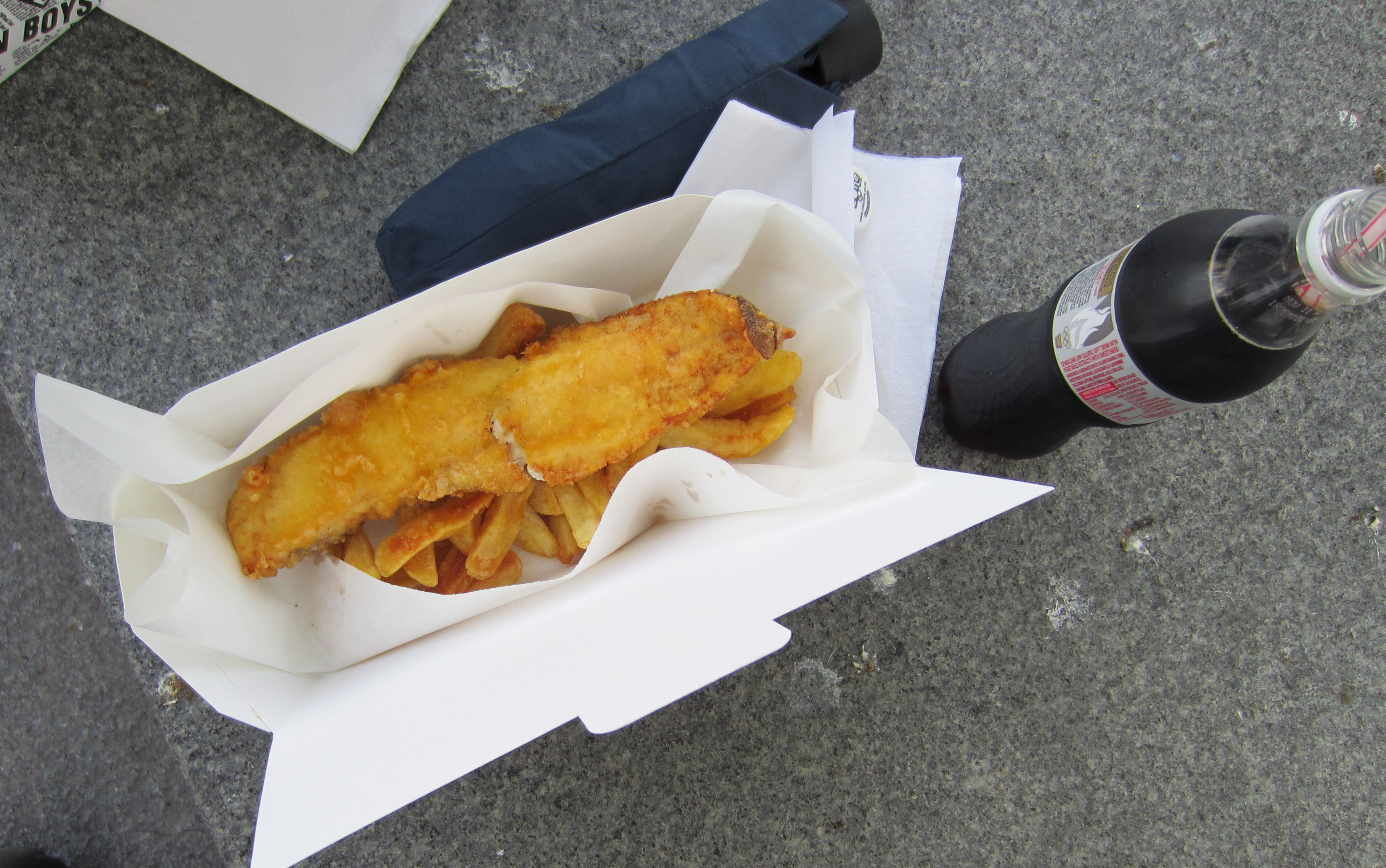
This was no-frills fish and chips. The piece of fish was quite big with a nice fishy taste and reasonably fresh. The batter was medium thick. The chips were bright yellow in colour. The colour might have come from the variety of potatoes used, or it might have been because of the cooking oil or some additive. The chips were not freshly cooked, however. Clearly they had been lying in the glass display counter for some time, so the bigger chips were half limp and the smaller ones had dried out and had become hard and crackly. No lemon was provided with the meal but it could be salted to taste at a buffet table beside the serving point. The meal came in a cardboard box decorated with newspaper motifs – an inventively cute substitute for traditional newspaper wrapping.

No frills fish and chips at the Tower of London.

Newspaper motifs on the cardboard packaging of fish and chips at the Tower of London.

Inside the Royal George Hotel, Birdlip.

5. Royal George Hotel, Birdlip. August 20th

According to the menu the fish and chips came with “petit poids”. These were soggy and tasteless peas – no doubt from a long opened pack of frozen peas. The chips were reasonably crisp but also tasteless. The fish was cod, but it was not fresh. In fact the fish was bland, tasteless and a bit watery. The batter was thin and overcooked at the edges.The meal came with tartare sauce and lemon but these failed to impart a flavour boost. Over all, this was one of the most tasteless meals I have ever eaten.

Royal George’s less than impressive fish and chips.

From Kings Head Inn to Bath Abbey: Our last days on the Cotswold Way

It is around 8.00 pm on August 22nd. The evening air is warm and still. The sun is low in the sky shining though a hazy veil of clouds, but the sky is not overcast. We are strolling the streets of Kings Stanley, a village on the Cotswold Way not far from Gloucester. It is not really an historic village. Most houses are relatively new and they are not particularly unique or beautiful. Yet pride shines from every one of them. Many are individually named, and the names project a certain vision of country England: Walnut Tree Cottage, Rose Nook, Clover Cottage, The Laurels, Woodland View, Jackdaw Cottage, Sunbeams, Field House, Greenfields, Manor View, The Brush (with a fading image of a brush-tailed fox beside the name).

Horses in the streets of Kings Stanley.

The village is built around a village green with a cricket strip in the middle. As we pass we hear the muffled shouts of young men playing soccer: playing without much skill but with seriousness and energy. The referee is clad in the officialdom of a referee’s jersey and he uses his whistle a lot. A coach bawls a stream of advice and instructions. Some excited children are running up and down the sideline.

We have just eaten dinner in the upstairs restaurant of the Kings Head Inn, right beside the village green. When we arrived, just short of 7.00 pm, the restaurant was unlit and unattended. The young man behind the downstairs bar thought he knew why.

“The chef’s gone out for a few minutes – down to the next pub, I think. He’s not allowed to drink here. I’ll get the owner. She’s just next door.”

Are they soup tureens, or…?

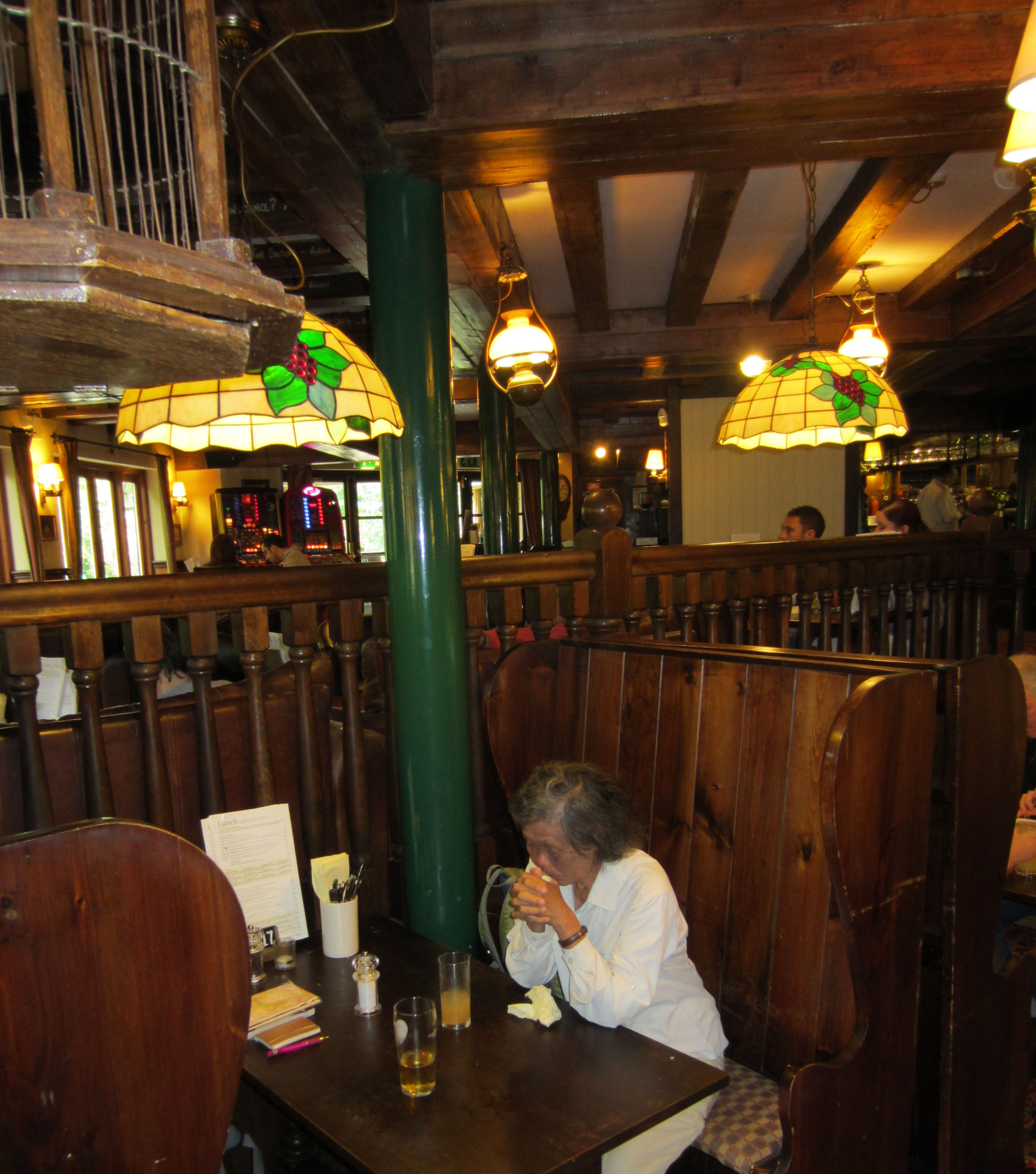
A few minutes later the owner bustles in full of apology. She switches on the lights and calls the chef on her mobile. We look down the long narrow room. On shelves at the far end there is a display of painted porcelain platters and, hanging from hooks, a row of what look like large chamber pots. Emmy doesn’t believe that chamber pots – however antique they may be – could be used as decorations in a restaurant. They must be soup tureens, she says. Reader, I leave you to judge (see picture).

When the chef turns up – a young man wearing the white jacket and checked cotton trousers of a chef – he prepares a meal that is unexpectedly delicious. I have fish and chips (to be reviewed in a later post) and Emmy demolishes a big dish of nachos. The chef fusses over us as we eat, checking that we have salt and pepper, adjusting the level of the background music and asking if the meal is to our taste.

As we walk slowly back to our accommodation at the Valley Views B&B the sky has cleared and the sunlight is retreating from the hills below the village. Trees stand in ranks that criss-cross the slopes, each tree split into a half of golden light and a half of darkness, throwing a long, tapering, dark-green shadow into the lime green of the fields. There is quiet poetry in the evening of a long day. We will sleep well tonight in our garret room.

****

The warning has come too late… we have to continue walking.

On Tuesday August 23rd we walked from Kings Stanley to the small town of Wotton-under-Edge, a distance of 25 kilometres. It was a long stretch but most of the path took us through cool woodland and we were walking on soft surfaces. Several times I stopped to listen to the silence of the woods. The Australian bush had taught me to expect a certain amount of noise: cackling and chirping and screeching. I had learned to eavesdrop on scratchy chatter and peer up into treetops full of mad laughter. I knew how to filter out the deafening sawing of summer cicadas and brush away the static of flies. But here in England… where were the birds? Where were the insects? Where was the companionship of wild voices? England’s woodlands seemed eerily empty.

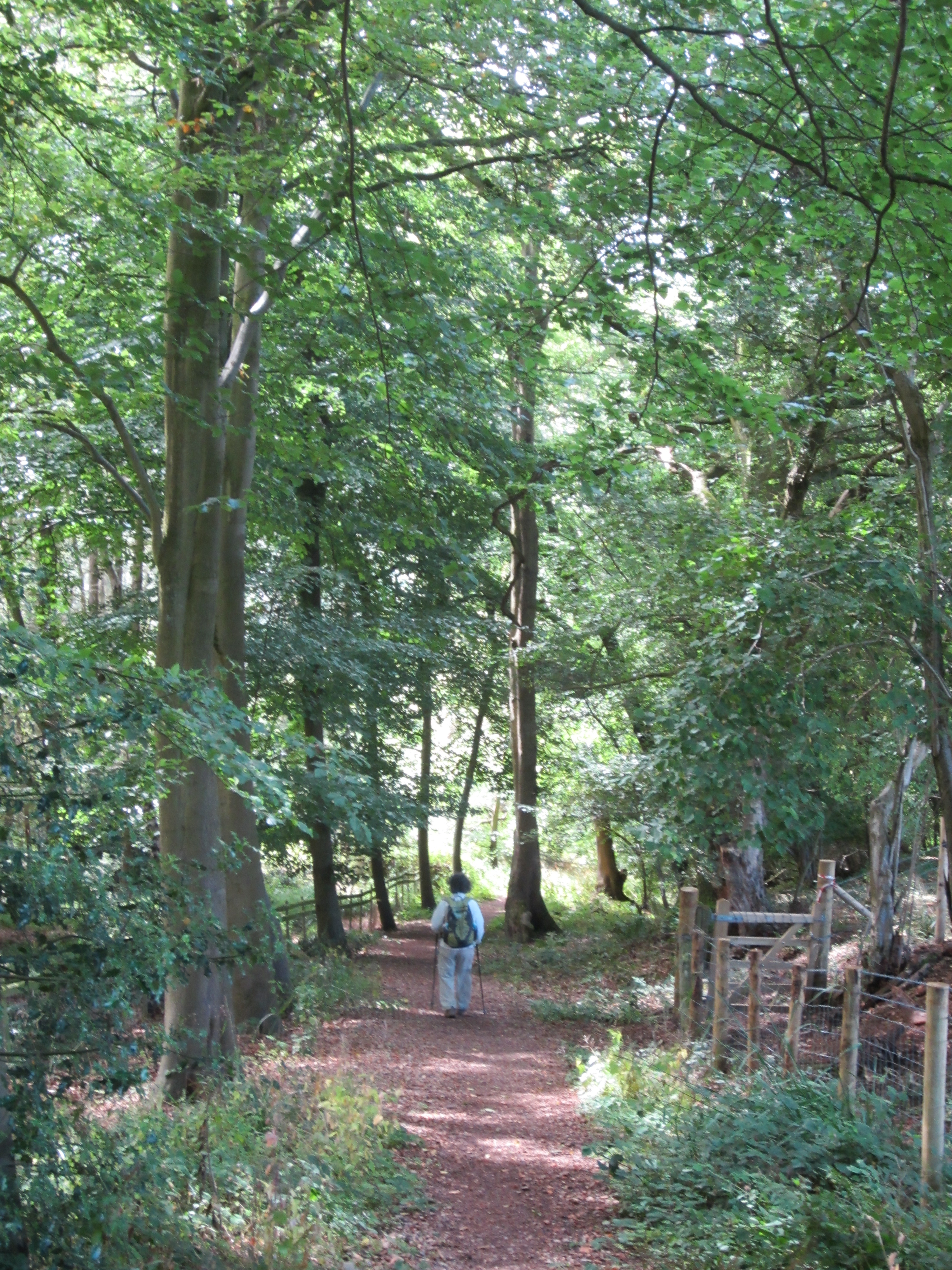
The beautiful and silent woodlands of the Cotswold Way.

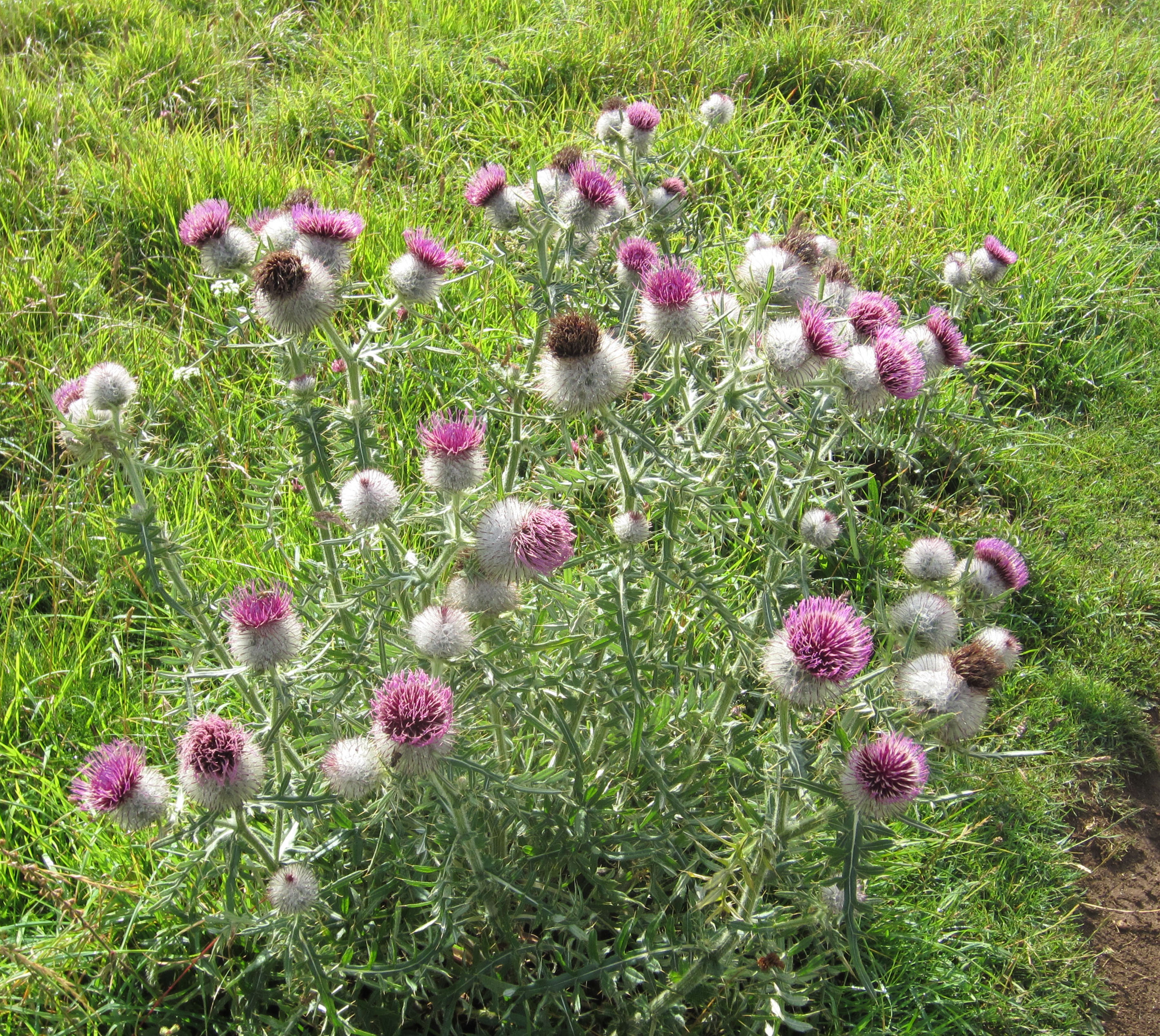
On the other hand there were plenty of wildflowers to admire: daisies and dandelions, buttercups and bluebells, brilliant red poppies, thick banks of tall purple flowers (rosebay?) and carpets of clover. There were blackberries (edible but tart) and rowan berries, stinging nettles and bloated thistles.

Walking between banks of rosebay.

Wild poppies…

… and daisies.

Rowan berries…

… obese thistles…

… and stinging nettles.

A slow-worm crosses our path (slowly).

Occasionally there were signs of wild fauna. We saw grey squirrels and rabbits, but they were too quick and timid to photograph. Just out of Kings Stanley we were halted for a few minutes by a slow-worm on the path. The slow-worm is kind of legless lizard that looks like a snake. True to its name it slid very slowly across the path, a tiny tongue flicking from its mouth.

English roadkill.

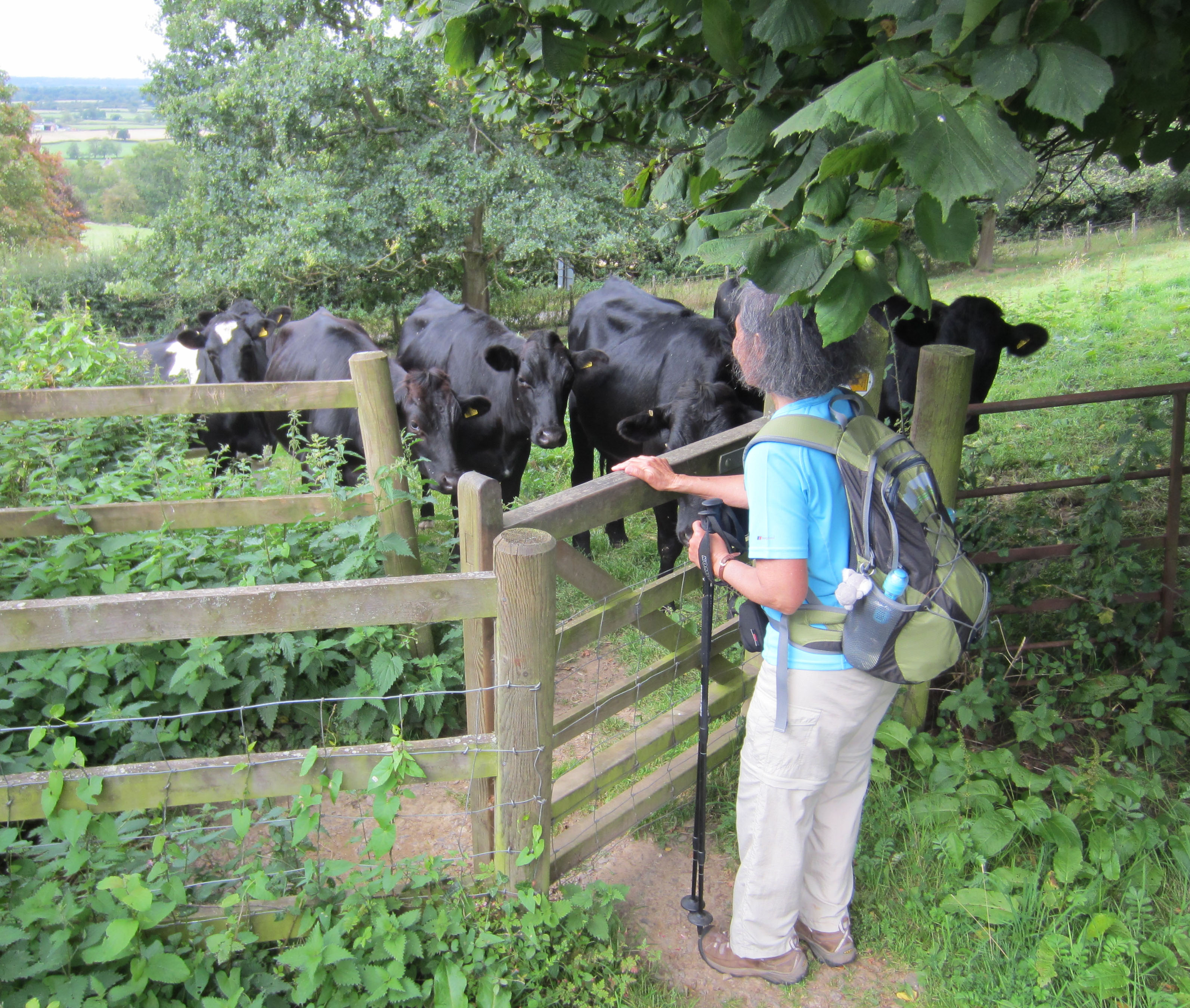
Much of the walk was over pasture where we often had to push our way through crowds of sheep and cows. There were several encounters with horses, intelligent creatures that seemed especially curious about Emmy.

Emmy is harassed by a horse (I think it smells food in her backpack).

Courage, Emmy, courage.

And needless to say we met other walkers. Near Wotton-under-Edge I was labouring up a steep hill, puffing heavily, my heartbeat thumping in my ears, sweat stinging my eyes, when a young woman – maybe 20 years old – came gliding down the slope. She was carrying a huge backpack but had no walking poles to steady her and help her down the hill. Yet she was walking rapidly and easily as if she was on a city street hurrying to the office. I rasped out a greeting.

“Hi. Where are you heading?”

She was rosy with good health and her teeth braces glinted in the sun.

“I’m on my way to John o’Groats.”

“What!? John o’Groats at the top of Scotland?”

“Yes. I started from Lands End three weeks ago.”

“And you’re on your own?”

“Yes, but…” she added modestly “I’m doing it in stages. I’ll be taking break for a few days in the midlands. And I might stop for a day or two in Edinburgh, especially if the weather is cold.”

I dug my walking poles into the earth and levered myself up another step. Above me, on the summit of the hill, Emmy – who is older than me – was waiting and getting impatient. Suddenly the hill seemed steeper and I felt my age.

For the second half of the Cotswold walk we enjoyed the intermittent company of a Dutch couple, Ronald and Francis from Enschede, who stayed each night in the same accommodation as us. They were very fit, very focussed walkers who invariably overtook us, then fell behind again as they took detours and explored places that our speed and stamina did not allow us to reach. Apart from meeting over breakfast our paths also criss-crossed during the day: These encounters were always a pleasure. Their cheery faces are now indistinguishable in my memory from the exotic and quaint places where we met and chatted: Parsonage Street in Dursley, the Dog Inn in Old Sodbury, the Falcon Inn in Wotton-under-Edge, the Major’s Retreat in Tormarton.

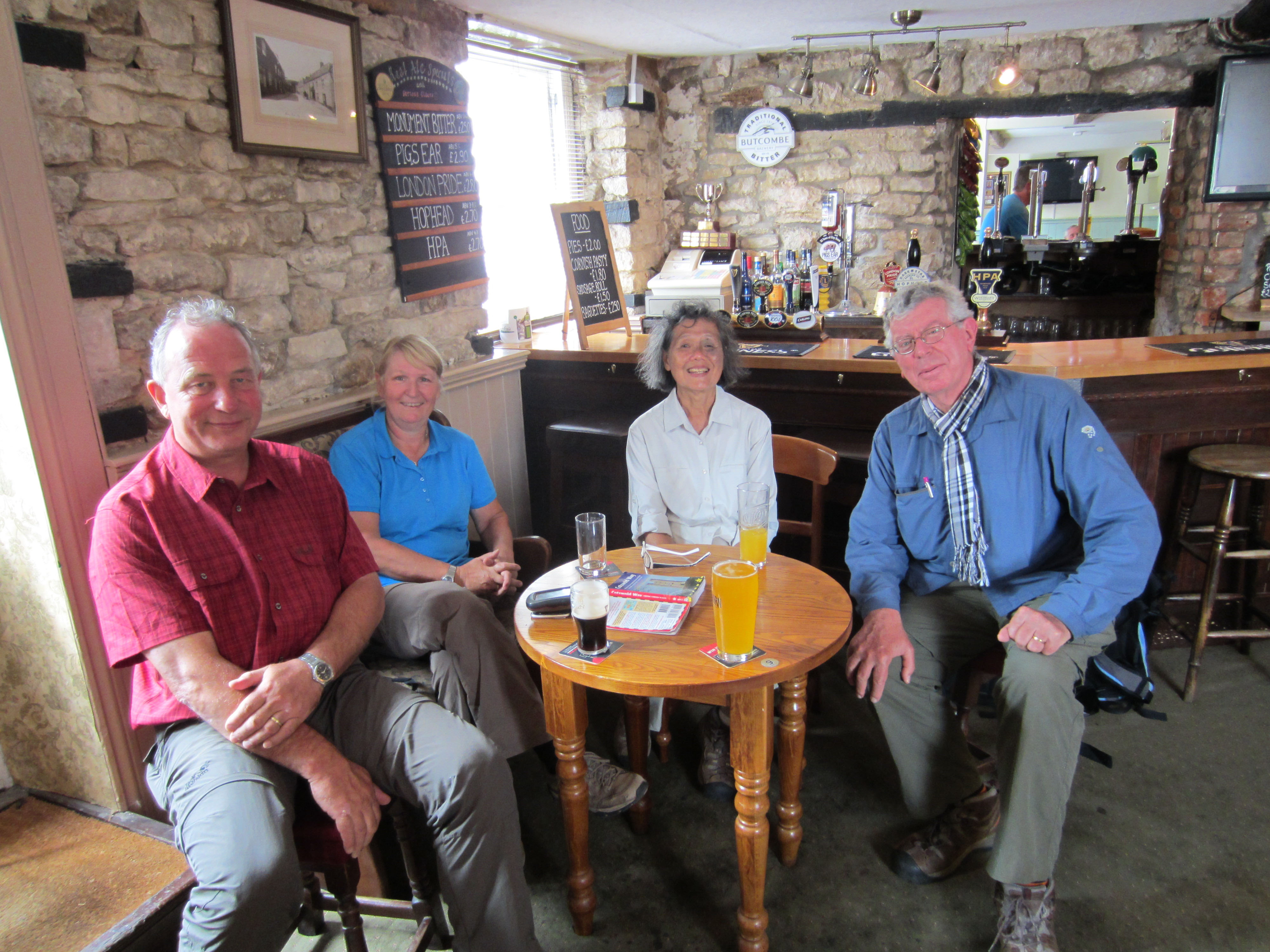
With Ronald and Francis in the front bar of the Falcon Inn, Wotton-under-Edge.

****

August 25th was the last day of the walk. After a big hit of calories and cholesterol courtesy of the legendary “full English breakfast” (marmalade on buttered toast accompanied by bacon, eggs, sausage, half a tomato, sliced mushrooms – all fried – plus baked beans) Emmy and I headed out into the cool of the morning. I took deep breaths of champagne air as we opened gates into easy walking over dew-laden fields. The euphoria didn’t last long. It had rained the previous night and the “easy” paths were slick with mud. Within minutes big pancakes of clay had formed on the soles of our boots. We skidded and slipped, and had to walk lifting our knees like flamingos, stopping from time to time to scrape the clay away. We graduated to narrow incisions between banks of grass. Hidden in the grass there were nettles easily able to deliver a sting through the thin cloth of our pants as we brushed past.

As we walked the sky slowly darkened. Around 1.00 pm we reached the high, wind-blown fields of Lansdown where royalist and parliamentarian forces clashed in 1643. The stone walls where soldiers had crouched were still intact, and the positions and movements of troops were indicated with metal flags and information displays. But nothing else remained of the battle.

The English Civil War was probably the first time in human history that an attempt was made to establish the authority of a representative parliament by force of arms. The success of Oliver Cromwell’s parliamentarians was not immediate or perfect, but its impact has rippled across the world. As I stood in the empty fields of Lansdown they dissolved into desert, the jagged stone walls acquired a plaster veneer, the sky cleared and a hot sun beat down. In my imagination I was in Libya where, three hundred and sixty-eight years after the Battle of Lansdown, the forces of parliamentary democracy were still locked in battle with the forces of dictatorship. As in 17th century England, in Libya too there would be no quick and decisive outcome. Only rarely does history instantly dismantle a worn-out order and replace it with something wholly new. In Libya the dictator Gaddafi will fall, as Charles the First did, and the supremacy of parliament will be instituted, as it was in 17th century England. But Libya now faces a testing period of transition that may, for a time, produce a “lesser” or “transitional” dictatorship, as happened in 17th century England under Cromwell and is currently happening in Egypt.

Suddenly the sky unfurled veils of heavy rain. We made a run for trees at the edge of the battlefield. Water was streaming off the leaves of the canopy as we struggled into our wet weather gear. At Lansdown the Cotswold Way forks. The official “scenic” route curls five kilometres through high hills and farmland before dropping down into Bath. The “unofficial” route is a little shorter and takes the walker directly down an asphalt highway into the city. With cold water trickling down our backs we wimped out and chose the latter.

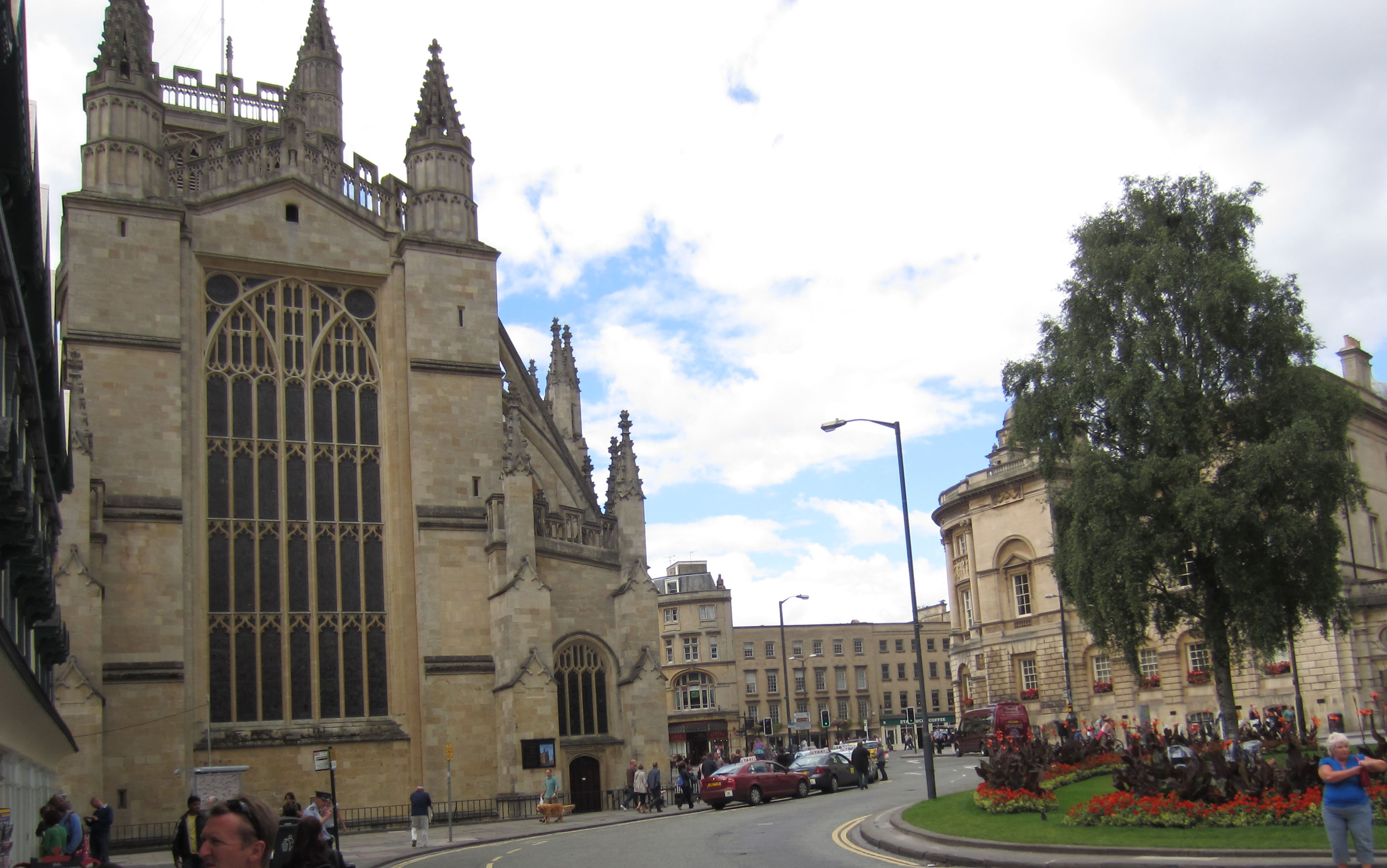
Our endpoint at Bath Abbey.

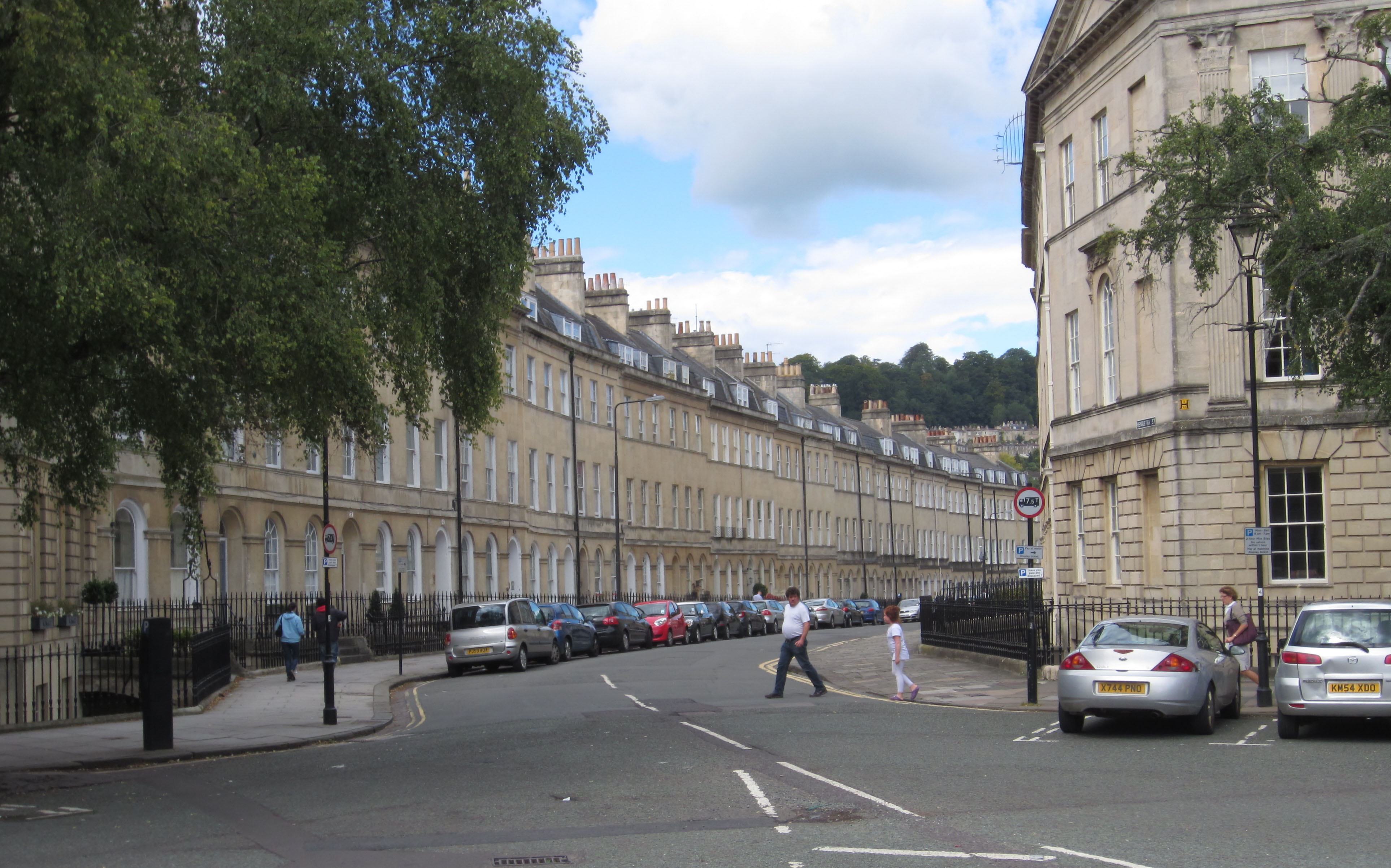
Streetscape in Bath. Our hotel was in the row of buildings on the left.

At 4.00 pm we were standing in the streets of Bath looking up at the soft grey stonework of its Regency buildings. We gave Bath Abbey – the official endpoint of the Cotswold Way – a quick salute and hurried to our accommodation in the comfort of the small Kennard Hotel. Since July 14th – a period of six weeks – we had walked the Camino’s Via Portugues, the Cumbria Way and the Cotswold Way, a total of 500 kilometres.

It was time to kick off our boots and relax.

Taking in the sights of Bath: the ancient Roman baths.

[Next up: My ranking of fish-and-chip meals in England]

The Soggy Chip awards for bad food (appeal pending)

Welcome to the Soggy Chip awards for bad food (known as “The Soggies”). This famous award is for dodgy food served to famished Australian walkers in restaurants and pubs across the UK. There were many nominations and the judges have had great difficulty narrowing them down to a short list, but after intensive discussion and very scientific scrutiny they have arrived at three outstanding nominations.

Griddle-cooked pancakes with bacon and (in jug at top right) sweet maple sauce.

1. Griddle-cooked pancakes with bacon and sweet maple syrup, The Pancake Place, Dumfries (Scotland).

When the judges saw this dish advertised in the window of a restaurant they were incredulous. Could it really be true that bacon was being eaten with sweet maple syrup? Sadly, it was true. The dish consisted of three big griddle-cooked pancakes (known locally as pikelets) interleaved with greasy rashers of bacon. A jug of very sweet, very dark maple syrup was also supplied to be tipped generously over the hot bacon and pancakes. The syrup came with two small packets of butter, though it was unclear whether the butter was to be added to the syrup or spread on the bacon.

‚

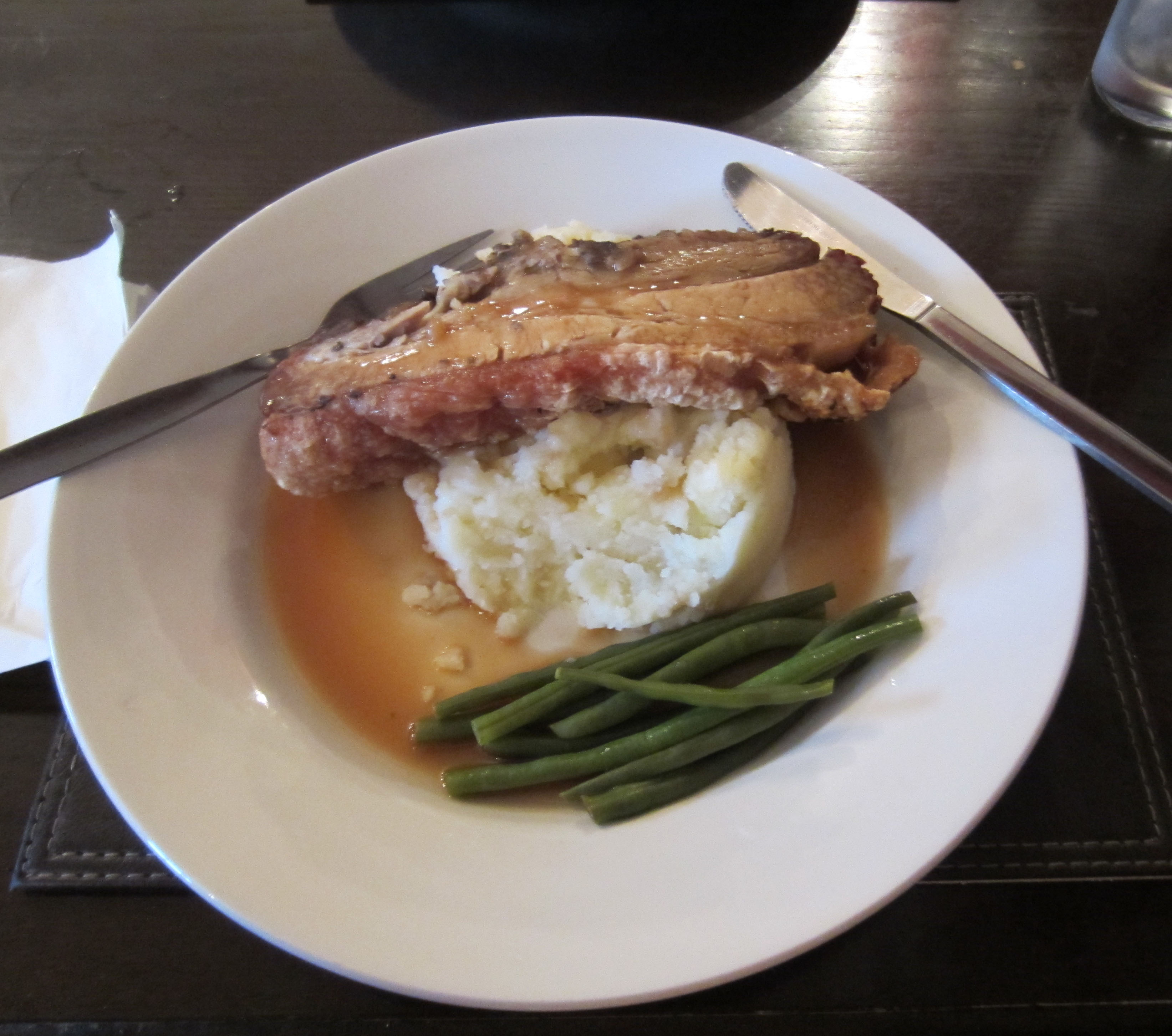
Aromatic belly pork on a bed of mashed potato.

2. Belly pork on a bed of mashed potato, The Crown Inn, Coniston (Cumbria).

The thick slice of belly pork was intimidating. It consisted of extremely salty, rock-hard crackle, and several layers of glistening pork meat cooked to varying levels of done-ness. The meat lay across a mound of mashed spud next to half a dozen well-boiled but very emaciated runner beans. A thin gravy had been found somewhere and splashed over the plate. A unique feature of the dish was the farmyard smell of the pork… a whiff of… what could it be? Fodder pellets? Diesel? Dung?

Traditional roast dinner with (top) Yorkshire pudding.

3. Traditional roast beef dinner with Yorkshire pudding, The Oddfellows Arms, Caldbeck (Cumbria)

According to the menu the roast beef came from prime Cumbrian cattle. This may well have been the case but it was referring to a cow that lived several decades ago. The meat was not tender but crumbly. It disintegrated when the fork touched it and the fragments had to be scooped up with a teaspoon. The Yorkshire pudding was in fact a deep frozen pastry shell in disguise. It was rubbery and very resistant to the sawing motions of a knife. The roast potatoes were fine, and so were the boiled potatoes provided one overlooked the raw interior of the potato. There were no greens.

And the winner is…

… the belly pork on a bed of mashed potato. An unforgettable meal, the aroma of which clung to one’s clothes for several days afterwards.

And now for the special awards…

 Dodgy beverage service. A special Soggy Chip award goes to the Maharaja Indian Restaurant at the Volunteer Inn in Chipping Campden for its failure to satisfactorily serve a cup of tea. Chief Soggy Chip judge George Quinn reports:

The dining room at the Volunteer Inn lies right behind the front bar. In fact you can look from the dining room over a counter, through an archway, past shelves crammed with bottles, into the bar. In the morning the room serves as the Inn’s breakfast room. In the evening it becomes the Maharaja Indian Restaurant, operated by a small squad of stony-faced Indians who put long-stemmed glasses on the tables and carefully guard a small hoard of laminated menus stacked on a sideboard.

Emmy and I are fond of Indian food so we were looking forward to our meal on the evening of August 16th. Behind the counter one of the staff busied himself with administrative matters, frowning over bills and receipts, jabbing at a calculator, making entries in a ledger, and occasionally taking phone calls. His associate took orders from diners and served the food. He also steered carefully between the bar and the dining room carrying bottles of wine and glasses of cider. Neither of the staff cracked a smile. Not once.

I ordered a hybrid Euro-Indian dish: curried lamb shanks.

“And to drink, sir?”

“Just tea, thanks.”

There was a long moment of stunned silence. Then an incredulous squeak.

“Tea?”

“Yes, tea.”

“You mean, black tea?”

“Yes please, black tea.”

Ten minutes later (I’m not exaggerating the time lapse here) a single cup of tea arrived. It was about two thirds full of water with a tea bag drifting in it. After I fished out the tea bag the water level dropped to less than half a cup. At a neighbouring table wine gushed from bottles and cider twinkled in huge glasses.

The dish of curried lamb shanks was tasty, but its gastronomic appeal was marred by the £1.80 (about $3.00 Australian) I had to fork out for a tea bag and half a cup of warm water.

‚ Dodgy hygiene in the dining room. A special Soggy Chip award goes to the Travellers Rest Restaurant in Talybont-on-Usk (Wales) for its failure to protect diners from the restaurant’s cats. Chief Soggy Chip judge George Quinn reports:

When we were shown to our room at The Travellers Rest – a B&B cum restaurant in the hamlet of Talybont-on-Usk – a black cat was curled up snoozing on the only chair.

“It’s his favourite place,” said our hostess giving him an indulgent pat. So we didn’t disturb him. We made ourselves as comfortable as we could sitting side-by-side on the bed. We learned that in total three cats lived permanently at The Travellers Rest. Their names were Maddie, Zuki and Quinn. Yes, I’m afraid so… Quinn, named, I believe, after Dr Quinn Medicine Woman, an American TV show.

All three cats appeared in the dining room that evening. They stalked the floor for a while, sharpening their claws on the rough wooden pillar that supported a ceiling beam in the middle of the room before disappearing out the back in the direction of the kitchen. They appeared again the following morning as we were having breakfast. I was about to put a fatty piece of sausage into my mouth when there was a sharp shout:

“Quinn! Stop it!”

I quickly lowered my fork and looked around. Two cats were facing each other on the dining room floor, growling and swishing their tails. Our hostess was looking at them fondly.

“They’re always irritable in the morning before they’ve had breakfast.”

Later there was the sound of loud hawking and retching. One of the cats coughed up a furball on the dining room floor. The front door was propped open to clear the sour odour and a clammy hand of morning chill reached in to touch us on the neck as we ate.

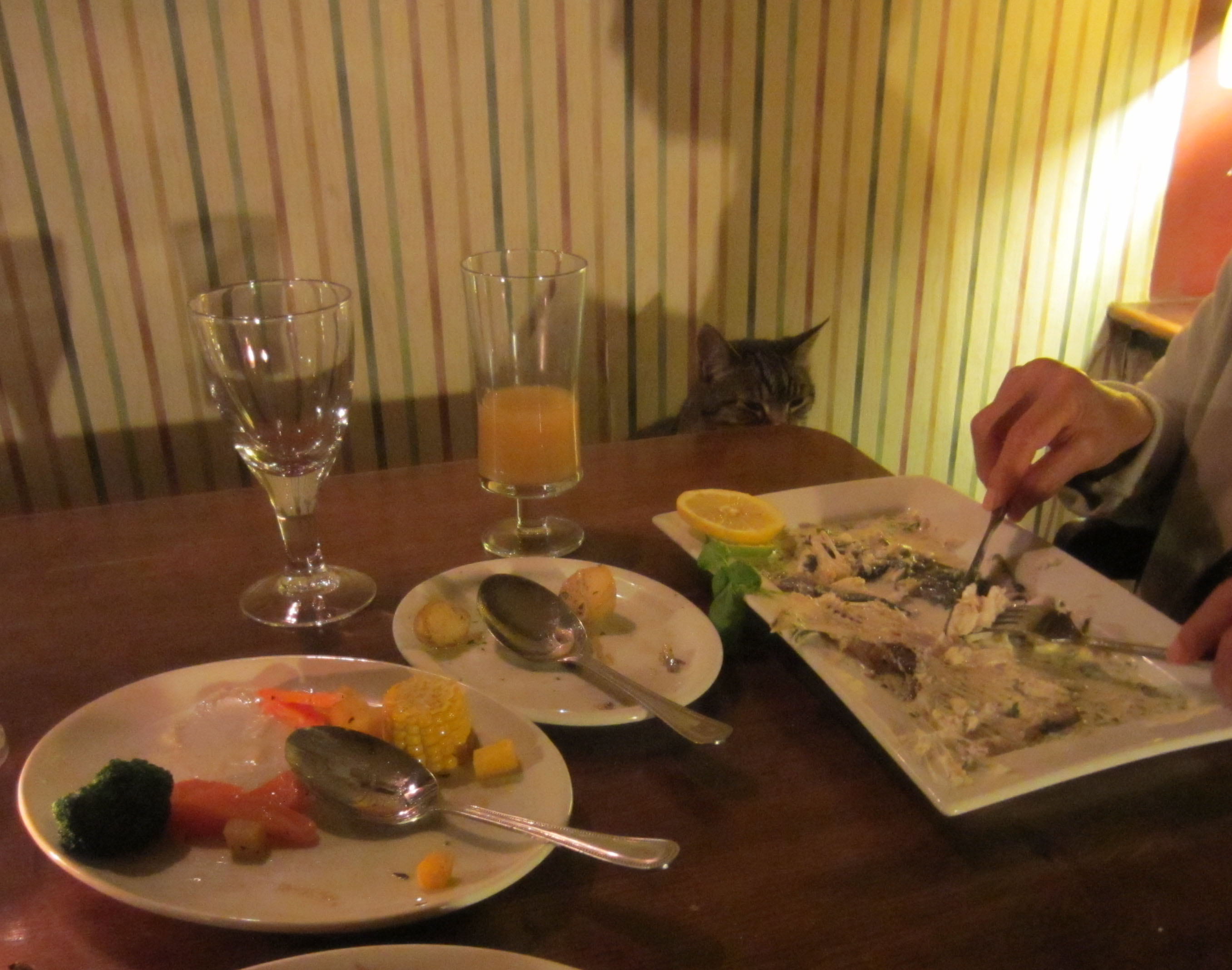
A hungry cat joins us for dinner in the Travellers Rest Restaurant.

That evening, as we enjoyed an excellent dinner of lamb cutlets with Welsh leeks, the cats again joined us. There was a scrabbling and hissing under the table as they fought for position. The winner seized the right to sit on a chair and peer up over the edge of the table. Its head nodded up and down as it followed the transfer of lamb cutlet from plate to mouth. When dessert arrived the cats disappeared.

“They’re not really interested in sugary food,” our hostess explained.

STOP PRESS! Appeal against Soggy Chip award

The organisers of the world famous Soggy Chip awards have received an appeal against their decision to award a Soggy to Coniston’s “belly pork on a bed of mashed potato”. It has come to their attention that the chief judge actually enjoyed the meal. He was observed crunching through the crackle with special relish. Apparently he was considering ordering a second helping. The plaintifs are arguing that enjoyment of a meal disqualifies it from a Soggy award. The organisers of the award are in a panic. They have now found out that the chief judge actually enjoyed all the nominated meals (including – perhaps especially – the griddle-cooked pancakes with bacon and maple sauce). A decision on the appeal is pending. The awards are in disarray.

[Next up: Encounters with animals and wildflowers along the Cotswold Way.]

Of hymns and history and dogs: The first half of the Cotswold Way

The Cotswold Way is a long distance walk running for around 170 km through southwest England from Chipping Campden at its northern end to Bath in the south. Most of the walk lies within the county of Gloucestershire. Emmy and I completed it in nine days, each one-day stage averaging around 20 km in length, with a one-day rest in Painswick halfway along the trail.

The main street of Broadway, half a day into the Cotswold Way walk.

The Cotswold Way is not a difficult walk. There are no mountains or stretches of wilderness, and only a small part of it piggy-backs on highways or runs through urban areas. Most of the terrain is undulating countryside. There are several long steep climbs that will get you puffing hard, and because you walk five or six hours a day it demands a reasonable level of fitness. It is well way-marked but it is nevertheless possible to lose your bearings, as we did a couple of times. A good map and guidebook – better still, a GPS device – are essential. Some parts of the walk run through areas that are about as distant from services as it is possible to get in densely populated England, yet every night we slept comfortably in small guest houses or B&Bs and we ate well, mostly in village pubs. We used Macs Adventure, a Glasgow based company (http://www.macsadventure.com/cotswold-way/overview.php), to arrange our accommodation and transport our heavy luggage from stopping-point to stopping-point. They did an excellent job.

The Cotswold Way is no ordinary walk. It is more like a hymn sung by the feet in the great cathedral of the English countryside. This metaphor is way way over-the-top, I know, but in the after-glow of completing the walk, I like it. The contours of the hills, the rise and fall of the path, the beat of hedgerows, gates and farmsteads, the refrain of stone villages, and above all the grand melodic sweep of the panoramas, all come together in a beautiful fugue that commands the walker to join in. Like a musical composition, the Cotswold Way is wholly artificial and mannered. Its pastures and hedgerows, its cobbled villages, its stone towns sliced by narrow streets, even its woodlands and streams – everything is man-made. Centuries of cultivation have stamped and moulded every hedgerow, every copse has been manicured to its present shape, every meadow laid down by human hand. Every wall, no matter how mossy and “natural”, has been assembled stone by stone, every building has been cut and crafted and re-crafted often over many generations.

A typical rural panorama along the Cotswold Way.

Postlip Hall, a rural mansion near Winchcombe.

Walking through woodland.

In short, on the Cotswold Way you will not be alone. When you walk it you join an invisible crowd. Like a stadium or cathedral, the Cotswolds are a giant, echoing amphitheatre whose seats are filled with the ghosts of countless human lives. You walk as an act of homage. Each day your steps sing a quiet day-long paean of admiration and gratitude to those who made the spectacular beauty you can now enjoy.

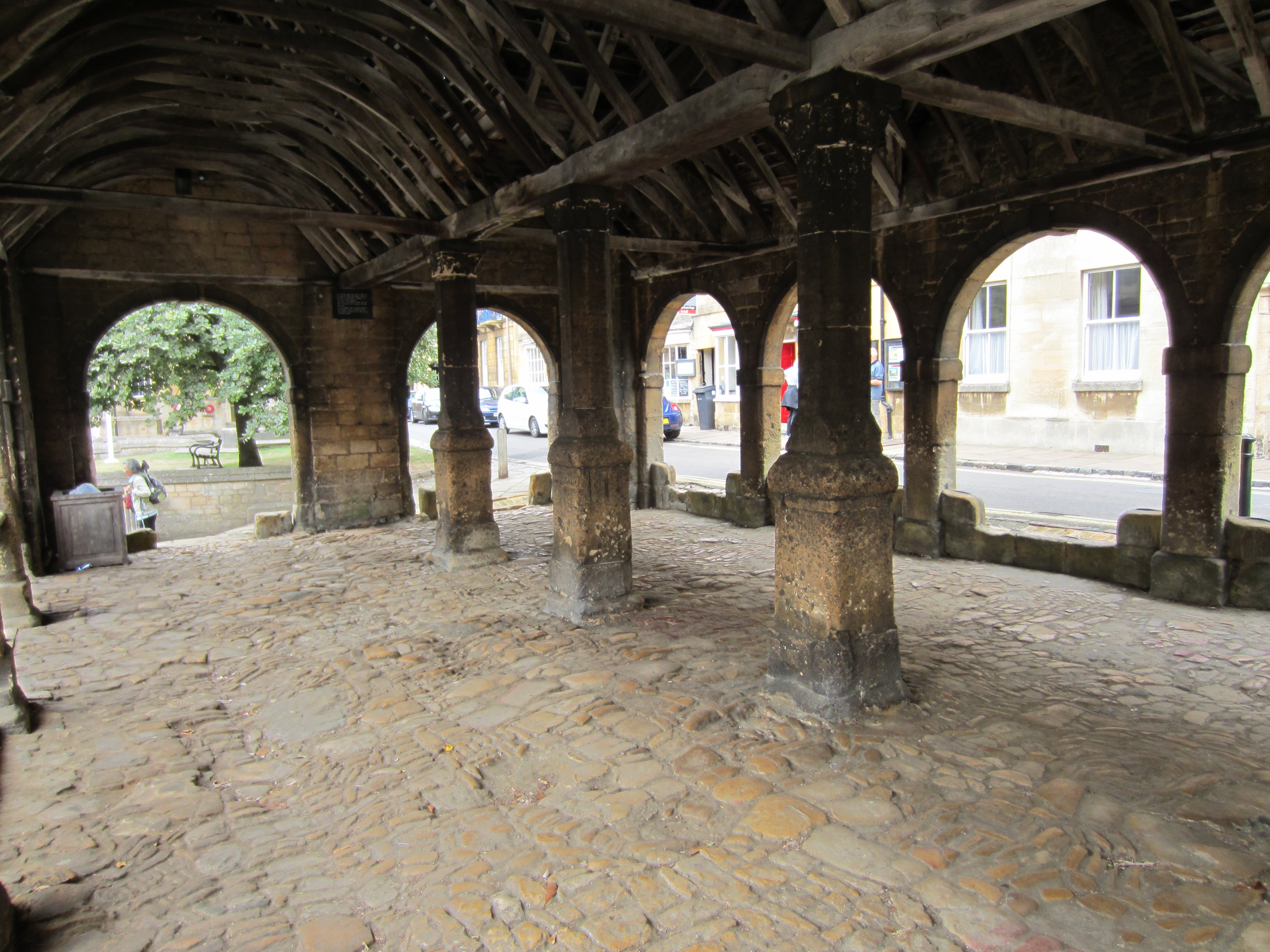
Chipping Campden’s old livestock market. Its rough floor still smells of sheep and cows.

If you are walking from north to south (it is equally possible to walk the Cotswold Way from south to north) you start in the old livestock market in the centre of Chipping Campden. Peering out past the building’s columns and arches you take in the remarkable kilometre-long double rank of honey-coloured stone houses that line the main street. They haven’t changed much in the centuries since they were built. Even the roughly cobbled floor of the market building is still exactly as it was 200 years ago. In fact, although the livestock market has not been used as a market for at least a century, if you kneel down (as I did to take a photograph) you inhale the faint acrid odour of animal urine and dung still sweating from the stones. To me, it felt like Thomas Hardy’s home ground, where (in my mind’s eye) Michael Henchard, the mayor of Casterbridge, might once have cut deals in corn and hay and sheep.

The remarkable main street of Chipping Campden.

It was the production and export of wool in the 17th and 18th centuries that created Chipping Campden’s prosperity. When that trade declined in the 19thcentury it froze the town, and other nearby towns, in the time capsule that we see today. History ambushes you at every stage of the walk, from Belas Knap prehistoric burial mound, to the extravagances of Regency architecture (1790 – 1830), to aristocratic follies like Broadway Tower (1799), to the lonely memorial that commemorates the life of William Tynedale (1494-1536), the brave man who first translated substantial portions of the Bible into English for the general public, and whom a grateful and merciful Church executed by strangulation and burning at the stake. Gloucestershire was a major theatre of combat during the first English Civil War (1642 – 1646) changing hands several times. In Chipping Campden a large manor house abandonned by a royalist supporter still stands derelict 350 years after it was scuttled by its owner. Further south the walk passes across the quiet fields of Lansdown where a bloody but inconclusive battle was fought between royalist and parliamentarian forces in 1643.

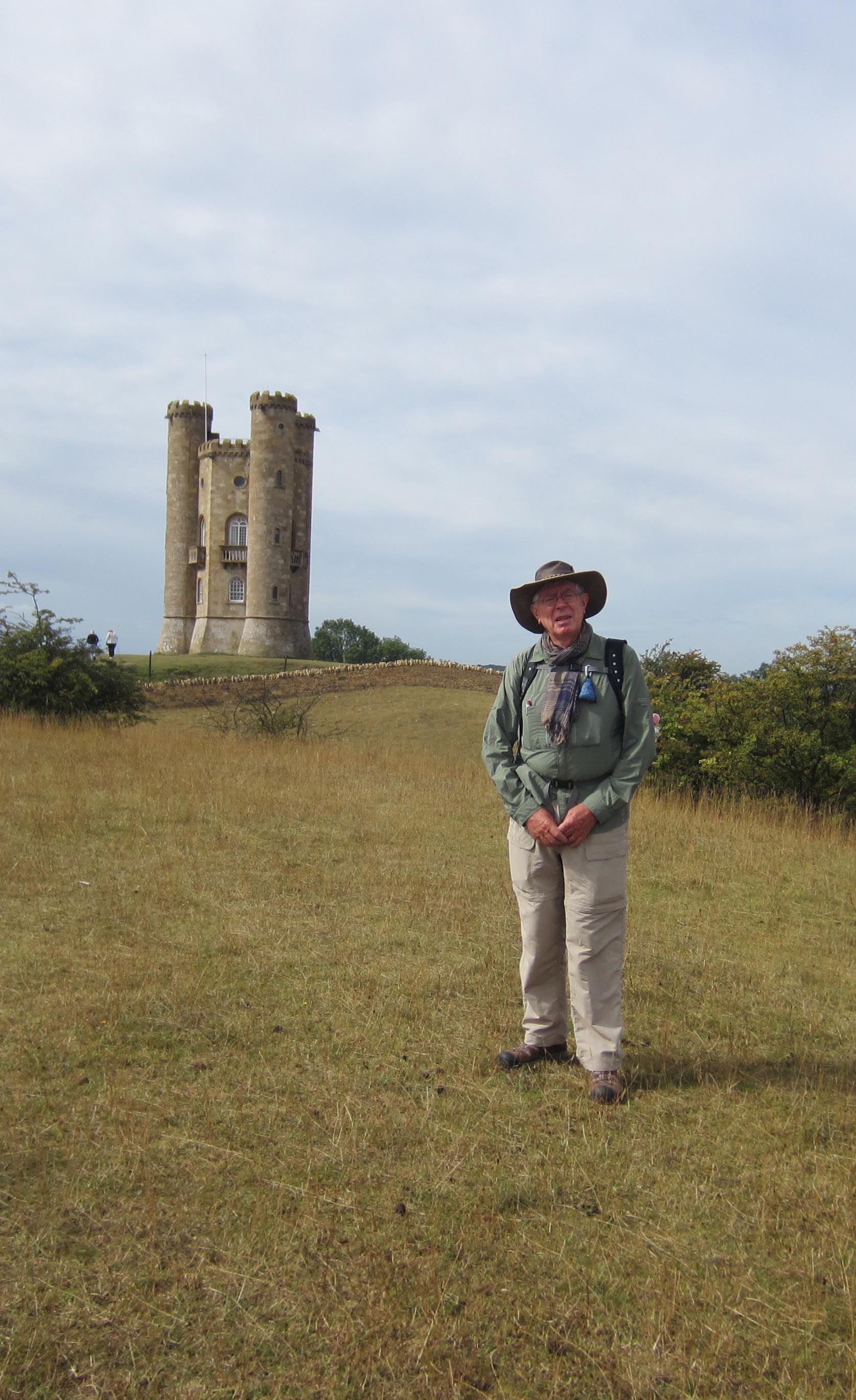
Broadway Tower, built for no special reason by a dotty aristocrat. Today it is a tourist attraction and a welcome stopping point for tired walkers.

Emmy and I headed out of Chipping Campden on the fresh, warm morning of August 17th. The first day gave us a synopsis of the route to come: pasture, wooded hills, hedgerows, gates, and vast, faintly whispering vistas of England’s park-like countryside. It was a world of green, punctuated by villages and small towns clustered around church spires, their glowing stone houses embedded in bright flowers. We stopped for a lunch of pumpkin soup and scones in a traditional tearoom in the town of Broadway and we slept a peaceful night in the wonderfully welcoming Shenberrow Hill B&B under huge trees in the picturesque stillness of Stanton village.

A house in the village of Stanton. Thatched roofs are becoming rare, but the honey-coloured stone is the most common building material in this part of the Cotswolds.

The following two days took us along the escarpment that skirts the eastern extremities of Cheltenham, a major city that we could see laid out below us in the distance. Here, on a Saturday morning, we had to wade into a strong current of dogs. On day-release from high-walled back yards and dark cells in their city apartments, they had dragged their owners up the escarpment and on to the Cotswold Way. Tiny hair balls on four legs yipped along beside drooling monsters with flapping jowls and turkey necks. The dogs washed around us with remarkable politeness. We met two young women surrounded by a slobbering, panting mini-tribe.

“You are out walking nine dogs?”

“Yes. My friend has four dogs and I have five.”

“I can see only eight.”

“Oh, it’s Madge. She got left behind again. Madge! MADGE!!”

Special bins for the disposal of dog poo. Notice… not one bin, but three. How many dogs does it take to fill three bins with poo? Go figure.

Madge – a yellow, long haired labrador – slunk guiltily out of the bushes and headed for what looked like a row of three rubbish bins. We had seen these at several points along the Cotswold Way. They were special receptacles for dog waste. Madge started pawing the grass beside them. Her owner produced a plastic supermarket bag and waited fondly as Madge revolved in circles sniffing the ground.

“Good GIRL Madge! See… she knows where to go when she has to go. She’s such a well-mannered dog.”

She was indeed a very well-mannered dog. For the most part, the English have taught their dogs to be as polite and ordered and friendly as the human population is. But always, in one way or another, the essential dogness of dogs will overrule efforts to fully humanise their behaviour.

When we arrived at our B&B accommodation in Painswick – an atmospheric and comfortably lived-in 17th century townhouse – we found two large dogs stalking the stone floors. They were short hair, blue-grey dogs, thin, gaunt and perfectly polite. Their main interest in life was scheming to get out of the house. As soon as they realised we could not help them they stopped trying to ingratiate themselves with us and disapppeared.

The next morning as we sat down to breakfast our hostess was apologetic.

“I’m so sorry,” she said, “I had some beautiful local cheese for you but I put it on the kitchen window sill. The window was open and the dogs were in the back yard. They grabbed the cheese and ate it.”

The two dogs were sitting by the front door hoping their crime would get them expelled from the house. Our hostess called to her daughter.

“Would you take the dogs out for a walk, darling?”

Instantly the two dogs thumped their tails on the floor. Success!

Just south of Painswick we reach the Cotswold Way’s halfway point, 55 miles or 88 km into the walk.

[Next up: The “Soggy Chip” award for bad food, and Quinn’s report card on English fish and chips.]