Footsore in Carlisle: We complete the Cumbria Way

Keswick (pronounced “kezzick”) must surely be the walking capital of the world. As you pass through the old, cobbled market place in the centre of town, you float in a current of people wearing boots, stooping under backpacks and brandishing hi-tech walking poles. They sit sipping coffee in cafés, they huddle around maps, they stand in queues at the bus terminal.

The centre of Keswick in mid summer. Note the two walkers right of centre.

They also ebb and flow through the town’s innumerable outdoors shops. Keswick is a small town but it must have more outdoors shops than any comparable place in the world. Mountain Warehouse, George Fisher, Ultimate Outdoors, Rathbones, Sports Temple… they jostle along the main street and squeeze into side alleys.

At this time of year business is booming. At 10.30 am on the morning of Sunday August 7th – yes, Sunday – a crowd of around 20 people were standing outside the front door of George Fisher’s (“The UK’s best outdoors store”) waiting for it to open. I know because I was one of them. I was on the hunt for a new pair of hiking socks, snared by the headline “The Joy of Socks” in the shop’s newsletter. On the opposite side of the street the bell of the old Anglican Church clanged in forlorn entreaty as a few elderly parishioners toiled up the steps for the morning service.
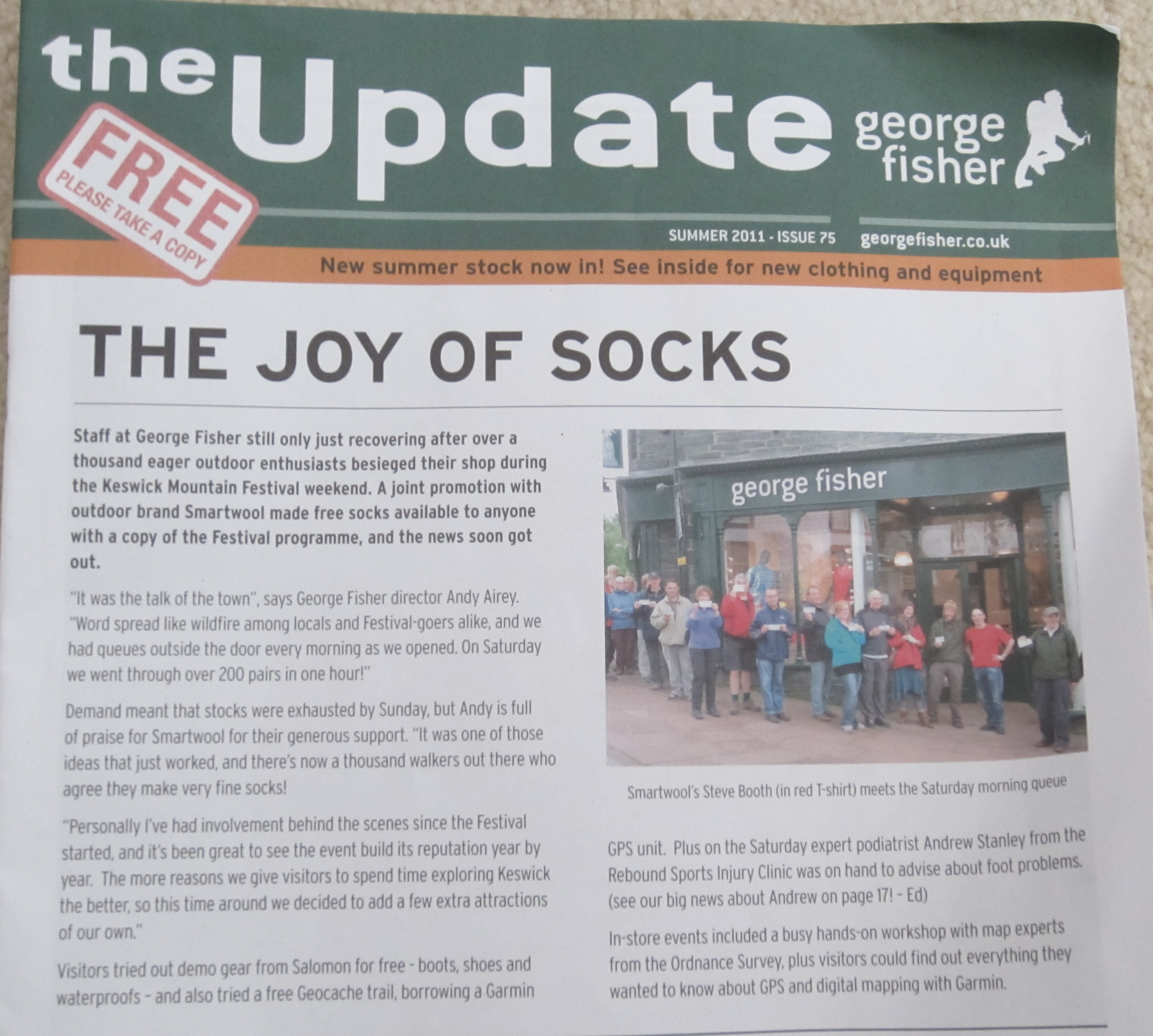
The irresistable page 1 story in an advertising newsletter of the George Fisher outdoors shop in Keswick.

Keswick must also be the B-and-B capital of the UK. In most of the streets around the town centre every second house – almost literally – seems to be a bed-and-breakfast establishment, or a guest house, or a small hotel. As Emmy and I walked to our accommodation at the Latrigg Guest House we noticed only one or two “Vacancies” signs in the streetside bay windows. Mostly it was “No Vacancies”.

In times past Keswick used to be famous as the pencil manufacturing capital of the world. There were abundant supplies of plumbago lead and wood in the surrounding hills. Today this industry has virtually disappeared leaving behind a lonely and slightly desperate Pencil Museum paddling hard against the tsunami of modern communications technology.

“Be amazed at the world’s longest colour pencil, marvel at the James Bond style World War II pencil, follow the history of pencil making, find out exactly how we get lead into a pencil…”

We had scheduled a rest day in Keswick and we decided to fill it with a bus trip to nearby Grasmere. At the bus terminal I bent to peer at a timetable on the pole of a bus stop. An intense voice spoke into my ear.

“There’s a queue ’ere, y’know.”

I straightened and saw beside me a smallish woman, about 40 years old with short blond hair, a pale complexion and pinched, lined features. I apologised and moved to the other side of the woman standing beside her.
“It makes me so ANGRY,” she said to no-one in particular. “Why do people INSIST on queuing to the right when they should queue to the left.”
I made myself as inconspicuous as possible on the left hand side.
“And another thing that makes me REALLY angry,” she said working the muscles of her jaw, “it’s people who get on the bus and put their bags on empty seats. I mean… they are paying for one seat, aren’t they!? They’ve got no right to fill up the other seats!”

The bus, a double-decker, lumbered into sight. The woman pulled her lips inside her mouth, clenched her fists, and stomped aboard. I saw her again sitting in the front seat on the top deck of the bus. An American couple – both walkers – were sitting across the aisle. They had placed their backpacks on the seat behind them. Emmy and I took the seat behind the backpacks. The angry woman half rose in her seat, turned and looked fiercely at me, jabbing her forefinger in the direction of the backpacks. When I failed to respond with anything better than a smile, she snapped around and sat glaring out the front window, her body clenched rigid. Angry.

Lush summer growth on roadside trees scratched the bus as it wriggled along the country road. In the impossibly picturesque village of Grasmere we sought out Dove Cottage, one of the iconic attractions of the region where William Wordsworth – poet and long-distance walker – lived for some twelve years. We took a guided tour through the cottage and were joined by visitors from Africa, India, Germany and China (one or two Britons too, not to mention Emmy from Indonesia). Our group bore witness to the impact that the study of English and English Literature has had in even the remotest corners of the globe. In Trivandrum, Bulawayo, Kowloon, Hamburg and Salatiga generations of students have bent over their textbooks and dutifully intoned the lines:

I wandered lonely as a cloud
That floats on high o’er vales and hills
When all at once I saw a crowd
A host of golden daffodils.

Just between you and me, dear reader, (I have to whisper here) this is pretty undistinguished poetry. But the “golden daffodils” industry will not brook any quibbling about aesthetics. There is an image to be promoted and money to be made.

The transformation of William Wordsworth

The gift shop at Dove Cottage was stuffed with tea towels, fridge magnets, special editions of the poet’s works, thimbles (thimbles? …for thimble collectors, of course), mugs, umbrellas, stickers, illuminated pictures, soap, CDs, tea cups, vases, coasters, place mats, postcards, key rings, note books, sachets of perfume, aprons, oven mitts, tea pot cosies, pot holders, book marks, pen and pencil sets, condoms (sorry… cross out that last item), all with golden daffodil motifs. Daffodils have become a mythologised tag super-glued to the name of Wordsworth.

But despite my ungenerous thoughts about daffodils, I did enjoy the visit to Dove Cottage. The cramped rooms with their low ceilings, rough wooden beams, dark wainscoting and small windows have been carefully preserved more-or-less as they were 200 years ago. The floorboards creak as they did 200 years ago, an ancient clock ticks loudly and chimes as it did 200 years ago, the garden still produces vegetables as it did 200 years ago. The house is still “alive” despite falling into the hands of conservationists.

We returned to Keswick refreshed and looking forward to the challenge of the next day’s walk. But when we awoke at six o’clock the following morning a strange darkness filled our room and there was a scratching noise at the window. I pulled aside the curtains. Heavy rain was washing over the stone houses of Keswick. Visibility was down to 100 metres. The temperature was 14 degrees and struggling to get higher.

Emmy and I looked at each other and experienced one of those all-too-rare moments in a marriage when there is instant silent understanding and instant silent agreement. We would not be walking over the lunar scrabble of High Pike (658 metres) that day, or any other day.
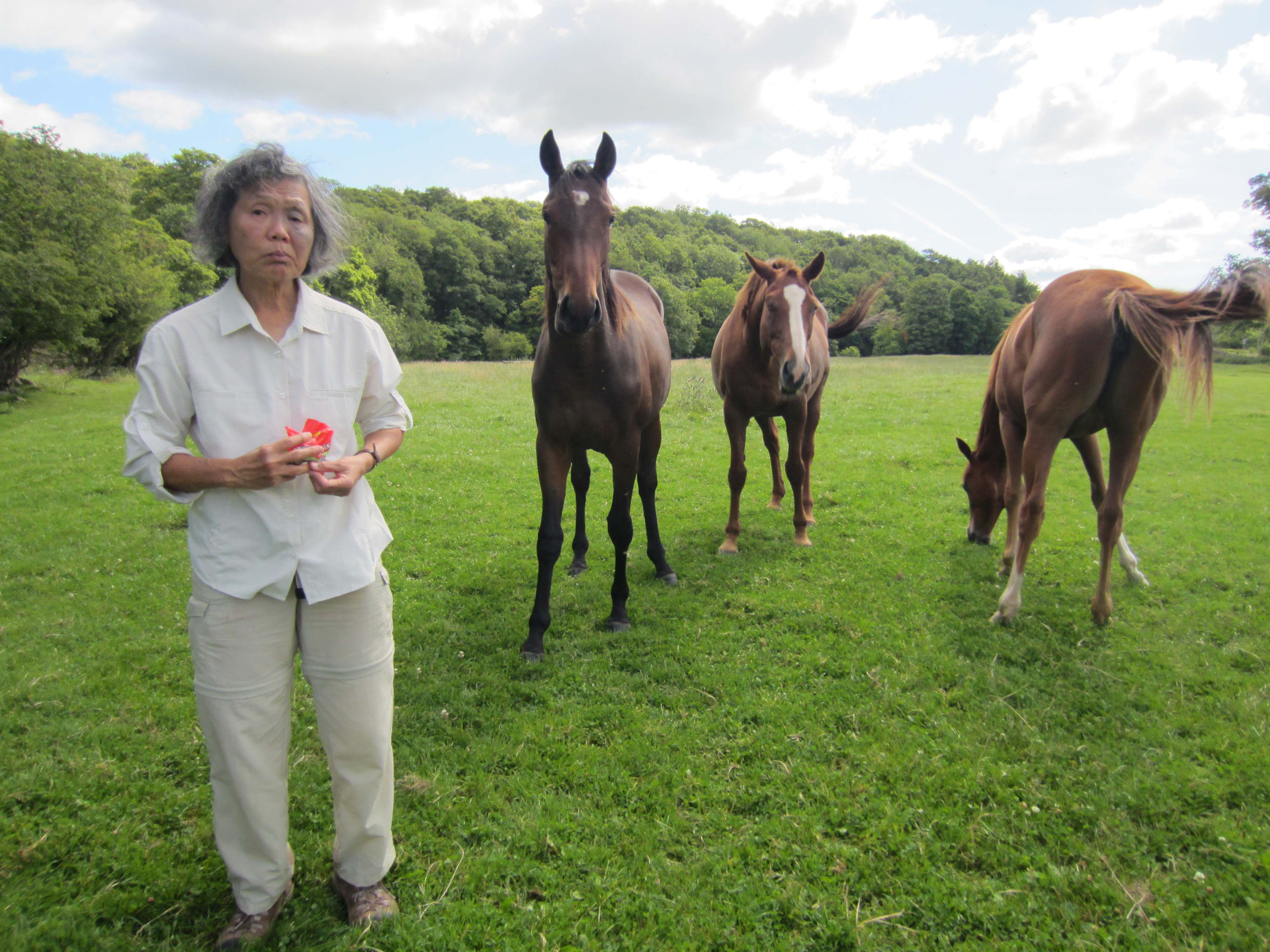
Curious horses interrupt Emmy as she takes a break on the walk to Carlisle.

For us, the last leg of the Cumbria Way began the next day in the hamlet of Caldbeck, a taxi ride past High Pike. The weather was clear and warm, but the path sodden and slippery with rainwater from the previous day. In places it was ankle-deep in mud. We pressed on through sparkling woods and fields, shooing away curious horses and leaning aside to avoid drenching ourselves in the dew of tall purple wildflowers. A grey heron-like bird jumped from a stream and flapped slowly into the long grass of a neighbouring field. Rabbits and squirrels played across our path.

The muddy path left behind by the previous day’s heavy rain.

Mid afternoon the outer ranks of Carlisle’s estate houses came into view and, with 23 kilometres behind us for the day, we walked into town past the low grey walls of Carlisle Castle. We had done it! We had walked the Cumbria Way (well… most of it).
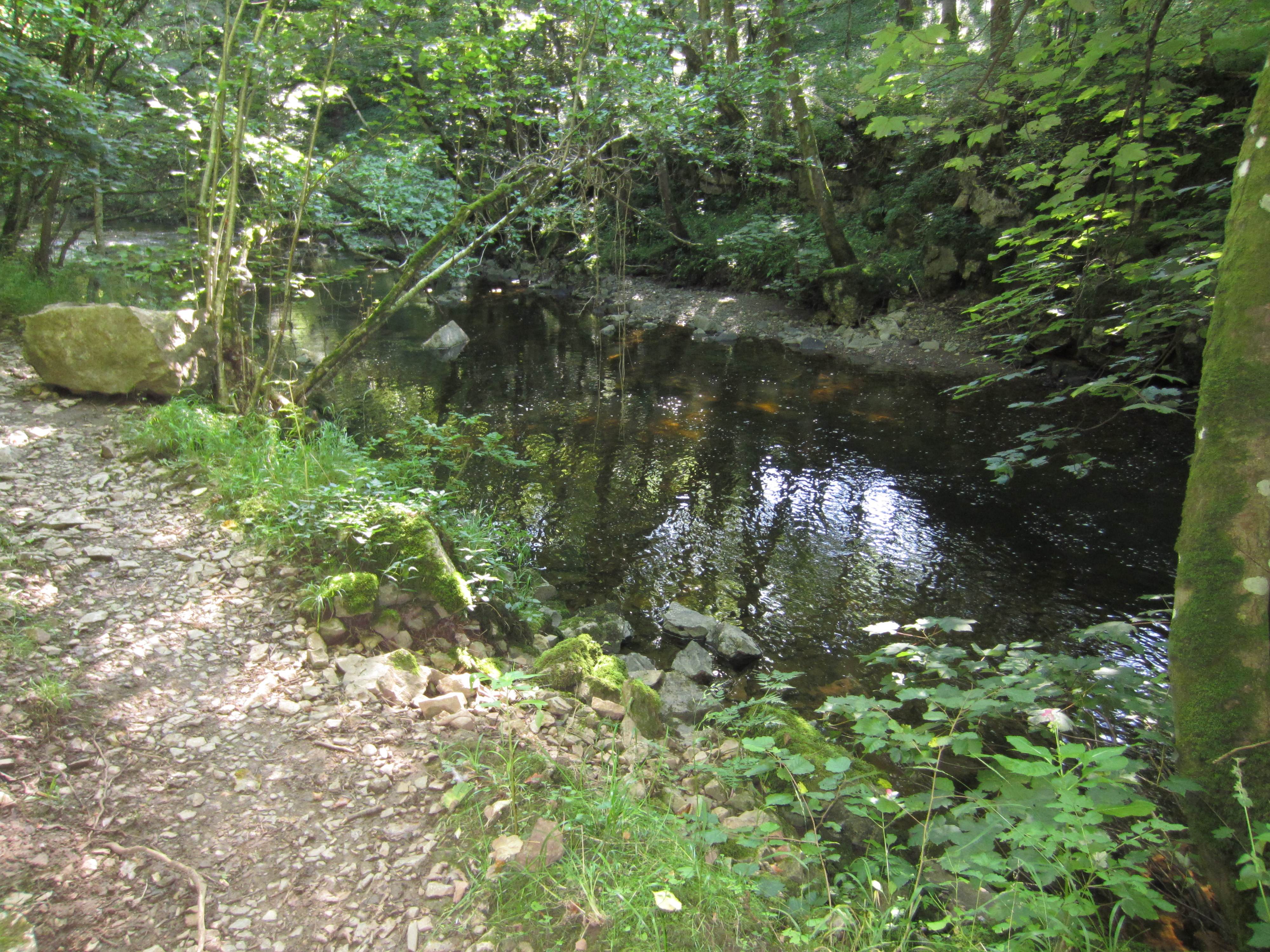
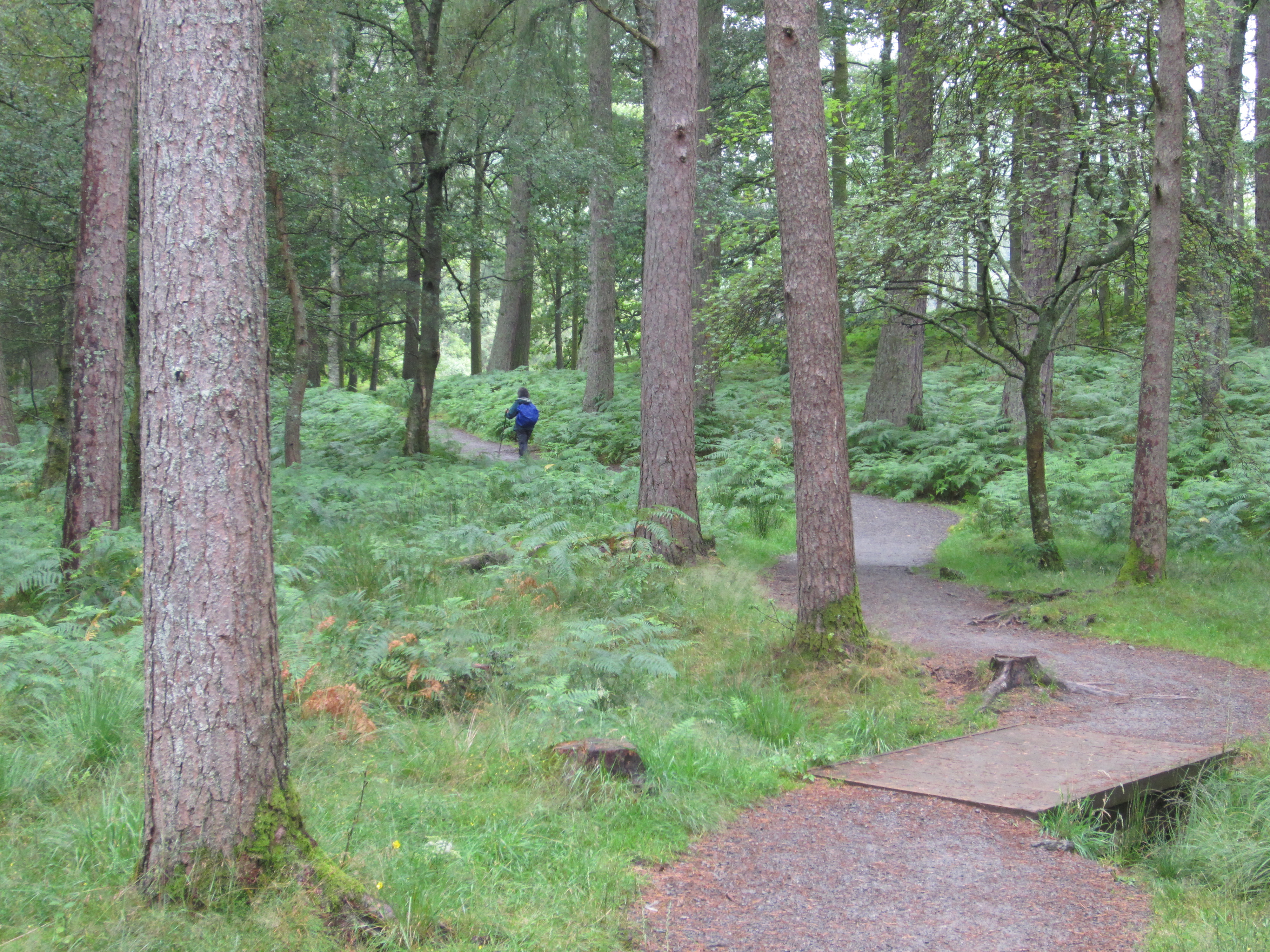
Woods and water along the Cumbria Way north of Caldbeck

Our accommodation was at the Langleigh Guest House. Footsore and exhausted we tapped at the front door. There was no response, but a note stuck to the door said “If nobody is at home go four doors down the street to the Derwentlea Guest House.” Tip-toeing on my burning feet I went to the Derwentlea Guest House and rang the doorbell. No response, but a note stuck to the door said “If nobody is at home go four doors down the street to the Langleigh Guest House.”

Back at the Langleigh Guest House I noticed a button hidden in the ivy beside the door. I pressed it. It triggered a frenzied outbreak of barking inside the house. The door opened and a middle-aged gentleman appeared momentarily before being knocked aside by two knee-high spaniel dogs.

“I hope you’re all right with dogs,” he said cheerily, trying to stay on his feet while the dogs hammered at his legs.
“No problem at all.” I had a sudden memory of the delicious meal of dog-meat gulai stew I had enjoyed in Solo, Central Java. “I just love dogs,” I said truthfully.
“Great. Let me introduce them. This is Daniel…. Daniel the spaniel, ha ha ha! And this is Jack… Jack the ripper – ha ha ha… he had a few behaviour problems when he was a puppy but we’ve managed to repair most of the damage.”
The two dogs sat on their haunches and looked up at their master with mournful spaniel eyes. They had heard these jokes before.

The following morning we went down to the breakfast room, weaving around the dogs as they raced up and down the stairs, sticking their heads through the banisters and yapping in our ears. In the breakfast room our host was clinging to the mantelpiece as he tried to keep our bacon and sausages away from the dogs.
“They’re such wonderful company, don’t you think?”
Under the table the dogs snuffled around our legs.
I looked up at our host. “In Australia,” I thought grimly, “you’d be sent to prison for this. And I for one would be happy to convict you.”

But I smiled back. “Yes, they are indeed wonderful company.”

[Written in Stratford-upon-Avon and Painswick. Next up: The Shakespeare Industry]
Coniston to Keswick: Scenic drama, beauty beyond description

Dr Fisher of Coniston is in fact two people, a husband and wife. According to the proprietor of the Lakelands Guest House, when you make an appointment to see “Dr Fisher” you never know which one you’re going to get.

I limped into Dr Fisher’s rooms on the morning of Thursday, August 5th to be greeted by the female partner, an attractive young lady who spoke English with a gentle German burr. She sat me down and lifted my bare feet on to a neighbouring chair. She examined each toe close-up, then checked the balls of my feet and the heels.
“Basically your feet are okay,” was her judgement. “There is no infection in your little toe.”
She recommended I buy gel-padded inner soles for my boots and she prescribed an ointment that would lessen the burning sensation in my feet and soften the skin. Then she spoke the words I had secretly been hoping to hear.
“Perhaps it might be a good idea if you gave your feet a rest for a day.”

The ointment was dispensed through a small pharmacy in the doctor’s reception area, and when I reached for my credit card I was halted by a vigorous shake of the head.
“No charge for the medicine.”
“Eh? What about the consultation?”
“No charge for that either. The UK has a reciprocal agreement with Australia. UK citizens in Australia get free treatment, so you get the same privileges here.”

I didn’t dare reveal the reality… that in Canberra no more than a handful of the hundreds of doctors and specialists in the city were prepared to provide free “bulk-billed” treatment. Whenever I visited my GP I had to pay the full cost of the consultation on the spot then claim a partial refund from a Medicare office. And free medicines in Australia? What a laugh!

Dazed at my unexpected escape from financial punishment I joined Emmy in the waiting room. I reported Dr Fisher’s advice, translating it into my own words.
“The doctor strictly forbids me from walking even one step today.”
Emmy struggled hard but unsuccessfully to paste a look of disappointment over her face. It was quickly decided… we would be heading for our next stopping point by taxi.

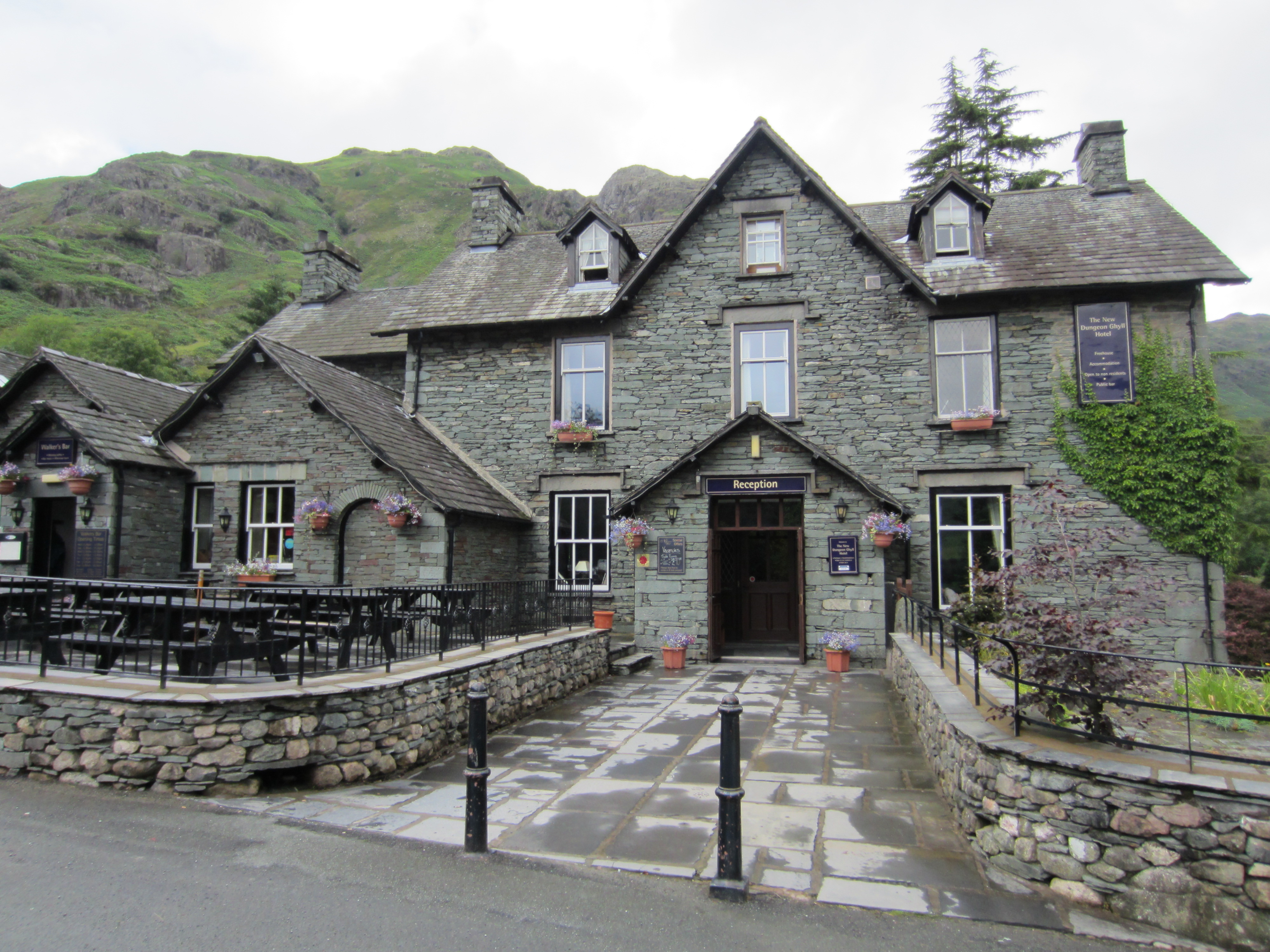
A haven for walkers: the New Dungeon Ghyll Hotel at the entrance to Langdale Valley

That is how, around 1.00 pm that day, after a comfortable taxi ride, we found ourselves sitting in the bar of the New Dungeon Ghyll Hotel enjoying a drink and smiling condescendingly at the stream of walkers who came stumbling through the door to slump over the bar and gasp for the consolation of alcohol.

The New Dungeon Ghyll Hotel stands in naked isolation at the entrance to the Langdale Valley, one of the iconic features of the Lake District National Park. The treeless sides of the valley form an enormous letter U with its upper points prised apart. Early the following morning we were walking strongly into the valley over a rough scree path, heading for what looked like a cul-de-sac at the far end. My feet were pain-free and I felt a sudden rush of enjoyment.

At the end of the valley we headed up a steep zig-zag path that cut through rough bracken. We made strenuous use of our walking poles and had to stop often to draw breath and drink. Looking behind us we saw a shining thread of water snaking away down the great moss-green trough of the valley. Hundreds of metres below, another group of walkers – as tiny as microbes – seemed frozen in the immense splendour of the landscape.

Looking south down Langdale Valley from the heights of its northern cul-de-sac

It was a struggle of more than an hour for us to cover the couple of kilometres up to Stake Pass, at 478 metres the high point of the path out of the valley. We were far above the tree line, even above the bracken. In the still, high, empty air we could hear the voices of other walkers coming towards us from a kilometre away. Only boulders and wiry grass covered the worn ridges around us.

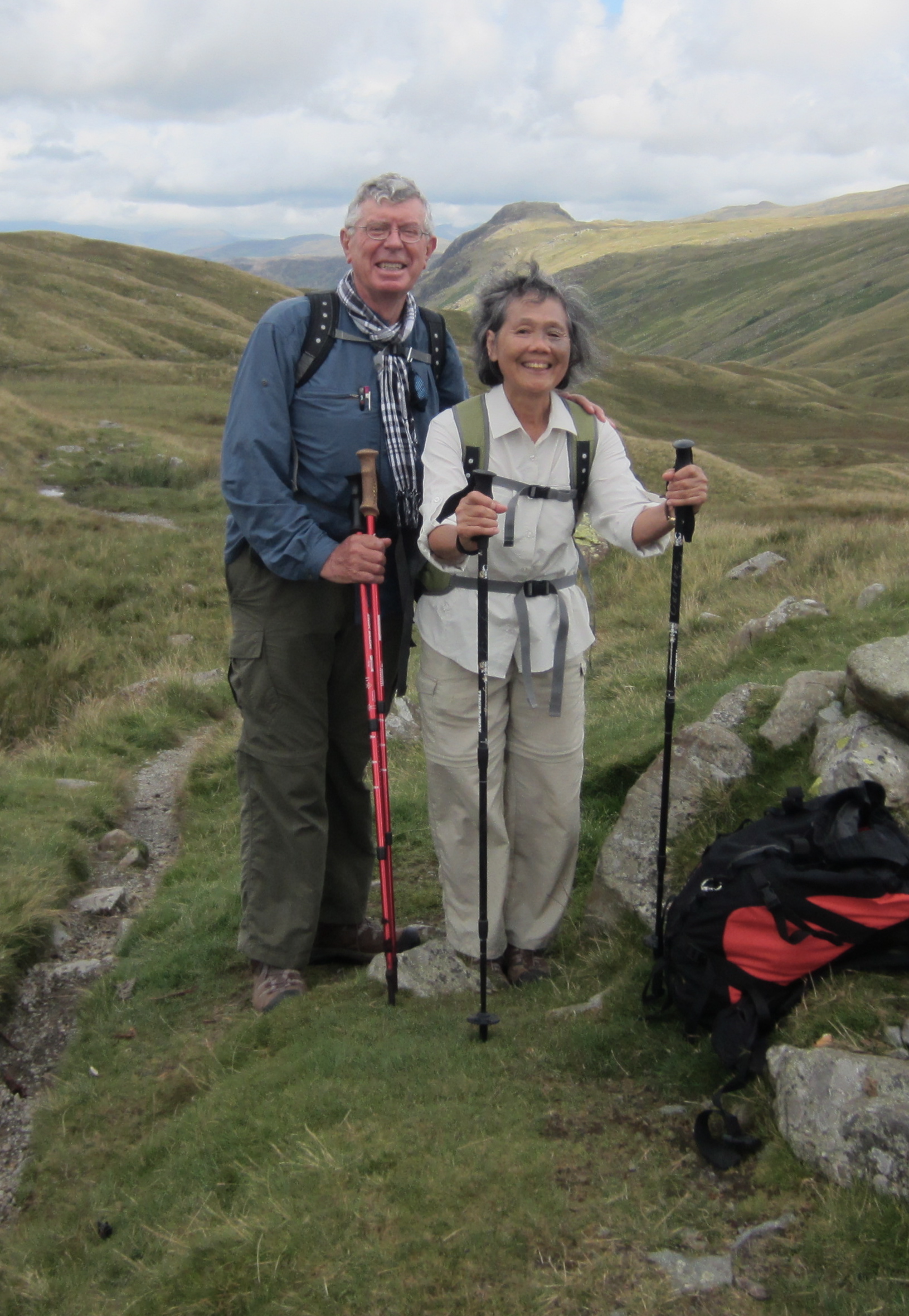
We conquer the heights of Stake Pass. Now for the descent…

Then we were moving precipitously downwards. We hobbled along a rough belt of loose rocks and stones. It fell away from us in a long series of hairpin bends. Again our walking poles were essential. With each downward step we tested the ground with our poles, braced ourselves against them and used them to maintain balance.

The zig-zag path down from Stake Pass

The path was, frankly, dangerous. One slip, one stumble, one moment of inattention and we might have been pitched down a slope that in a couple of places was close to vertical. A mountain stream roared and whispered beside us all the way down. Our eyes were focussed on the immediacy of the path but again and again we stopped to take in the splendour of the vista that stretched bare and wild down the new valley before us. In the floor of the valley we hobbled and clambered over kilometres of uneven, rocky pathway. Whenever we found a few metres of flat ground that we could traverse at normal gait we savoured it like a luxury. But it never lasted long.

The austere and beautiful drama of the day’s walk was still playing in our mind’s eye as we walked into the hamlet of Rosthwaite late that afternoon. Our accommodation was at the Royal Oak Hotel, a modest establishment run with the precision of a SWAT operation. When we checked in our hostess explained the rules.
“Breakfast is any time between 8.30 and 9.00 in the morning. Any time.”
“And dinner?”
“Dinner is at 7.00 pm sharp. Tonight we are having steak and mushroom pie.” She eyed us with a fierce frown. “Is that all right with you?”
“Excellent. Wonderful.”

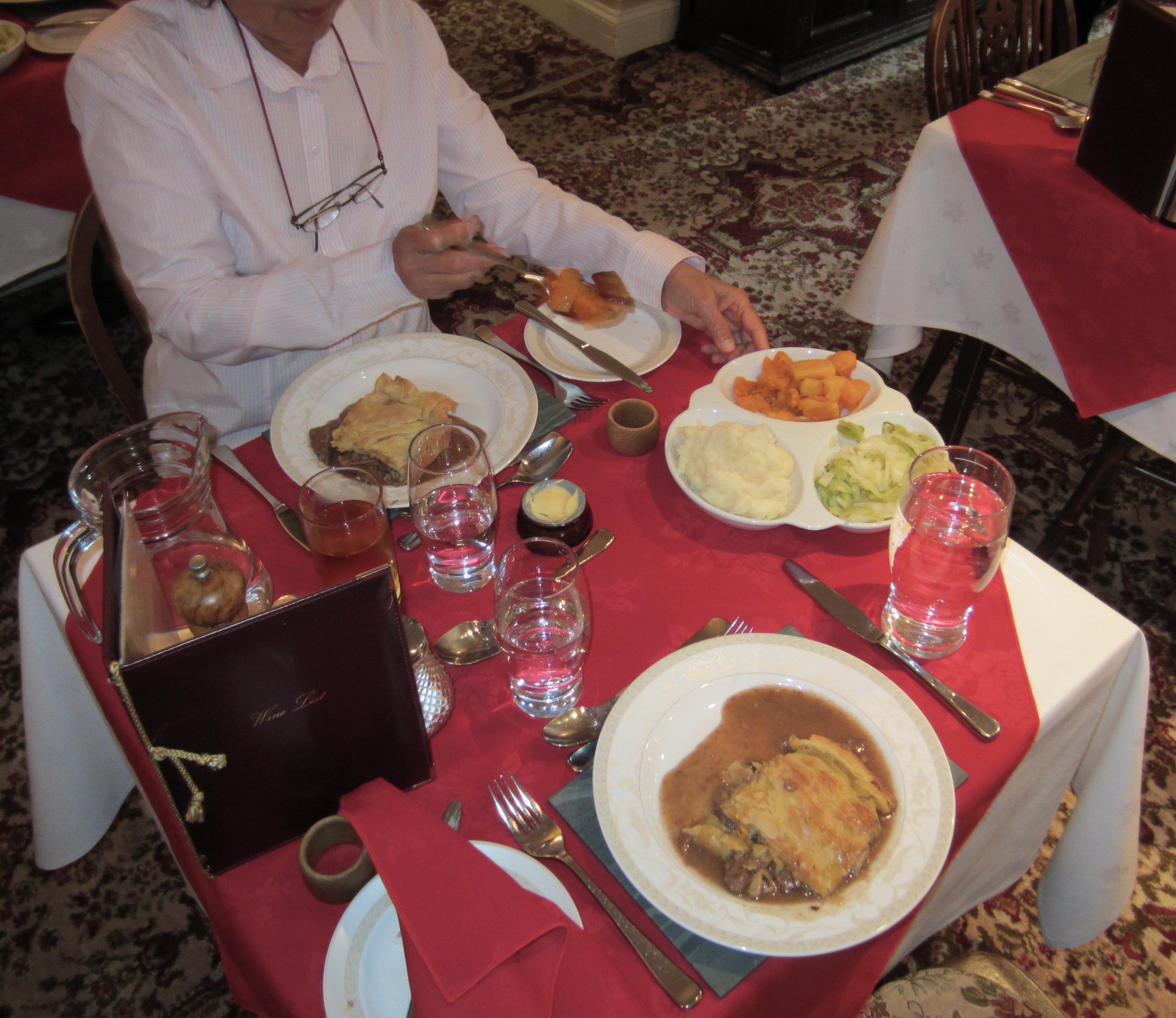
The only item on the menu: steak and mushroom pie and boiled vegetables

At exactly 7.00 pm an ear-shattering clamour rang through the hotel. It was our hostess thrashing the dinner gong. The guests came creeping from their rooms and lined up at the dining room door. Inside the door a waitress stood with a clipboard in her hand.
“Room number?”
“Fourteen.”
“Table eight. NEXT!!”

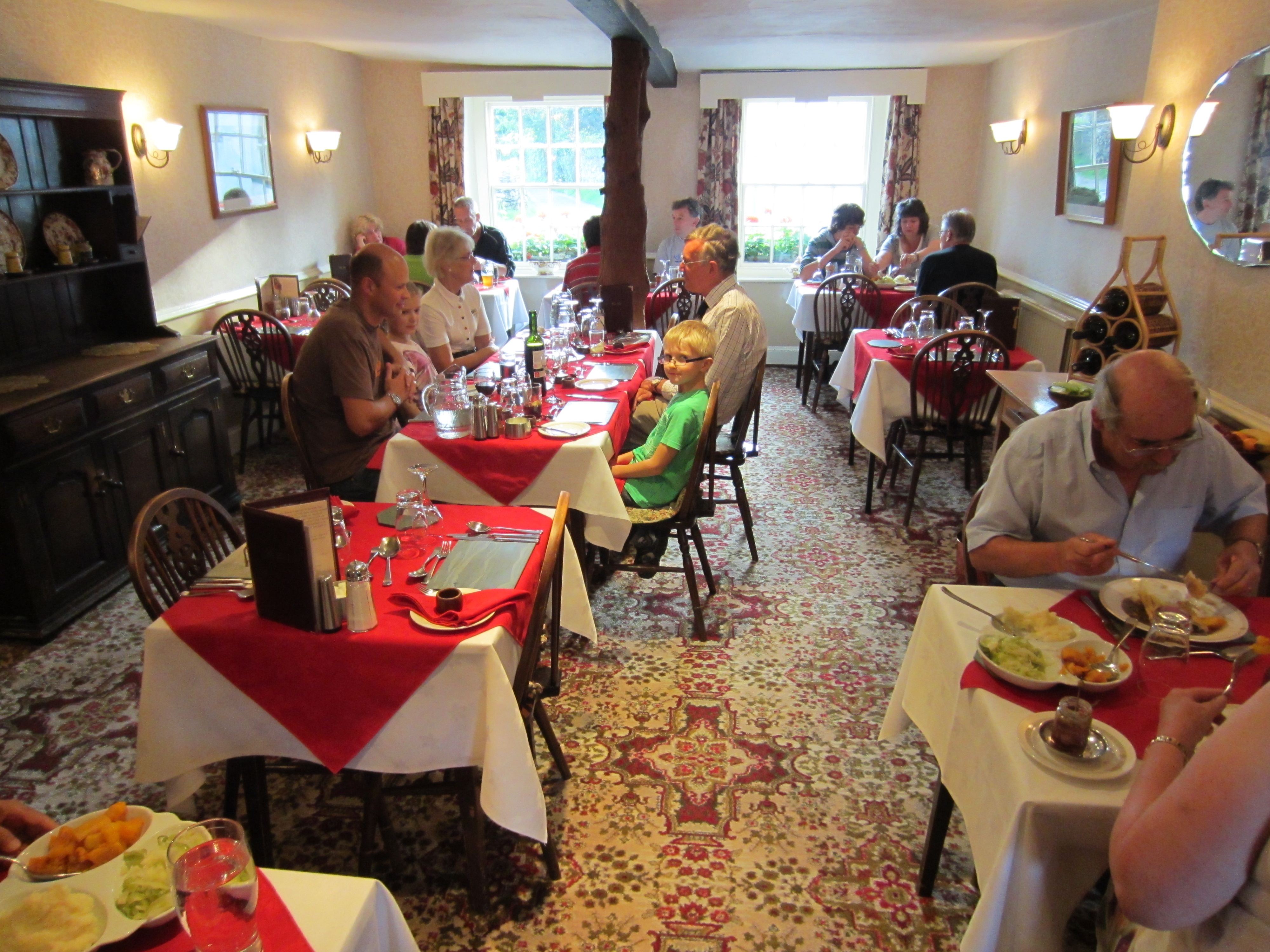
We filed meekly to our tables. When everyone was seated the room was invaded by a mini-squad of two waitresses carrying plates of thin vegetable gruel. They distributed these rapidly and were followed by a third waitress carrying a wooden board with bread on it.
“White or brown?”
“Brown, please.”
A thick slice of brown bread dropped on to my plate.

We supped in stunned silence. As soon as the last spoonful of gruel had been scooped up, the plate was snatched away and replaced by another filled with a soggy slice of steak and mushroom pie. A dish of vegetables also arrived: a ration of carrot, cauliflower and cabbage boiled and (I guessed) boiled again just to make sure it really was boiled right through.

Eating what they’re given in silent gratitude: the cowed diners in the Royal Oak Hotel, Rosthwaite

Every time we looked up a waitress would hurry to our table with a tray eager to grab our plates and cutlery. So we ate with our heads down. Dessert was a poached pear in sugary sauce. It was quite nice but we scarcely had time to enjoy it before the head waitress – her eye glancing nervously at the dining room clock – announced that tea and coffee would be served in the hotel lounge.

By eight o’clock the dining room was empty and had been made ready for the next day’s breakfast.

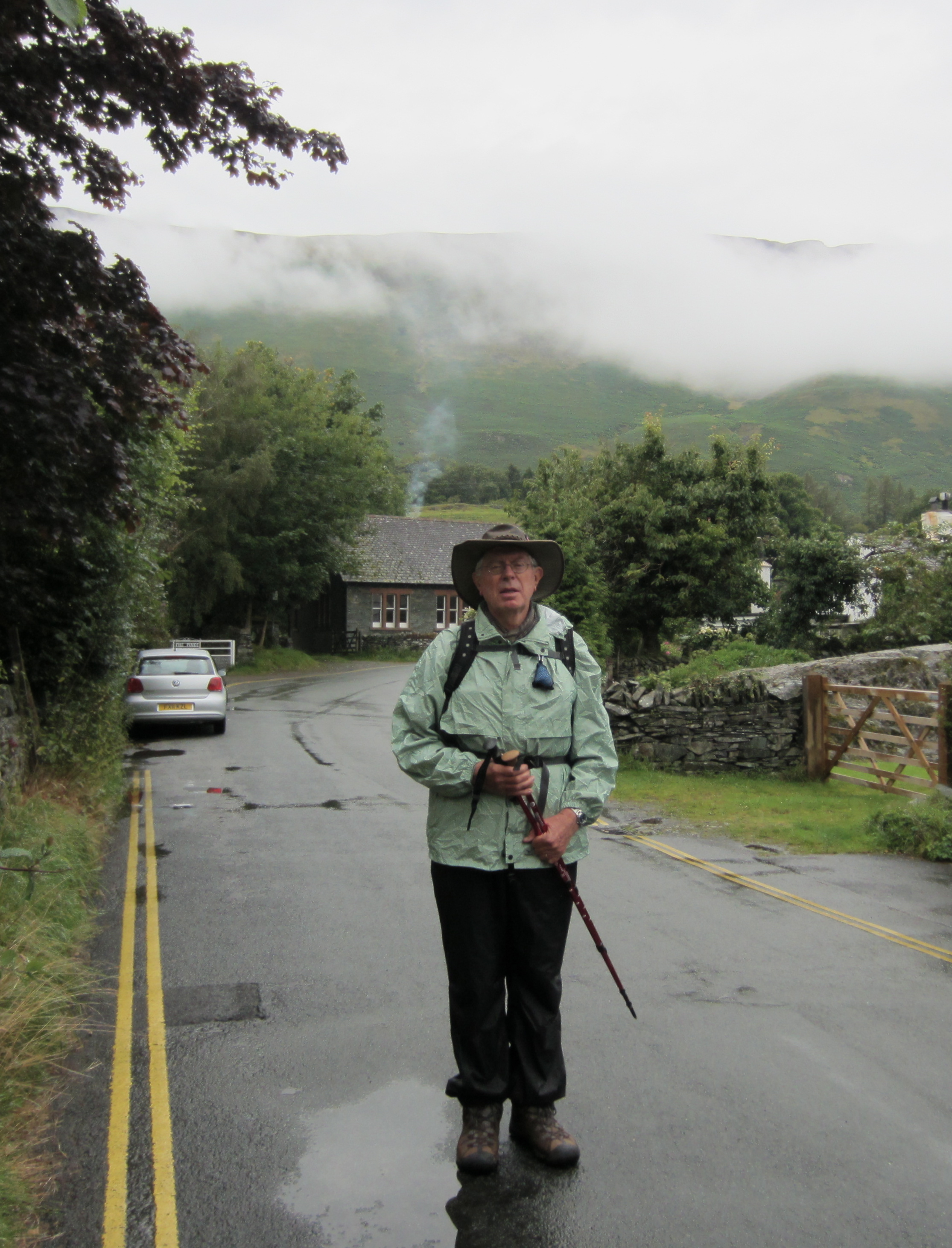
I pose in my wet weather gear in the hamlet of Grange. Scarves of dank mist lie over the hills and smoke rises into the chilly air from the chimney of a nearby cottage.

The next day dawned overcast and cool. We had walked scarcely one kilometre out of Rosthwaite when light rain began to fall. For the first time in our travels we broke out our wet weather gear: rainproof leggings, rain jackets and a waterproof cover for our backpacks. The rain intensified and the track became boggy, but we walked with exhilaration. We were passing through woodland along the banks of a stream. A dense mosaic of foliage formed a ceiling over quietly flowing water and feathery, dripping undergrowth. Every twist in the path seemed to open a new page of bright greenery, lustrous with water.

In the hamlet of Grange we stopped at the one-and-only shop to sit under the verandah and enjoy tea and scones. The instant we sat down the rain stopped, and as we stood up to resume our walk the rain rejoined us too. It stayed with us – never intense but steady and friendly – until, through arches of trees we saw the muted gleam of Derwent Water. Across the lake, half hidden among trees, there were stone houses and mansions. We had wandered into an Arcadia of woods and water and forest lodges. It was beautiful beyond description.

Walking through woodland near Derwent Water

Derwent Water with its dramatic mountain backdrop

An English Arcadia: homes amid the forest on the shores of Derwent Water

As we walked along the western shore of the lake we passed several jetties. At one of them a small ferry had puttered up to stop for a few moments and discharge several passengers. Emmy and I did not need to consult each other. We hurried along the jetty and clambered aboard.

I recalled the cry-from-the-heart of Xenaphon’s soldier Leon of Thurii as he arrived on the shores of the Black Sea after his column’s long trek from the hinterland of Persia 2500 years ago (mentioned in a previous post).

“What I want is to have a rest now from all this [walking], and since we have now got to the sea, to sail for the rest of the way, and so get back to Greece stretched out at my ease on deck, like Odysseus.”

I leaned back on my varnished wooden bench and watched the lake ripple out from the bow of the boat as it headed towards Keswick.

[Written in Carlisle and Lichfield, August 11-13. Next up: Footsore in Carlisle.]

I misjudge the Cumbria Way and pay a painful price

Ulverston is a small town on the west coast of northern England just inland from the Irish Sea. Seagulls nag the town with incessant complaining, resentful caws.

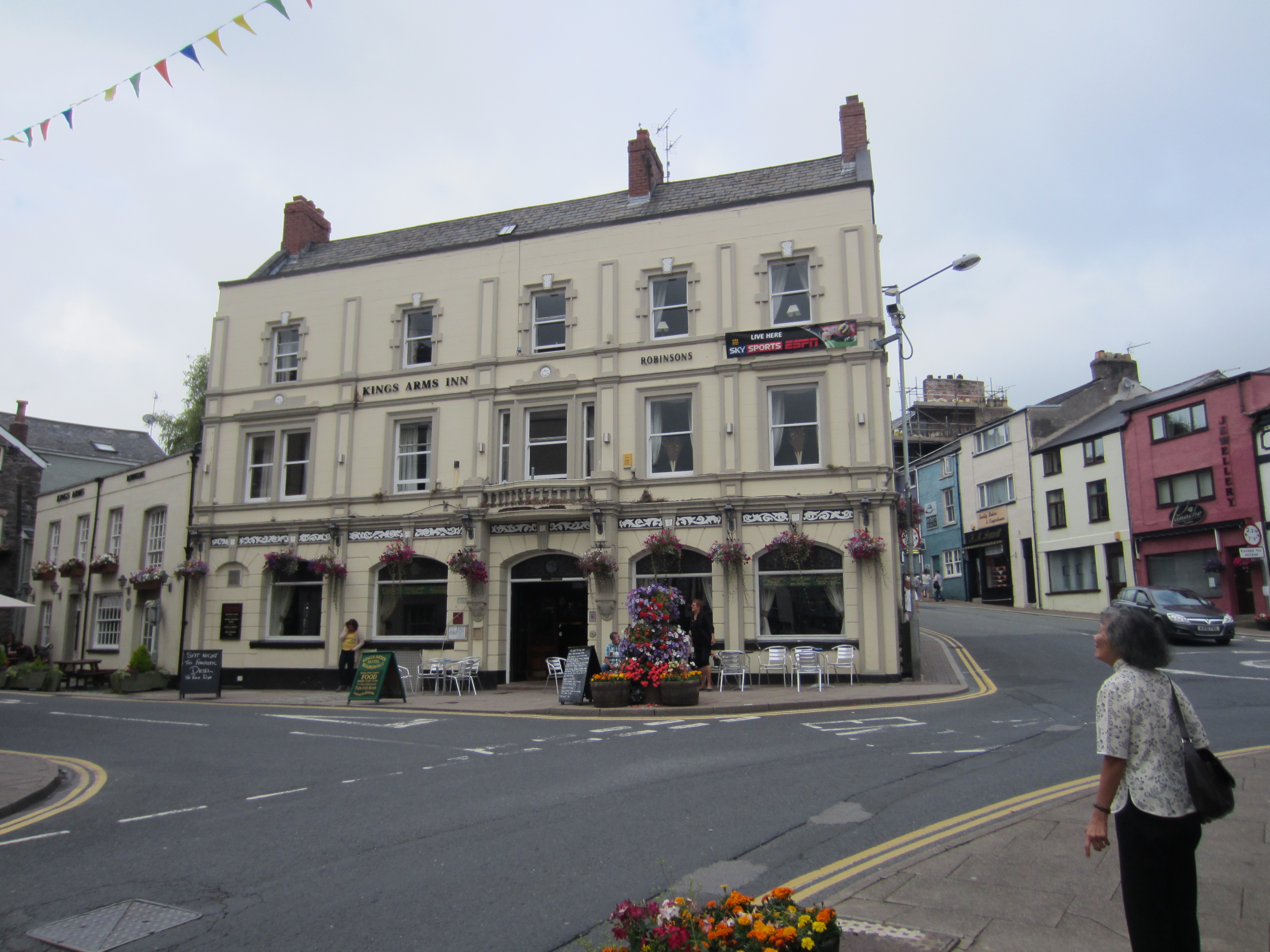
In Enid Blyton country. The centre of Ulverston.

After arriving by train from Manchester Emmy and I hauled our suitcases up two steep and slot-narrow staircases to a garret under the roof of a traditional guesthouse, then went out in search of lunch. Ulverston’s narrow streets are flanked by picturesque, close-packed ranks of old two- and three-storey townhouses. The compact town centre seems dedicated to eating. Everywhere there are tearooms, cafes, snack bars, restaurants, pubs. We found a small tearoom in a side street and sat down to some delicious home-made cream of chicken soup.

At the next table a very elderly and very dishevelled gentleman sat labouring through a bowl of potato chips and slurping into a cup of tea. A grimy plastic bag sat at his feet and he appeared to be writing on a postcard as he ate. Eventually he struggled to his feet. He turned to us and said, in a heavy north-country accent:
“We ‘aven’t ‘ad enoof ren.”
He looked gloomily out the window at the relentless sunshine.
“It rained yesterday, and this morning, and last week. But it’s not enough.”
Then his face brightened and he made a surprising follow-up statement.
“I’m a postcard collector.”

This non-sequitur caught me off guard and I didn’t know how to respond, but luckily he didn’t wait for a response. Leaning unsteadily over our table he delivered a rambling lecture on the joys of postcard collecting.
“Did you know,” he said pinning us down with a bright glare, “photographs didn’t appear on postcards until 1894. Unbelievable, isn’t it? And yet by 1904 thousands – literally thousands – of postcards were being produced every year with photographs on them.”
He looked disdainfully around the tearoom.
“I live in Barrow-in-Furness. I wouldn’t come to a place like Ulverston if it wasn’t for postcards. There’s a dealer in the market here.”
His gloom returned and he looked into his plastic bag.
“But all I got today were modern postcards.”
He said the word “modern” with distaste.
“But that’s life, I suppose,” and he shuffled out the door.

It hadn’t occurred to me that collecting postcards was a metaphor for life. But as we paid our modest bill I thought maybe it was as good a metaphor as any. Certainly as good as “The Camino”. The prefabricated, stereotyped images on postcards and their scrawled messages from distant times and places, not to mention the ephemeral life of postcards and their secret existence in dusty albums captured much of the public and private worlds we all experience. Yes, postcards were like us.

We left the café and stood entranced in the street. Ulverston was our first experience of a small English town and we liked what we saw. A fish and chip shop exuded its oily aroma from behind prim lace curtains, red begonias burst from window boxes, fat chimney pots squatted in threes and fours atop slate roofs. Truly this was Enid Blyton territory. At any moment the Famous Five – with their dog Timmy – would race down one of the cobbled streets in pursuit of smugglers.

A Tibetan monk strolled past.

I blinked. No, it was not an hallucination. It was a monk. He had close-cropped black hair and sandals on his feet. He was wearing a claret-red robe with yellow trimmings. He paused and looked with curiosity into the display window of a cured meat shop. More red caught my eye. There was another Tibetan monk… and another. In a kind of panic I looked up and down the street. There were Tibetan monks everywhere.

Clearly something had changed in Ulverston. The Famous Five would never have stumbled into a ripping adventure that involved Tibetan monks. Later that night I learned why. Conishead Priory near Ulverston – a monastery for Augustinian monks founded in 1160 – had become derelict and had been taken over recently by the Kadampa Buddhist community. They had restored the monastery and built a spectacular Buddhist temple in its grounds. On the day we visited Ulverston an international Buddhist festival was taking place at the temple attended by 4,000 delegates from all over the world.

As we dined that night in an Indian restaurant we were surrounded by Buddhists munching on the vegetarian menu. Most of them had American accents. Behind us two of them in the garb of Tibetan monks debated the best combination of flights for their return to the United States. Their close-cropped heads of black hair touched as they pored over airline timetables through an app on an iPhone.

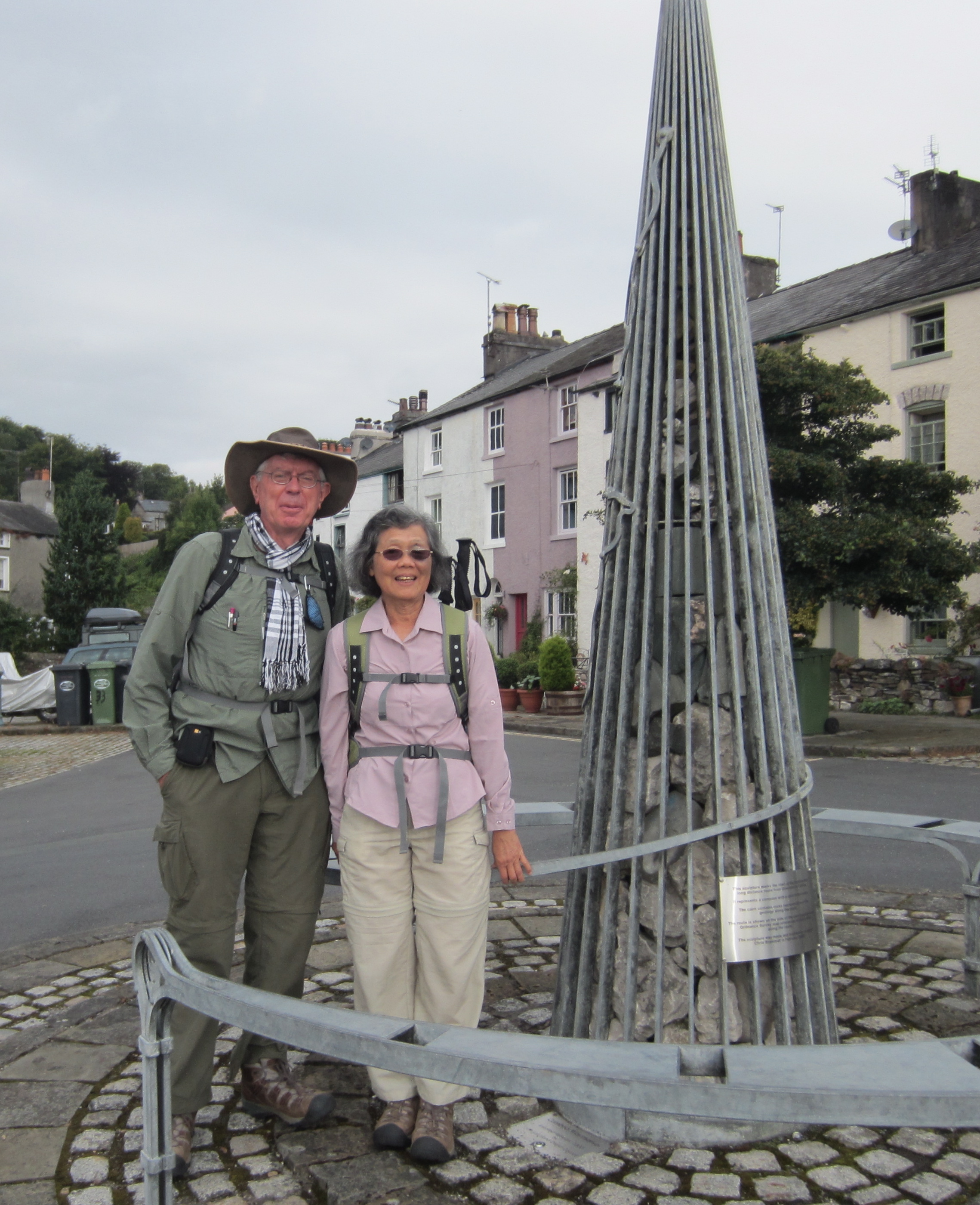
At the start of the Cumbria Way. Little did we know…

At 8.30 the following morning Emmy and I strode to the small monument on the edge of Ulverston that marks the beginning of the Cumbria Way. Conditions were good for walking: warm, overcast, a little humid. We were in high spirits. Our first day on the Cumbria Way would be a good day. I could feel it.

But I should have called a taxi, or gone back to bed. A bad day was about to happen.

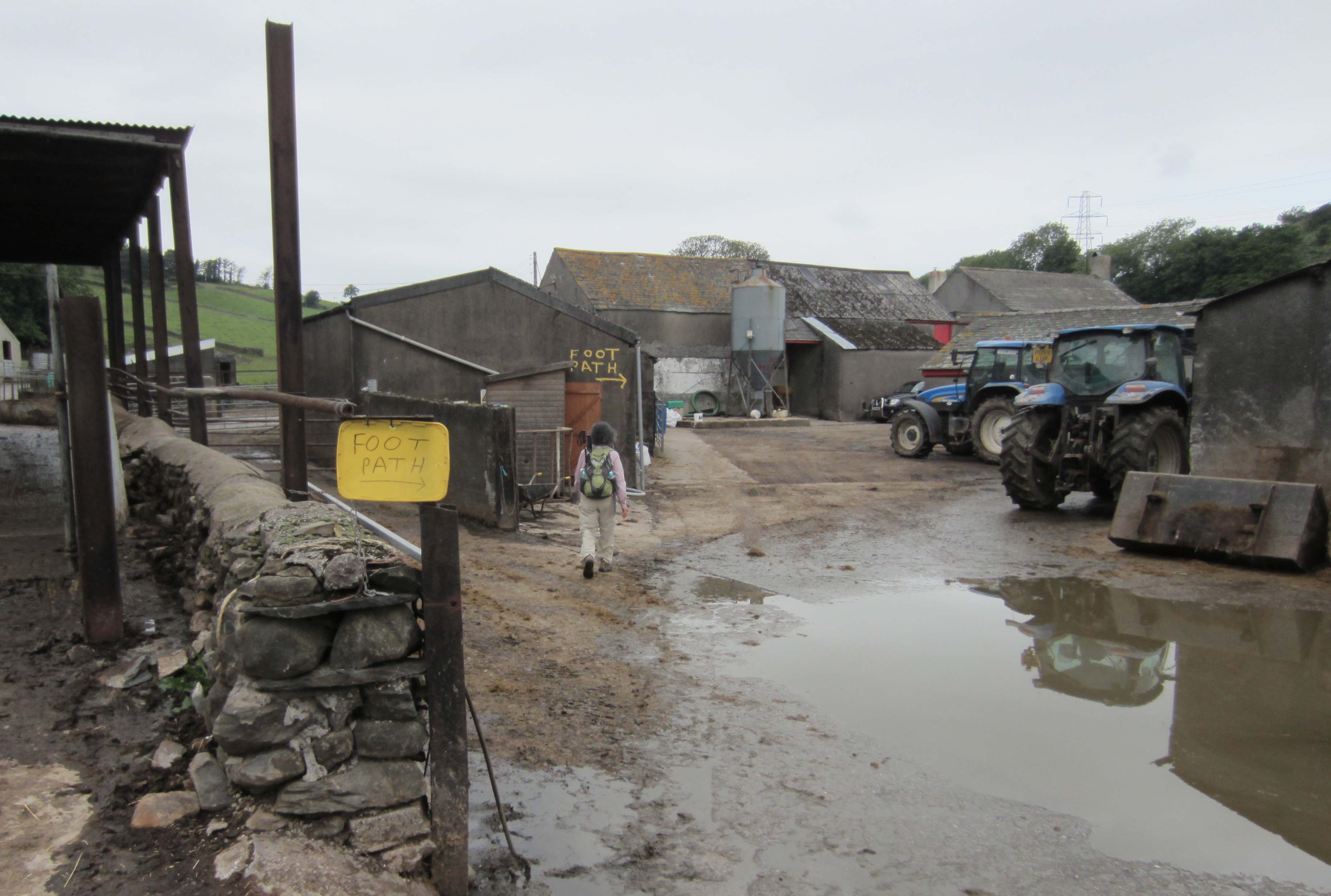
At first the Cumbria Way greeted us with a friendly face. We walked along a rocky path under the thick foliage of overhanging trees following lines of rough stone walls. The path ran out and we graduated to unmarked trajectories across open fields. The long wet grass squeaked under our boots and soaked the ends of our trousers. We clambered over stiles and picked up a path again. It rose steeply into pasture-clad hills, taking us through farm gates, across the muddy compounds of farmsteads, through fields of calmly grazing sheep, and over yet more stiles. Some of the stiles were made of wood, but most consisted of stony steps jutting from slate-rock walls. Two or three times we had to strip off our backpacks and pass them over the wall, then negotiate the steps of the stile like it was a mini rock-climbing exercise.

Across fields…

… through farmyards …

… and over stiles (lots of them).

Ahead of us lay a series of reassuringly cosy place names: Old Hall Farm, Beck Side, Hollowmire, Nettleslack, High Stennerley, Tottlebank, Appletree Holme. But as we climbed higher and the vistas panned out to rugged distant horizons the cosiness vanished and the Cumbria Way turned nasty. The pasture ran out and menacing, crouching bracken crowded around us. The path became boggy, then tangled, then indistinct. High on the heath there were no farmhouses and we were utterly alone.

Bracken closes in, and we’re in trouble.

We trudged on, stopping often to consult our map. I cursed my foolishness for not bringing my eTrex GPS device which had a compass in it. I had assumed that the Cumbria Way would be as intensively sign-posted as the Camino. But there were no wayside markers here, and I recognised none of the landmarks on the map. Slowly I had to admit to myself that we had strayed from the track and were lost.

It was around two o’clock in the afternoon. We had been walking for five hours and fatigue was starting to slow us. We had to find a farmhouse and get help. Below, in the far distance, I saw a strip of greenery. It looked like farmland so we headed downhill, pushing through bracken until we met a stream and crossed a barbed wire fence into some fields. We came across a slate-stone farmhouse, but it was derelict. We pressed on and walked into the back yard of another slate-stone farmhouse. There was no-one at home, but a narrow asphalt road led away from it and we were grateful to tread its smooth surface. We walked for around two kilometres through deserted countryside. Then, around a corner, we came upon a miracle. It was a white two-storey house – bright chintz curtains in the windows – standing amid fruit trees and roses behind a neatly trimmed lawn. A middle-aged lady was sitting in the sunshine on a garden bench with a young man beside her.

I called out over the garden wall.
“Excuse me! Sorry to intrude. We’re two hikers. We seem to have strayed off the Cumbria Way. Could you tell us where we are?”
Instant consternation. The lady sprinted across the lawn and opened the garden gate. Shooing away her big, glossy black dog, she ushered us into the house. She was a model of brisk, very English, hospitality.
“I’m Lucy. This is my son Rob. Please, do sit down. The WC is just over there.”

Two big glasses of water appeared before us and a map was spread out on the table. It was at once clear where we had gone wrong. We had walked along a high flat ridge and descended on the wrong side. We were at least ten miles from the Cumbria Way.
Lucy issued orders to her son (he was on holiday with her), a car was backed cautiously into the narrow lane in front of the house, and we were driven back to our path. It was a surprisingly long drive – almost half an hour squeezing along impossibly narrow roads to the southern end of Coniston Lake. But we were back on track. Our very warmest thanks to you, Lucy and Rob!

It was now mid afternoon and we still faced a lakeside walk of nine kilometres north to the village of Coniston. My feet were hurting and Emmy was drooping with fatigue. We walked with our heads down, doggedly, oblivious to the tree-lined beauty of the lake. Around five thirty we made it into Coniston. We had been on the road for nine hours and I estimate we had walked almost thirty kilometres.

In our room at the Lakelands Guesthouse I removed my boots. The anti-blister plaster on my left little toe had come loose. I peeled it off and the toenail came away with it. Fortunately my toe was still attached to my foot, a fleshy, swollen, nail-free appendix.

I flopped back on the bed and took stock of the day’s events. The glitzy advertising of the Cumbria Way and our relatively straightforward experience of walking the Camino had lulled me into carelessness. The Cumbria Way was a true hiking challenge. It was not, perhaps, a true wilderness experience (there were sheep grazing everywhere, even in the remotest parts of the Cumbria Way) but nevertheless it was a challenge that demanded good physical condition, the right equipment and the right mental outlook. I had the first two (although I had forgotten to carry my compass) but the third component was missing. For my shortcomings of mind – my unthinking overconfidence – I had been punished by the law of karma that governs the fate of all long-distance hikers. In retrospect I should have stayed in Ulverston and headed for the Buddhist festival. Maybe there I could have got some insurance against my karmic shortcomings.

I sat up and looked at my toe. In the morning I would have to visit a doctor.

[Written in Keswick, Cumbria. Up next: “Back on track: From Dungeon Ghyll to Keswick.”]

Our last day on the Camino

We spent our last night on the Camino – our twelfth – at the basic but very friendly Rosalia Hotel in Padron. The hotel is right beside the former residence of 19th century writer Rosalia de Castro who today is revered as one of the greatest writers in the Galician language of northwest Spain. Set in a beautiful garden, her small two-storey stone house is now a museum, beautifully maintained and dedicated to her memory.

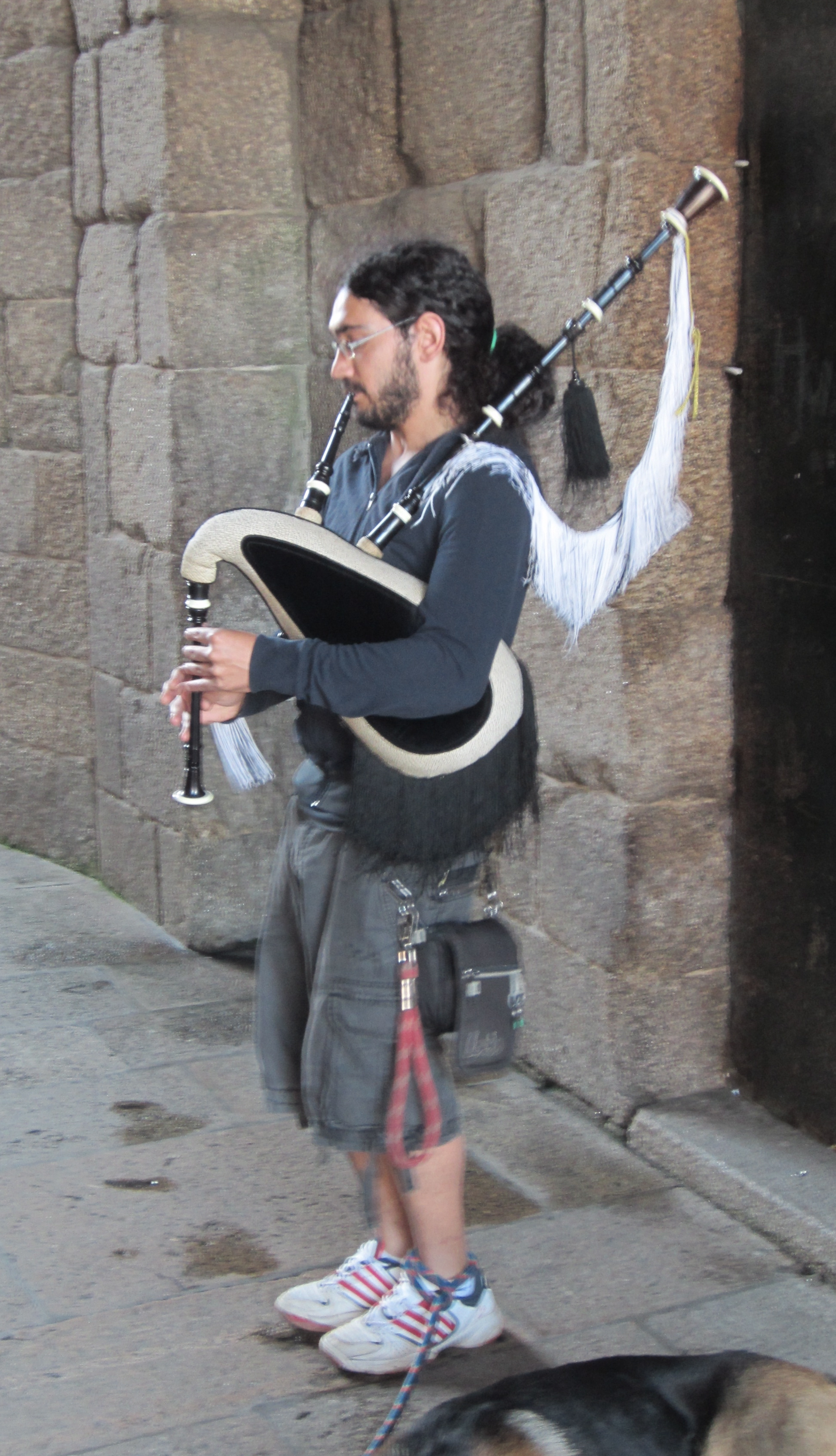
A Galician bagpiper in the streets of Santiago

The Galician language is closely related to Spanish and Portuguese. It is given prominence in public signage, in local education and in the mass media of the region. But Galician culture also preserves traces of its primordial Celtic character, most prominently in its Irish-style folk music and in the Galician bagpipes which we first heard as we passed through Redondela during a festival celebrating Galicia’s national day.

Approaching Padron that morning we came across a kind of checkpoint manned by two men from a volunteer organisation that helps Camino pilgrims. They were wearing bright orange shirts and police-style boots. Besides providing first aid and pamphlets full of good advice on the perils of long-distance walking, they were also recording statistics on the passing parade of pilgrims. At 11.00 a.m. that day Emmy and I were the 48th and 49th pilgrims to be counted. Their clipboard showed that Spanish pilgrims were easily the majority, followed by Portuguese, Germans, Poles and Italians. We were the only non-Europeans to pass through the checkpoint that day.

With fellow pilgrims and pilgrim assistance volunteers (in orange) at a “checkpoint” near Padron

Padron’s famous green peppers, a delicious appetiser with olives and a glass of wine at the Rosalia Hotel

After a delicious dinner at the Rosalia Hotel that featured a deservedly famous local delicacy, small green pimientos peppers fried in olive oil and served with a touch of salt, we slept so soundly behind the shutters of our room that we almost missed the beauty of the dawn that crept limpid and cool over the shady green park in the centre of town.

At 8 o’clock we were standing confused on the edge of town, trying to locate the yellow arrows of the Camino and shading our eyes against a lazily rising sun. We zig-zagged through narrow walled lanes. In one of them a nun, clad in a traditional black habit and white wimple, knelt on the threshold of a street-side door scrubbing the stone step with soap and water. Several times we crossed, and re-crossed, a busy highway and twice darted nervously over a railway line. As we moved slowly north towards Santiago the houses became more prosperous-looking, sitting comfortably in neatly maintained flower gardens with bags of bread hanging freshly baked and freshly delivered on gates and doorknobs.

An early morning delivery of freshly baked bread hanging from the knob of a streetside door

The day warmed and we walked into quiet, eucalyptus-tinted woodland. Our boots crunched on fine gravel with tiny grasshoppers jumping among the stones. We tuned in to the thin zing of a forest fly, the ripple of leaves in the wind and the muffled tolling of a distant bell.

Five young men on bicycles came powering up a slope behind us, bent low and standing up on their pedals, jamming their legs down hard, yanking their bikes left and right, revelling in their youth and strength. They had signs fixed to the handlebars of their bikes, Camino de Santiago, and they puffed an exultant “Buen Camino!” as they overtook us at the crest of the hill and disappeared. The quietly rustling stillness came back and wrapped its peace around us.

We got our first glimpse of the ancient pilgrim city from a bridge across a four-lane freeway. In the distance the suburban houses of Santiago de Compostela clambered across hills and fell sharply into valleys. From our vantage point there was no sign of the spires of the cathedral that, tradition says, have always beckoned pilgrims into the city in the final stage of their walk.

Slowly the suburbs lapped around us and we pushed into the city centre along wide streets filled with busy traffic and modern buildings. Like most of the towns we had passed through Santiago de Compostela has a well-preserved historic heart. Its narrow streets were crammed with tourists wandering among the restaurants and souvenir shops. When we looked up we saw only slivers of the afternoon, warm and blue above us.

And suddenly we were there, standing in the spacious square before the ornate entrance to the Cathedral of St James. I felt no special emotion apart from an intense curiosity. Emmy and I rested gratefully among the clumps of walkers standing, sitting and lolling – many of them exhausted – across the square. There was no feeling of relief or exultation, but also no feeling of letdown. We had arrived, and there was much to see.

An exhausted young walker recovers on the flagstones in the square in front of the Cathedral

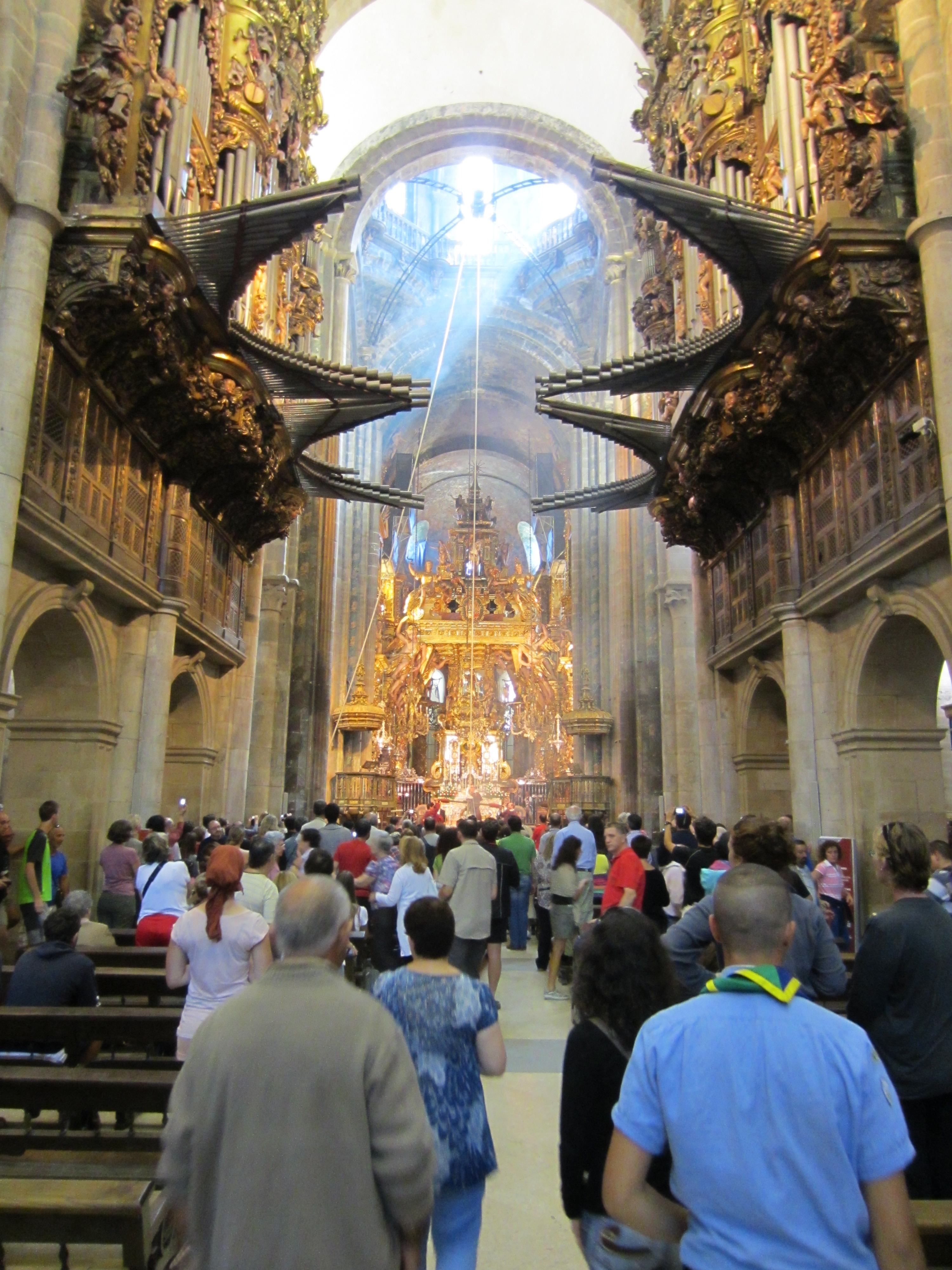
After checking in to our small hotel (not far from the cathedral) we set out to explore. We went first to the cathedral. Over the centuries the interior has been embellished and ornamented beyond what the eye can take in. The pipes of the cathedral organ lie horizontal, extending from left and right over the pews.

The dramatic and ornate interior of Santiago’s cathedral with its horizontal organ pipes.

Above the altar St James presides. A doorway at one side of his image gives access to a cramped stone staircase that leads up to a suffocatingly close space behind the image of the saint. Here, under the supervision of a priest, a shuffling queue of pilgrims squeezes up against the saint’s back. One by one they put their arms around him and press their cheeks against the ornately embossed silver cape that covers his shoulders. They hug him and say a prayer.

Reader, I did this too… although as I released St James from my embrace I caught a quizzical glint – perhaps a gleam of scepticism – in the eye of the priest. Another narrow stair-tunnel took us beneath the floor of the cathedral and into the saint’s burial chamber. There, protected by a big pane of glass, lay St James’ shining silver coffin. In front of the window supplicants were kneeling, their hands clasped together and their eyes tightly shut. In a nearby alcove others lit candles. The reverent hush was disturbed only by the ching of coins dropping into donation boxes.

Scrunching our eyes against the evening sun we went in search of the Office of Pilgrim Affairs. Through an unassuming archway and up a flight of stairs we arrived at a counter something like a Medicare office. A large illuminated sign hung above us directing us to one of several free places at a long counter in a neighbouring room. The office was quiet when we called and we were served immediately. We handed over our pilgrim passports – our credencial – to a church canon who examined them carefully and stamped them with the culminating stamp, that of the Cathedral of Santiago. He then recorded our details in a ledger and a few minutes later he handed us our compostelas.

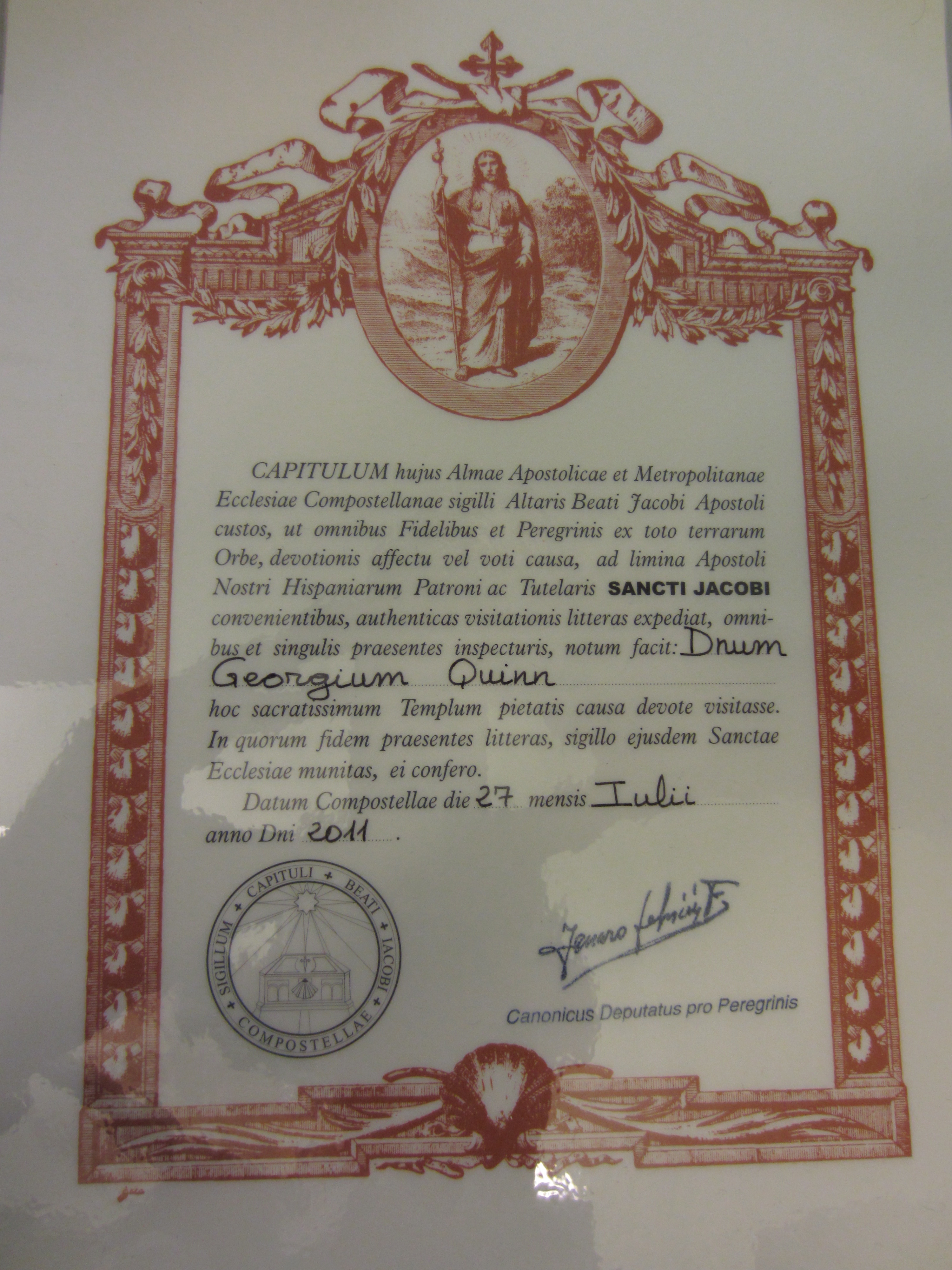
Hmmm, looks like I passed. Georgium Quinn’s compostela.

A compostela is a certificate in Latin declaring that the holder has completed the pilgrimage to the most holy temple of Santiago “in a pious and devoted fashion”. My compostela was made out to Georgium Quinn, and I accepted it with a stirring of pleasure garnished with a hint of pride. The officiating canon congratulated me on my faith.

[Posted from the New Dungeon Ghyll Hotel in the UK’s Lake District National Park.

Next post: “I misjudge the Cumbria Way and pay a heavy price on our first day of walking”]

Between Tuy and Arcade: The daily depths and shallows of walking the Camino

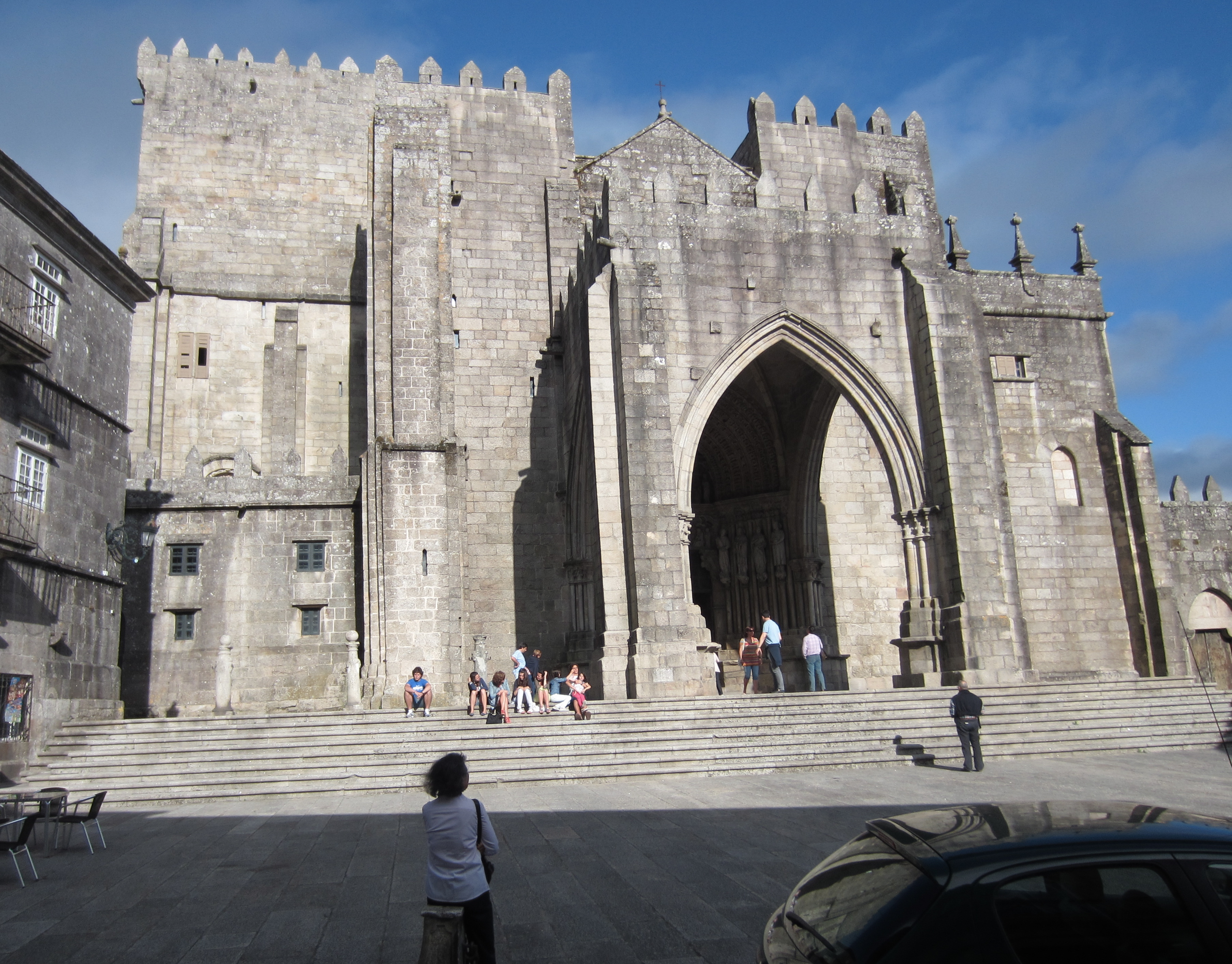
In the cool of early morning on July 22nd Emmy and I walked through the historic centre of Tuy on the Spanish side of the Miño River. The alleys were deserted. Our voices and footfalls bounced back at us off high stone walls. The fortress-like cathedral stood hard and square against the pale blue of the dawn sky. A ginger cat slinking low across the flagstones froze mid-step to stare.

The fortress-like profile of Tuy’s old cathedral

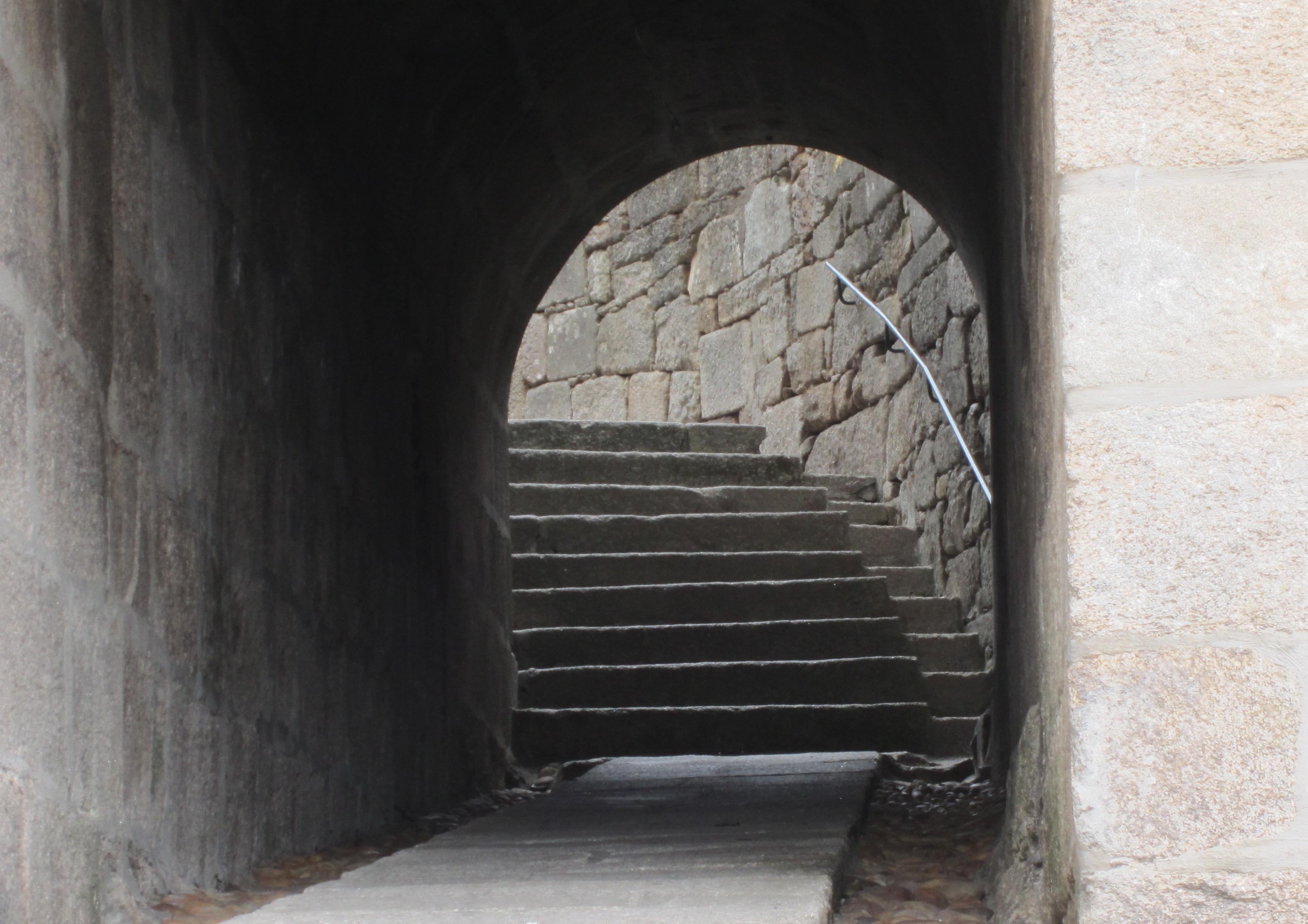
We picked up the Camino and followed it down a narrow staircase through a roofed passage known as the “Nuns Tunnel” into a small maze of lanes that twisted among the town’s oldest residences. After half an hour we emerged into woodland and followed a sandy path that unrolled upwards into low hills. The walking was easy.

Ahead of us we saw a wiry figure with a big camera bumping against his chest. He was wearing a kind of cap with an enormous crescent-shaped visor shadowing his face, but with no crown to cover an explosion of black hair on the top of his head. He kept stopping to cup the long lens of his camera in his hand and aim it left and right snapping pictures. This was Mr Chang, a Korean. He told us that he had been on the Camino for 41 days. Several years earlier he had walked the Via Frances with his wife, but this time she had refused to come with him (wise lady). Alone, and speaking no Spanish at all (“just Hola”), he had walked the long ribbon of the Via de la Plata, the branch of the Camino that starts in Seville in the far south and winds north to Santiago de Compostela through the arid and often hot Mozarabe and Merida regions of central Spain. When he reached Santiago he had walked through the city and on to Finisterre, 90 kilometres away on the Atlantic coast. Then he had doubled back to start yet another walk, this time with Tuy as his beginning point.

“I am making a DVD for Korean pilgrims,” he explained. “Can I interview you?”
“About what?”
“Well, why are you walking the Camino?”
In a lonely spot amid pine trees, as I crouched drinking deeply from my water bottle, a gentleman from Korea had suddenly asked me a question that I had not yet asked myself, at least not seriously. It was a surreal moment.
“I’m doing it as a personal challenge.”

Mr Chang was delighted. This was the perfect answer for the purchasers of his DVD. But I was left musing. I’m not much given to hard physical challenges – especially of the sporting kind – and I am not a big fan of “adventure” tourism. After falling over and injuring myself in Barcelos I’m no longer convinced that long-distance walking is necessarily good for the health of old people. Nor was I walking the path as a religious exercise (readers of this blog will know I am trying to be a hard-line atheist). But I was curious about the motivations of other pilgrims, and I did enjoy the exotic ambience of Portugal and Spain.

I hadn’t finished browsing these thoughts when the Camino took a sudden dip and tipped us into the industrial suburbs of Porriño. For around six kilometres we had grit in our eyes and on our teeth as we plodded past a car assembly plant, a seafood cannery, a cardboard packaging factory, an industrial chemicals refinery, a rank-smelling recycling plant, a vast yard stacked with pre-fabricated building materials, and much more. Smears of signage flashed by on the sides of trucks, smoke rolled across the road, the howl of compression braking preceded long fog-horn blasts.

Pilgrims (right) compete with trucks and cars in the dusty industrial estates of Porrino.

In his Pilgrim’s Guide to the Camino Portugues, John Brierly describes this portion of the walk as “a long and soulless trek”, but in truth it has a kind of gripping energy that is the very opposite of “soulless”. If nothing else Porriño is a healthy antidote to the escapist romanticism that clings like a cheap perfume to so much of Camino rhetoric.

After checking in to our hotel in the functional and rather ugly centre of Porriño, Emmy and I took a stroll down the main street. At six o’clock in the evening the townspeople had not yet thrown off the blanket of their daily siesta. The sun was still streaming across the central plaza but the streets were largely empty. We went into a church – the Igreja Santa Maria – and sat in the dim stillness. A solidly built man, about 30 years old, dressed in black and carrying a Bible, was patrolling the aisles. When I tried to take a photograph he apologised for the poor lighting in the church and hurried up past the altar to flick some switches.

We got into conversation (his English was slow but very correct). He was deacon of the church. He had completed six years of study (two years of general philosophy and four years of Catholic theology) in preparation for the priesthood and was hoping to be ordained by the end of the year. I told him we were walking the Camino. He congratulated me on my faith and asked how old I was. I told him it happened to be my 68th birthday on that day. He shook my hand hard and disappeared into a side room returning a moment later with a birthday gift: a small book in Spanish, Evangelio 2011. It contained Bible readings and commentaries for every day of the year. With a practised flip of the hand he turned to July 22nd and translated the Spanish text for me.

“Amazing,” he said. “Today’s reading is from Matthew Chapter 13 verses 18 to 23. And see… this line… it mentions the Camino!”
He read out verse 19 in halting but excited English. “When anyone hears the word of the kingdom and does not understand it, the Evil One comes and snatches away what has been sown in the heart; such words are like seeds that are sown on a much-walked path (camino). They will not grow.”
“Perhaps,” I said, testing him, “this verse suggests that faith should not be based on the shallow rewards of the Camino.”
“You are right. You are right. The Camino only goes so far. Real faith has no final destination. Truly it is refreshing to meet someone with your depth of insight.”
He threw his arms around me and gave me a big bear hug.

As I stepped out into the sun-struck brilliance of late afternoon I looked back at his dark figure standing beside the altar in the dim interior of the church. I was sorry to leave his company. I felt a pang of shame that I had not matched his sincerity with an equal measure of sincerity. I should have told him I was not a Catholic, in fact not even a Christian. I should have told him I did not have any insight and certainly no faith. But my courage had failed me. I had simply tried to make a trite debating point. When he asked me to pray for him in Santiago I enthusiastically agreed to do so.

“The sea! The sea!” The Camino approaches Arcade on an inlet between Redondela and Pontevedra.

I was still turning this incident over in my mind the following day, walking despondently and berating myself for my small-mindedness, when the Camino led us out of the hills north of Redondela and opened up a view of the sea. I was reminded of the famous cry of relief raised by Xenophon’s troops as they emerged from the hills of Turkey 2,500 years ago.
“The sea! The sea!”

Instantly I felt refreshed and my stride lengthened. I was on a high as we headed for our night’s accommodation in the seaside town of Arcade.

The mystique and the shadows of the Camino

The Camino Portugues is no ordinary walk. Sure, there is much that is “ordinary” about the mundane succession of villages, factories, shops, woodlands (sometimes tragically degraded woodlands), farms, churches, urban streets, barking dogs and suburban houses that pass by you as you walk. There is nothing natural and uniquely unsullied about the Camino. The tarnishing, despoiling hand of humankind lies over every inch. And yet… somehow the mystique of the Way transforms its ordinariness into something special. It is the essence of religion, and of religious experience, that the authority of symbols, language, history and art can make the ordinary seem extraordinary to those that have faith.

The Camino runs through the “Nuns Tunnel” in the old centre of Tuy.

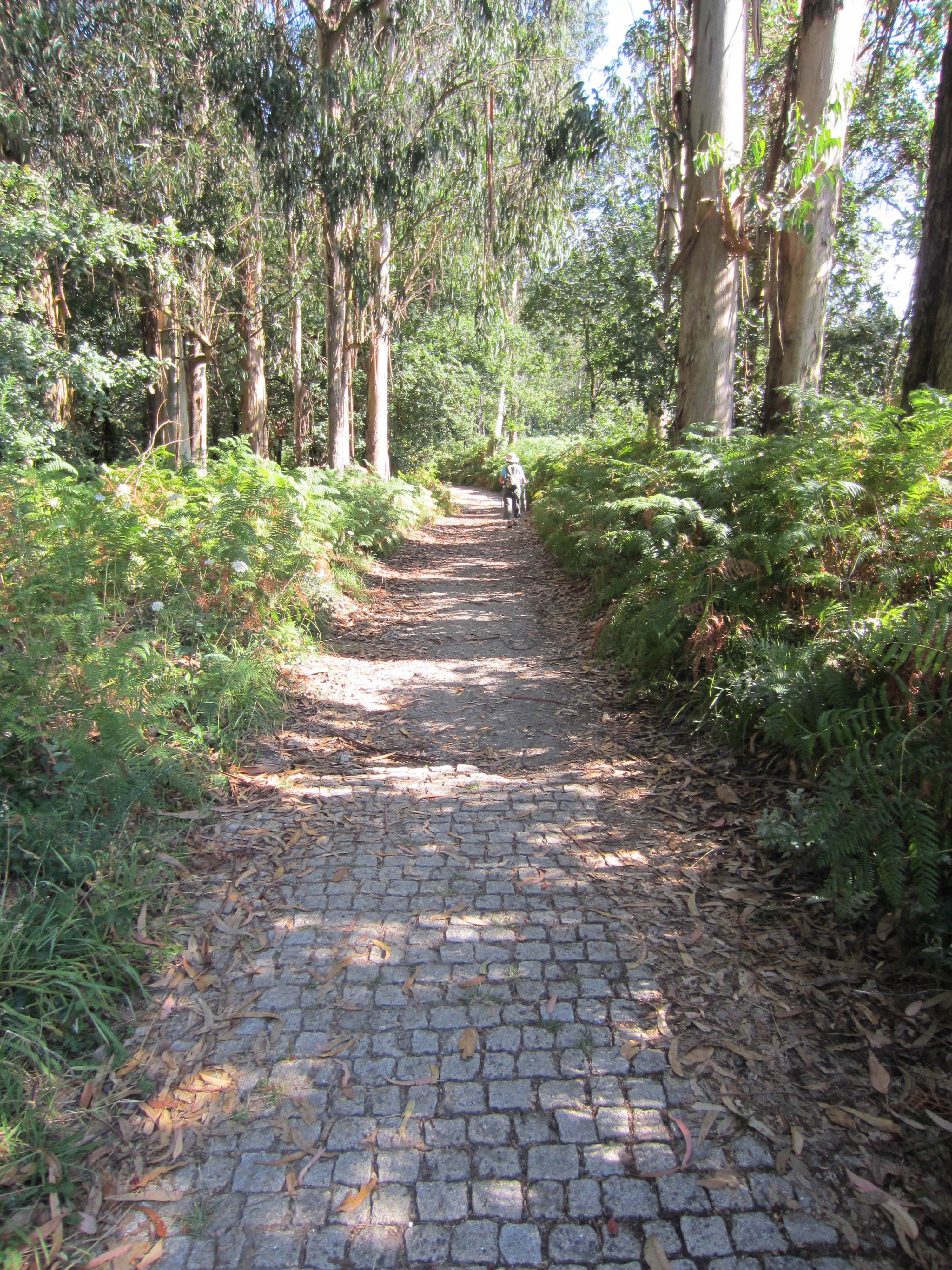
A segment of bush track in Galicia, with cobblestones and eucalyptus trees.

The Camino Portugues has immense variety, palpable history and, of course, moral-religious stature. It takes you through densely built urban streetscapes, rural flatlands, and rolling hills. One stretch, between Ponte de Lima and Rubiaes in northern Portugal, is “mountainous”, though the ascents and descents are only moderately hostile and the highest peak is just 470 metres above sea level.

You walk asphalt streets and highways as well as cobbled lanes, cobbled village roads and cobbled urban footpaths. Sometimes, on narrow roads, you have to walk on rough verges and even in roadside gutters. The cobbled surfaces are especially challenging to walk on. They are (literally) rock hard, they are uneven, and they often extend for kilometres at a time. They delivered a hard pounding to my feet and my feet replied with blisters yelling their protest. You also walk on dirt and gravel paths and occasionally (but never for long) on tracks luxuriously carpeted with pine needles or eucalyptus leaf litter. In a few places the Camino shrinks to an unkempt track: the dry bed of a rock-strewn stream or a metre-wide trench amid jostling shrubs and blackberries that grab at you as you pass.

Around you, the built landscape changes from dark grey medieval stone walls and bar-code city townhouses, to bland suburbs, to country lodges and farmsteads, to industrial estates: factories, warehouses, refineries, parking lots and vast yards full of manufactured litter. The farmland is very beautiful and very intensively cultivated, mostly in corn and grapes. There are no extensive grasslands. Nor is there any untouched wilderness left at any point along 230 km of the Camino Portugues. The path passes through many areas of cool woodland, but these are all secondary growth forests. In fact the most common forest trees along the Camino – especially in northern Portugal – are Australian eucalypts. We saw no signs of any wildlife, not even many birds. The silence of the landscape is a welcome balm for ears (and spirits) crushed by the din of highway traffic. But it is also an eerie warning. Behind the riveting beauty of the rural landscape in northern Portugal and on the approaches to Santiago in Spanish Galicia there is a environment hushed by its fatigue.

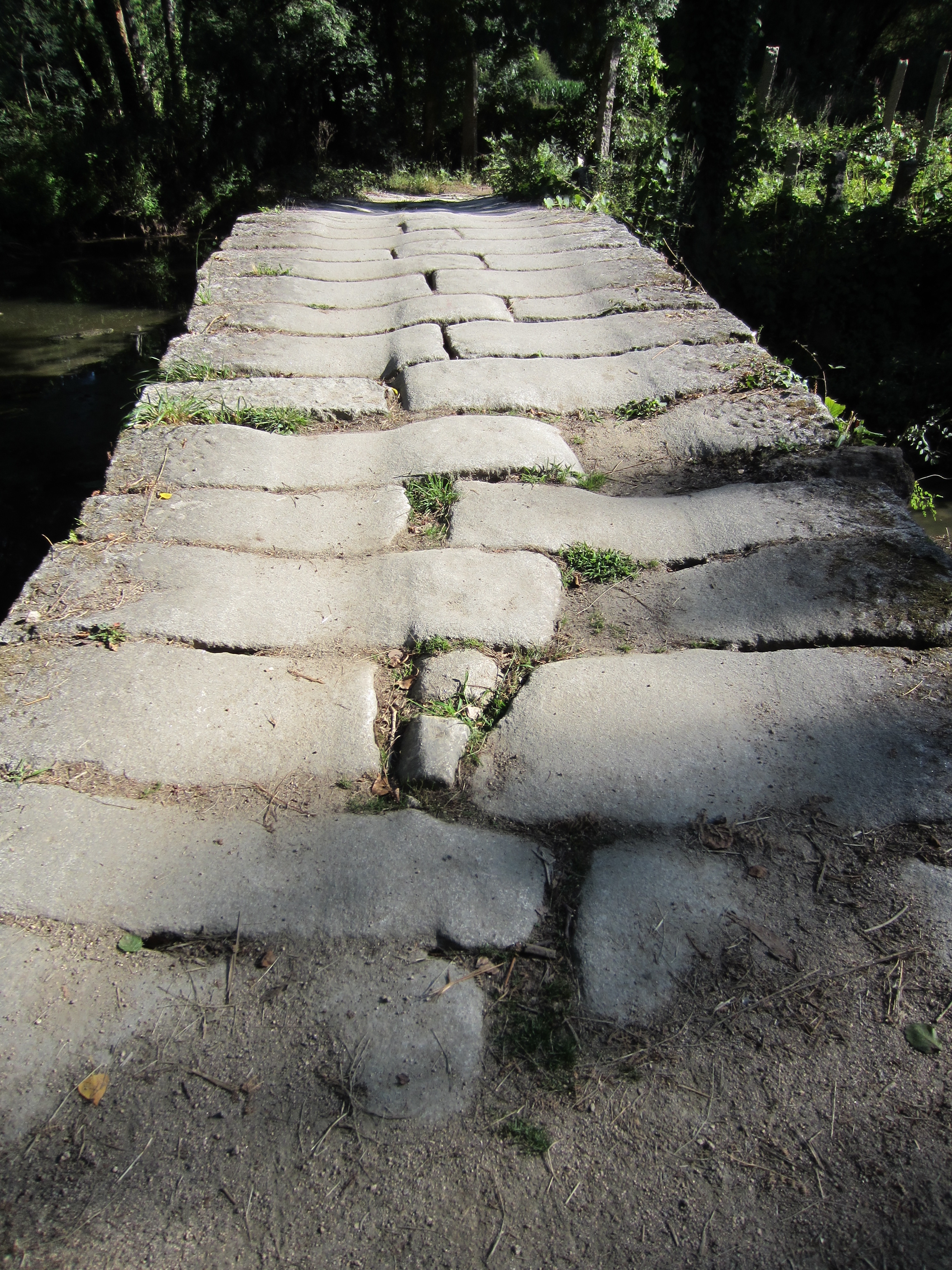
The timeworn flagstones of Highway XIX north of Tuy.

Everywhere the shadow of distant history haunts your steps. Through northern Portugal and across northwest Spain you walk large lengths of Highway 19. That’s not Highway 19 of Portugal or Spain, but Highway XIX of the Roman Empire. In places you cross bridges that the Romans built, and you walk over flagstones they (or rather, their plentiful local slaves) put in place around 2,000 years ago. There are many wayside stone crucifixes that bear witness to the antiquity of the pilgrim impulse. Some of them date from the middle ages when pilgrimage to Santiago was at its height. On them you see – in addition to the crucified Christ keeping watch over pilgrims – weather-beaten images of the pilgrims themselves dressed in long robes and carrying staves with water gourds attached to them.

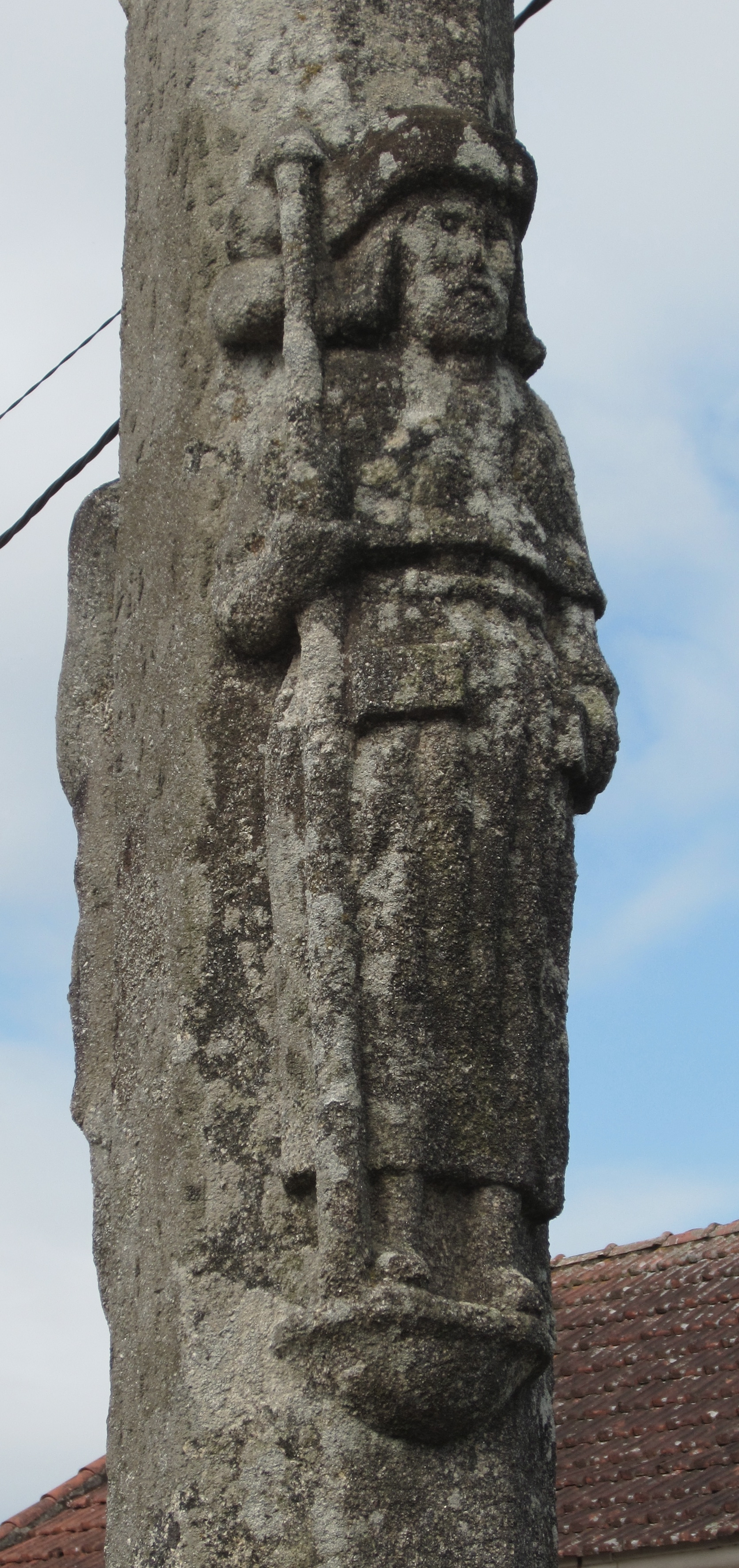
A wayside image of a pilgrim probably erected in the 15th or 16th century, with staff and (just visible at the top of the staff) a water gourd.

You fill your water bottle at fuentes, or freshwater spouts, that refreshed pilgrims a thousand years before you stopped there. You pass through the largely unchanged ancient centres of town after town: Porto, Barcelos, Ponte de Lima, Valenca (you step off the Camino momentarily to explore Valenca’s beautifully preserved medieval walled town, the Fortuleza), Tuy, Pontevedra, Padron and Santiago itself. You stop at the doors of churches that have changed little in 500 years. You sit in the cool of tiny wayside chapels, breathing in the same calm that stilled the weariness of pilgrims 25 generations ago.

Above all, perhaps, you feel your scepticism start to weaken as you digest the story of St. James (known as Santiago or Jacob). It is a story that every common-sense instinct tells you is pure man-made fantasy, and yet you start re-telling it to yourself, half accepting that holy stones, giant incense burners and scallop shells (on sale at 1.50 euros each) are proof of its truth. You hear that St James was an apostle of Joshua (better known as Jesus Christ, son of God) who was so ignited by the fire of faith that he took it to the ends of the earth – literally. At the time, northwest Spain was regarded as the westernmost extremity of the world, the last outpost of land before the endless western seas that extended to the edge of existence. After performing prodigies of missionary labour there, he returned to Palestine where he was arrested and executed by Rome’s local satrap, King Agrippa I. His disciples transported his remains back to Spain in a stone boat. Yes, a stone boat. And the stone mooring post where this boat berthed is still visible on the banks of the shallow river that runs through the town of Padron. Eventually his bones were interred in the place that now carries his name, Santiago, and atop his tomb a massive stone cathedral threw its spires high into the sky.

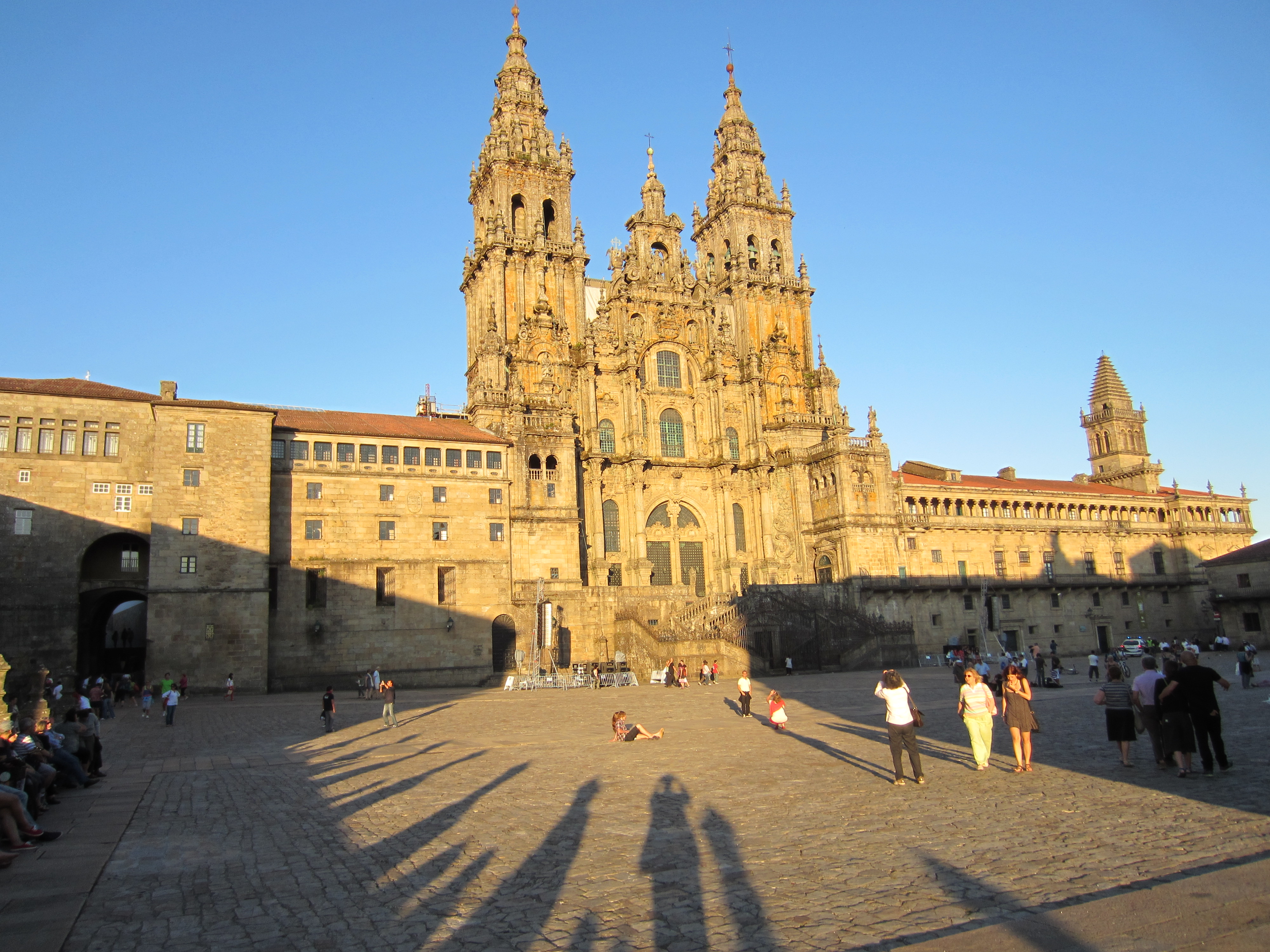
Journey’s end. The many branches of the Camino converge on this square with Santiago (St.James) looking down from high between the twin spires of his Cathedral.

This is what draws pilgrims. In the plaza before the cathedral they stare upwards with tears in their eyes, or they stretch out on the flagstones and sleep, or they hug each other and take photographs, or they fall into a frenzy of souvenir shopping, or they raise rah-rah sports chants, or they simply sit silent, silent, silent around the perimeters of the square.

For every one of them the end of the journey has a message beyond simply arriving at a destination. The Camino seems to speak. Somehow its diverse beauties and its history give it a transformative authority. Even closed-minded cynics like me can feel it. My feet are aching not because I’ve hammered them on cobblestone anvils, my blisters are jabbing me not because of dermatological chafing, my rib-cage is sore not because I hurt it in a fall, my mouth is dry not because I haven’t adequately regulated my fluid intake to adjust to the ambient temperature. All these physical rebukes are moral rebukes. They are lessons that I deserve. If only I could read their messages I would solve my problems and be a better person.

At a wayside snack-bar between Arcade and Caldas de Reis I exchanged a few words with a German walker, a young woman who had started her walk in Tuy.
“What on earth have you got in there?” I asked pointing at her huge backpack.
“Stones,” she answered with a slightly forced laugh.
I thought she was joking so she felt compelled to explain.
“I am carrying stones of sorrow. I packed them in Germany and I will carry them to Santiago. In Santiago I will let them go.”
“You have many sorrows?”
“Me? No, I have none at all.” She pointed out the window at three girls squatting on the kerbside beside their much smaller backpacks. “I am carrying these stones for my friends. They have big problems and deep sorrows. You know… boyfriends and all that stuff.”
She staggered slightly as she heaved the backpack on to her shoulders. For a very fleeting moment something medieval, something deeply moral, something mysterious, something irrational but far more human than I am, passed across my line of sight.

I guess it was the spirit of the Camino.