Rotorua Walking Festival 2012: Weekend of Walks, Day Two

Spectacular tatooed face on a Maori carving, central Rotorua.

Sunday, March 18th was warm, overcast and humid. There was a hint of rain in the air, but it never materialised. Our route on the second day of walking took us through the suburbs and parks of Rotorua city, along the shores of Lake Rotorua and through the city centre.

As always, the unassuming demeanour of our walking companions hid stories that might fill a library. As the comfortable houses of suburban Rotorua slid past I fell in with a small feisty woman, well into her sixties. She had a remarkable story to tell. Born in Amsterdam she had worked for a time in England where she met her husband, a polynesian from the island of Rotuma in the Fijian archipelago. They married and migrated to New Zealand where they ran a small convenience store in a hospital in the Bay of Plenty region. The business was a great success.

Part of Rotorua township and Lake Rotorua. The picture was taken looking north-east from: 38° 7'45.73"S, 176°14'47.33"E. Check the site on Google Earth.

One day she asked her husband to steady a chair she was standing on while she reached for something on a high shelf in the shop. Somehow her husband’s foot got pinched under a leg of the chair while she was standing on it. He didn’t cry out and the incident lasted no more than a few moments. But its consequences were devastating. Her husband was a stoic gentleman, she told me. He thought the pain in his foot would be momentary, but it persisted, though he never complained. Months later the pain had become unbearable and he had his foot x-rayed. A bone was broken. It had become infected and had “gone all black” (probably it was gangrenous). Like many polynesians, her husband was “large” and he had developed diabetes. The circulation in his leg was not good, the problem worsened and medication didn’t solve it. Eventually the leg had to be amputated at the knee.

He became immobile. The couple had to abandon their shop and the lady became a full-time carer for her husband. She managed to get him into a respite care centre for a couple of days a week, and, to help make ends meet, she worked as a cleaner at a tourist resort on those days. Her work required her to clean 54 bedrooms plus a dining room in one day. In the course of a year, Rotorua’s two-day walking weekend was her only opportunity to have a holiday. To participate in the walk she had persuaded her daughter to drive down from Auckland and take over caring duties for two days. That’s why she was walking with such a surprising spring in her step.

Formerly hot baths, now Rotorua's museum.

The Maori people are fighting hard to keep their language and culture alive. Our path took us past this Maori-language early childhood education centre.

Rotorua’s thermal underground breaks the surface at many points in and around the city. Steam billows over some city parks (see for example Google Earth at: 38° 7’47.99″S, 176°14’39.22″E), there are pools filled with infusions of hot milky-green water, steam gurgles up from porridge-pots of hot mud. In some places fumes kill the vegetation, creating blasted mini-landscapes of grey and white (Google Earth: 38° 8’26.90″S, 176°15’35.91″E). Many houses tap into the heat beneath them for hot water and warmth in winter.
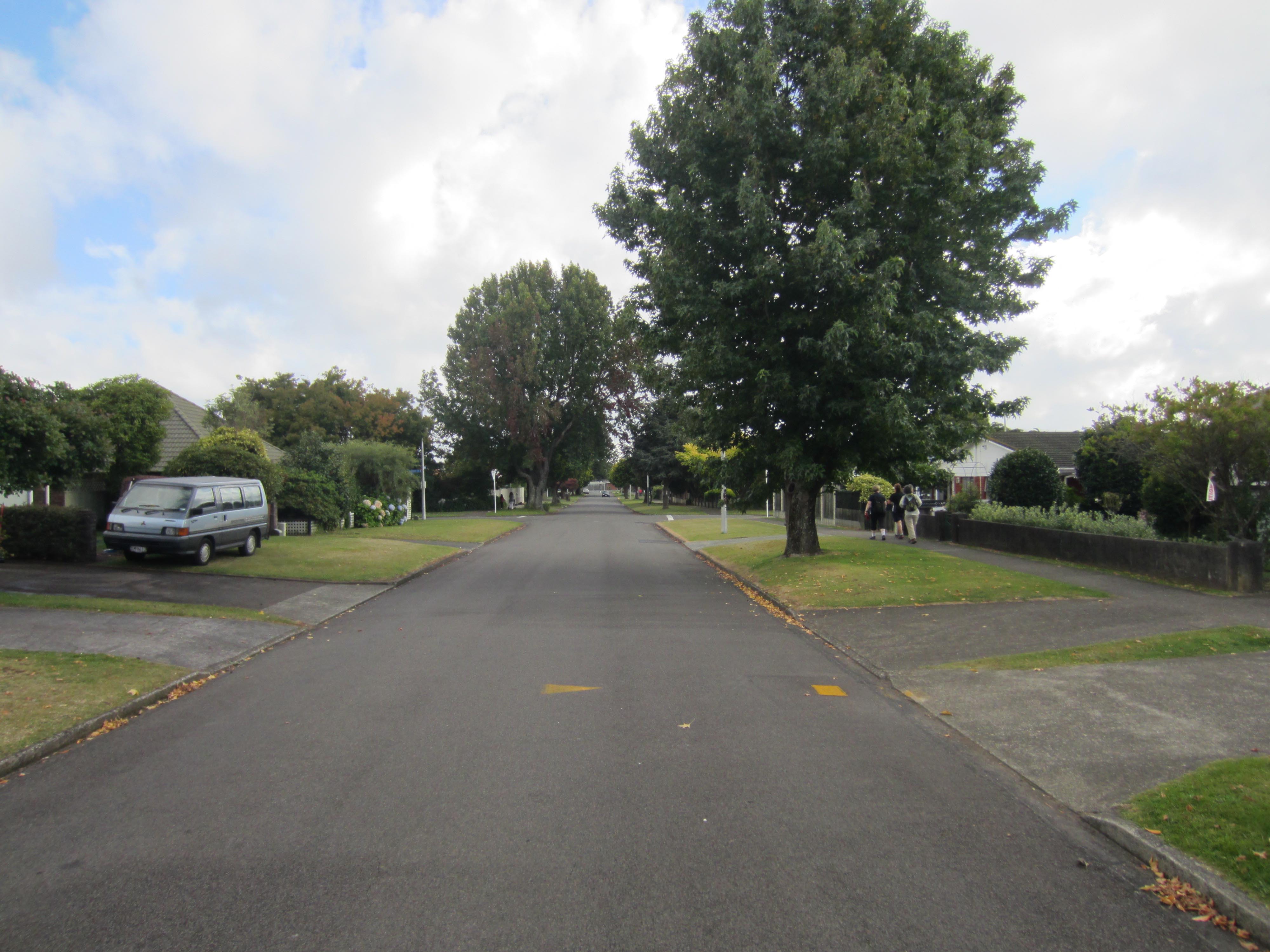
Our path on day two of the Walk took us through the quiet suburbs of Rotorua.

Steam rises from the ground right beside a suburban house. Many homes are heated with natural geothermal heat from the ground beneath them.

The downside, of course, is the sulphuric smell. It was already wrinkling our noses on the highway as we drove towards the edge of town two days earlier. In Wellington, my brother had praised Rotorua’s aroma. Thoughtfully eyeing my grey hair and wrinkled face he told me that Rotorua was great place for the elderly. It had a caring community, a fantastic environment and excellent health care services.

“And best of all, when you fart no-one notices the smell, so it’s perfect for old people.”
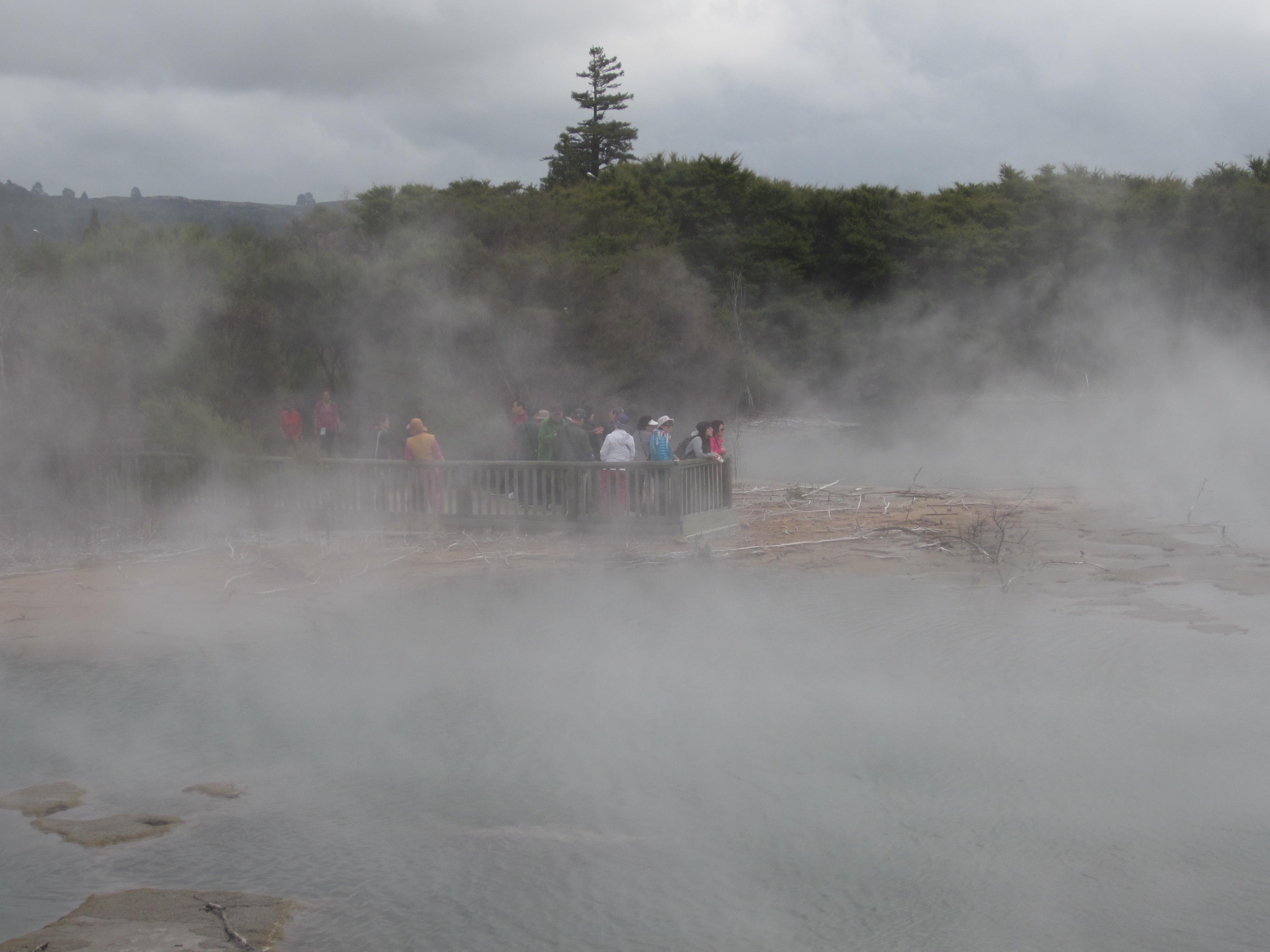
Tourists getting steamed in a public park near the centre of Rotorua.

Emmy makes her way very carefully across a section of the track that passes over earth made lifeless by the effects of geothermal heat.

Around 2.00 pm Emmy and I limped into the Control Centre and were handed a congratulatory lollipop. An informal closing ceremony followed. Mr Kim received a special IML award for his walking achievements across the world. There was a “lucky draw” of prizes from local businesses, one of them being free entry to a sheep shearing exhibition. And to close, we sang “Auld lang syne” and the beautiful Maori song “Now is the hour”, both to the accompaniment of a solo ocarina.

It was all charmingly amateur but organised with warmth and efficiency. Somehow it left a small lump in my throat. Rotorua… we will be back.
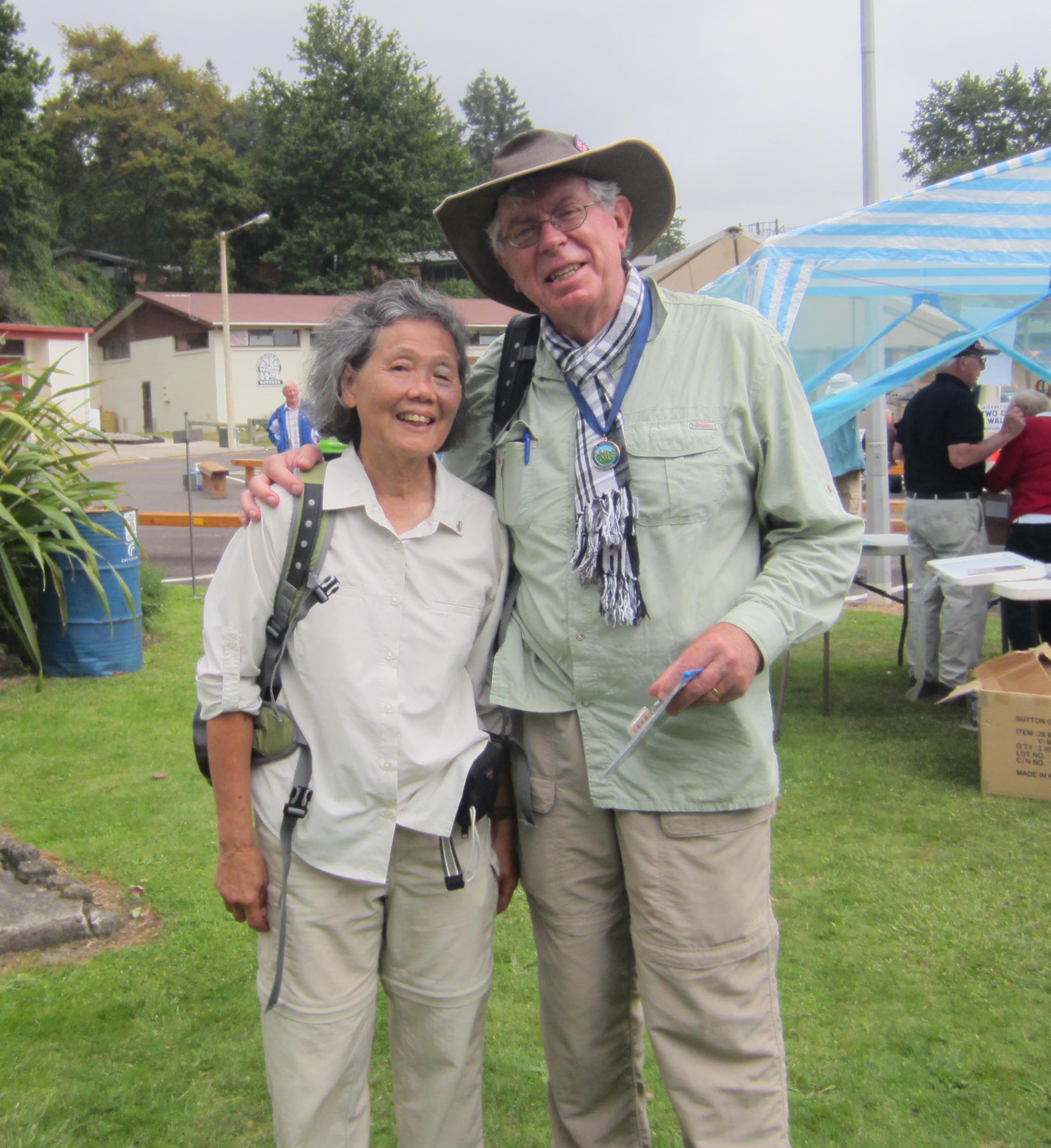
Steam-cleaned but not yet deodorised, we make it to the end point of the two day walk.

Rotorua Walking Festival 2012: Weekend of Walks, Day One

Maori carving of a guardian figure in Rotorua

If there is one word that sums up Rotorua in New Zealand’s Bay of Plenty region it is “hospitable”. Sure, the town is a bit of a tourist trap, but in the nicest possible way. Its friendliness reaches out at once, its laid back style is disarming, its Maori culture and thermal environment are a unique and winning combination.

The annual Rotorua Weekend of Walks is part of a week-long walking festival (see http://www.rotoruawalkingfestival.org.nz/ ). The weekend walks qualify for awards under the auspices of the International Marching League (IML) see www.imlwalking.org/. The IML offers walkers medals for completing its walks in 26 different countries across the globe. Walkers are required to complete at least 20 kilometres on each day of a two-day event, and this achievement is recorded in an IML “passport”. Rotorua’s two-day walk is also affiliated with the Internationaler Volkssportverband (IVV) see www.ivv-web.org/english/.

In the early evening of Friday, March 16th Emmy and I arrived at the Walking Festival headquarters in Rotorua’s Neill Hunt Park for an appetiser: a one-hour guided excursion at night into nearby Whakarewarewa Forest on Rotorua’s outskirts (check the location on Google Earth at: 38° 9’17.81″S, 176°16’50.70″E).

This turned out to be a memorable event, in fact the cliché “magical” is almost appropriate. It was memorable for the deliciously spooky experience of walking in pitch darkness along narrow dirt paths illuminated only by flashes of torchlight and glimpses of the moon sailing among black trees in a starlit sky. The haunting calls of New Zealand’s ruru native owl kept us company. Glow worms gleamed under pathside bushes and we looked up into dark green fans of mamaku ferns far above us.

Our guide – a professional ecologist – provided interesting and occasionally disturbing commentary. (Sorry, I’ve forgotten his name… but he was top value.) For example, he told us that New Zealand’s 2,500 species of native plants were matched by 2,500 species of introduced plants. There was now almost no place in the country where original vegetation could be seen untainted by invasive species. Some 60 million Australian possums were devastating the environment and nothing much could be done about it. Biological controls (like the species-specific calicivirus disease that has dramatically reduced rabbit numbers) could not be developed for possums because of the danger that it would spread to Australia and devastate possum populations in their native habitat. Right on cue, our guide’s flashlight picked up a possum clinging to the trunk of a nearby tree. The size of a cat, but with a bushy tail and a pink, pointed snout, it calmly looked down at us, its eyes bright with curiosity.

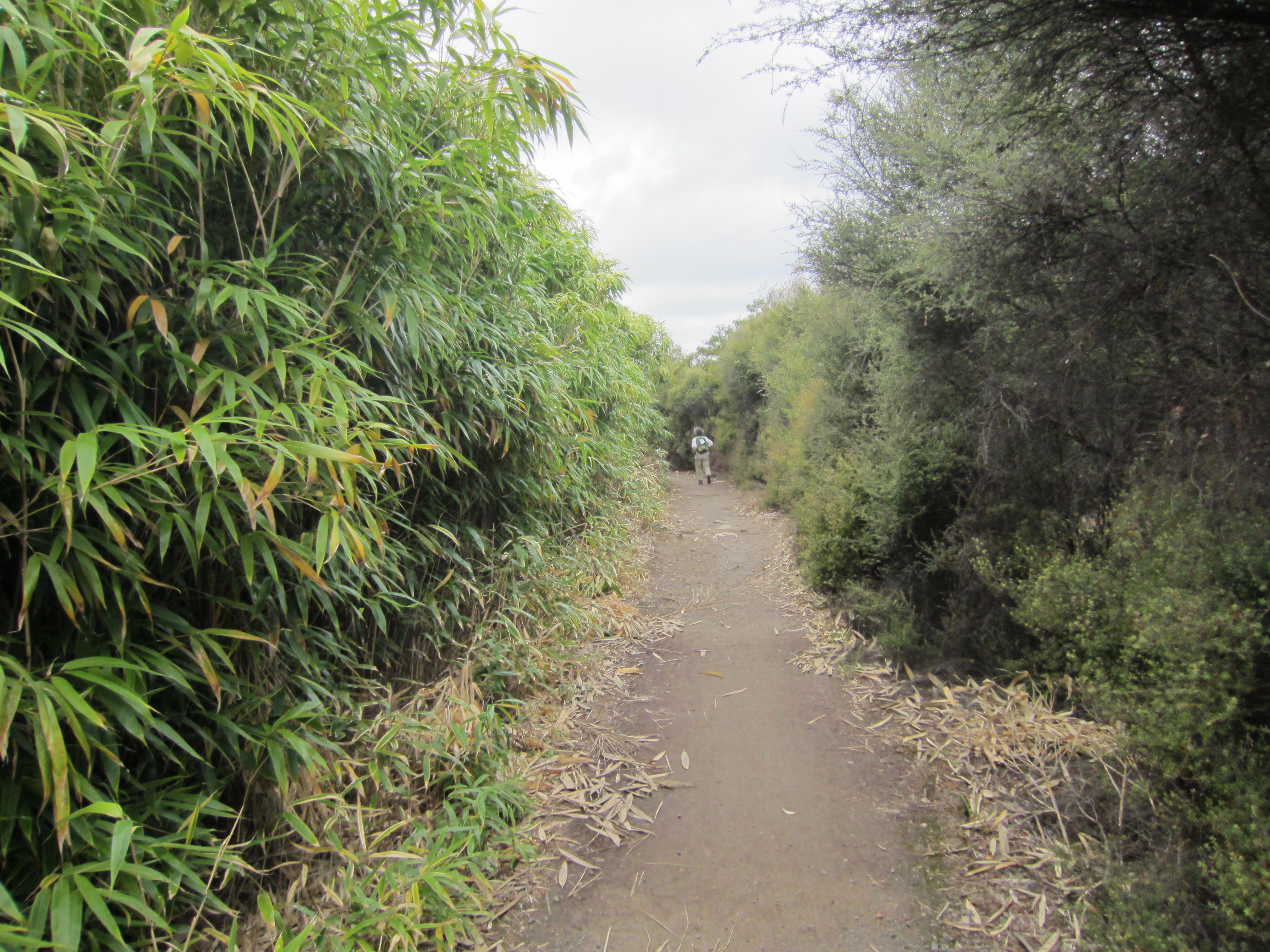
We walk along the border between an aggressive invasive species (bamboo) on the left, and a native species (tea tree) on the right.

Around 60 million Australian possums infest the forests and gardens of New Zealand. Cute but destructive. (Wikipedia image)

The following day we saw the Whakarewarewa forest in bright sunshine. The walk took us on a meandering path twenty kilometres through its various sections. Much of it is a working commercial forest producing radiata pine logs for sawn boards and paper chips. There is also an extensive and beautiful plantation of tall California redwood trees. The forest lies over a geothermal area with thermal pools and plumes of steam rising here and there. It is popular with mountain-bike riders who crunch the gravel paths at high speed, no doubt getting an exhilarating lift from the wind in their faces but missing the forest’s bird calls.

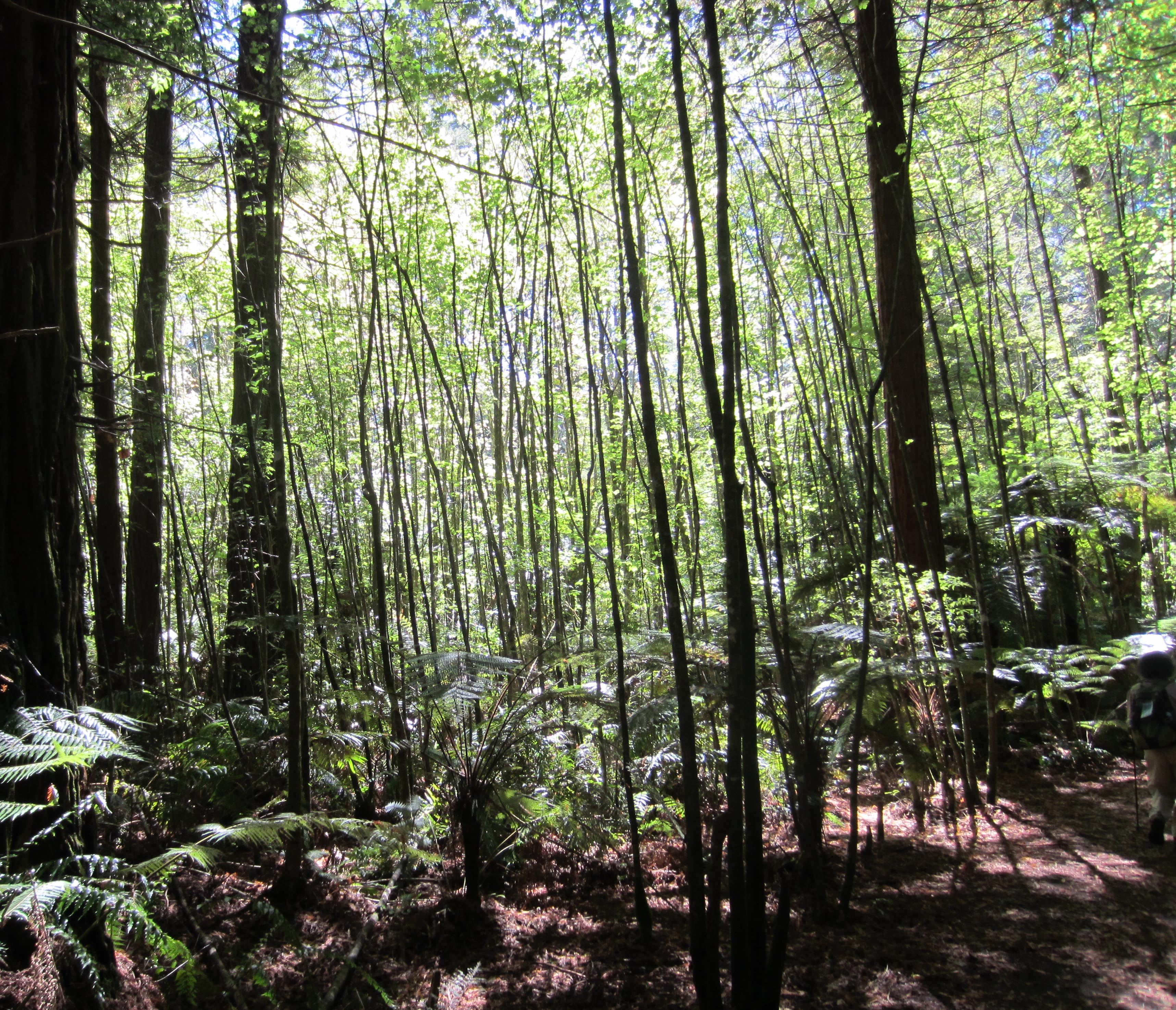
We are dwarfed by "young" north American redwood trees.

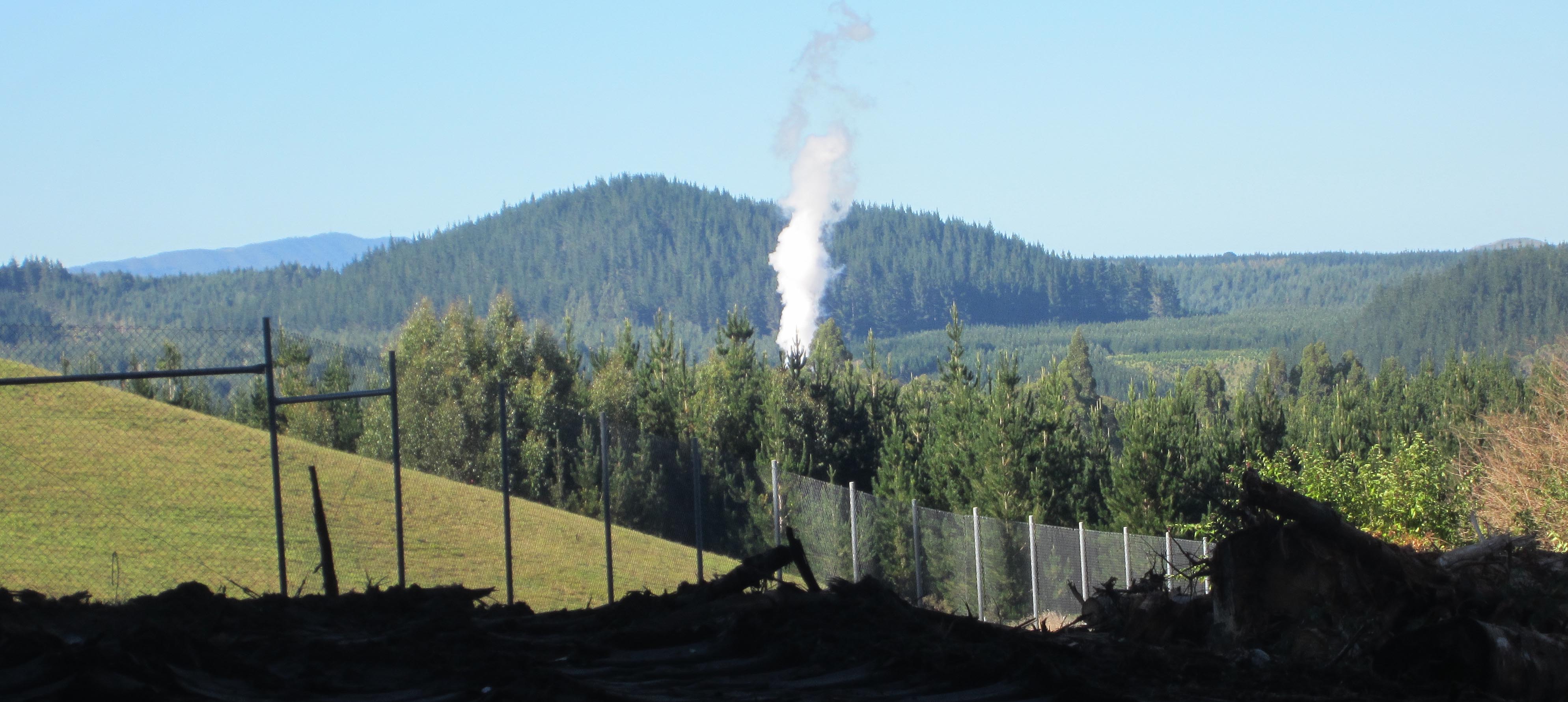
A plume of steam rises from a hot pool in Whakarewarewa forest.

It's not just possums that are a problem for the environment of New Zealand. Australian wallabies are getting in on the act too. We came across this dead one on a forest path.

Mr and Mrs Kim, proud Korean patriots.

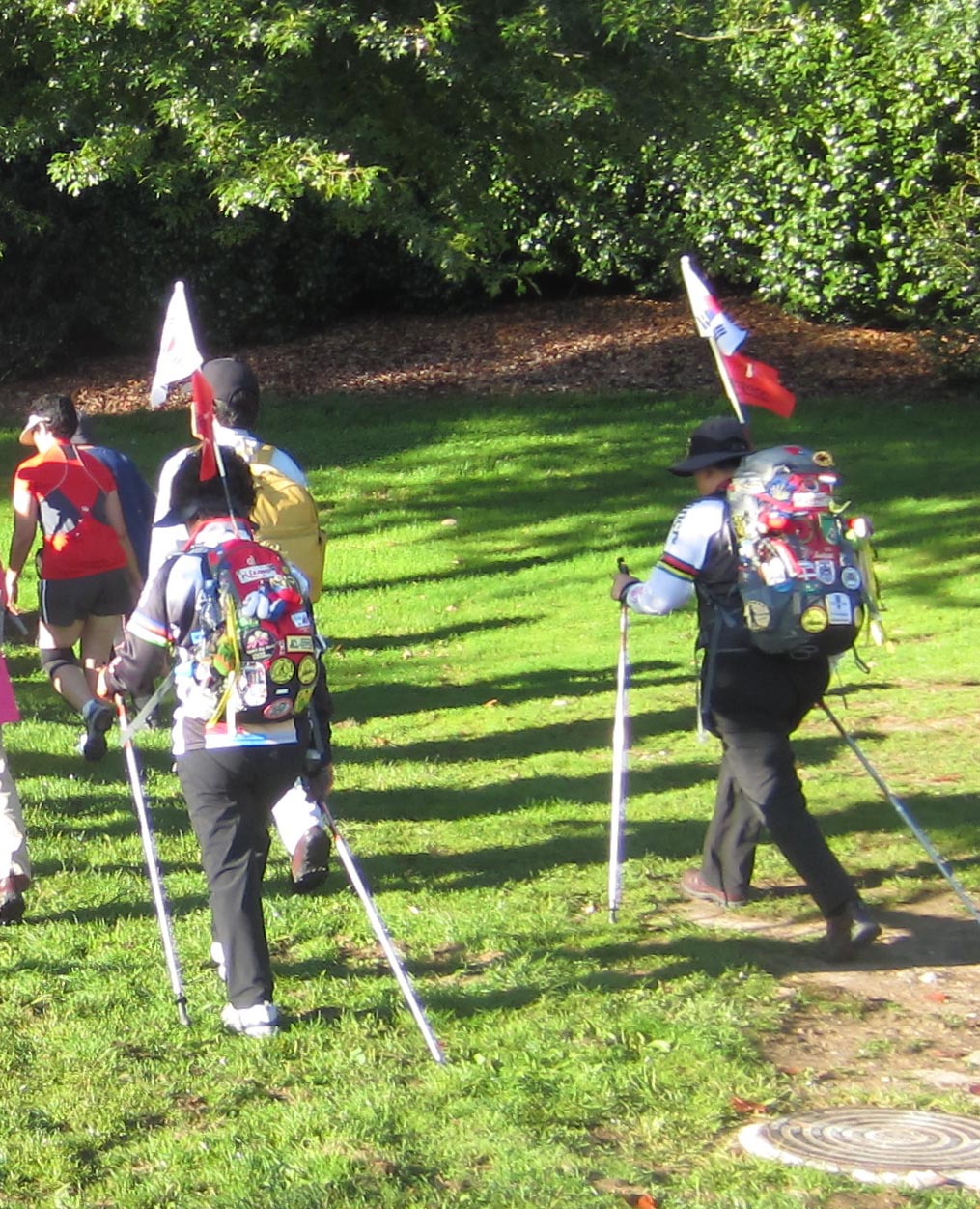
Ahead of us I saw the unmistakable figures of Mr and Mrs Kim from Korea. They walked under the flag of their country and the flag of Mr Kim’s company (he supplies tailor-made inner soles that correct problems in the gait of walkers). Crammed on their backpacks were colourful badges and patches gathered from walks all over the world. They propelled themselves forward with nordic walking poles, taking care to wield them in the technically correct fashion. Less spectacularly clad, but no less memorable, was the Dutch-New Zealand ocarina player. He piped us on to the track with “When the saints going marching in” and pushed us along with “Tulips from Amsterdam” and many other tunes.

Mr and Mrs Kim, the most "professional" of the walkers on the Rotorua two-day walk.
An ocarina virtuoso helps us conquer the Whakarewarewa track.

It was our ocarina virtuoso who also piped us into the Walk Centre after four and a half hours and twenty kilometres of bushland beauty. The warmth of the day had sapped our strength and we gratefully bit into the freshly picked, very juicy apples that local volunteers (some of them children) handed to walkers as they checked in.

Afternoon light amid the trees of Whakarewarewa forest.

Bird song greets the sunlight as it filters into the forest..

But Whakarewarewa is a "working forest" and this is the fate that awaits part of its wild beauty.

Between earth and asphalt: faith, hope and the modern world in the Camino pilgrimage

Heading for the same destination. Two roads to Santiago de Compostela, near Caldas de Reis, Galicia.

In the distant past, most pilgrims walked the Camino as an act of religious devotion, ritual penance or thanksgiving. Perhaps they were searching for remission of sins or paying off a moral debt. Maybe some believed that the travails of the walk tempered their souls in preparation for the rewards of a vividly imagined afterlife. Perhaps pilgrimage was a seasonal thing, something you did because winter had melted away and the restlessness of spring was tingling in your feet.

Today these rationales still propel some pilgrims. As Emmy and I walked the Via Portugues, we bobbed for a time in the wash from a group of earnest Spanish pilgrims. There were about a dozen of them: elderly women rolling along in black dresses and black stockings with snow-white Nike shoes; chattery, lip-sticked housewives; cheerful men with waistlines as lumpy as their backpacks; and several children making occasional watchful attempts at naughtiness. (One of the children was an African boy about 10 years old – probably a newly arrived orphan refugee – who couldn’t speak much Spanish and whose big eyes seemed filled with loneliness and bewilderment.) The party managed to combine solemnity with ebullience. They carried aloft a small cross on the end of a pole, and as they progressed they recited Hail Marys, sang hymns, thumbed their rosary beads, and knelt in roadside prayer.

But they were exceptions. In one way or another most of the pilgrims we met seemed to be… what is the right word… escapees? They kept their religious motivations (if they had any) to themselves but many walked with a kind of single-minded intensity, grunting and puffing with the clenched determination of marathon runners. Pre-Camino, they had probably been living a life that was regimented, stressed, noisy, cramped, fraught, compromised. They were hounded by a reality that grabbed them and bullied them, constricted their chests and glared relentlessly into their faces. On the Camino they were eager for an experience that would lift this weight of the everyday from them. To that extent they were “religious”.

In their book The Year We Seized the Day, Australian pilgrims Elizabeth Best and Colin Bowles report on their Camino experience. “It’s taken a week but – aware now of my solitary purpose – the urgency has finally left my feet. There are no bills to pay today, no calls to make, errands to run, traffic to battle, friends to meet or appointments to keep. But there is much work to be done. And it all revolves around the same four threads woven throughout every day: food, water, health and shelter. The life of a pilgrim is a life stripped bare, reduced to the essentials and nothing more.” [p.2]

Another Australian writes “Pilgrimage is about letting go of so many of the taken-for-granted props we have grown to depend on — cars and buses and trains to carry you from one place to another; the knowledge of where you will sleep this night; the ready availability of clothes and food. The journey of a pilgrim can depend on none of these. (“Strange encounters on the Spanish Camino” Tony Doherty Eureka Street 14/10/2009 http://www.eurekastreet.com.au/article.aspx?aeid=15731)

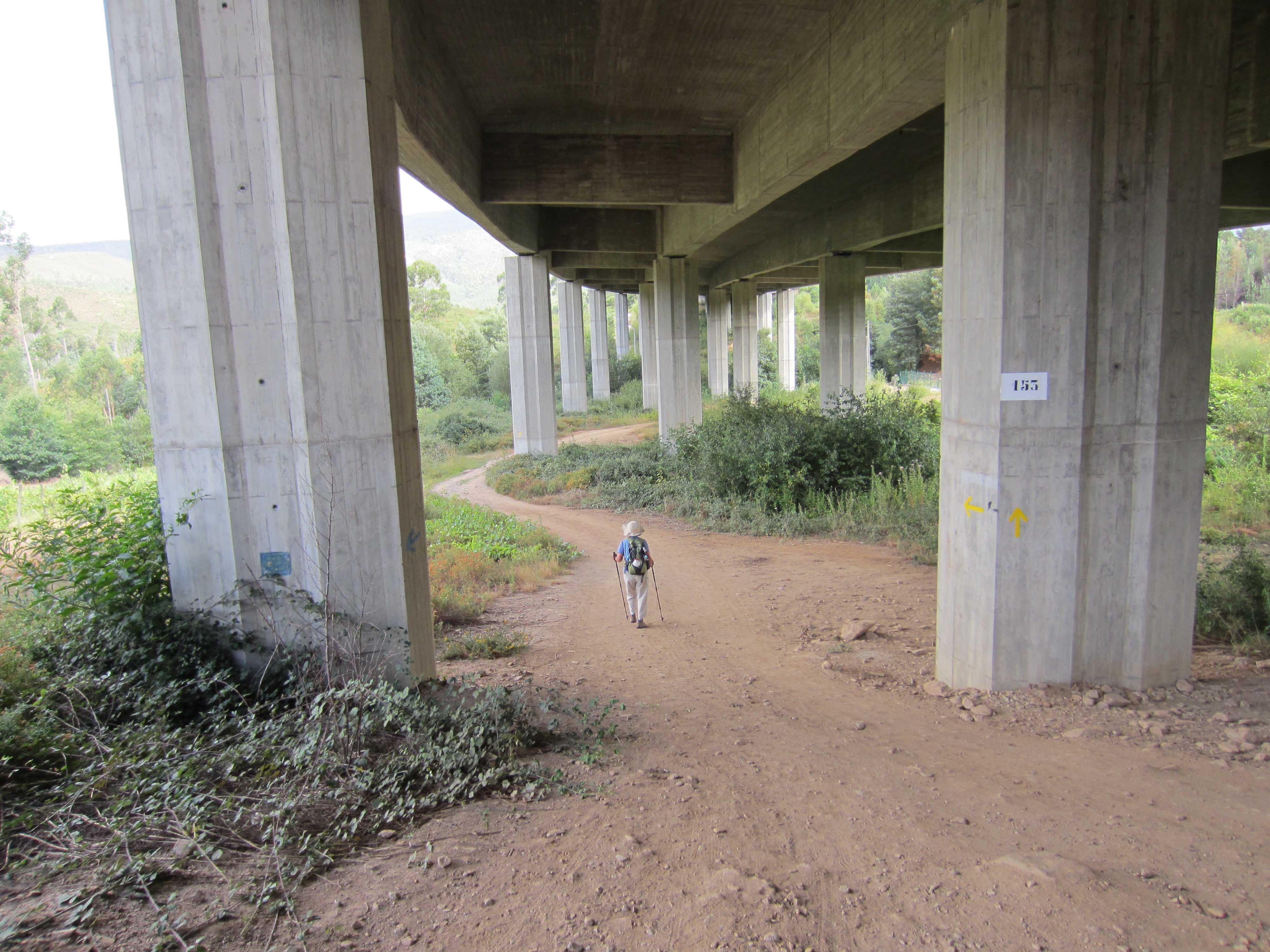
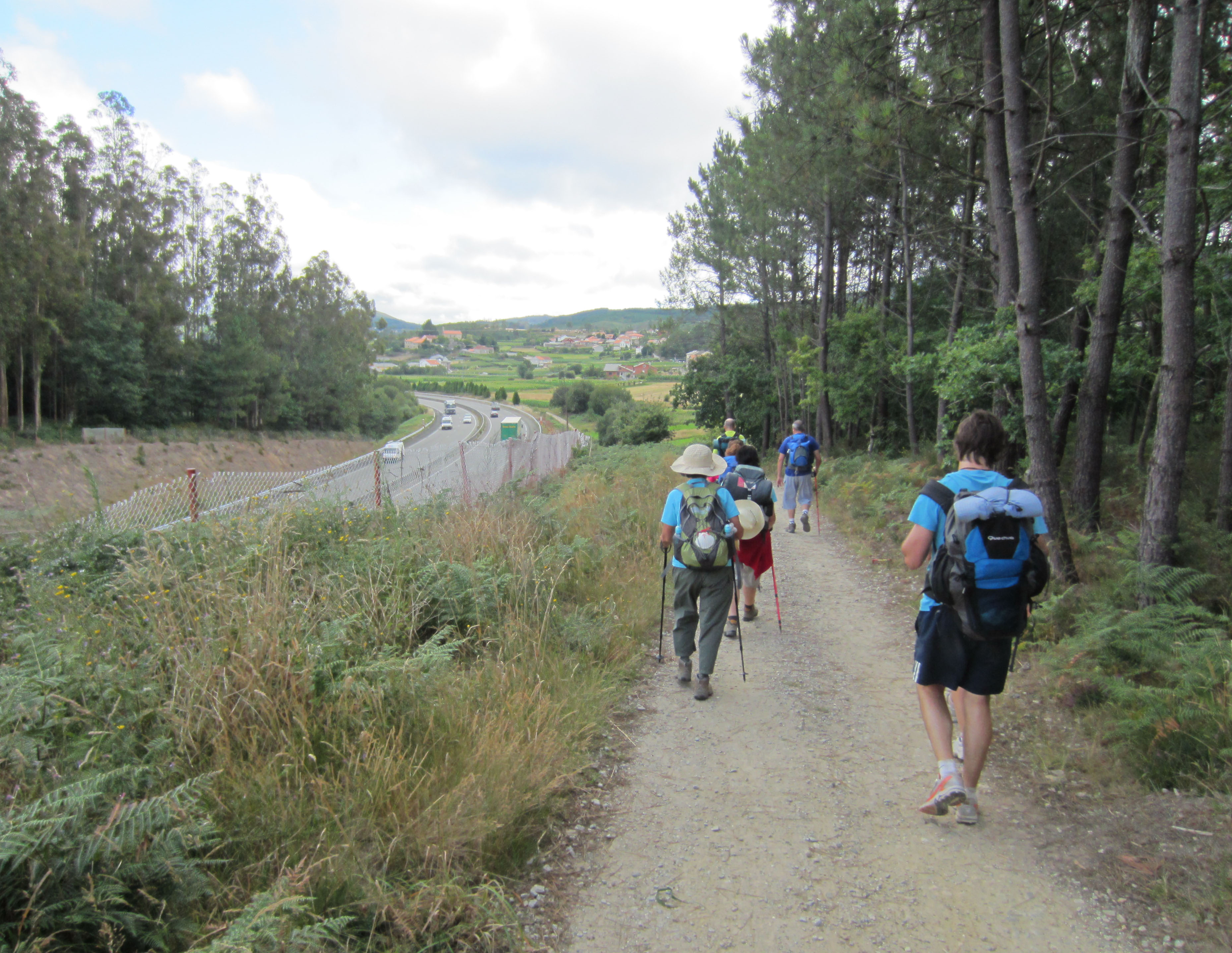
Irreconcilable cultures? The Camino passes under a freeway between Ponte de Lima and Rubiaes in northern Portugal. (If you look closely you can see the yellow arrows of  the Camino roughly painted on the pillar at front right. Very symbolic!)

Jane Christmas, a Canadian, wrote “The idea of a pilgrimage – it has such a Chaucerian ring – was irresistable. It evokes a noble challenge, a test of one’s faith on a harsh, unknown, ancient path, the sort of pursuit that taps the primal urge to wander with intense curiosity. The Camino seemed a logical, albeit extreme, next step in my reconciliation with Mother Nature. All I needed was a backpack of belongings, strong legs and boundless enthusiasm. Check. Check. Check.” (What the Psychic Told the Pilgrim, p.7)

There is a kind of excited innocence, and sometimes a scarcely concealed yearning, in these observations. They communicate a vision of the Camino as a back-to-basics path of pre-modern simplicity, a bucolic idyll speckled with antique buildings and beaming companions. Certainly this image is right up front in John Brierly’s canonical guides to the Camino pilgrimage routes – little books that almost all English-speaking pilgrims seem to carry (certainly we did). For example, Brierly greets woodland paths and country roads lyrically and contrasts them with the harshness and danger of asphalt highways.

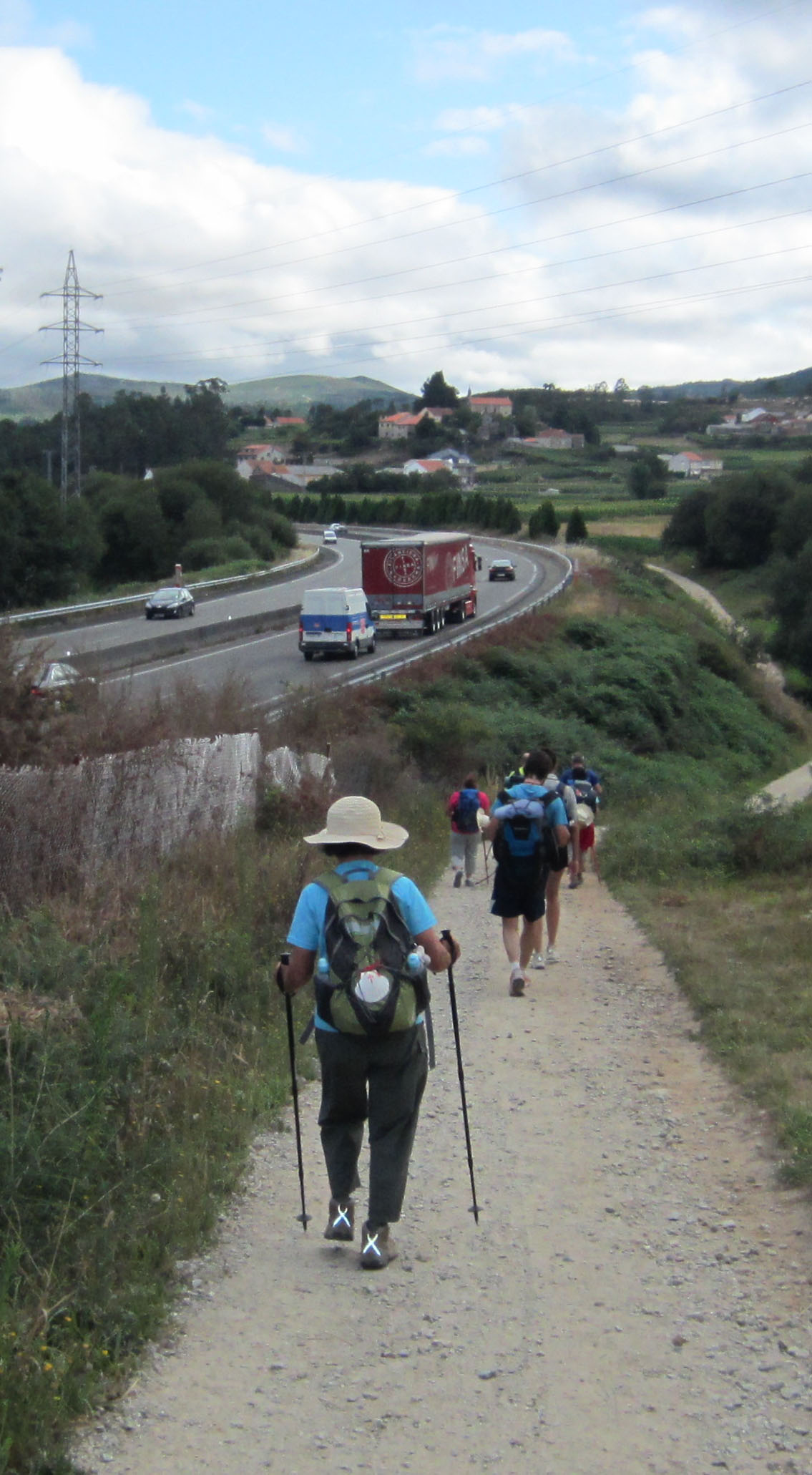
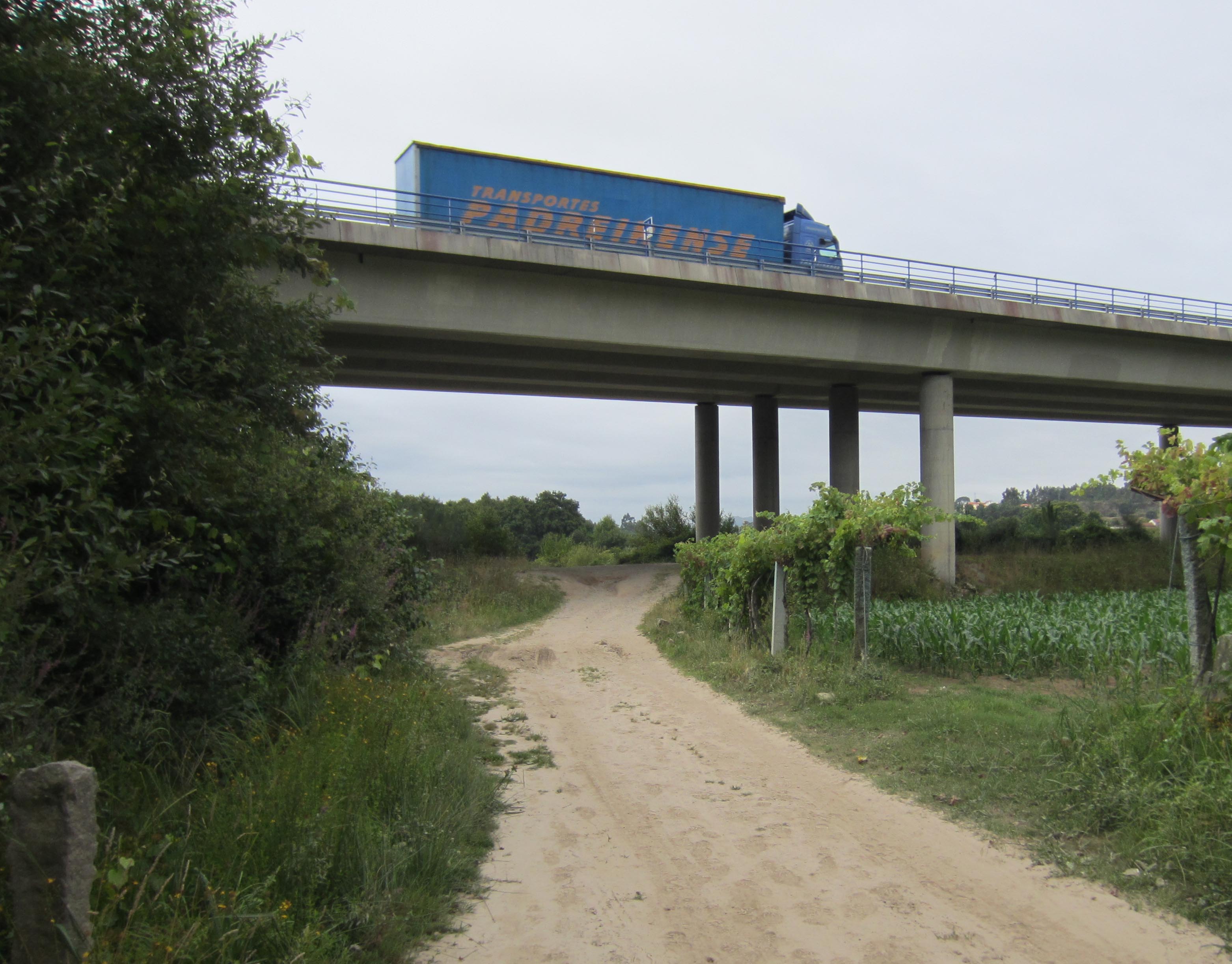
A truck passes over the Camino path. It is probably carrying the necessities of life that pilgrims must consume in order to keep walking.

“We now have our first glorious day where natural paths account for over half the route and there are no main roads at all.” (Camino Portugues p.132) “Most of this stage is along quiet country roads and woodland paths that follow the lovely Rio Louro valley. There is good shade and several drinking fonts along the way. The challenge today is the stretch of main road both entering and leaving the industrial town of Porrino and the slog through its industrial estates.” (Camino Portugues p.148)

For Brierly and, I suspect, for most pilgrims, walking the Camino is an exercise in the hope of redemption, a redemption that is beyond our grasp on the traffic-fraught highway of our ordinary lives. “We have a sacred contract, a divine function, and a reason why we came here. Perhaps your calling to go on pilgrimage will be the opportunity to find out what the purpose is and to provide the necessary space to re-orientate your life towards its fulfilment.” (Camino Portugues p.9) “And so, like a latter day Rip van Winkle we rise to dust off our boots and join the merry band of pilgrims making their way through the welcoming beauty and peace of northern Portugal to the city of St. James in neighbouring Galicia. You will meet other wayfarers and the native folk whose lands you pass over, but above all you may meet your Self, and that may make all the difference.” (Camino Portugues p.18)

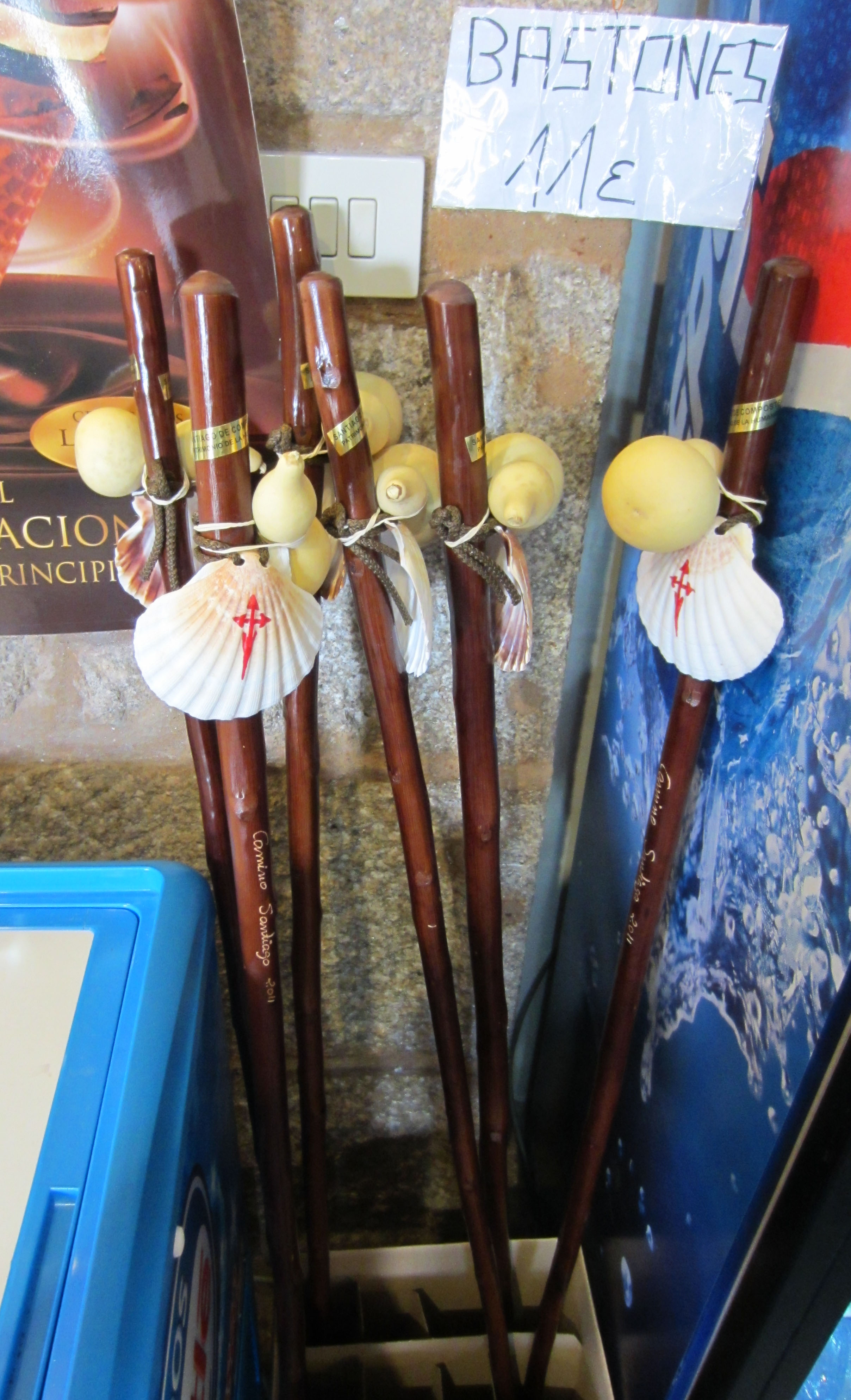
Souvenir staves, shells and water gourds… just 11 euros per set in a souvenir shop in Tuy on the Spain-Portugal border.

Unfortunately for the integrity of this vision, the great python of the tourist industry has wound its coils around the Camino pilgrimage and is squeezing hard. Its jaws are already clamped over the city of Santiago de Compostela and it is sucking in the roads that lead to the city. Slowly the liminal innocence of the pilgrimage is being gulped down, helped along by peristaltic waves of seasonal enthusiasm generated by the tourist industry, the church, and supportive government policy. Tim Moore, an American who walked the Via Frances with a donkey, catches this half-ingested – half spiritual, half self indulgent – quality with sardonic accuracy. “… [walking the Camino] was the search for something beyond the typical tourist routine, an antidote to the vacuous consumerism of contemporary travel. A trip to the moral high ground – I hear the view’s excellent up there. A trip purged of the empty decadence that characterised most foreign trips, yet still demanded alcoholic indulgence in the name of historical authenticity. A holiday that wasn’t a holiday, even though it involved going to Spain. A journey of transcendental discovery that was also a stiff but sensible aerobic challenge, and whose inherent asceticism had the happy side benefit of economy. A medieval tale retold for our times but at 1350 prices.” (Spanish Steps 2005, p.5)

The fact is, the Camino cannot be disentangled from the lifestyle it is supposed to reproach. Its romanticised “otherness” is a delusion. The despised asphalt highway carries the food that pilgrims eat, the materials that build albergues and hotels, the buses that whisk staff to the airports that pilgrims use, the vans that run sherpa services for pilgrims, the trucks that deliver souvenirs to the shops of Santiago de Compostela. To be blunt, it is this “degraded” world of modern commerce that makes mass pilgrimage possible. There is no return to a medieval past, there is no genuine stripped-down simplicity, except in the imagination of pilgrims determined to shut out reality and romanticise their walk. Today the Camino pilgrimage is in a symbiotic embrace with the economy of northern Spain. The two infuse each other and give momentum to each other. They are Siamese twins with a single heart.

The cathedral of Santiago records the number of compostela certificates issued to pilgrims who complete the pilgrimage. The statistics show that pilgrim numbers have been rising steadily since the 1980s. Last year there were 272,000 arrivals at the cathedral, though 2010 was a Holy Year when higher numbers than usual walked the Way. The current year 2011 will probably see close to 200,000 arrivals, down from last year but still a very big number and well up on the 146,000 of 2009. These multitudes have to be sheltered and fed in the small towns and villages they pass through. As Tony Kevin says: “… the economic value of the pilgrimage in encouraging remote-area tourism and bringing more economic activity into isolated villages [has been] accepted. Of course, the pilgrimage has wider long-term benefits for Spanish tourism: walkers on the camino may not be big spenders, but they may return in later years with their families for more conventional holidays in Spain.” (Walking the Camino p.39)

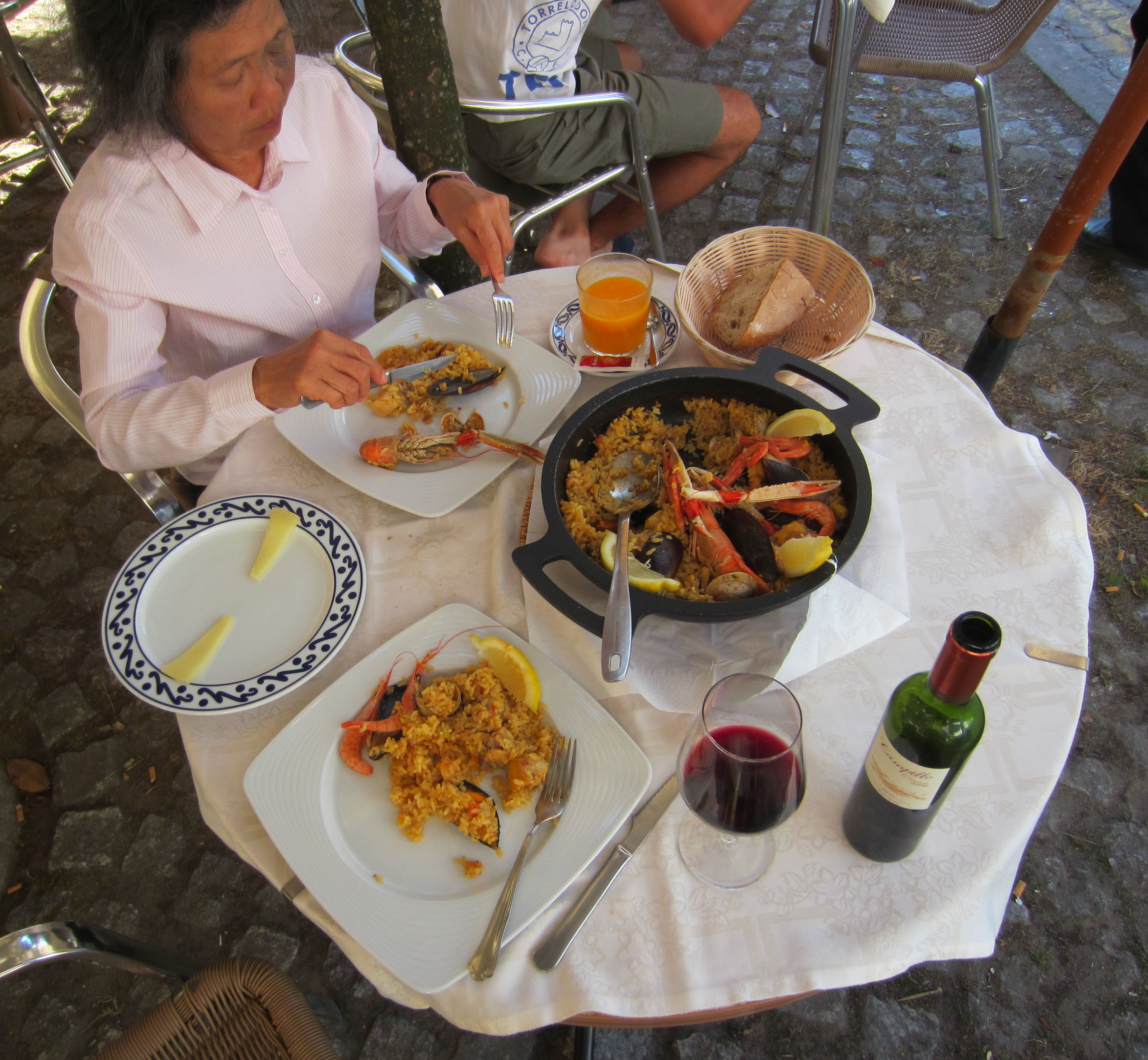
Hungry pilgrims who like to eat well (like Emmy and me, for example) keep countless local restaurants alive.

And the commercial momentum of the Camino pilgrimage is flowing out across the borders of Spain. In scores of cities across the world young women in shiny high-heels, and young men wrapped in the fragrance of after-shave, are sitting in front of computers making money from the provision of services for sweaty, dusty pilgrims. Emmy and I were customers of Follow the Camino, a company based in Dublin. Working via the internet and email they organised our accommodation, arranged sherpa transport of our suitcases from stopping-point to stopping-point, and supplied information about the route. It was relatively expensive but for us it was money very well spent. [see: http://www.followthecamino.com/]

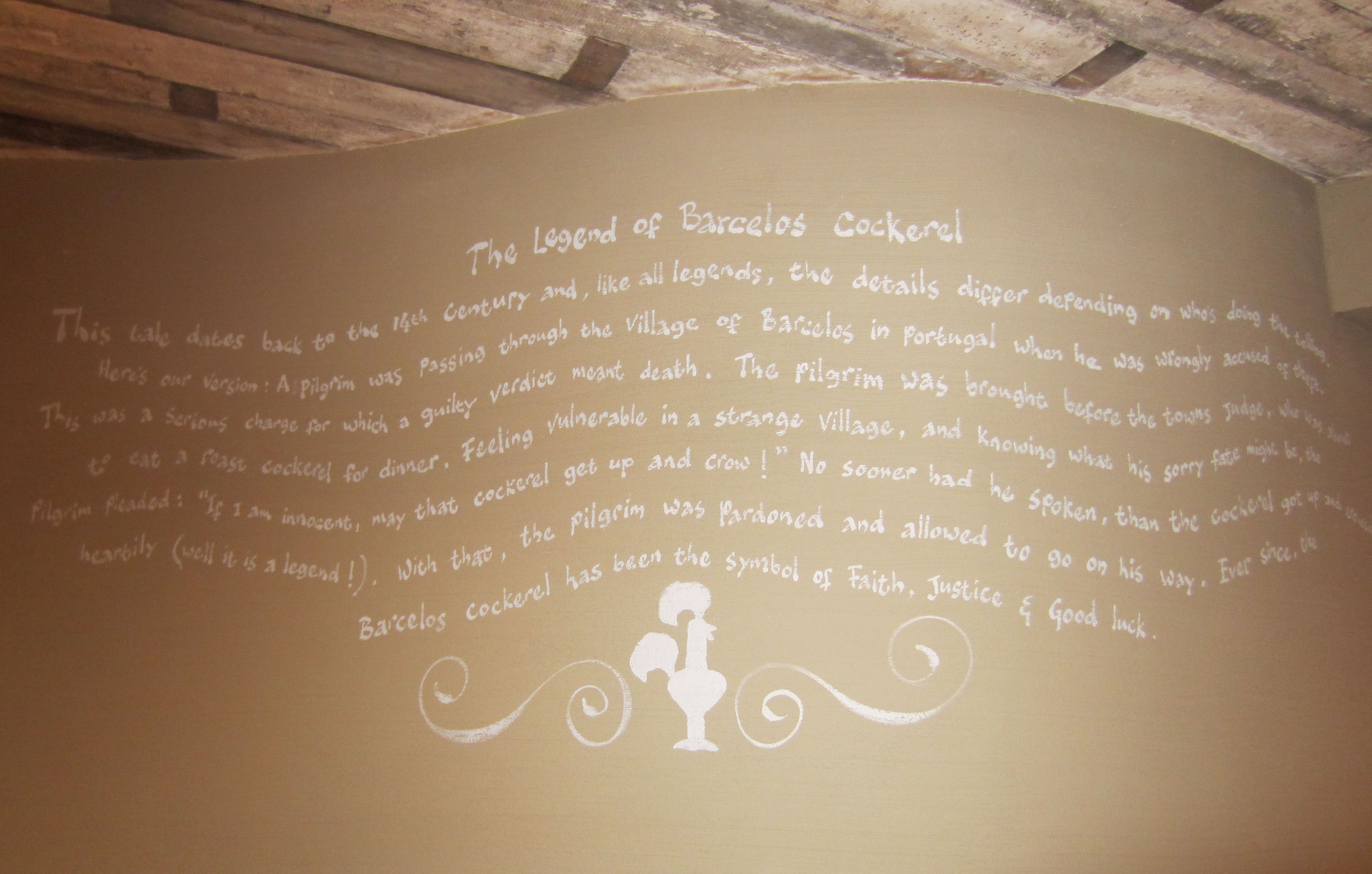
In Carlisle, northern England, we celebrated our completion of the Cumbria Way walk (see Footsore in Carlisle: We complete the Cumbria Way posted August 22, 2011) with a meal at Nando’s in Warwick Street, one of a world-wide chain of restaurants that specialise in fried chicken spiced with Portuguese peri-peri sauce. A Camino story was emblazoned in wavy lines of lettering on the wall behind us.

“This tale dates back to the 14th century and, like all legends, the details differ depending on who’s doing the telling. Here’s our version. A pilgrim was passing through the village of Barcelos in Portugal when he was wrongly accused of theft. This was a serious charge for which a guilty verdict meant death. The pilgrim was brought before the town’s judge who was about to eat a cockerel for dinner. Feeling vulnerable in a strange village, and knowing what his sorry fate might be, the pilgrim pleaded: “If I am innocent, may that cockerel get up and crow!” No sooner had he spoken than the cockerel got up and crowed heartily (well it is a legend!) With that, the pilgrim was pardoned and allowed to go on his way. Ever since, the Barcelos cockerel has been the symbol of Faith, Justice & Good Luck.”

… and – we should add – it is also the symbol of Nando’s peri-peri fried chicken.

A story from the Camino pilgrimage on the wall of Nando’s peri-peri chicken restaurant in Carlisle, northern England.

Thus does the power of a Camino narrative lend pseudo-religious authority to Nando’s corporate image, helping the company to filch money from the pockets of diners and boost profits even in the bleak streets of distant Carlisle.

For many pilgrims, walking the Camino is a “spiritual” experience they imagine (or hope?) is utterly different from stressing out on the highways of modern society…

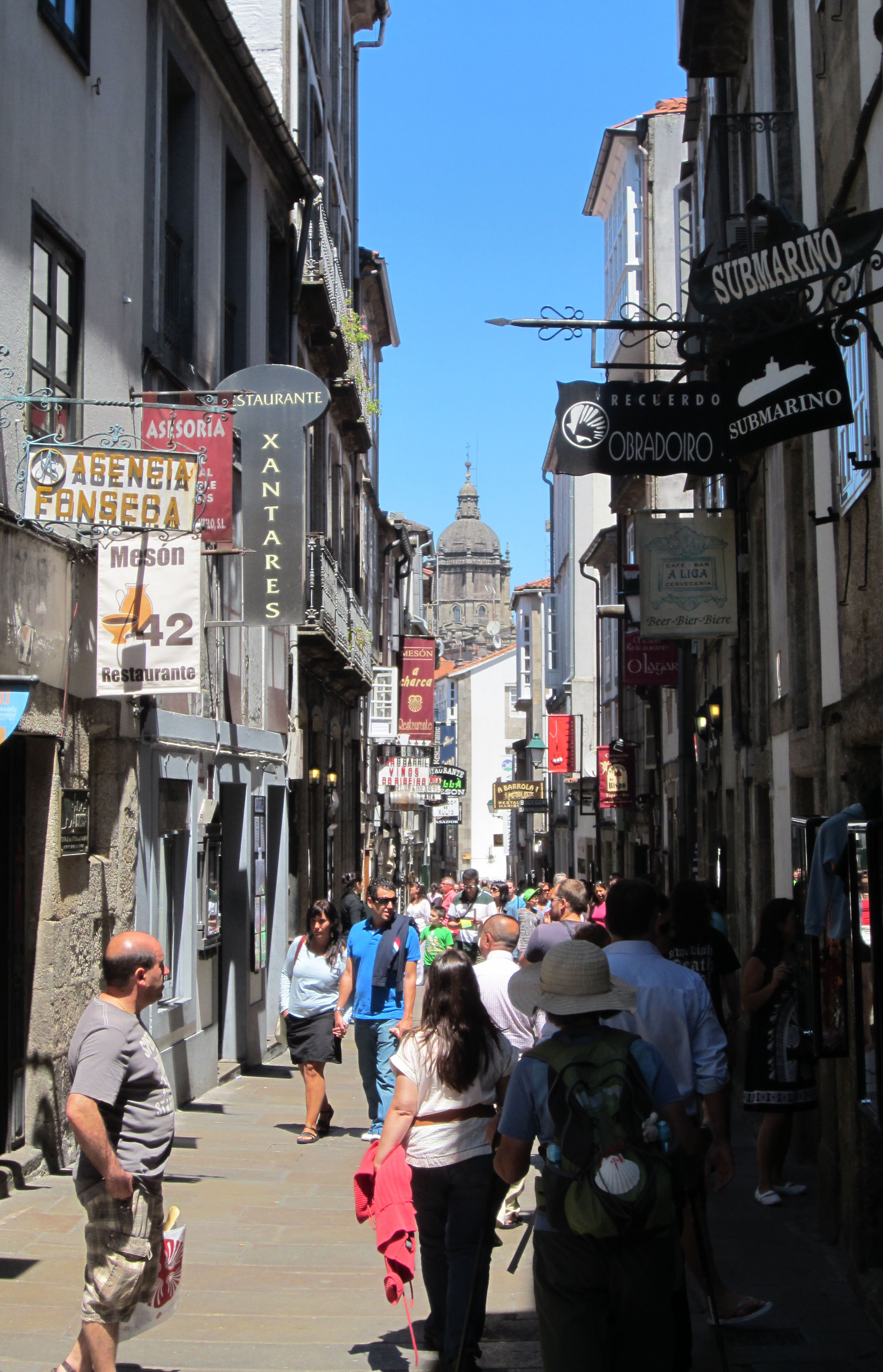
… but the Camino depends absolutely on those highways, i.e. on the infrastructure of modern commerce, and can’t be disentangled from it. In Santiago de Compostela the earthen path and the asphalt highway merge in the city’s narrow lanes – packed with restaurants and souvenir shops – that lead to the cathedral.

Traditions, rituals and icons of the Camino

The Cross of St.James

Over the centuries traditions, rituals and unique icons have gathered like age lines on the face of the Camino. They lend the pilgrimage an endearing, antique charm. Pilgrims fresh from the hard streets of Warsaw, Seattle, Madrid, even Canberra, embrace them with enthusiasm. Some seem to believe very genuinely that the Camino’s rituals bring them religious illumination and merit. Others may be looking for some vague connection with the past. Quite a few, perhaps more than a few, are simply and sincerely hoping that, as they walk the Camino, they are “doing it right”, like tourists solemnly stumbling through an exotic local dance at their resort hotel.

Canberra writer Tony Kevin, who walked to Santiago over the Via de la Plata and wrote a fine book about it (Walking the Camino: A Modern Pilgrimage to Santiago, 2007), quotes part of a poem by sixteenth century adventurer Walter Raleigh:

Give me my scallop-shell of quiet,

My staff of faith to walk upon,

My scrip of joy, immortal diet,

My bottle of salvation,

My gown of glory, hope’s true gage,

And thus I’ll take my pilgrimage.

The Passionate Man’s Pilgrimage (1604)

Many of these trappings are still to be seen in the Camino pilgrimage four hundred years later. The scallop shell, the staff (today more commonly a telescopic carbon-steel walking pole), the pilgrim’s menu (the quality of which sometimes threatens to deliver you more quickly than you expected to the realm of immortality), the calabash gourd bottle (today replaced by steel or plastic bottles, even by “camel-back rehydration bladders”)… all these and more still extend their offer of symbolic authority to the modern pilgrim. In their current incarnations they can connect us to the distant past, though there is no doubt that today their power as religious symbols has weakened.

Here are notes on some of these rituals and traditions as I experienced them on the Via Portugues in July 2011.

The yellow arrow

The yellow Camino arrow with (pointing in the opposite direction) the blue arrow of the pilgrimage to Fatima in Central Portugal.

Along all the branches of the Camino you will find yellow arrows pointing the way to Santiago de Compostela. They appear on walls, trees, roadside milestones, footpaths and in formally painted signs. Mostly they have been put in place, and are re-painted from time to time, by pilgrim support organisations. In northern Portugal they appear every few hundred metres. Occasionally they are no more than a few metres apart, especially at intersections or in places where there might be doubt about the correct way forward. The yellow arrows are less frequent on the Spanish leg of the Via Portugues, but there are still plenty of way markers in the form of tiles with the scallop shell motif (see below). Like many traditions along the Camino, the yellow arrows are not as old as they are sometimes taken to be. In fact their use as way markers dates back no further than the 1980s, attributed to Don Elias Valina Sampedro (died 1989), a priest of O Cebreiro parish on the Via Frances to the east of Santiago de Compostela. He pioneered the restoration of the Camino pilgrimage in the 1970s and 1980s. In Portugal the now ubiquitous arrows first appeared no more than 10 years ago.

Don’t follow the asphalt road! Three arrows on tree trunks direct you down a side path in northern Portugal.

The scallop shell

A scallop shell tile on a wall approaching the outskirts of Santiago de Compostela.

Outside the massive front doors of the cathedral in Tuy a street vendor presses his wares on visitors. He is selling scallop shells harvested from beaches along the Iberian coast. They cost €1.50 (about Aust$2.00) each. They gleam in mat-white ivory with the characteristic fan-shaped pattern of grooves radiating over their gently arched outer surfaces. For reasons that are now hidden under the mildew of time the scallop shell has become the iconic symbol of the Camino pilgrimage. In stylised form it is seen everywhere, especially on tiles that – cemented to walls and milestones – point the way to Santiago. Many pilgrims display the shells on their clothes and gear, or dangle them from their walking staves. The symbol is old, and there are many stories about its origins. Here are two (quoted from Wikipedia):

Version 1: After James’ death, his disciples shipped his body to the Iberian Peninsula to be buried in what is now Santiago. Off the coast of Spain a heavy storm hit the ship, and the body was lost to the ocean. After some time, however, the body washed ashore undamaged, covered in scallops.

Version 2: After James’ death his body was mysteriously transported by a ship with no crew back to the Iberian Peninsula to be buried in what is now Santiago. As James’ ship approached land, a wedding was taking place on the shore. The young bridegroom was on horseback, and on seeing the ship approaching, his horse got spooked, and the horse and rider plunged into the sea. Through miraculous intervention, the horse and rider emerged from the water alive, covered in seashells

Scallop shell in a city footpath (Tuy, north western Spain)

The scallop shell on my backpack identifies me as a Camino pilgrim.

Drinking fountains

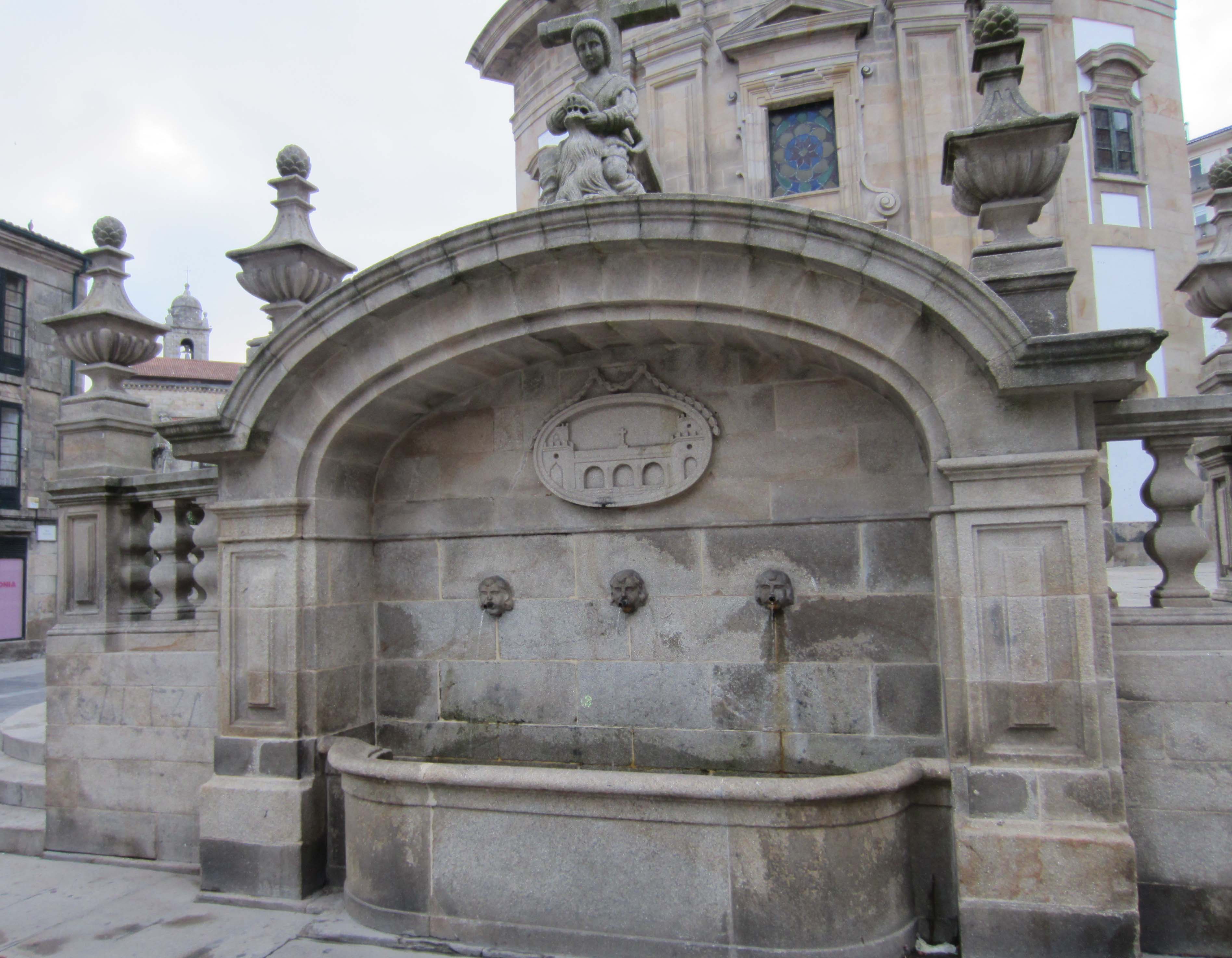
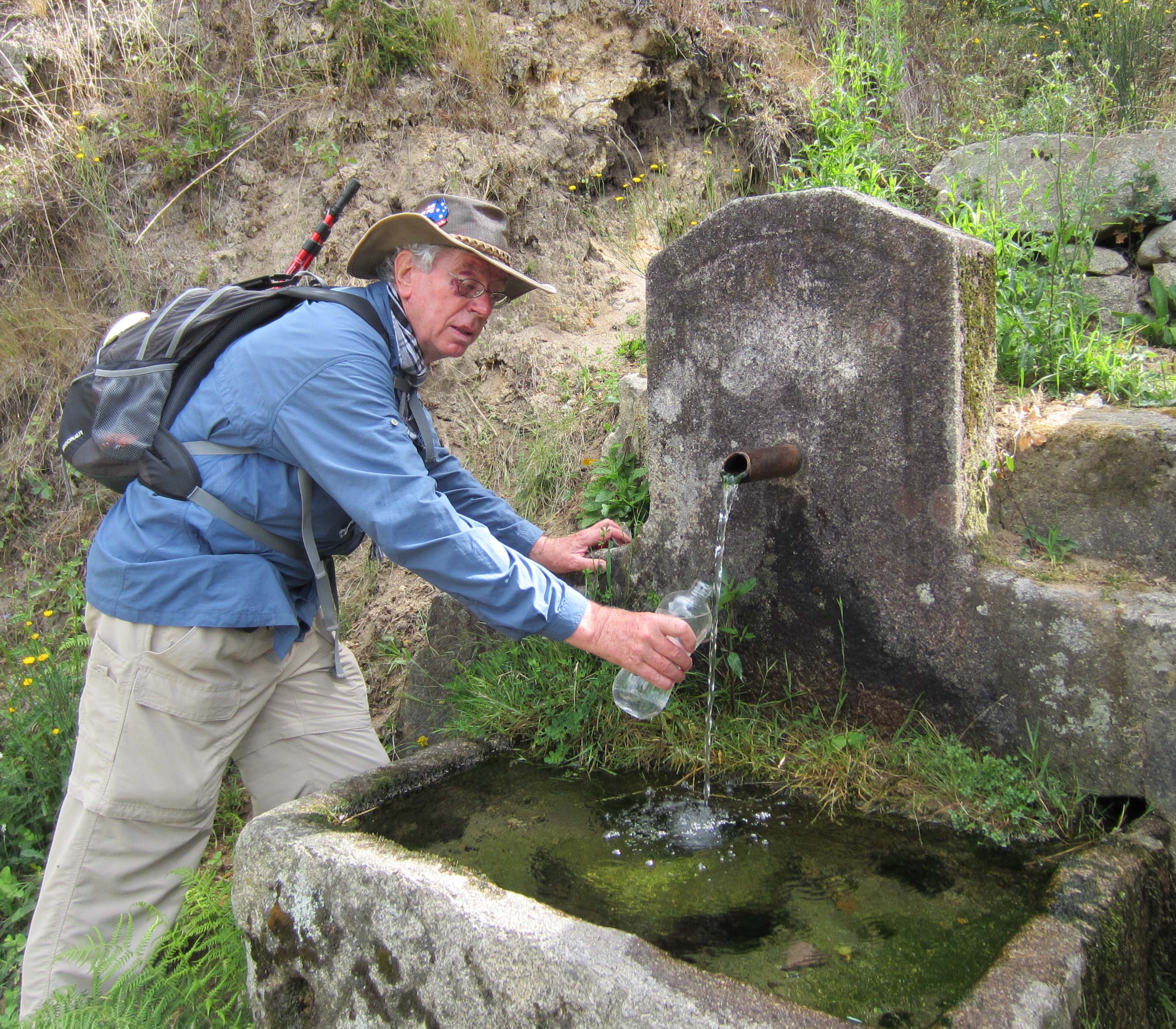
At many points along the Way there are water spouts emptying into stone bowls where pilgrims can drink and refill their water bottles. Called fonte in Portuguese and fuente in Spanish, many are clearly very old. They make an appearance in Walter Raleigh’s poem where he dreams of what he will do for “peaceful pilgrims”…

I’ll take them first

To quench their thirst,

And taste of nectar suckets,

At those clear wells

Where sweetness dwells

Drawn up by saints in crystal buckets.

Exotic stories cling to some of them. At the very least, for some pilgrims they have powerful symbolic value. Triple spouts (of which there are many in Portugal and Spain) are taken to represent the triple refreshments of the Christian Trinity. As Raleigh put it 400 years ago:

There will I kiss

The bowl of bliss,

And drink mine everlasting fill;

Upon every milken hill:

My soul will be a-dry before;

But after, it will thirst no more.


A triple fuente in the centre of Pontevedra, Spain

I fill up at a wayside drinking fountain in northern Portugal. Note my still-fresh black eye (see “Fajozes to Barcelos: Disaster (almost)” posted July 19, 2011)

Stones of sorrow

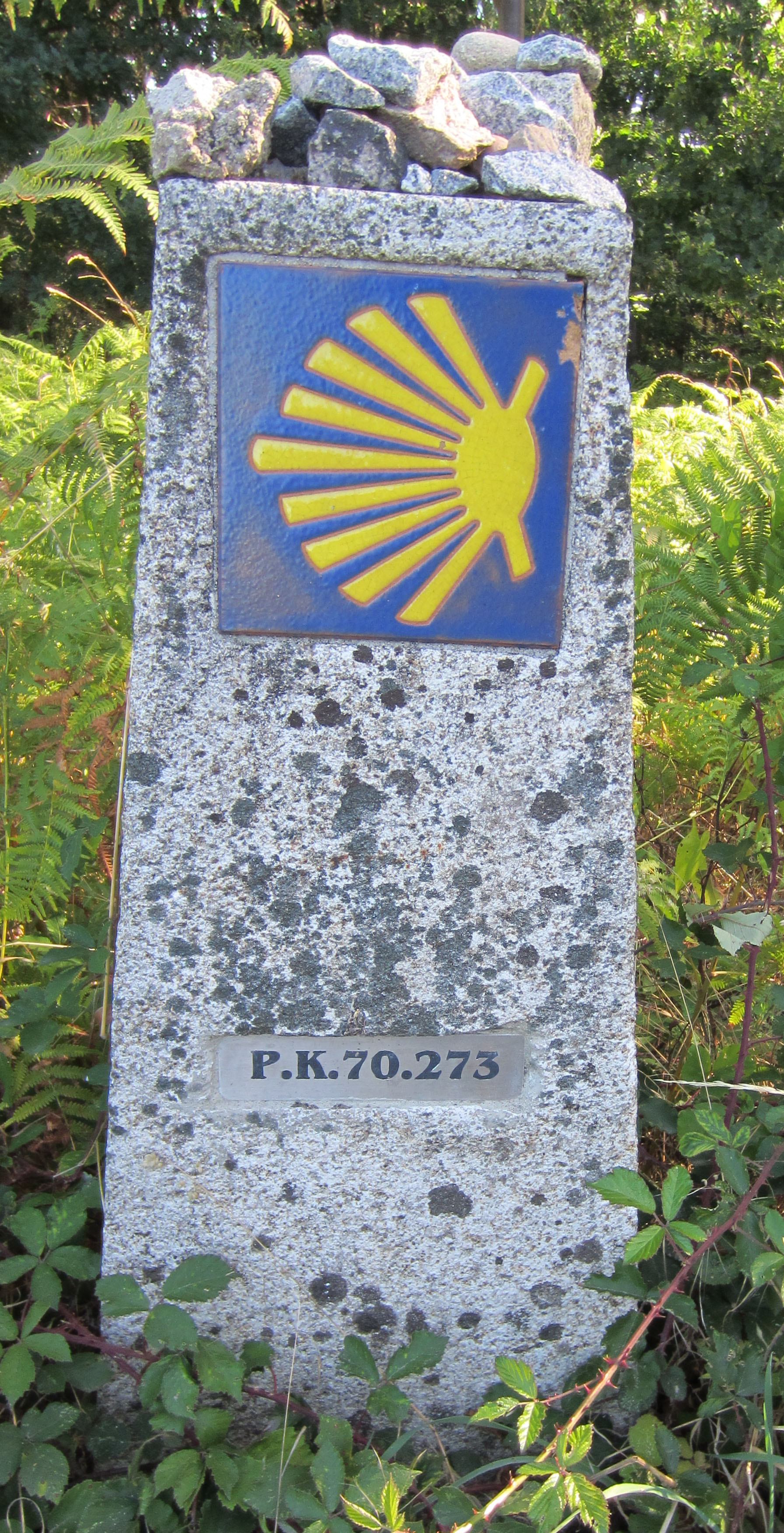
A milestone heaped with pebbles of sorrow. Note the number below the tile… just 70 kilometres more to Santiago.

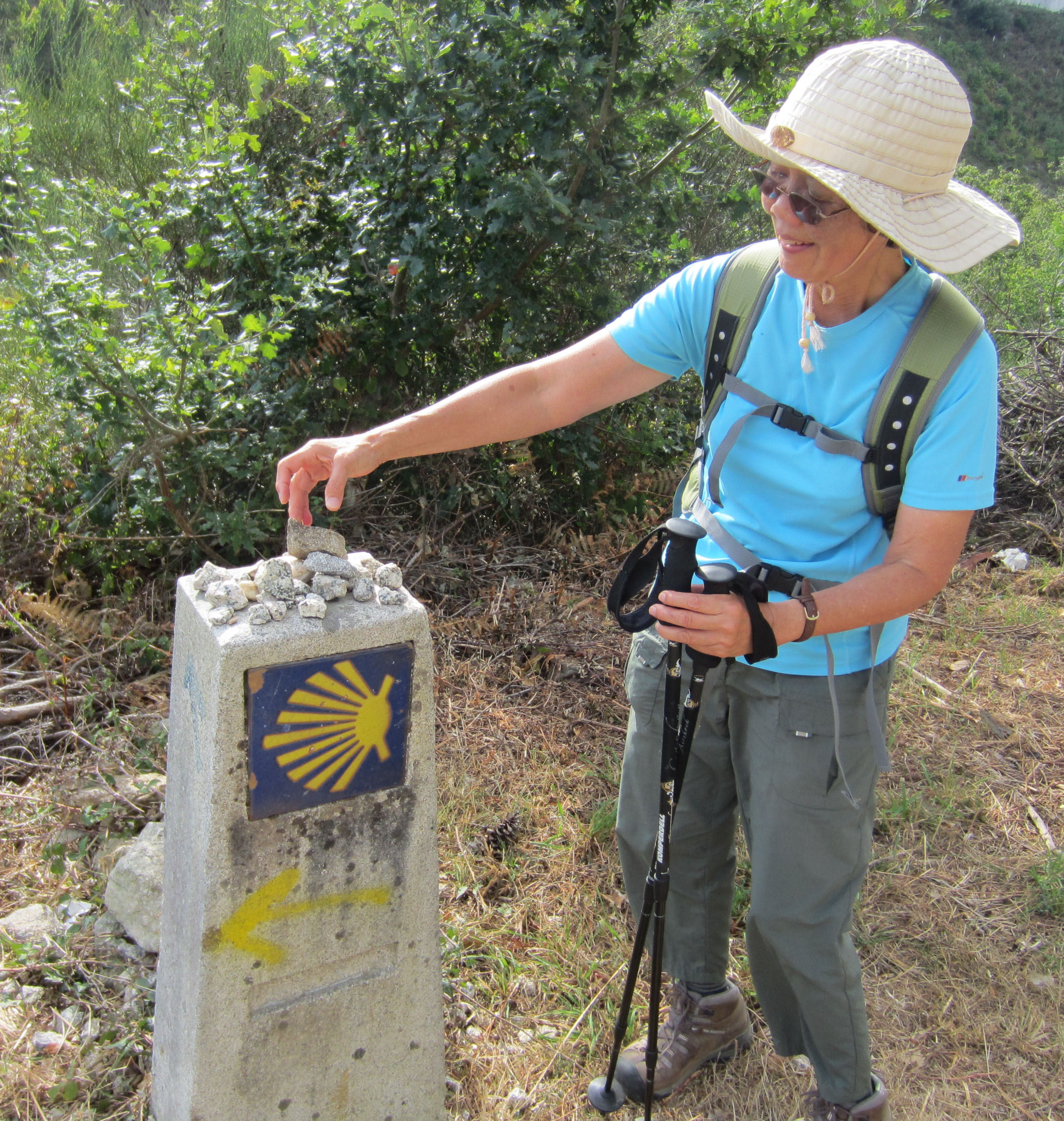
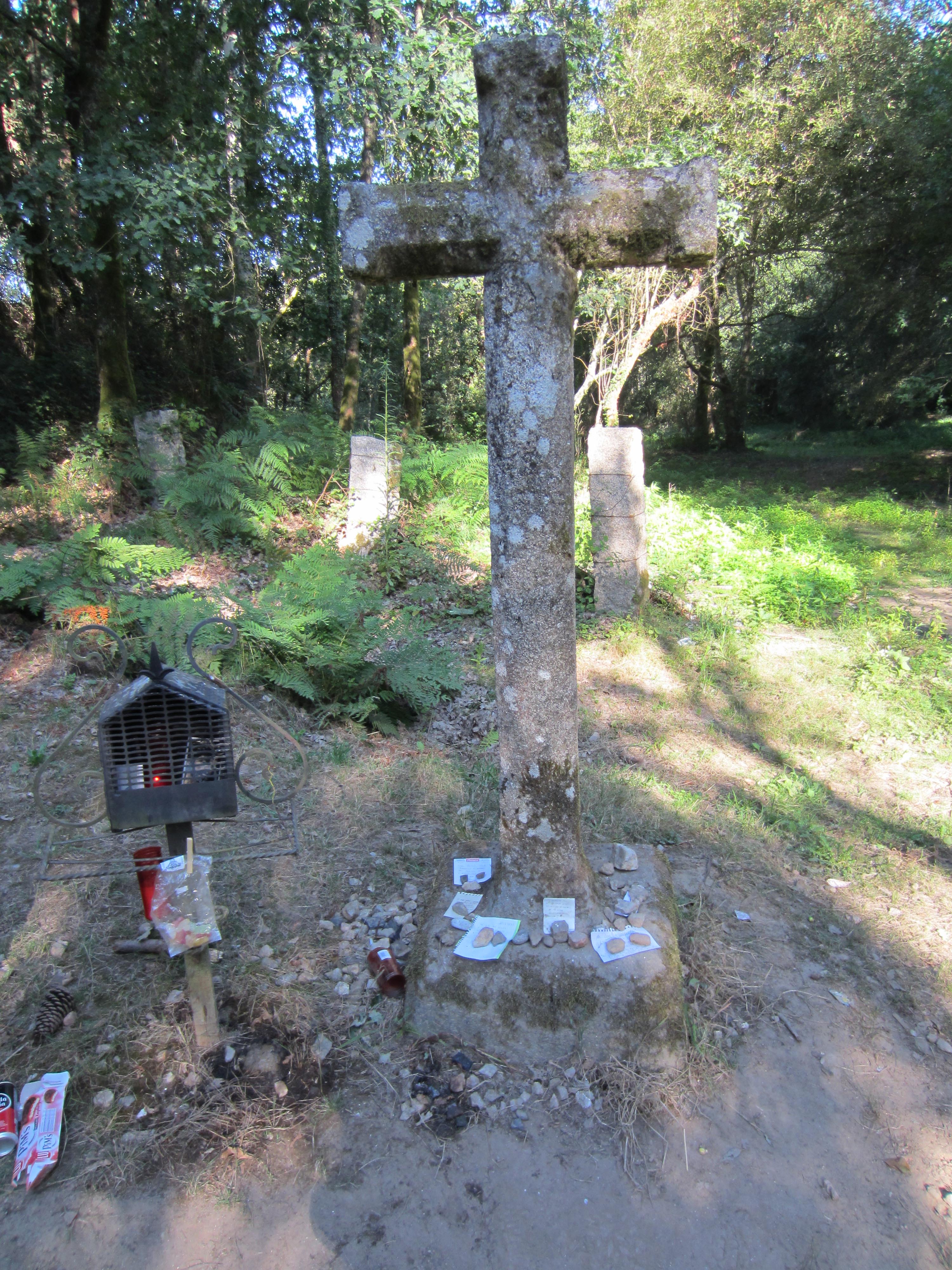
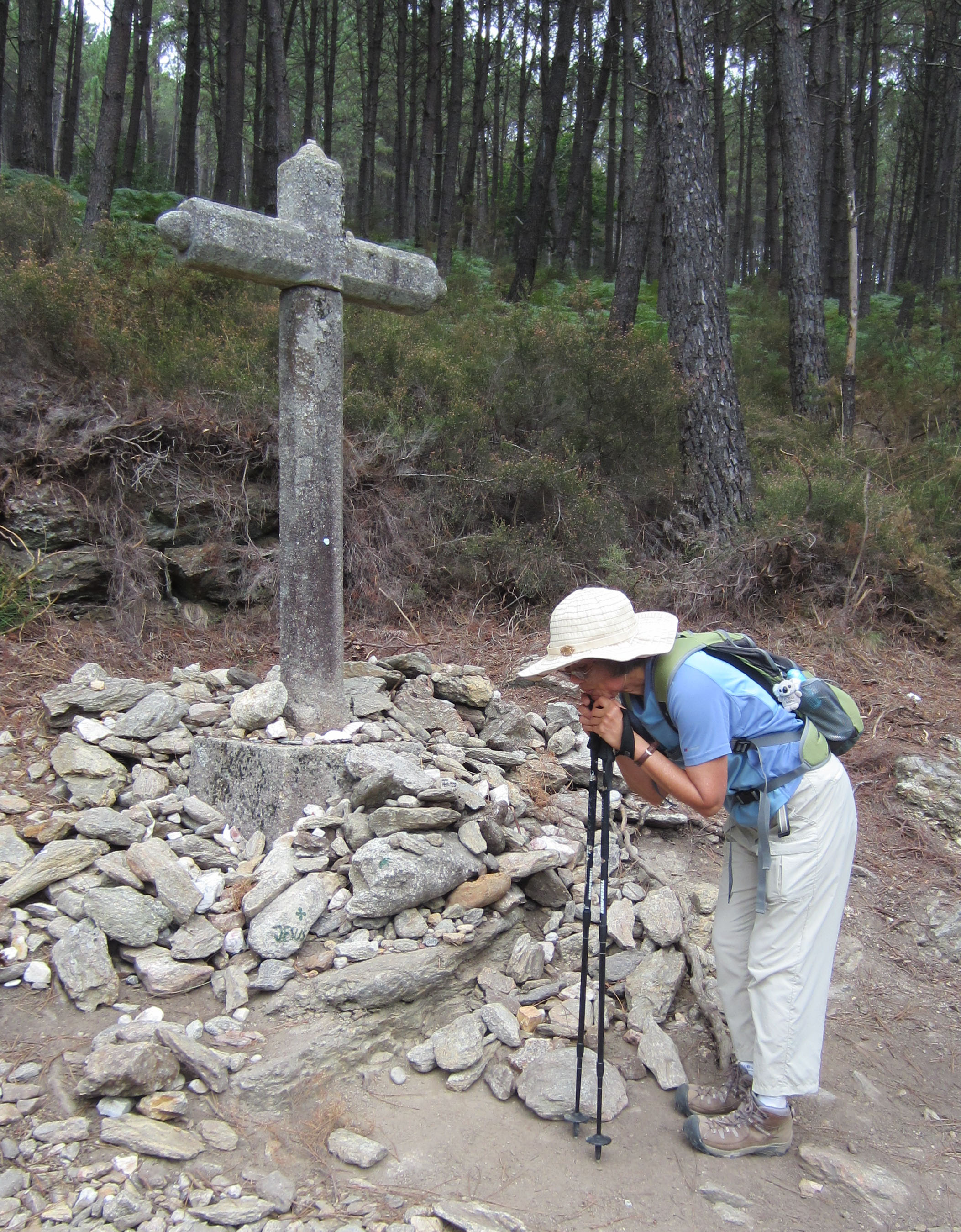
As I reported in an earlier post [The mystique and the shadows of the Camino, posted July 29th] some pilgrims believe you can pick up a stone, put your sorrow into it, and disburden yourself of that sorrow when you put the stone down. Some carry stones from their homes all the way to Santiago de Compostela cathedral, others abandon their stone in certain special places like the heights of Cruz de Farro on the Via Frances, still others do the ritual “in instalments”, picking up stones and relinquishing them as they walk. On the Via Portgues some waymarkers are piled high with stones, and stones litter the ground around many wayside crucifixes.
Emmy lets go of her sorrows (rather small ones).

A wayside cross littered with stones of sorrow at a high point in the Camino trail in northern Portugal.

Wayside crosses, shrines and chapels

A typical wayside cross with Christ above and a pilgrim below.

Like decorated letters that punctuate the lines of an illuminated manuscript, the tracks of the Camino are punctuated by exotic wayside crosses, tiny niche-in-a-wall shrines and small chapels that are filled with symbolic pith. Some seem to function like roadside guard houses – places where Jesus is thought to keep a protective watch over the passing current of pilgrims. Quite a few wayside crosses are carved with effigies of Christ on the cross. Below him, on the shaft of the cross, there may appear a weathered image of a pilgrim complete with walking staff, water gourd and scallop shell. Some crosses are festooned with paper prayers and messages left by passing pilgrims.

For the weary walker there are few sights more welcome than a wayside chapel. Inside you find quiet respite from the relentless unravelling of distance under your feet. The heat, noise and dirt of the road shrink away. For a short time at least, you can wonder at the stillness and allow it to refresh you before you step out again into the incessently moving world of the walk.

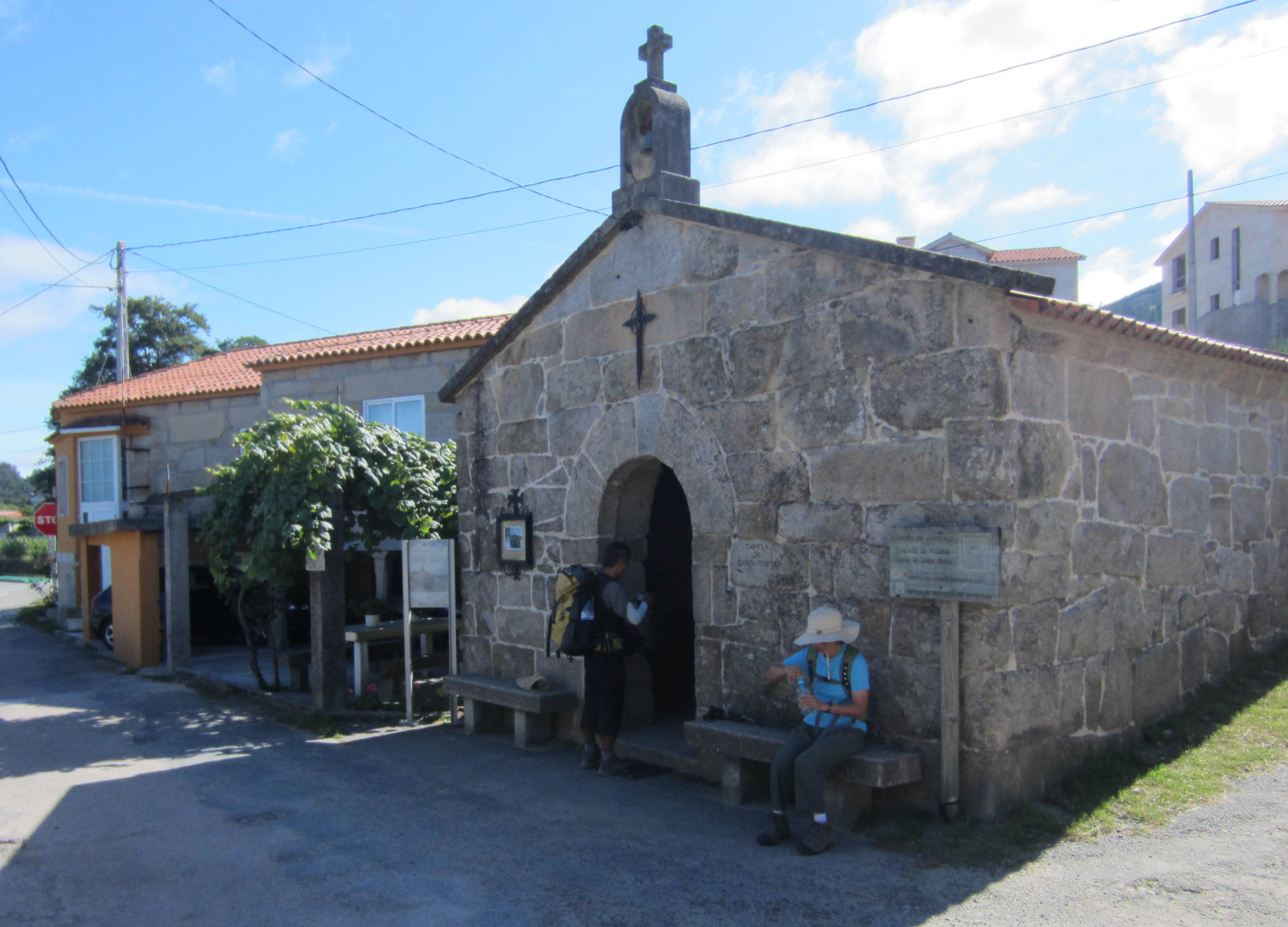
A small roadside chapel in Spain.

A small roadside chapel between Redondela and Pontevedra in Galicia, Spain.

Inside a wayside chapel, an image of “Christ of the Good Journey”.

A tiny makeshift shrine, stones of sorrow and paper prayers surround a wayside crucifix near O Porrino in Galicia, northern Spain.

The Camino greeting

It is a tradition for walkers on the Camino to greet one another, and to be greeted by non-walkers, with a special cheery phrase: Bom Caminho (pronounced /bong.ka.MEEN.yo/) in Portuguese, and Buen Camino (pronounced /b’wen.ka.MEE.no/) in Spanish. Translated into English the greeting means something like “Well may you fare!” I may be wrong, but I think I heard a Galician variant of the phrase in north-west Spain. It sounded like /b’wen.ka.MEEN.yo/, sort of halfway between the Portuguese and Spanish variants of the greeting.

Pilgrim accommodation and pilgrim food

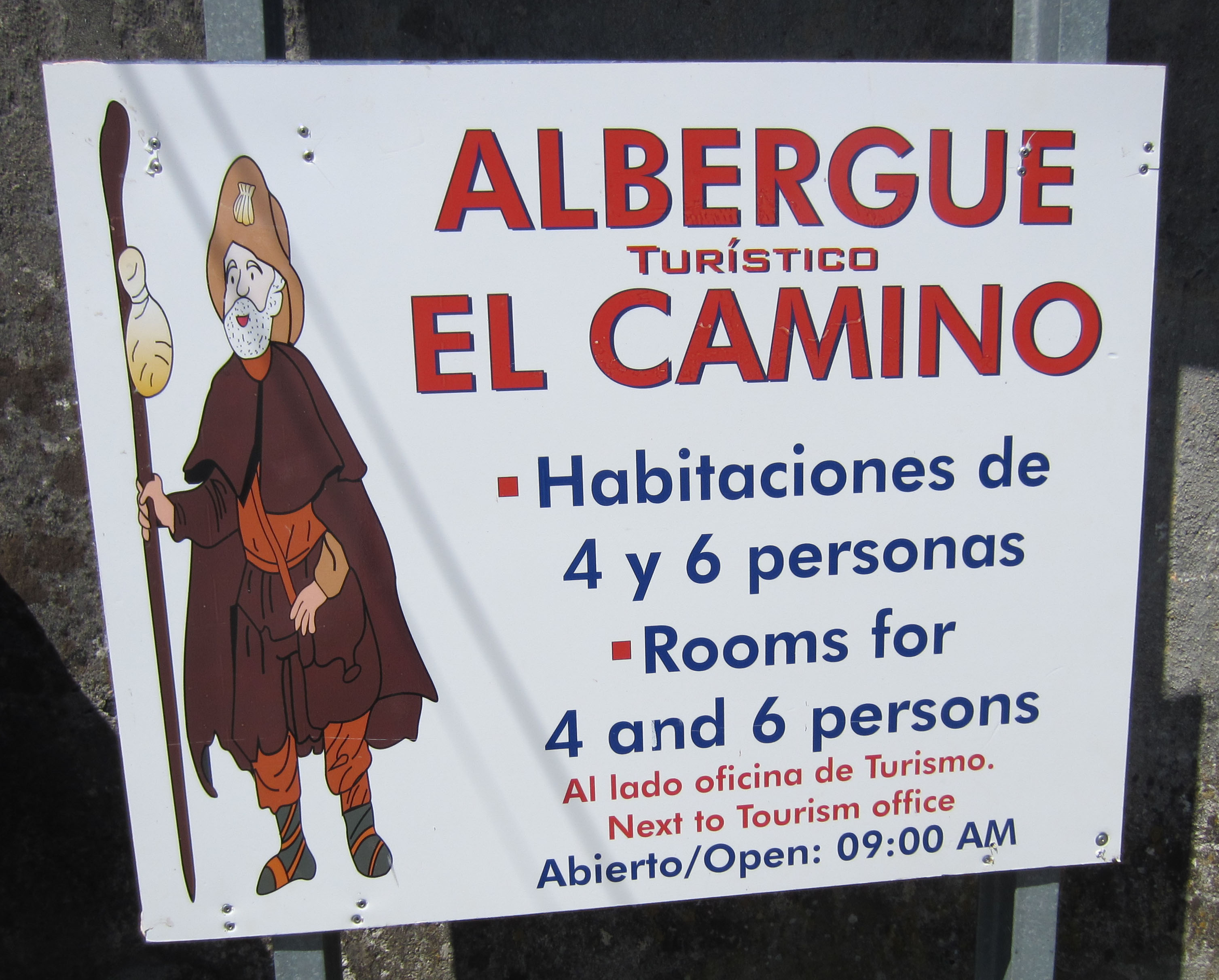
A sign advertising dormitory accommodation for pilgrims, north-western Spain

On the Via Frances there is a well-developed chain of hostel-type lodgings especially for bona-fide pilgrims. Called albergues or refugios they offer toilets, showers, bunk beds in dormitories, and simple kitchen facilities, all at a very nominal cost. This network is not so well developed along the Via Portugues, but there too the number of albergues is growing rapidly. Being too attached to bourgois comforts and the old-fashioned notion of privacy, Emmy and I did not stay in albergues. Instead we pre-booked accommodation that included breakfast and an evening meal in small hotels and B&Bs. Without exception these turned out to be comfortable although far from luxurious, with an especially warm welcome for pilgrims.

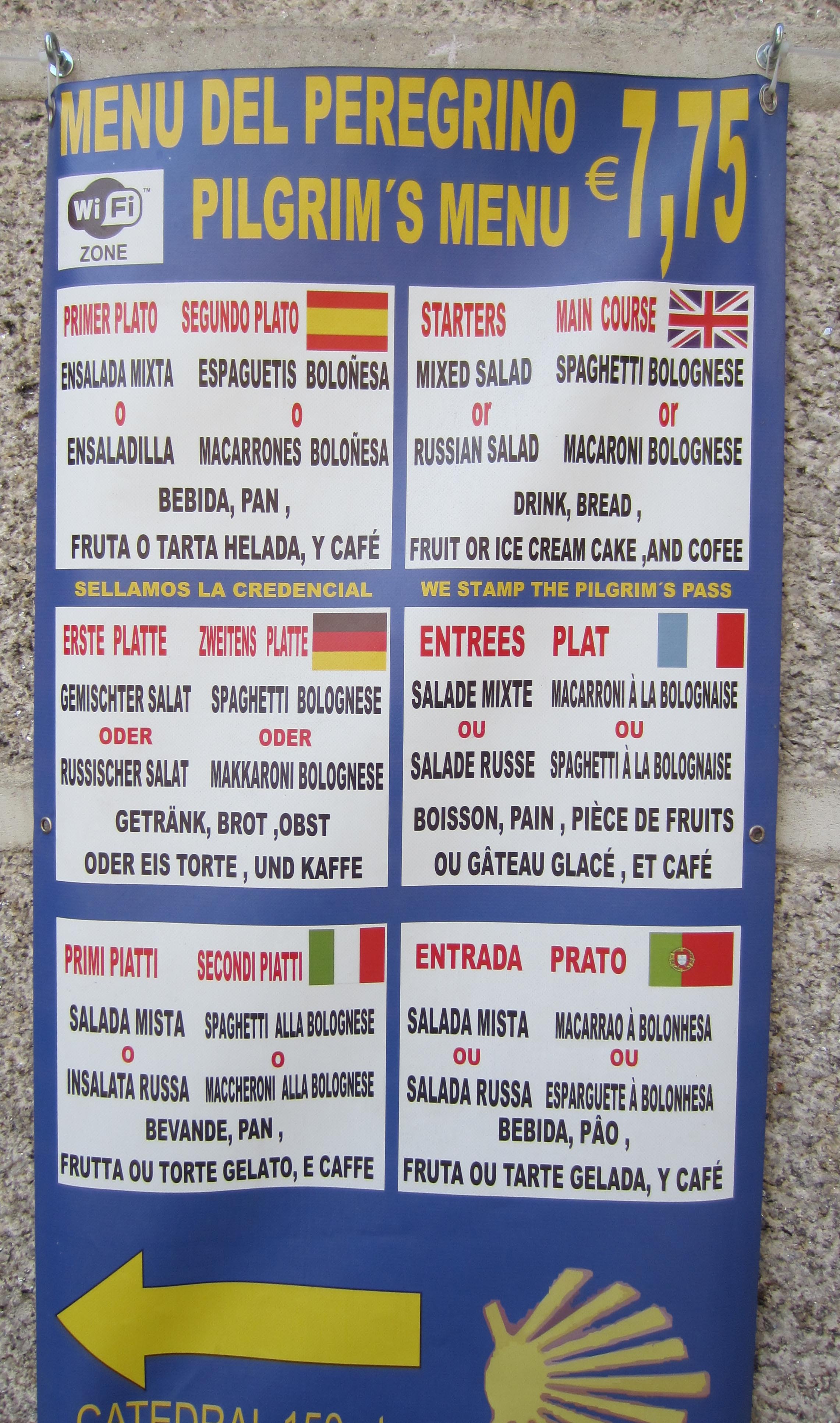
On the road, and in many of our overnight lodgings, we were able to order meals from a “pilgrims’ menu”. Meals on the pilgrims’ menu are slightly cheaper than standard meals, but the food is generally good, no-nonsense fare. An average pilgrim meal might consist of a soup entree, a meat dish (usually pork) with vegetables (usually boiled), and a dessert of fruit. Prices range from €7.00 to €12.00 including local wine and a cup of coffee or tea. In short, it is a good deal.

Multi-lingual advertisement for hungry pilgrims. Tuy, north-western Spain.

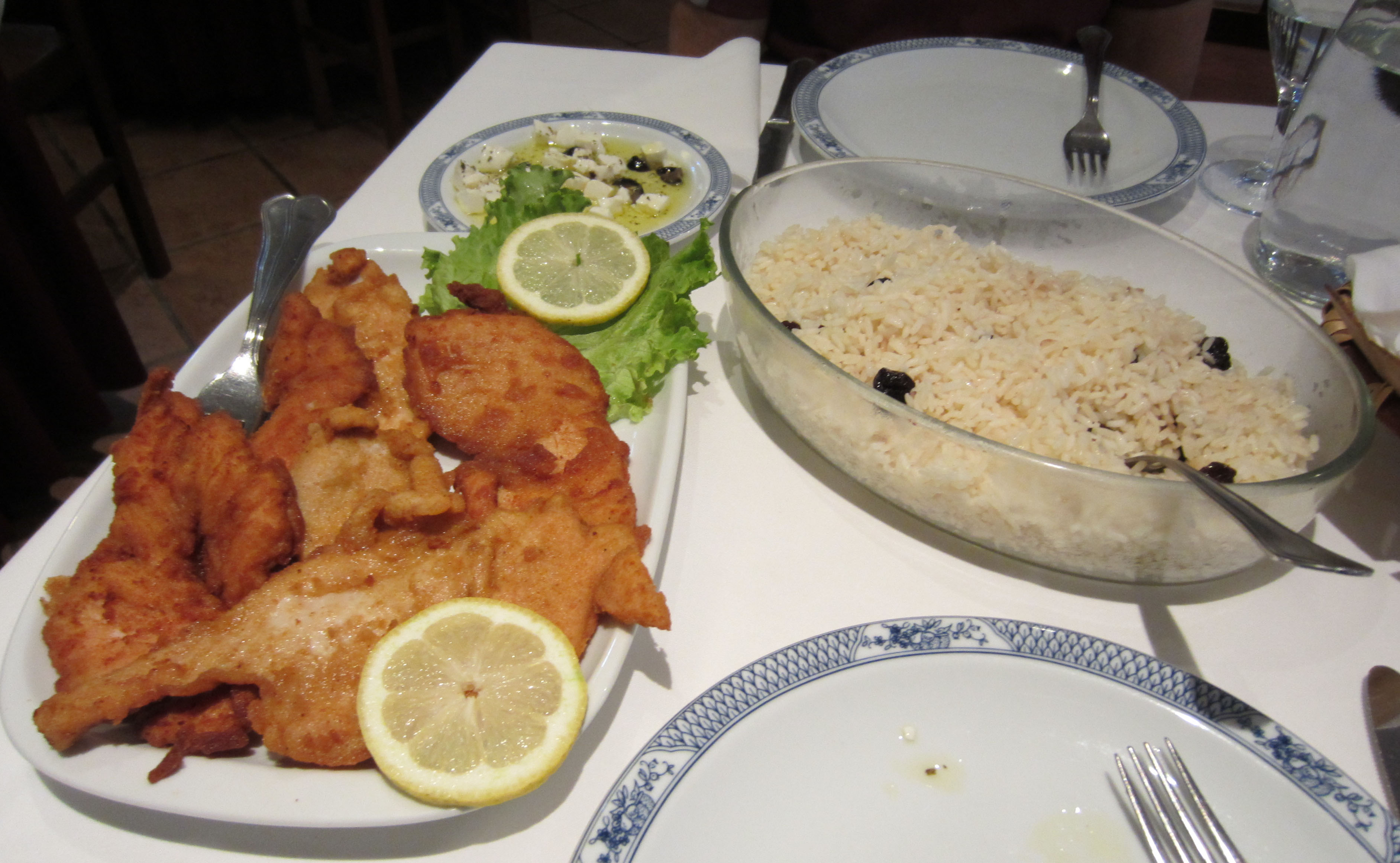
A typical meal from a pilgrims' menu: cheese and olives (top), rice and fried chicken. Served at Casa Cecilia Restaurant near Vilarinho, Portugal. Eight fifty euros including soup entree and cinnamon apple dessert.

A typical meal from a pilgrims’ menu: cheese and olives (top), rice and fried chicken. Served at the Casa Cecilia Restaurant, near Vilarinho, Portugal. It cost eight fifty Euros per person, including a soup entree and a cinnamon apple dessert.

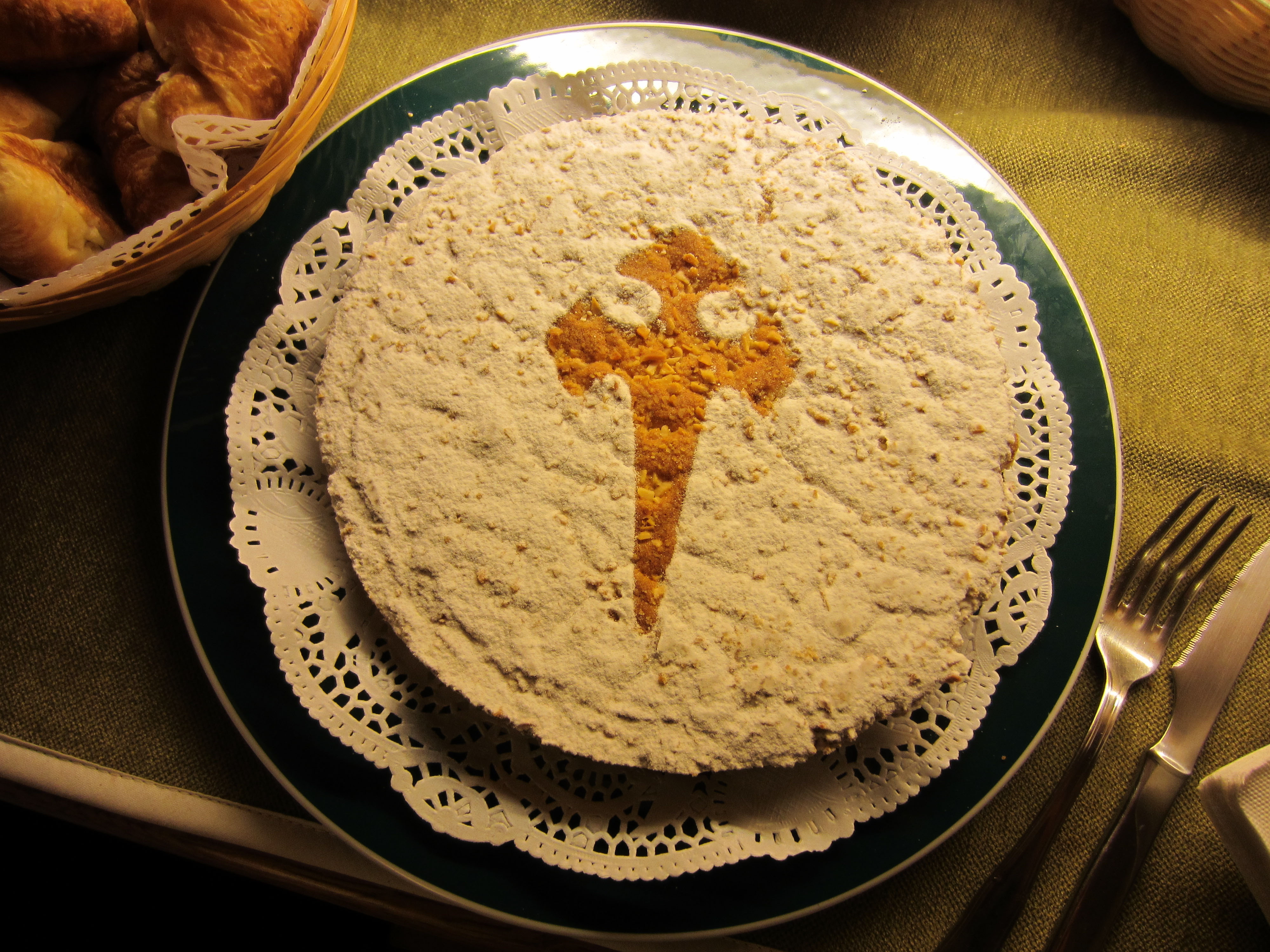
In Santiago de Compostela and in a few places beyond the city, you can buy a special Tarta de Santiago, “cake of St.James”. This is a round, almond flavoured cake, sprinkled with icing sugar and embossed with a stencilled cross of Santiago. The cross of Santiago is an ancient icon, probably derived from the age when Santiago was the celestial patron of the Christian armies that – for some 700 years – harried Iberia’s Moorish rulers. The shaft of the cross tapers into a piked point like the blade of a sword, while the arms and the head are split and peeled back into the triple curls of a stylised fleur de lis.

Tarta de Santiago.

The pilgrim credencial and the compostela

The Compostela certificate

A compostela is a certificate in Latin issued by the cathedral of Santiago to pilgrims who have completed the Camino pilgrimage “impelled by religious devotion” (pietatis causa). To meet the cathedral’s definition of satisfactory completion pilgrims must walk at least the last 100 kilometres to the cathedral end-point. Most pilgrims walk much further than the minimum. The Via Frances, for example, extends about 800 kilometres from the Pyrenees to Santiago, even further if you take Le Puy or Paris or Vezelay or Arles (all in the deep interior of France) as your starting point. Emmy and I walked 230 kilometres along the Via Portugues from our beginning point in Porto, northern Portugal. You are allowed to cut your walk into stages and complete them at different times with intervals between each stage.

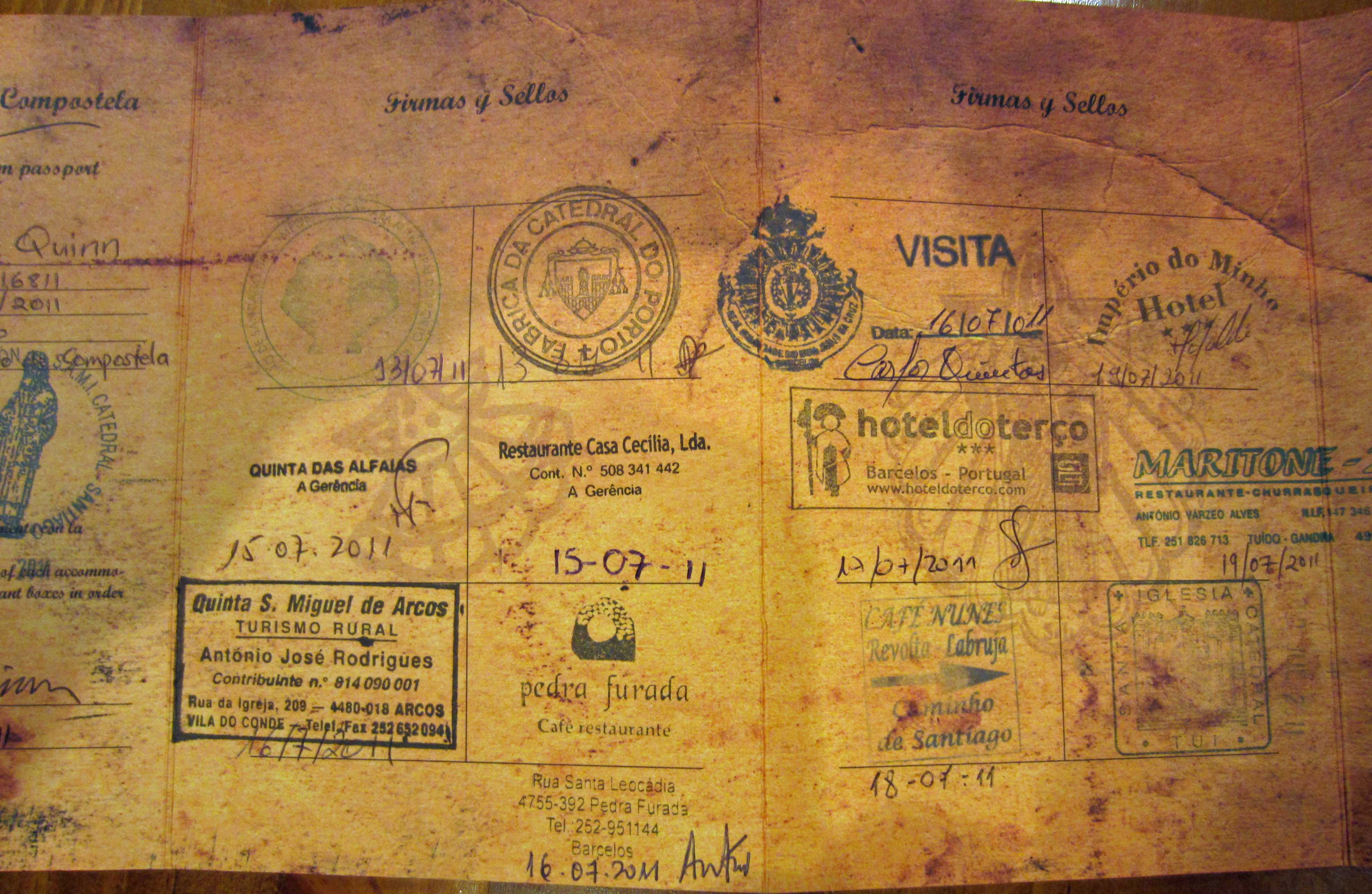
In order to get a compostela you must provide the cathedral with evidence that you have properly completed the pilgrimage. This takes the form of a document called a credencial or “pilgrim passport” which you fill with rubber stamps collected from from churches, albergues, restaurants and other places along the Camino way. Some restaurants even advertise their stamps to lure pilgrims in for a meal. At a pinch, a credencial can be simply a piece of paper, but mostly it takes the form of a concertina of printed cardboard issued by a pilgrim support organisation, a travel company or an albergue. (For an example of what a credencial can look like see: http://www.americanpilgrims.com/camino/credential_cover.html.) The sequence of stamps in the credencial is carefully examined in the Pilgrim Affairs Office (Oficina de Acogida de Peregrinos) at the cathedral, and if it fulfills conditions a compostela is issued on the spot (see Our last day on the Camino posted August 5th).

The credencial has other functions and benefits. To ensure that guests in an albergue are bona fide pilgrims and not freeloaders trying to chisel a cheap night’s accommodation, credencials are carefully examined when walkers check in. And as I discovered at Tuy General Hospital, other doors too can be opened upon production of a credencial (see I get medical attention in Tuy posted July 26th).

Part of my credencial, or pilgrim passport.

Part of my credencial, or pilgrim passport, with stamps from churches, hotels and restaurants.

The pilgrim mass and the botafumeira

A recently arrived pilgrim and a nun wait for the pilgrims’ mass to begin

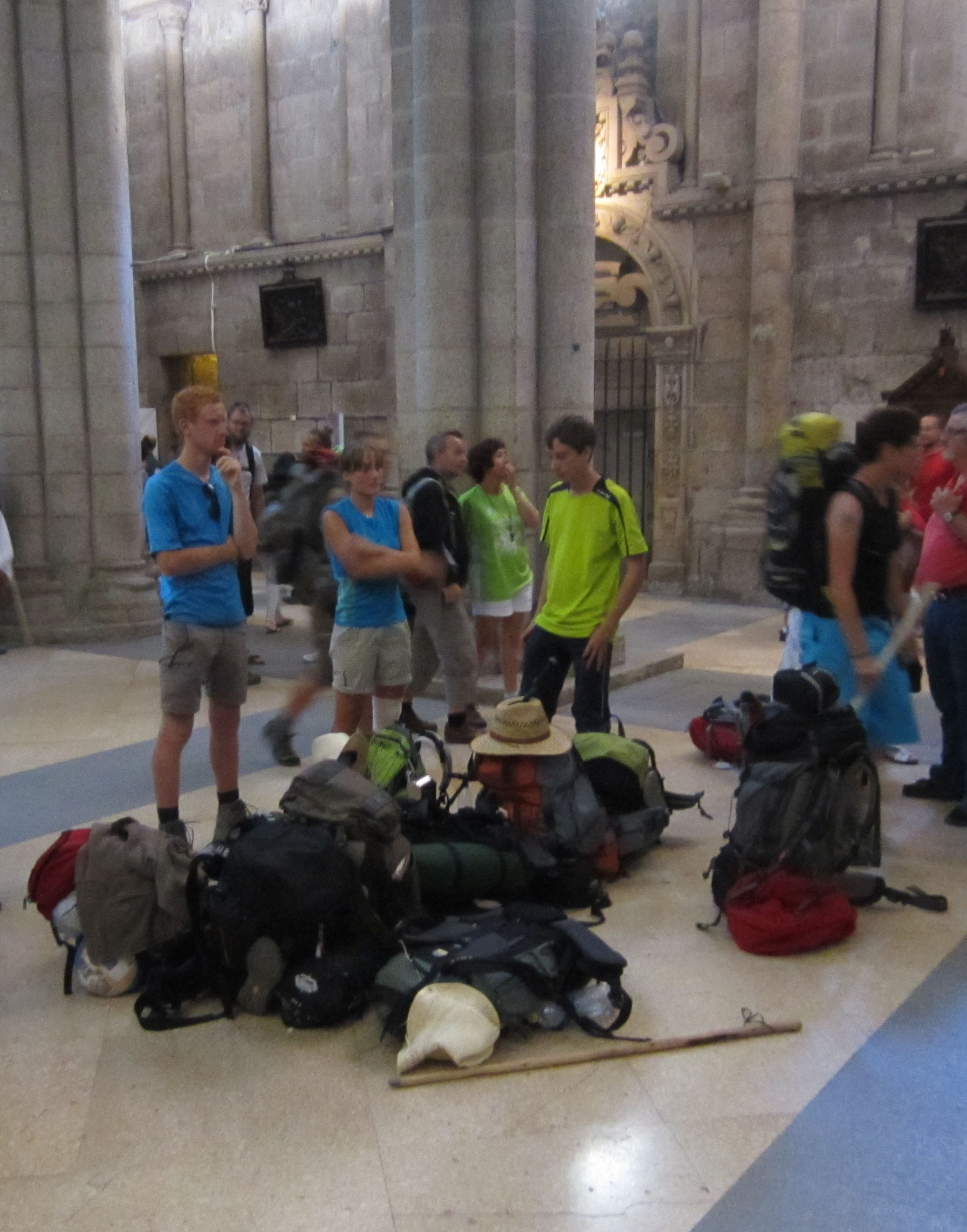
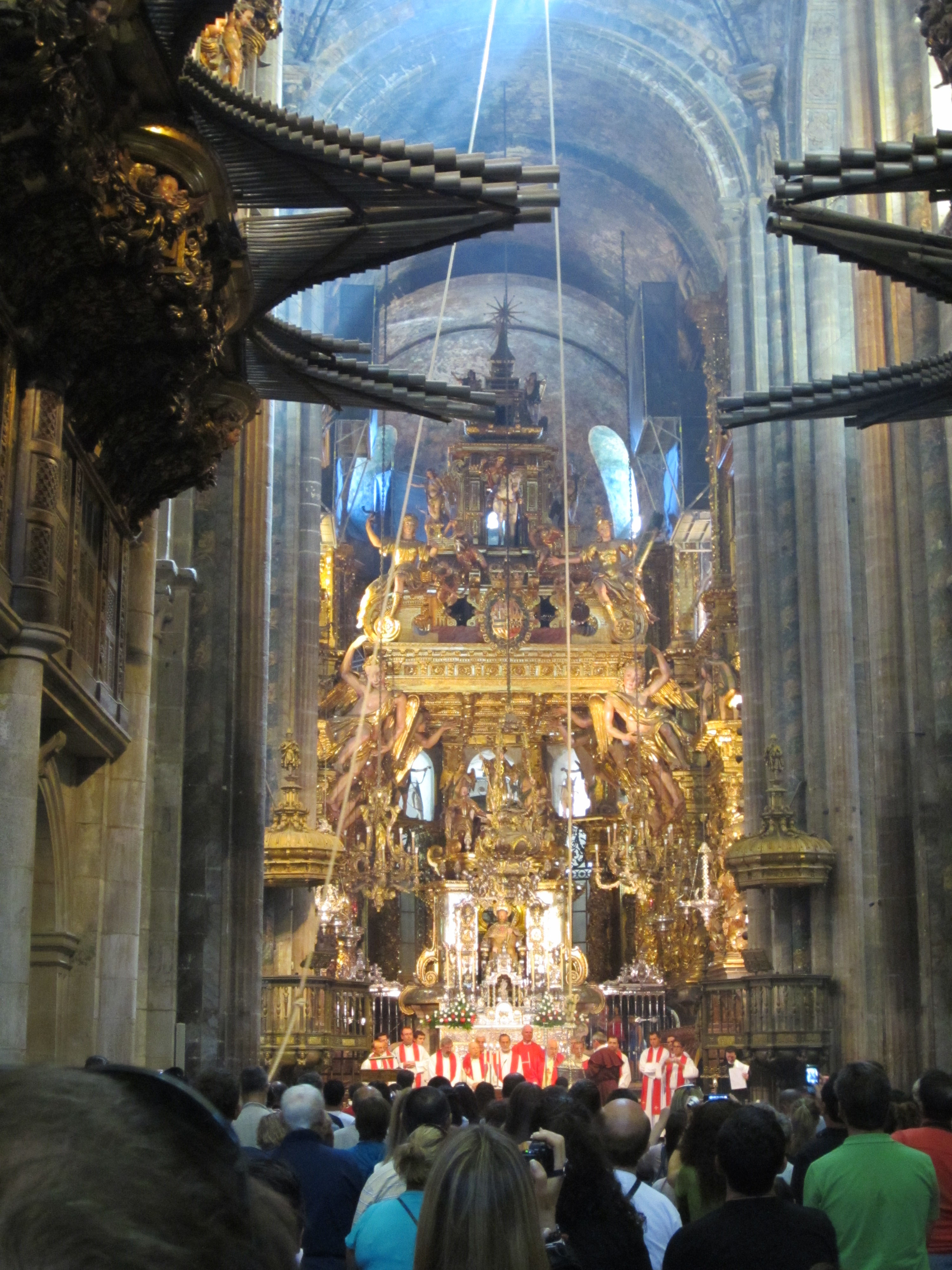
Every day at 11.00 a.m. there is a special pilgrim mass in the cathedral of Santiago de Compostela. It is an exotic experience. An hour before proceedings start the cathedral’s ranks of simple wooden pews are already filling up. Left and right, at intervals along the wall, anxious communicants kneel in hut-like wooden confessionals while priests lean solemnly towards them cocking their heads to take in tales of sin while gazing out at the ragged throngs eddying down the cathedral aisles. Newly arrived walkers mill in sweaty clusters, their swags and backpacks heaped on the flagstone floor. They quietly squeeze into seats beside nuns and primly dressed women with heads veiled in filmy lace. Every few minutes the buzz is quelled for a few seconds with a loud “SH-SH-sh-sh” that hisses from the public address system. By 10.30 it is standing room only.

Ten minutes before the start of the mass a nun appears on the raised apse and with grandiloquent gestures, portentiously rising on her tip-toes and solemnly descending, she leads the congregation through a rehearsal of the sung liturgy. Then a barricade of priests appears in white frocks and long red stoles hanging to the floor from their necks. The mass – conducted in Spanish with a few passages of German – gets under way. A waterfall of music tumbles over the congregation from organ pipes that project horizontally from the walls of the nave. The choir sends its criss-crossing lines of song up into the ornate ribs of the distant ceiling. The presiding priest reads out the number of pilgrim arrivals from the previous day and their countries of origin. Emmy and I strain to catch the echoing nuances of the Spanish, and yes, there we are: “two arrivals from Australia”.

The climax of the mass is the ritual burning of incense in an enormous bronze thurible, called the botafumeira. After lighting it, a squad of priests hoist it above the congregation and energetically swing it like a giant pendulum left and right across the transept. A bluish haze of smoke rolls up into planks of light that slant down from the dome far above the upturned faces of the congregation. Smiles break out. Children point. Cameras flash.

Pilgrims and their walking gear inside Santiago cathedral

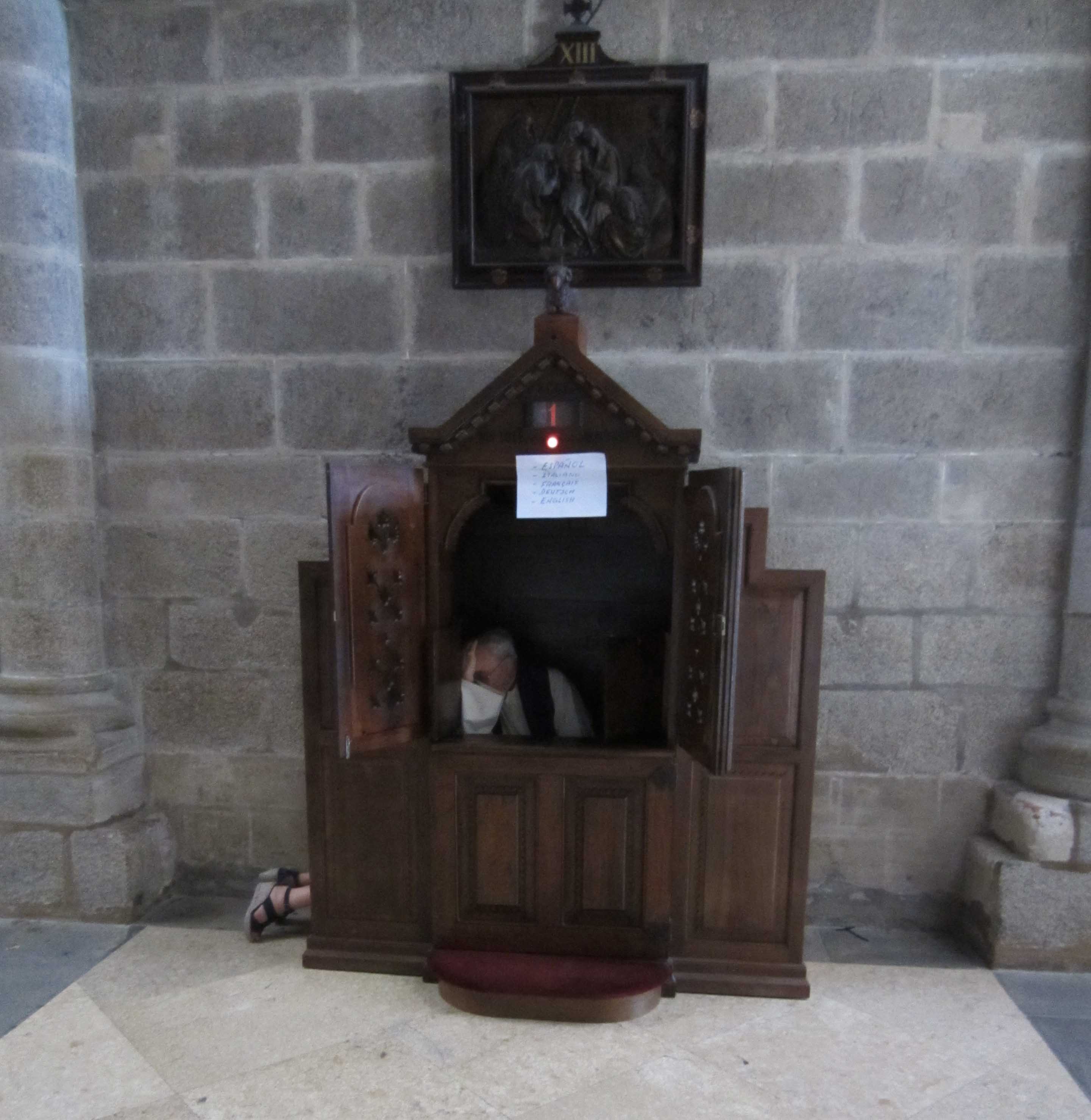
A priest hears confession inside Santiago cathedral. The kneeling legs of a repentant sinner protrude at the left. According to the sign on the confessional the polyglot priest can hear confessions in Spanish, Italian, French, German and English.

The atmosphere in Santiago cathedral during the pilgrims’ mass. Note the ropes used to raise and swing the botafumeira thurible.

Santiago, killer of Muslims: food for thought from the Camino pilgrimage

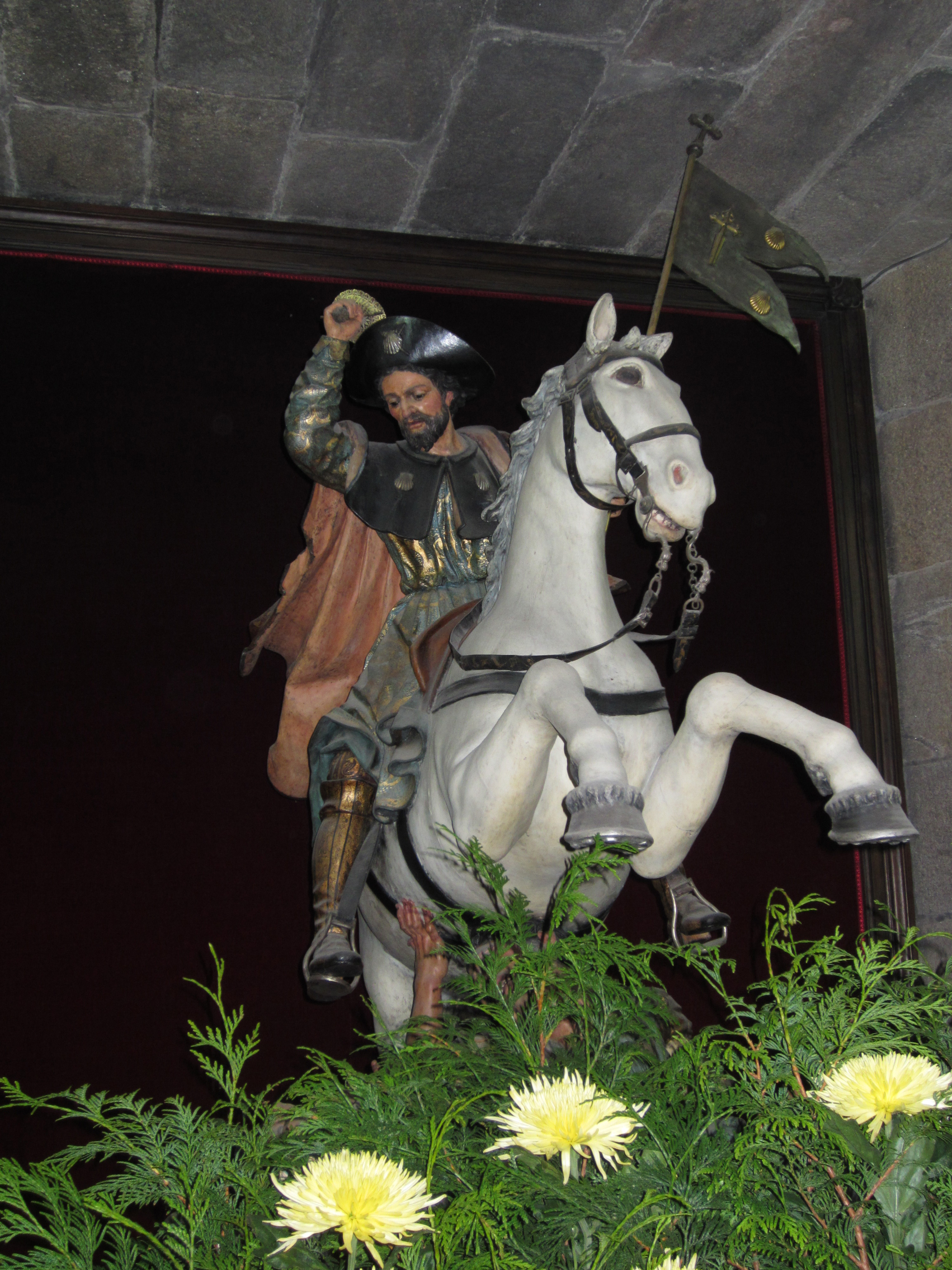
There is a dramatic effigy in a niche in the Cathedral of St.James in Santiago de Compostela. It depicts St.James in medieval military garb astride a horse, brandishing a sword above his head. Legend has it that St.James – Santiago – appeared to Christian troops during the semi-legendary Battle of Clavijo in 844 in which Spanish Christians defeated a much bigger Muslim army. During the following seven centuries of conflict between Christians and Muslims in the Iberian peninsula – from roughly 800 until 1492 – Santiago was adopted as the divine mentor of the Christian forces. He was given the name Matamoros, “Killer of Moors” i.e. killer of Muslims, and subsequently became the patron saint of Spain. “Santiago y cierra, España!” (St. James and attack, for Spain!) became the battle cry of Spanish armies as they slowly recovered the Iberian peninsula from its Moorish rulers. The cry persisted into modern times and was frequently used as a nationalistic slogan during Franco’s long years of Fascist rule.

Santiago Matamoros as I photographed him in Santiago de Compostela Cathedral, late July 2011.

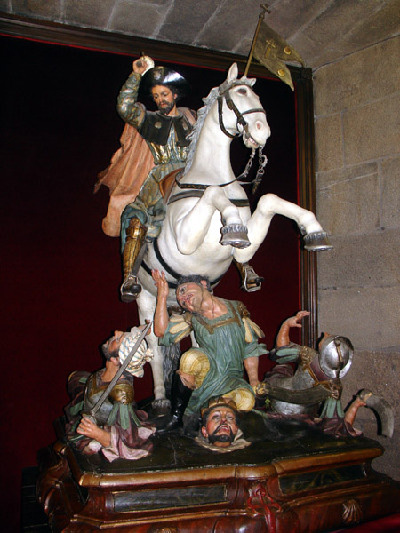
In the cathedral of Santiago de Compostela, the saint’s horse rears from behind an arrangement of fresh leaves and flowers. As even the quickest search of the internet will confirm, behind this fragrant corsage Santiago’s horse is actually trampling over Moorish soldiers and his sword is meting out death. There is even a severed Muslim head on the ground below him.

The “unedited” image of Santiago Matamoros (Wikipedia open access image)

It is, I suppose, to the credit of the cathedral that it seems to be squeamish about the image. Perhaps the mangled limbs are camouflaged out of politically correct consideration for the feelings of Muslims. Perhaps (and I hope this is the case) the church has awakened to the realisation that nothing could be more contrary to the teachings of Jesus Christ than this sympathetic, even admiring, representation of brutal murder. Whatever the case, the full barbarity of the image is something the Church no longer wants visitors to see. Someone on the cathedral’s staff regularly replaces the leaves and flowers, no doubt standing back each time to check that the true character of the image remains well hidden.

It is the purpose of a pilgrimage not just to present you with a challenge and deliver you to a destination but to set you thinking about life, faith and the practice of religion. In this spirit, the image of Santiago Matamoros triggered my curiosity about the intrusion of martial imagery into churches. Naively I wondered how widespread this was. So while walking through England I visited several cathedrals and churches. Without being systematic or obsessive about it, I kept an eye out for images of war and murder inscribed – as it were – inside these churches. I didn’t have to look very hard or very far. Every time I entered a church the images were immediately in my face. I found that – without exception – every one of the temples of Christian peace that I visited displayed eulogistic representations and commemorations of warriors and war. The churches, irrespective of denomination, seemed to be showcases for state-supported military mayhem.

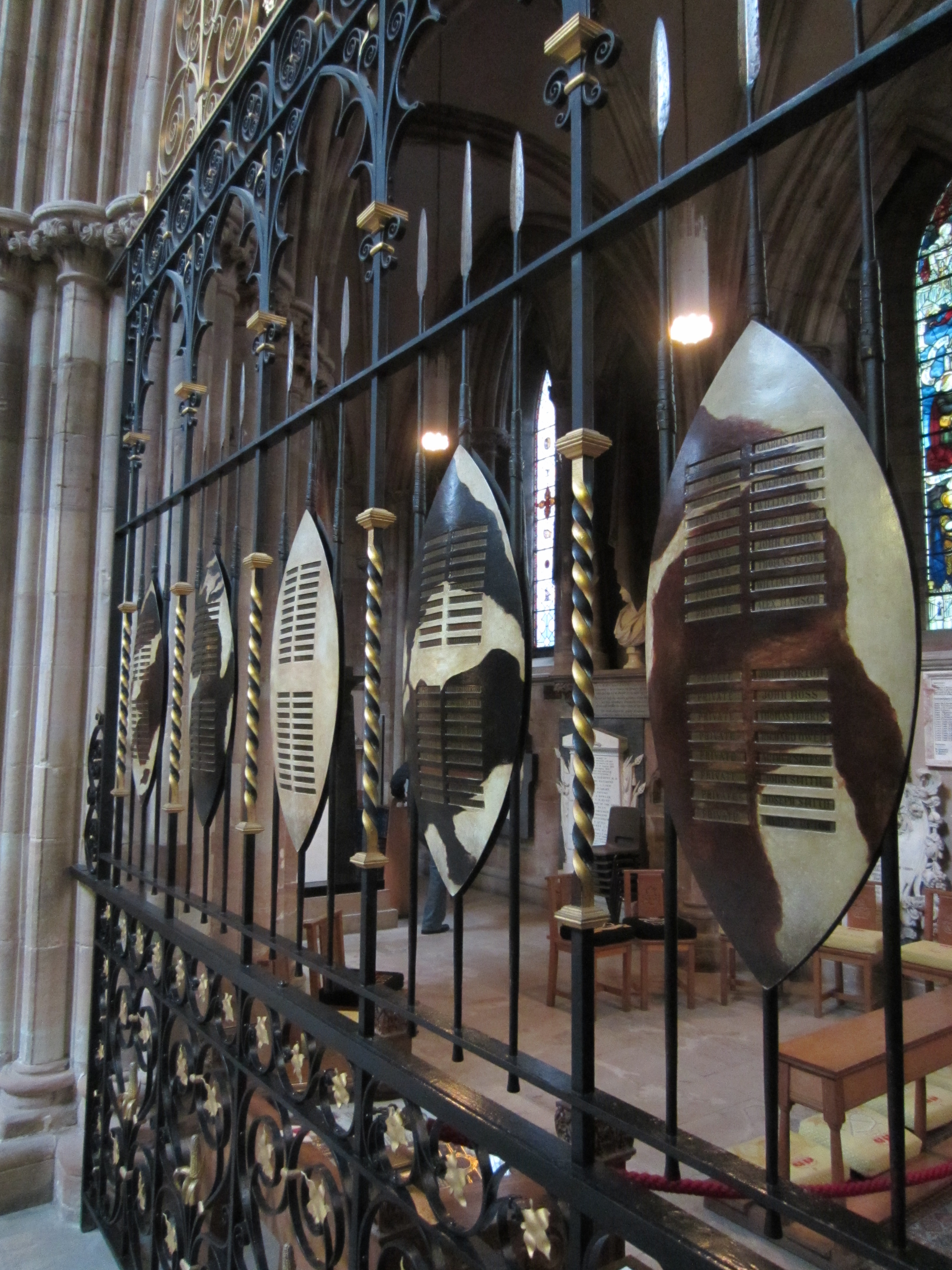
Zulu spears and shields: stylised war trophies in Lichfield Cathedral.

It would be a consolation if I could report that the images I saw only commemorated those who died resisting aggression by the enemies of freedom and peace. But I was struck by the many images – probably a majority – that commemorate Britain’s wars of aggression in distant lands. One of the most shocking is to be seen in Lichfield Cathedral. In one corner of the cathedral there is a prominent memorial to those who died during Britain’s wars of conquest against the Zulu people of South Africa (1878-1879). The memorial takes the form of a palisade of Zulu spears and shields – stylised war trophies, in effect. The names of the soldiers who died are inscribed on the shields.

The names of British war dead triumphantly inscribed on Zulu shields in Lichfield Cathedral.

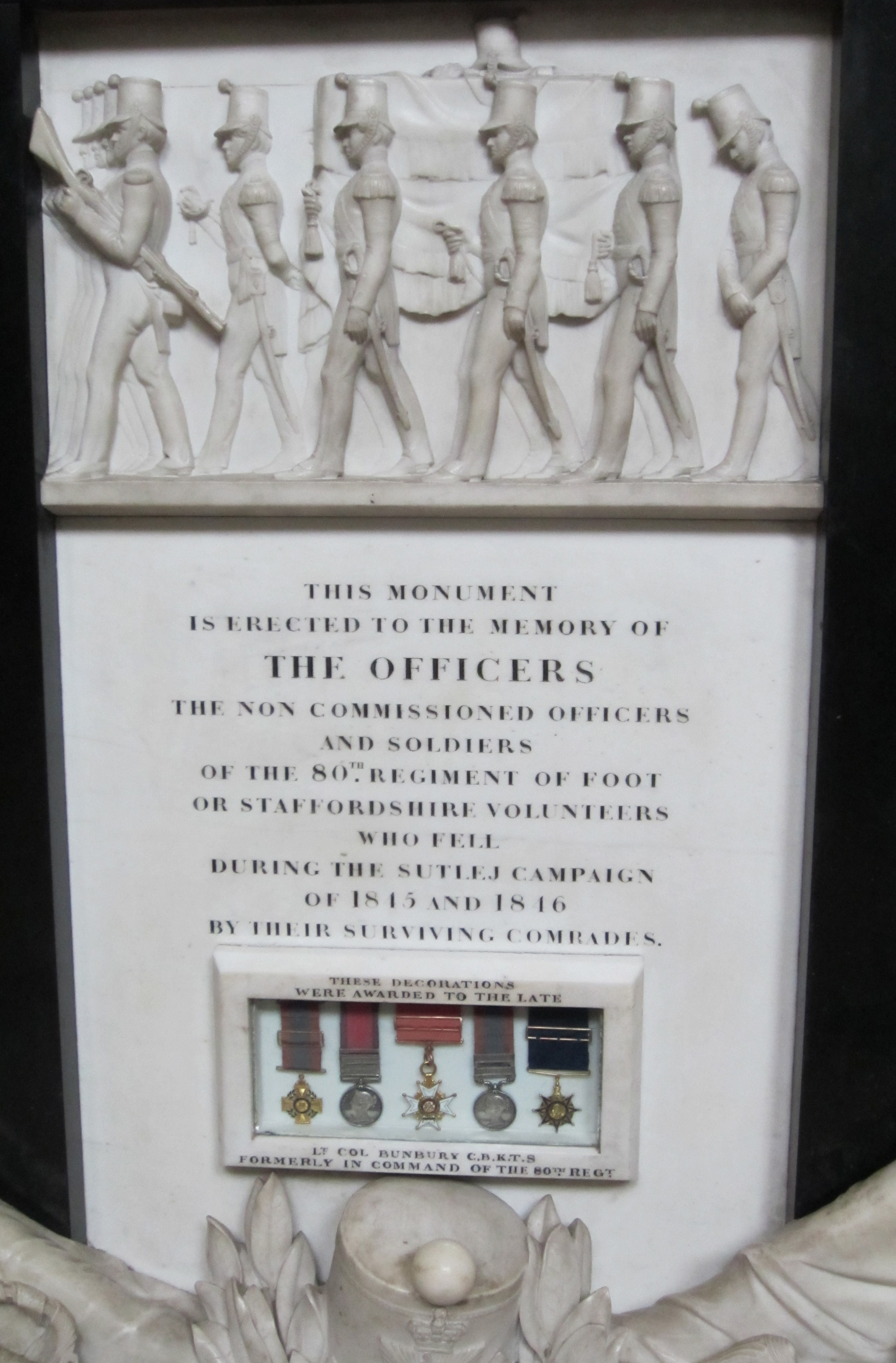
Also in Lichfield Cathedral there is a memorial to members of the local Staffordshire Regiment who died during the first Anglo-Sikh War (1845-1846) in India, also known as the Sutlej Campaign. The brutal Sutlej Campaign was the very first for which medals were issued with metal bars or clasps that could be attached to a medal’s ribbon. In a bizarre touch, some of this purely military memorabilia is displayed in the “holy” precincts of the cathedral.

Medals from the Sutlej Campaign on display in Lichfield Cathedral.

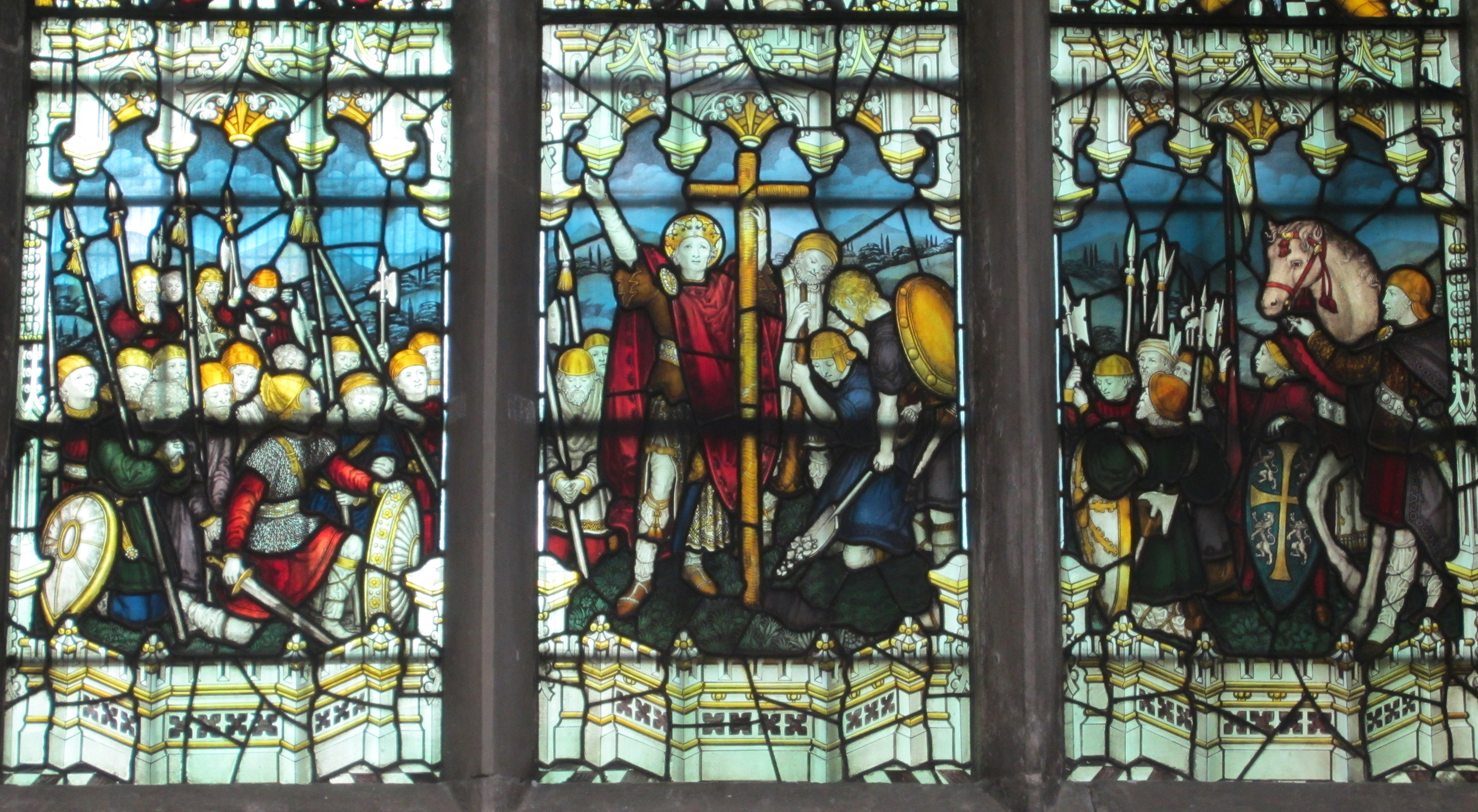
Beyond the unfeeling crassness of such memorials there are many more subtle and more powerful tributes to war. For example, in Holy Trinity Church, Stratford-upon-Avon (where William Shakespeare is buried), there is a stained glass window depicting England’s national saint, St. George, providing succor to the Crusaders. There is also a stained glass image of medieval combat with soldiers clustered around a big crucifix.

St.George, patron saint of England, urges on the Crusaders (Holy Trinity Church, Stratford-upon-Avon).

Medieval battle scenes with soldiers clustered around the Cross (Holy Trinity Church, Stratford-upon-Avon)

St.Oswald in full battle dress with the halo of Christian piety (Carlisle Cathedral).

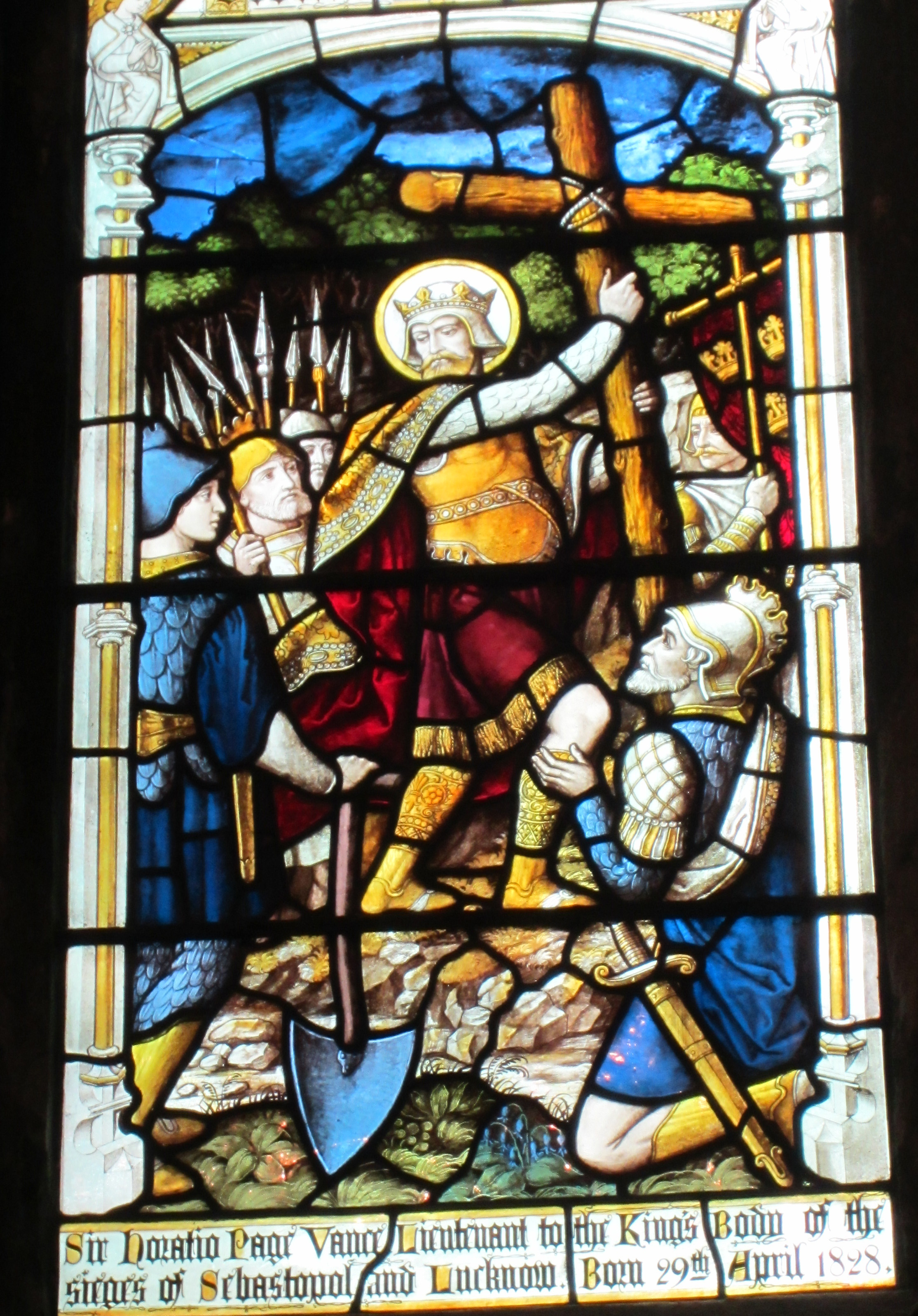
In Carlisle Cathedral, St.Oswald appears in full battle armour carrying an enormous sword with a halo of Christian piety crowning his head. In Lichfield Cathedral a colourful stained glass window is dedicated to the memory of a certain Sir Horiatio Page Vance who fought at the sieges of Sevastopol in the Crimea (1854-1855) and Lucknow in India (1857). It depicts British sappers, complete with a large shovel, undertaking a siege some time in the Middle Ages. In St.Mary’s Church, Painswick, a model sailing boat is attached to the wall. Beside it a plaque likens the Christian Church to a boat, then draws a parallel between the boat of Christianity and a battleship of sixteenth century England that saw action against the Spanish Armada.

Besieging the enemy under the protection of the Cross (Lichfield Cathedral)

The Christian church is likened to a battleship (St.Mary’s Church, Painswick)

It is possible to see these images as mere curiosities, toothless survivals from a cruel past preserved like exotic museum-pieces in the more enlightened times we now live in. But in the churches I visited, none of the images are presented as violations of Christian values. On the contrary, they seem tailor-made to normalise the uncritical depiction of violence within the precincts of the church. All of the images I saw – and no doubt countless more I have not seen – make a subtle but very powerful point: there is a hand-in-gauntlet alliance between the Christian church and the practice of war, and this alliance continues into the present.

The Ten Commandments and the Sermon on the Mount lie at the heart of Christian doctrine, and neither could be more forthright: Thou shalt not kill and Love your enemies… whosoever strikes you on the right cheek, turn to him your other cheek as well. These are tough admonitions so it is not surprising that in everyday life and politics they are pretty comprehensively ignored. And theologians too, from St.Augustine to the padres of modern armies, have tried to water them down. But (to me at least) it is surprising that they also seem to be almost totally ignored, even trampled on, certainly compromised, in the iconography and worship of Christian churches where, of all places, they should be prominently and uncompromisingly affirmed.

In short, on the evidence of what I saw in Santiago de Compostela and in England, many Christian churches are little short of arsenals stuffed with iconographic weapons and iconographic flak jackets for use by the propagators of war and their apologists. 

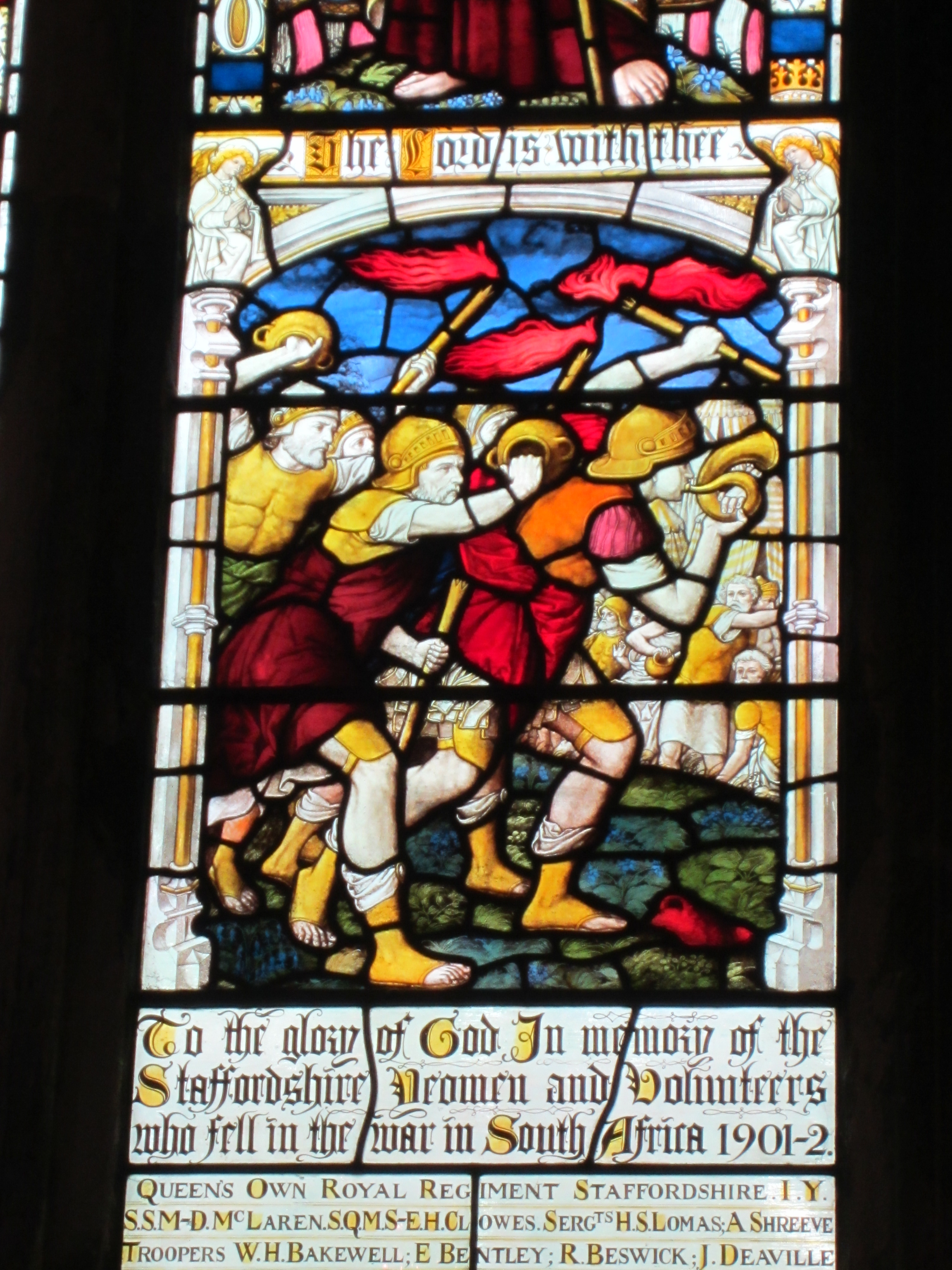
Images of soldiers charging into battle “to the glory of God” (from a war memorial window in Lichfield Cathedral)


Nine brief encounters, nine wry smiles

Walking is a good way to meet people, though often these meetings are fleeting. Here is a mini-album of encounters Emmy and I had during our walks in Portugal-Spain and the UK. Each was ultra-brief but images of the personalities involved have somehow stuck in my memory.

The Scottish shopkeeper

We spent a couple of hours in Dumfries in southern Scotland. I wanted to visit the house where poet Robert Burns once lived. It was somewhere near the centre of town but I couldn’t work out exactly where. I noticed a sign in a shop window: Streetmaps of Dumfries, £2.50. Inside, money changed hands and I turned to leave with a map.

“Hoo long are y’heer foor?” the helpful gentleman behind the counter asked in a thick Scottish accent.

“Just a couple of hours.”

“Och, y’dinna need a map then. Gie it back.”

I handed over the map. The kindly Scot turned to a photocopy machine and photocopied the part of the map that covered the centre of town. He pushed the £2.50 back into my hand, and, spreading the photocopy out on the counter, explained in detail how we could get to Robert Burns’ house.

I tried to pay for the photocopy.

“Och,” he said, “no charge. If you save money I’m happy.”

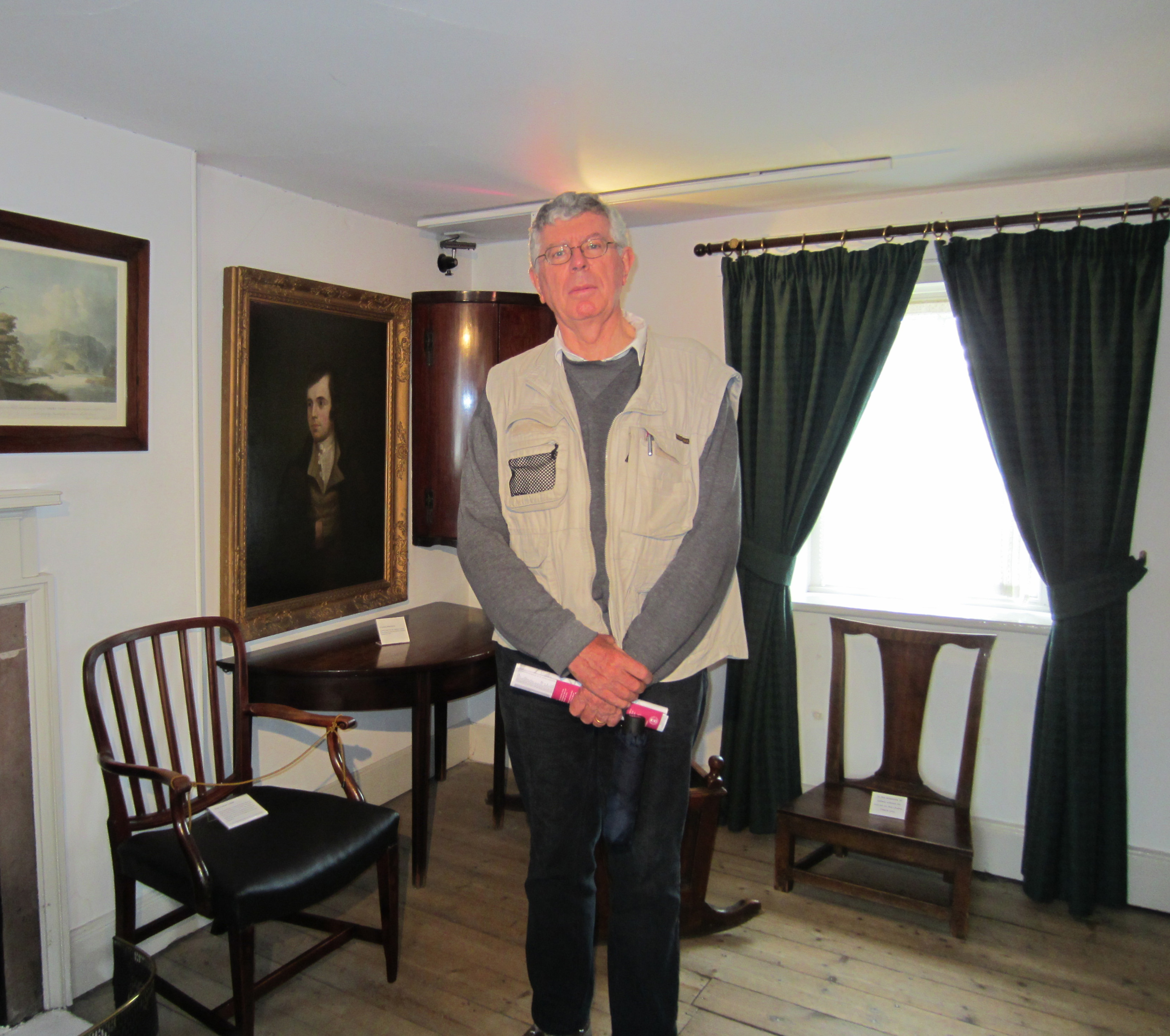
In the sitting room of Robert Burns’ house, Dumfries. I found the house with the help of a thrifty Scot and a photocopied map.

The “funny” taxi driver

Taxi drivers are talkative and funny, right? Sometimes talkative… yes, but not always funny. We took a taxi from Stratford-upon-Avon to Chipping Campden. I walked from our apartment to a taxi stand in a nearby Stratford street. The driver greeted me with a smarmy cheesy grin. I explained that I was going to Chipping Campden – about 20 kilometres away – but first we had to pick up my wife and two bags from our apartment.

“You’ve got three women in your life? How do you do it!?”

When we arrived at the apartment the driver lifted our two suitcases into the boot of the taxi.

“One’s heavy, the other’s light. I bet I know which one belongs to the missus, eh?” (nudge nudge)

I sat in the front seat, Emmy sat in the back.
“I’ll have to be on my best behaviour,” said our hilarious driver, jerking his thumb towards the rear. “Back seat driver, eh?”
The waitress with a midlands accent

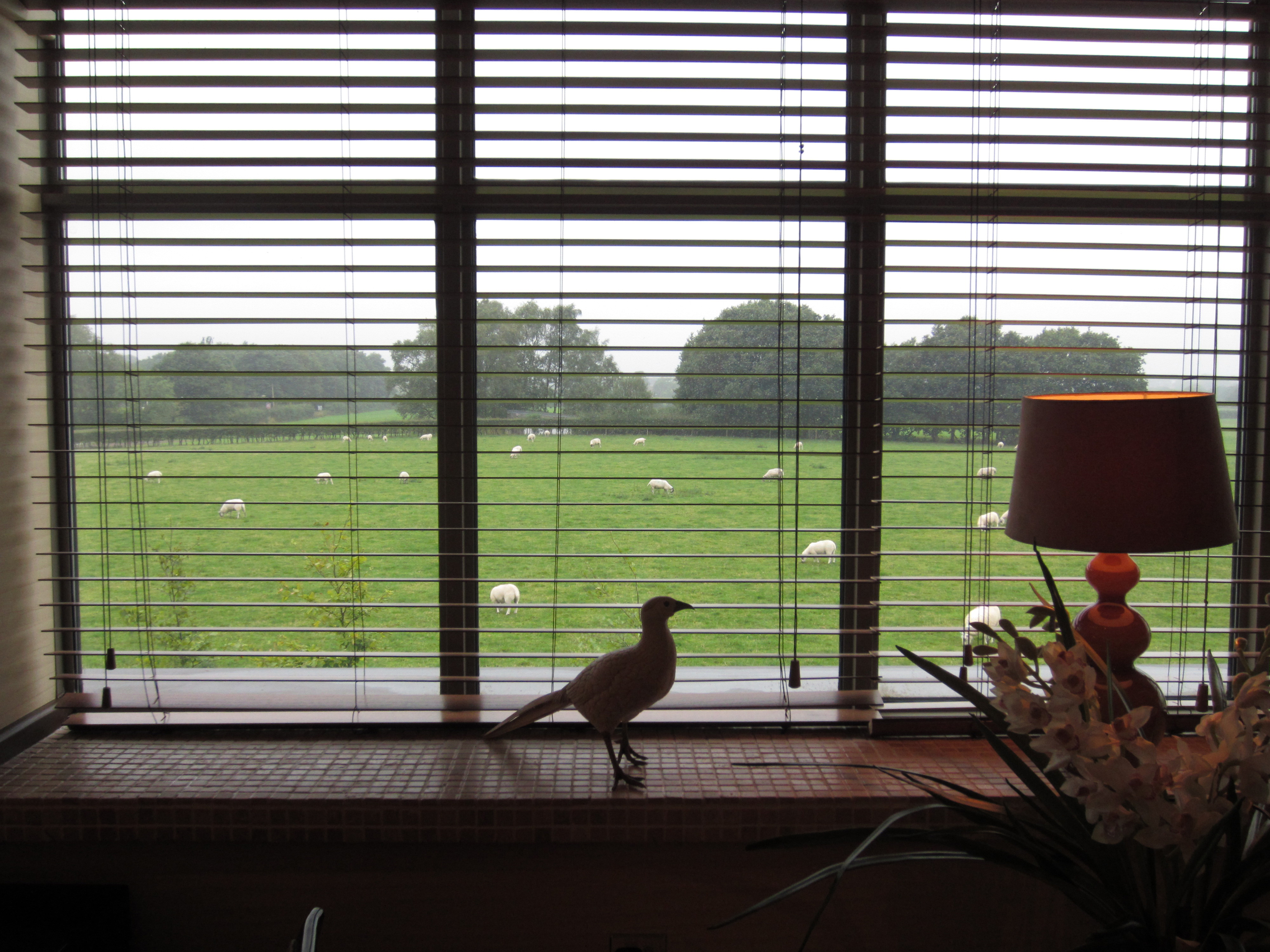
The restful view of sheep grazing outisde Bennet’s Restaurant, Wrightington, where I failed to understand the word “koof-fa”.

Driving down the M6 we stayed a night at the Wrightington Hotel and Country Club in the English midlands. Attached to the hotel, Bennet’s Restaurant has a restful view over a neighbouring meadow filled with grazing sheep. We enjoyed a very good meal there, pampered by an attractive and attentive young waitress. She was hovering over me as I finished my dessert.

“Would you like a koof-fa?”

“Excuse me… a what?”

“A koof-fa.”

I looked around bewildered hoping to see a koof-fa somewhere in the restaurant. Emmy (who is not a native speaker of English) intervened.

“She means a coffee,” she whispered.

The forgetful waiter

My dinner of fish steaks in Ponte de Lima. But where was the entree?

The restaurant in the Imperio do Minho Hotel in Ponte de Lima (northern Portugal) is not renowned for its food, so to attract customers they have installed a big TV screen tuned to a sports channel. We sat down not far from the screen. The waiter took our order.

“We’ll have soup first, please, followed by fish steaks with vegetables.”

The waiter was looking at the TV screen as he noted our order.

Fifteen minutes later the fish and vegetables arrived, but no soup. The restaurant staff were standing around the TV their backs to us.

“Excuse me! DESCULPE!”

The waiter turned, saw my waving arm and came to our table walking crab-like sideways so he could keep the football action in view from the corner of his eye.

“Where’s our soup?” I asked politely.

“Soup? Soup? Oh, sorry, sorry, sorry, I forgot the soup. But you have the fish, no? It’s enough.”

On the TV the crowd roared and the waiter hurried back to the game. As for Emmy and me, we ate an ordinary but very filling meal. The waiter was right… it was enough.

The know-it-all from Austria

At breakfast in the Ashton House B&B in Painswick we were joined by a couple from Austria. The husband looked remarkably like the composer Franz Schubert with small wire-frame glasses, pork chop sideburns and ruddy cheeks.

“You are from Australia? Australia is in the Far East, isn’t it. In fact the very word Australia means the land in the east.”

“Actually,” I said, “Australia comes from the Latin word australis meaning southern.”

“No! No!” he shouted excitedly in a heavy German accent. “You are wrong! Here’s proof. Austria is the English version of Österreich which means the land in the east. Austria and Australia are almost the same, so Australia must mean land in the east too!”

I was used to being the only know-it-all at the breakfast table and was about to defend my monopoly when I received a vigorous kick under the table from Emmy, so I kept quiet.

Jesus Christ

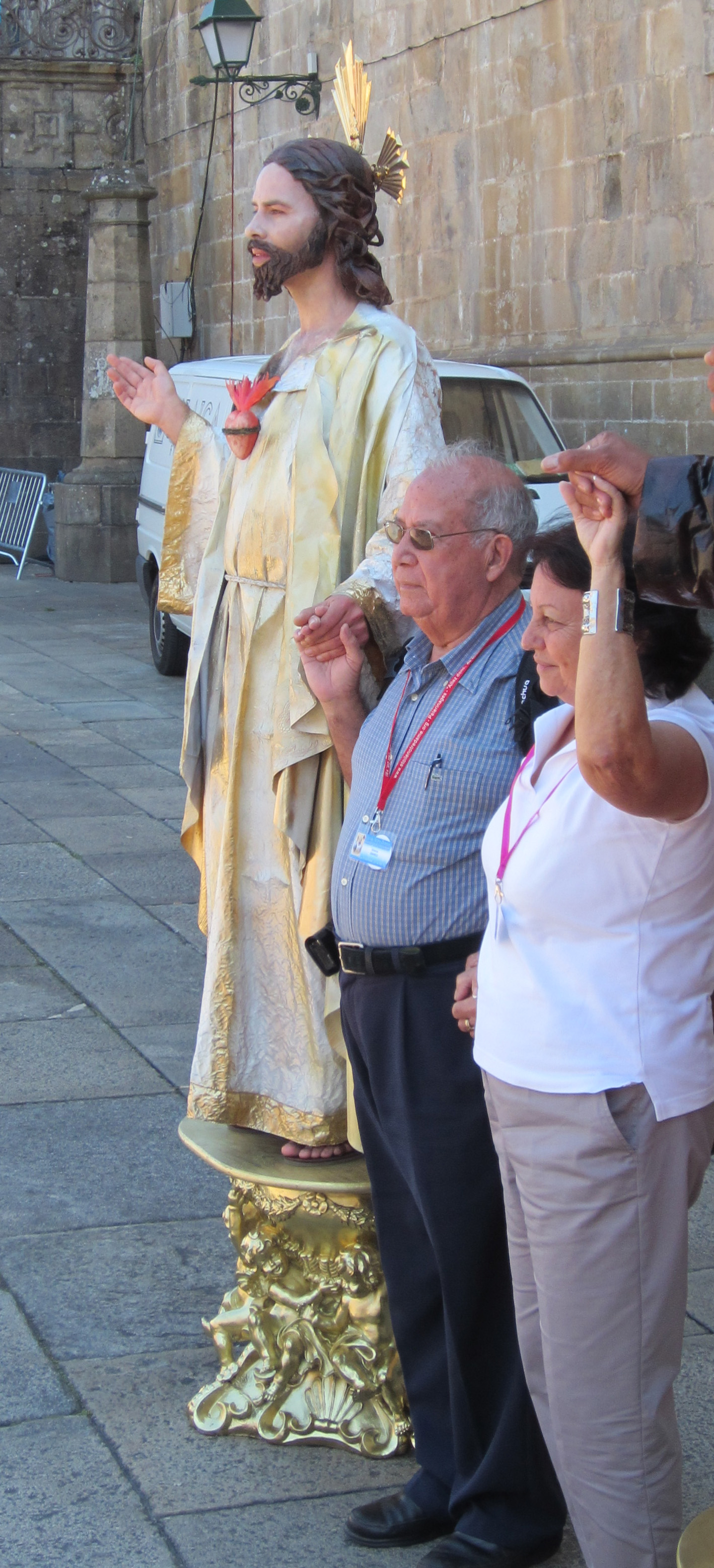
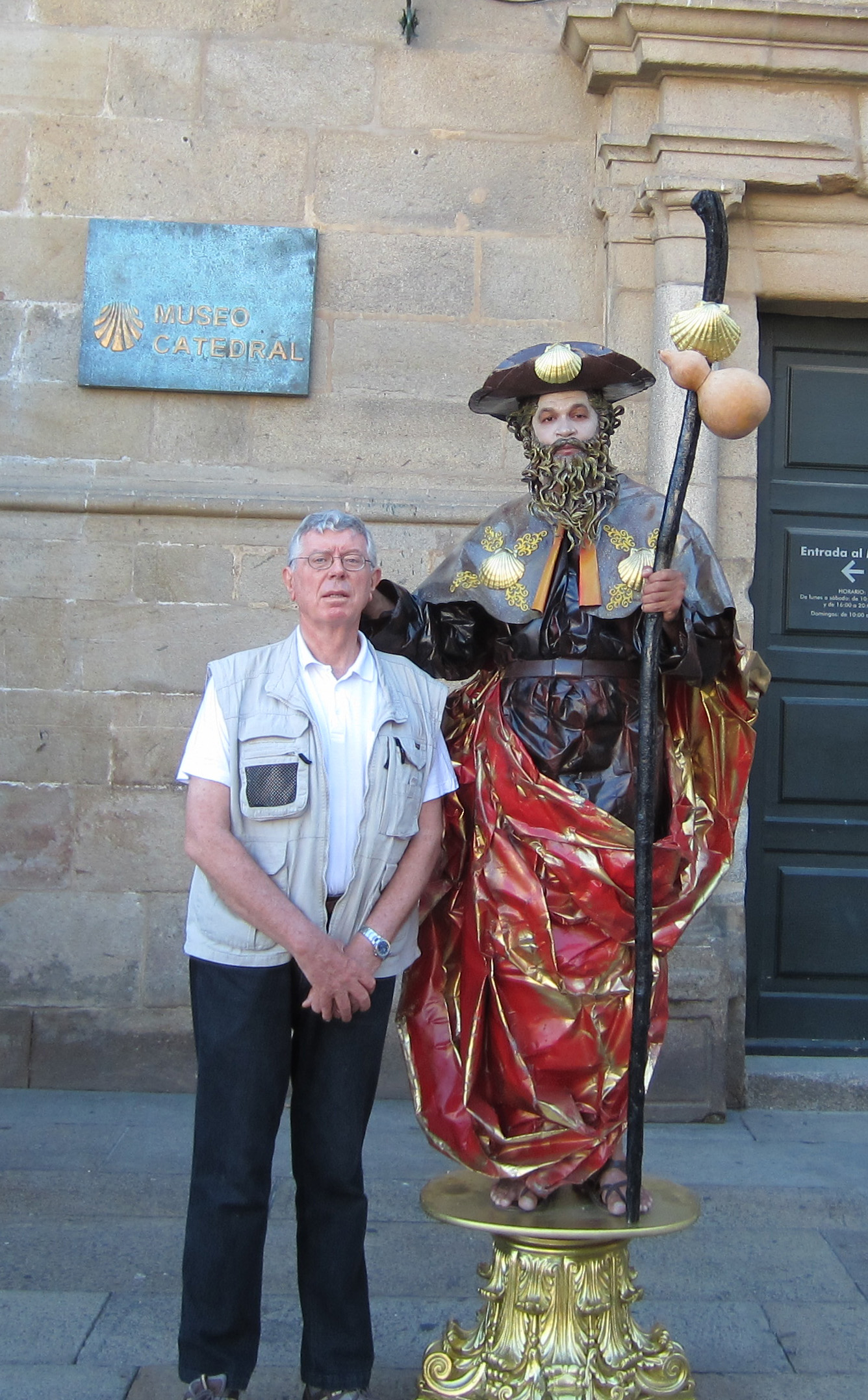
Tourists get a souvenir photograph with Jesus Christ in Santiago de Compostela.

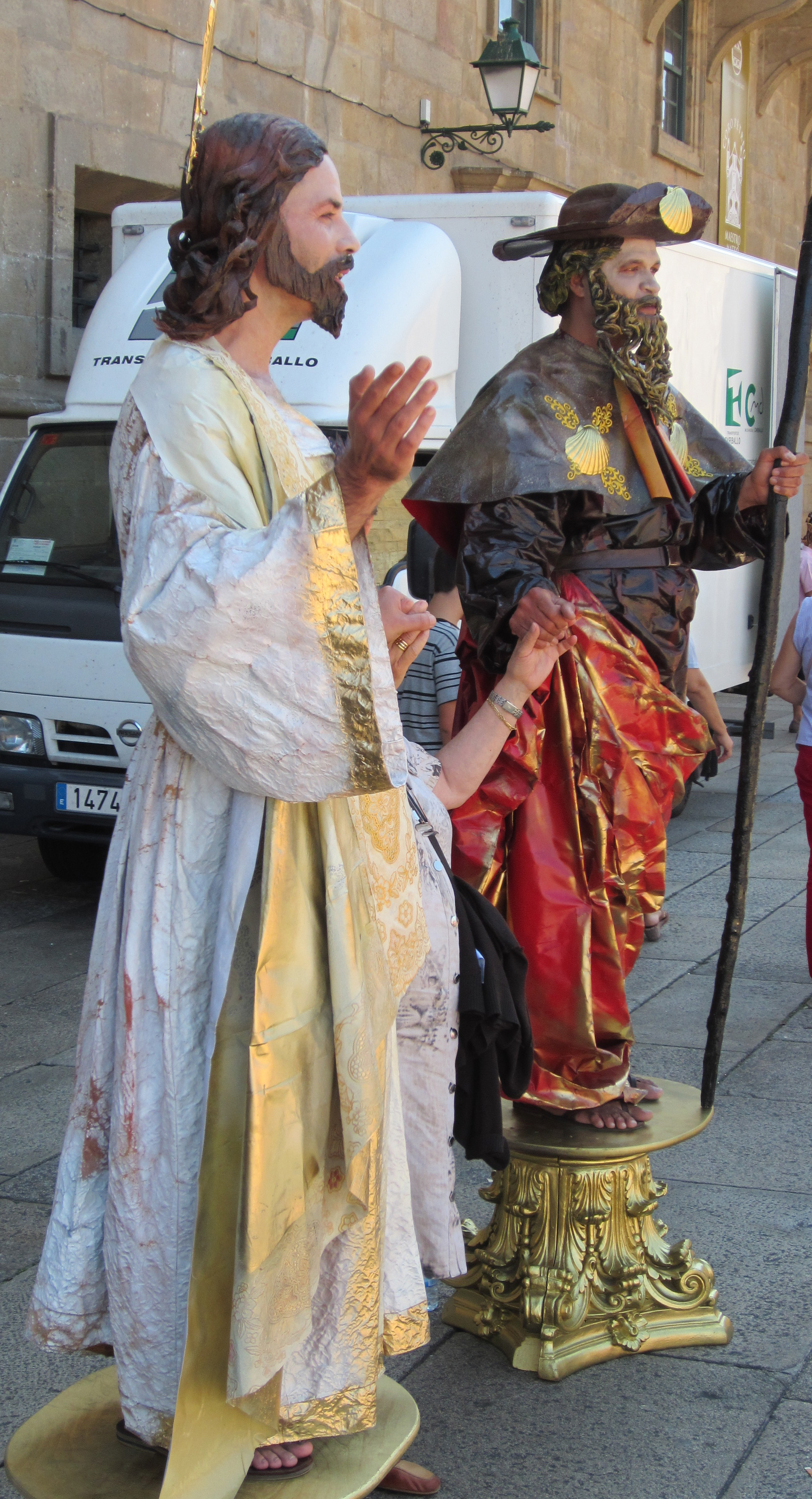
In the Praza do Obradoiro, the main square in front of the Cathedral of Santiago de Compostela, there are plenty of opportunities for pilgrims to part with their cash. For example, for a small “donation”, you can have your picture taken standing beside a meticulously costumed live figure of St.James. Even better, right beside him, Jesus Christ himself is waiting to be photographed (see pix).

Emmy took my picture receiving the benediction of St.James, but when I turned to Jesus Christ I found the Son of Man besieged by a long queue. I decided to come back later.

It was early evening when we returned to the Praza do Obradoiro. St.James was still there and still doing brisk business.

“Where is Jesus Christ?” I asked him.

St.James didn’t understand English, but a bystander helped me out.

“You’ll have to come back tomorrow,” she said. “Jesus Christ has gone home for dinner.”

I get the blessing of St.James (Santiago).

A meticulously costumed Jesus Christ (before he went home for dinner) and his apostle St.James.

Mark Webber’s Portuguese fan

As we negotiated the alleys of Fajozes Village north of Porto a four-wheel drive screeched to a halt beside me. The driver was a young man around twenty years old but already balding. He had seen the small Australian flag sewn to the side of my walking hat.

“You… from Australia?”

“Yes.”

“You know Mark Webber?”

Mark Webber? The name rang a distant bell somewhere on the horizons of my memory. Wasn’t he a Formula One racing car driver?

“You mean the Formula One racing driver?”

The young man was overjoyed.

“Yes! Yes! You know him!”

“No, I don’t know him.”

Despair. Then his eyes lit up.

“You live in Queanbeyan?”

(Queanbeyan is the nondescript New South Wales town where Mark Webber grew up.)

“No, sorry.”

Gloom again. Then I added:

“But I live in Canberra which is just ten minutes from Queanbeyan.”

Joy. His hands shot out of the car window and he clasped mine in a warm handshake.

“You live near Queanbeyan!? Amazing! I so happy! Mark Webber best man!”

He revved the engine of his car, lowered his head, and shot away behind a cloud of dust and diesel. He was a happy man. He had come closer to his idol than he ever thought would be possible.

The crossword puzzle fanatic

In London Emmy and I did a guided walk through the Notting Hill area. It was an entertaining walk, taking us along historic streets, past the houses of celebrities and into the travel bookshop that was the main location for the famous movie Notting Hill.

I noticed a woman in our group carrying a newspaper. As we gaped at the house once owned by Madonna she opened the newspaper, folded it a few times and began filling in a crossword puzzle. We walked on and she followed, head bowed, frowning, doing the crossword as she walked. She muttered to one of her companions.

“What’s bygone. Seven letters with a ‘q’ in it.”

The walk culminated in the crush of the Portobello Road market. Our guide let us loose to browse.

“Fruit and vegetables that way,” he said pointing up the street, “and antiques that way,” pointing in the opposite direction.

“That’s it!” said the crossword lady pulling the newspaper from her handbag. “That’s the answer. Antique. I’m so glad I came on this walk!”

The plainspeaking publican

The ivy-covered Major’s Retreat is the only watering hole in the hamlet of Tormarton, a day’s walk short of Bath on the Cotswold Way. On the evening we visited, Emmy sat at a table examining the pub’s menu while I put my elbows on the bar and ordered a pint of cider (for me) and a small glass of apple juice (for Emmy). The publican was talkative. He spoke with a plummy accent and had a vaguely military bearing consistent with the name of the pub. He recognised my Australian accent and we exchanged banter about the fortunes of our respective national cricket teams. As I put my hands around the two glasses I asked:

“Should I pay for these now, or later, together with our meal?”

“Oh, we’ll put the drinks on the tab for the time being.”

“How long can they stay on the tab?” I said, making a weak attempt at a joke. “Until after we get out the door?”

The publican laughed.

“I’ve got a shotgun under the bar here.”

He pointed at the front door.

“Before you could reach that door…” his eyes narrowed, the smile faded, his voice hardened and rose a little, “I’d put a barrel-full of buckshot up your arse!”

And I don’t think he was joking.

Tormarton’s ivy-cloaked pub, The Major’s Retreat.