From Fort William to Fort Augustus: we survive an encounter with Helen

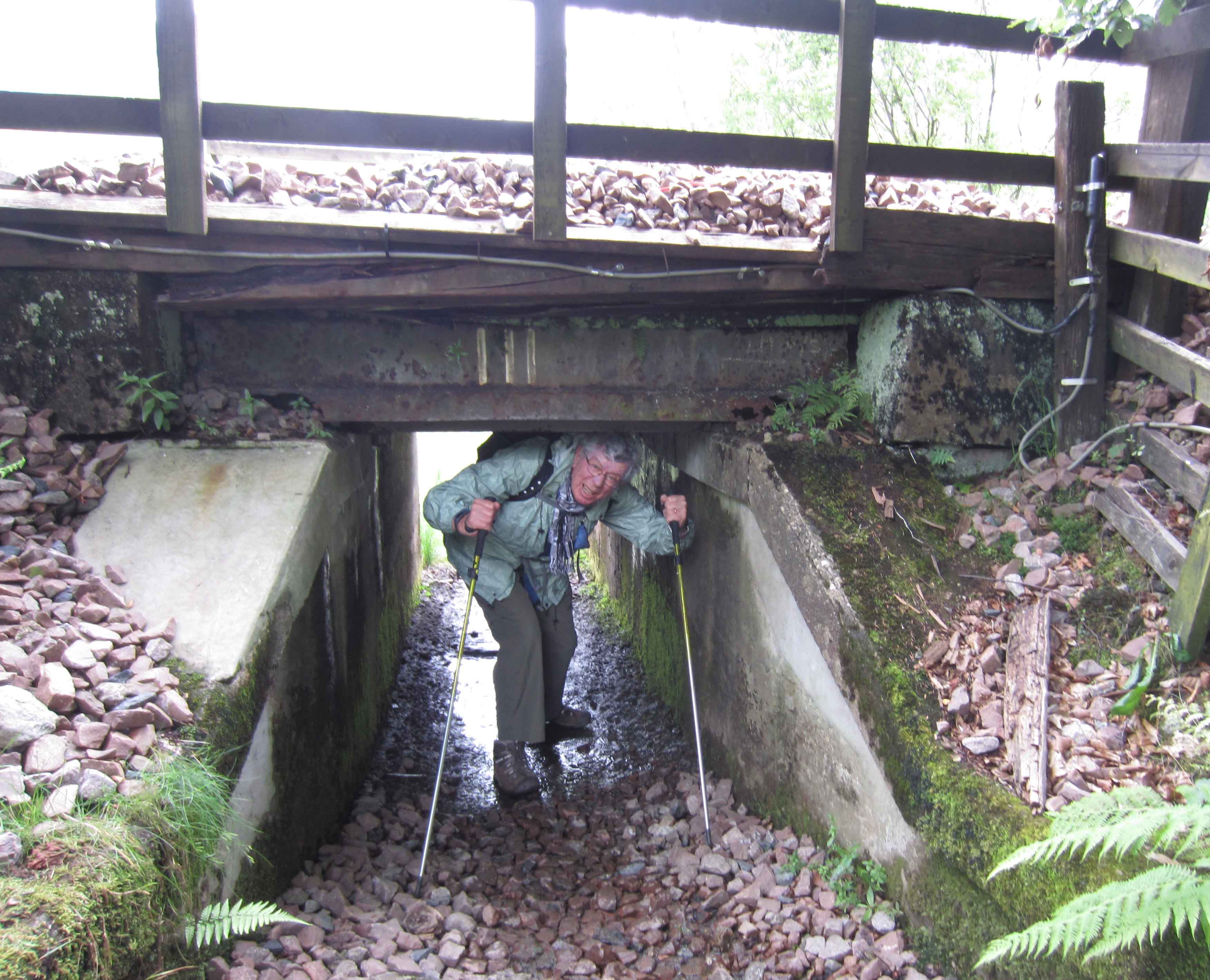
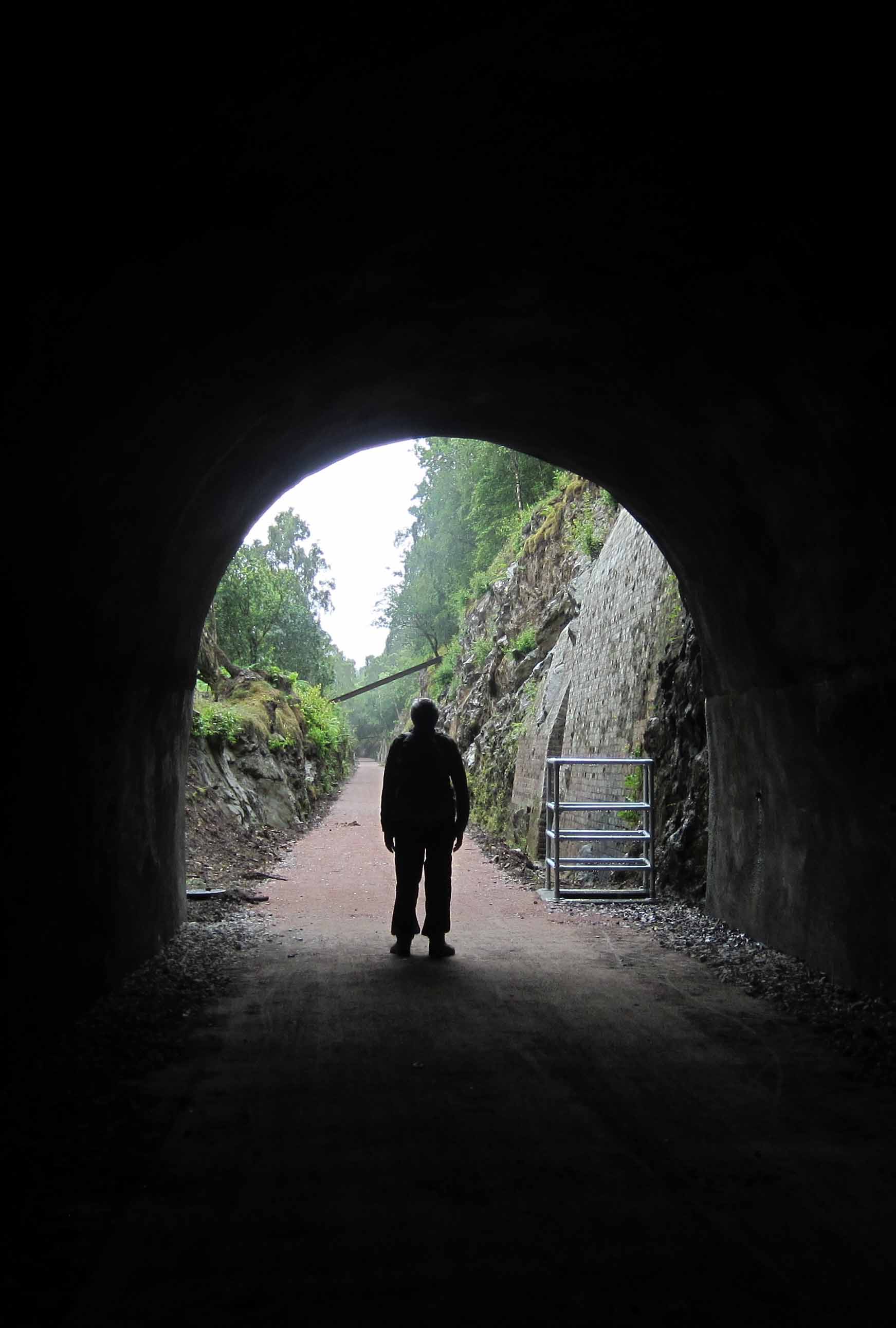
The Great Glen Way runs through a disused railway tunnel on the south bank of Loch Oich.

The Great Glen Way runs through a disused railway tunnel on the south bank of Loch Oich.

They are the largely unsung heroes of long distance walking in the UK… the many thousands of owner-operators of B&Bs and guest houses. John Cleese, alias Basil Fawlty, has made them objects of mockery, but in my experience they don’t deserve it. As I write this in Invermoriston on the banks of Loch Ness I see the patient, cheery faces of half-a-dozen proprietors who, over the last two weeks, have brought each day of weary walking to a comfortable end. Fiona at the Seaview B&B in Mallaig buffeted us with an effusive welcome. Her mile-wide smile followed us up the stairs to our small but well-appointed room where she stoked us with advice on our plans to visit Skye (to be reported in a future post). Dora at the Myrtle Bank guest house in Fort William runs by far the best B&B we have stayed in so far… spacious, squeaky clean and fresh, with distractingly beautiful views over Loch Linnhe, plus a delicious calorie-loaded breakfast and a spectacular flower garden. Dennis at the Glen Albyn Lodge in Invergarry was so captivated by local history he told us the story of the nearby Well of Seven Heads twice, embellishing it with gory details of blood, stink and heads on spikes. Peter at the Distant Hills guest house in Spean Bridge responded quickly to my phone call for a pick-up from the railway station about a kilometre from his B&B (we didn’t want to pull our suitcases that far in misty rain), and the following morning his wife Lesley lavished a banquet-size breakfast of delicious Scottish pikelets and fresh fruit on me. And here we are now at the Bracarina B&B in Invermoriston where Sheila has put a foot soaking and massage machine in our room “in case you need it”.

But there is one crusty exclusion from this honour roll – Helen at the Dreamweavers B&B between Gairlochy and Spean Bridge. At least, initially I thought she should be excluded, but maybe I was too hasty. She certainly started off in Basil Fawlty style. But she softened, a softening that allowed her flinty opinions to break out and strike sparks in a memorable conversation over the breakfast table.

Emmy at the start-point of the Great Glen Way in the centre of Fort William

Emmy at the start-point of the Great Glen Way in the centre of Fort William.

But before I tell you about that let me backtrack a little. On Thursday August 6th we strode down High Street – Fort William’s pedestrian shopping street – to the start-point of the Great Glen Way. Fingers crossed, this was to take us across Scotland to Inverness on the east coast. It took us well over an hour to shake off Fort William. We twisted and turned along a route that coiled through suburbs to Neptune’s Staircase on the outskirts of the city. Neptune’s Staircase is a series of seven locks that lift vessels (these days mostly pleasure craft – yachts, launches and the like) from the sea up into the freshwater Caledonian Canal. The Caledonian Canal is a remarkable engineering feat. It was built in the early 19th century to take barges across the highlands of Scotland by connecting three lakes – Loch Lochy, Loch Oich and Loch Ness – that lie end to end along an ancient fault line that has inflicted a deep diagonal incision on the mountainous interior of the country.
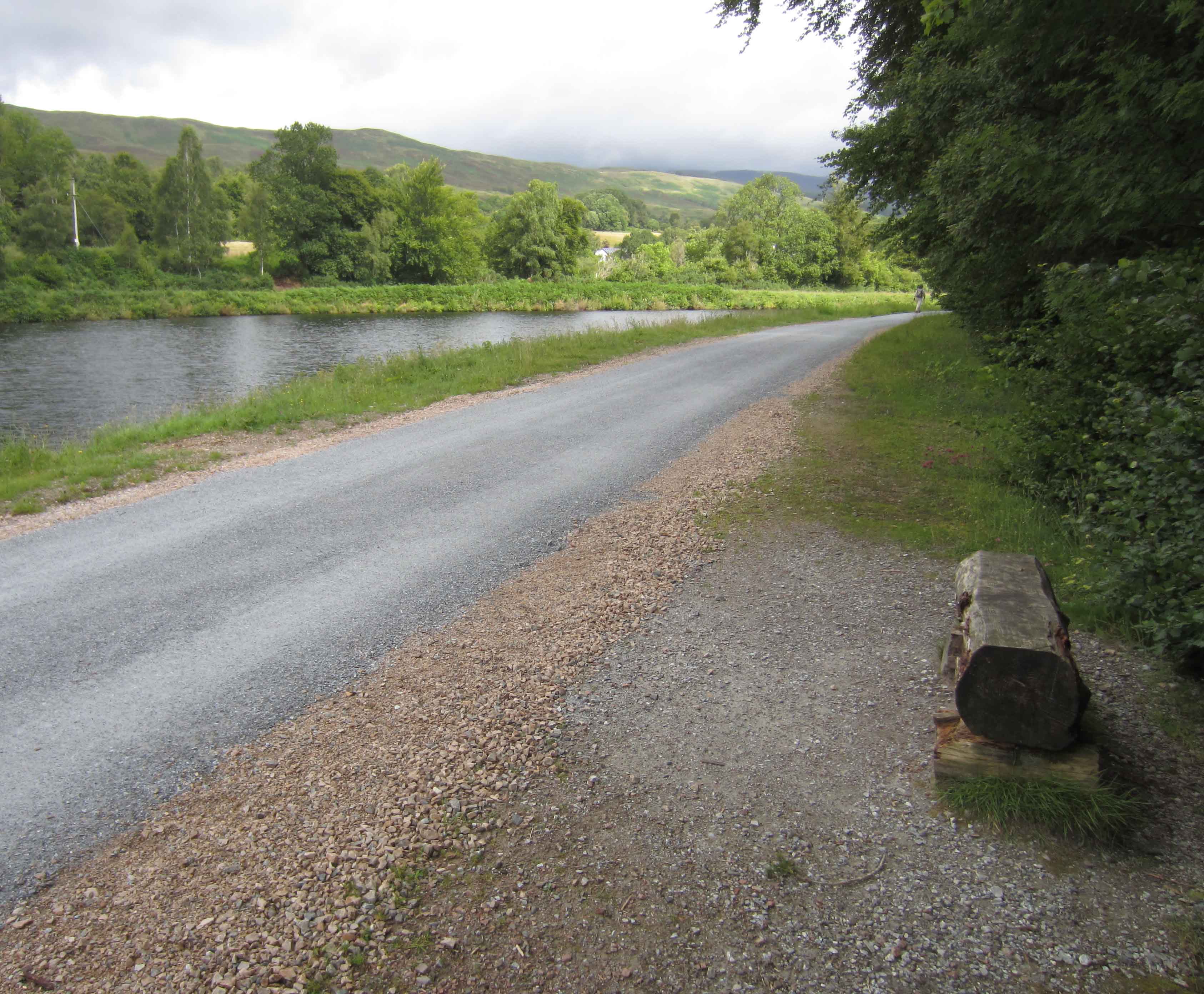
Most (but not all!) of the Great Glen Way is easy walking. Here, between Fort William and Gairlochy the path runs flat and wide beside the Caledonian Canal (left). It even has occasional trackside benches. Perfect for old people like us!

Most (but not all!) of the Great Glen Way is easy walking. Here, between Fort William and Gairlochy, the path runs flat and wide beside the Caledonian Canal. It even has occasional trackside benches. Perfect for old people like us!

Our first day of walking on the Great Glen Way took us along a wide flat gravel path on the banks of the canal. At first the weather was warm and cloudy and the walking was easy, but as we left Neptune’s Staircase and walked into the farmland behind Fort William the sky turned sombre. We quickened our steps, trying to keep ahead of the intermittent spitting rain that blew up from the sea behind us and pattered against the hoods of our rain jackets. Around one o’clock we reached Gairlochy, a tiny hamlet built around a lock on the canal. Here we swerved away into the countryside towards our accommodation at Dreamweavers B&B about three kilometres off the Great Glen Way.

Looking back towards Fort William from near Gairlochy, the mountains are still flecked with snow, and the summit of Ben Nevis (right) is blanketed in cloud as it usually is..

Looking back towards Fort William from near Gairlochy, the mountains are still flecked with snow, and the summit of Ben Nevis (right) is blanketed in cloud as it usually is..

The sky was dark as we opened the gate in front of Dreamweavers at a quarter to two, but it was probably not as dark as the scowl on the face of the owner, Helen, as she emerged from the front door to investigate our arrival. She was a compact woman aged in her sixties with an attractive face and shortish blond hair.

“Did’ye not know, check-in time is four o’clock?”
“Yes, I did know that,” I answered, “but it is cold and threatening rain, and we have just walked more than twenty kilometres. There is nowhere else we can go so I was hoping we could check in early.”
“Well I canna let ye do that. Check in time is four o’clock.”

I tried to look old and pathetic. I pulled back the hood of my rain jacket to expose my grey hair. Emmy bent over her walking pole like a trembling old crone. We huddled against each other.

Helen was not moved.

“You can walk down to The Pines coffee shop and wait there until four o’clock.”
“How far is it?”
“Not far.”
“How far exactly?”
“Och, about three miles.”
“We’re in our seventies, we’ve just walked twenty kilometres, it’s cold and starting to rain, and you want to send us on another hike?”

Helen considered this for a moment. She’s going to relent, I thought. But no.

“Alright, I’ll tell you what I’ll do. I’ll run you down to the coffee shop in my car. Then you can walk back after four o’clock.”

It was our best option. There was tense silence in the car as we headed along a narrow road to The Pines coffee shop at the front of an isolated resort hotel. Then, as we got out of the car, a breakthrough…

“If you give me a call around four o’clock I’ll come and pick you up.”

And that’s what we did. Feeling much improved after tea and scones I phoned Helen at four o’clock. Within minutes she was at the front door of The Pines and we were speeding back to Dreamweavers. In the front parlour she had set out tea and biscuits. Little by little the conversation delivered glimpses of another person. She had once been a successful teacher specialising in special-needs children. Her mother had developed Alzheimers and Helen abandoned her career to care for her. She injured her back in a fall in snow. She also suffered from inflammation of the digestive tract and could not eat solid food.

No wonder she was a bit cranky.

“Would you like more tea?” said Helen, warming to us as we were warming to her.
“Oh yes please,” Emmy and I said in unison.
“Good. Now where did I put the teapot?”

She looked around the cosy front room, its walls decorated with portrait photos of her lively, red-headed grandchildren. Tables, sideboard, window sill, even armchairs were searched… no sign of the teapot.

“Ah, here it is!” she exclaimed, picking up the teapot from the floor beside the fireplace. “It’s a good thing I don’t possess a credit card or a mobile phone. How could I keep track of them if I can’t even remember where I put the teapot?”

Walking through dense conifer forests on the north side of Loch Lochy.

Walking through dense conifer forests on the north side of Loch Lochy.

The following morning we sat down to breakfast with an English couple from Shropshire. The conversation turned to politics.

“How did you vote in the independence referendum?” I asked Helen.
“For independence, of course.”

She glanced at the couple from Shropshire.

And I supported the Scottish National Party in the general election. We Scots are fed up with Westminster. Do you know how many parliamentarians are sucking at the public teat down there in London? Put the Commons and the House of Lords together and it’s well over two thousand.[an exaggeration… the real number is around 1400]. Even the Americans can’t match that. Their country is much bigger than ours but the US Congress has only about five hundred members.”

I decided to try a mildly provocative follow-up question.

“So if the Scots are fed up with Westminster, how come they chose so decisively to stay part of the United Kingdom?”

Helen’s answer was steaming with indignation.

“Do you know what those miserable Tories did? They phoned all the pensioners in Scotland and told them that if they voted for independence they would lose their pensions.”

The couple from Shropshire were sitting bolt upright in their chairs, their heads thrown back a little as if a strong wind was battering them. I could see they were Tory voters.

The conversation zig-zagged down the ravines and canyons of politics. When the subject of social welfare turned up the lady from Shropshire saw her chance to redress the lefty bias that had dominated the discussion.

“When I was young,” she announced, “my family lived in great hardship but we never received any financial help from the public purse. Nothing. And it didn’t do us any harm, in fact it was good for us. These days young people think they don’t need to get a job. They can live the high life at the taxpayer’s expense. Teenage girls are deliberately getting pregnant so they can live off social security benefits. It’s not right. They shouldn’t get a single penny.”

Helen and I exchanged a split-second glance. We were allies. Helen pounced first.

“Statistics show loud and clear that social security payments to unmarried teenage mothers are a tiny, tiny proportion of total outlays. But they have a big, very positive effect on the lives of the children involved. Why punish children by withholding support for them? And anyway, how can you know what the motivations of teenage mothers are? How can you know that an unemployed girl from the backstreets of Liverpool deliberately got pregnant to pinch money from taxpayers? Eh? How can you know that?”

The lady from Shropshire looked shocked. Clearly, in her circles these counter-views were never heard.

I was waiting my turn. I was thinking of Prince George and Princess Charlotte, the infant children of Prince William and the Duchess of Cambridge. They would never know the character-building benefits of poverty. They would live lives of unimaginable privilege and luxury all at the expense of the British taxpayer. I smiled to myself and drew a deep breath.

But Emmy sensed I was about to open my big mouth and embarrass everybody. So she stood up abruptly.

“It’s time to get moving. We’ve got a long day of walking ahead of us.”

It was a struggle to get out of the dining room as Helen held forth in the doorway. Later as we sat at the front door putting on our boots Helen had kindly and useful advice on the conditions that awaited us.

Helen, we love you. You are by far the most intelligent and interesting host we have encountered on our travels. I think I’ll add you to the honour roll. Please, please, don’t change.

Like the yachts on the Caledonian Canal, we sailed smoothly up the gravel road on the canal’s bank. Thick conifer forests closed around us as we walked the north side of Loch Lochy. At the east end of the loch we crossed the canal on one of the lock gates at Laggan Locks. The next day the easy walking continued. We crunched along on the fine gravel of a beautifully renovated walking track that was once a railway line. It took us along the steep southern bank of Loch Oich. The weather was cool and overcast. Perfect for walking really. But as we circled the east end of Loch Oich a rain squall came sizzling up the lake from the west. We struggled into our wet weather gear, fighting hard against a fierce wind that tried to tear it from our hands. The fury didn’t last long. After just half an hour the rain was spent but a cold wind stayed pressed against our backs, pushing us towards Fort Augustus at the west end of Loch Ness.
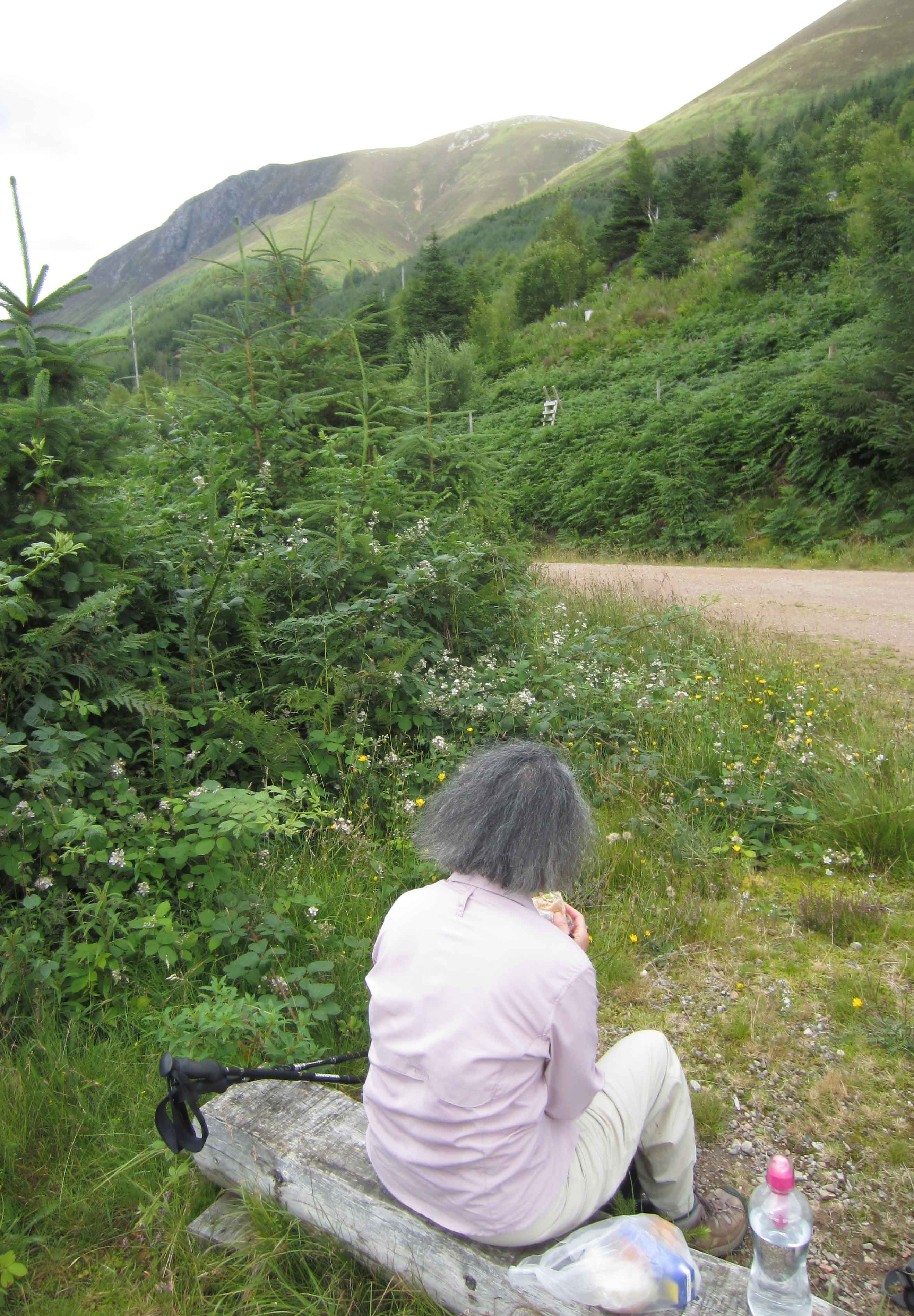
Trackside lunch amid blackberries with Scotland's dour highland hills glowering above.

Trackside lunch amid blackberries with Scotland’s dour highland hills glowering above.

We found the town jammed with hundreds of day-trippers. Many were lining the canal locks in the centre of town watching the spectacle of gates opening and closing, with small vessels rising and falling and water spilling and seething in the lock ponds. We headed straight for our accommodation at the Bank House B&B. It was around 2.00 pm, two hours ahead of the “official” check-in time of 4.00 pm. Given our experience at Dreamweavers I was worried our early arrival might be unwelcome. But our host Ian greeted us very warmly and immediately settled us into our comfortable room erasing in an instant the discomfort of the day’s walk.
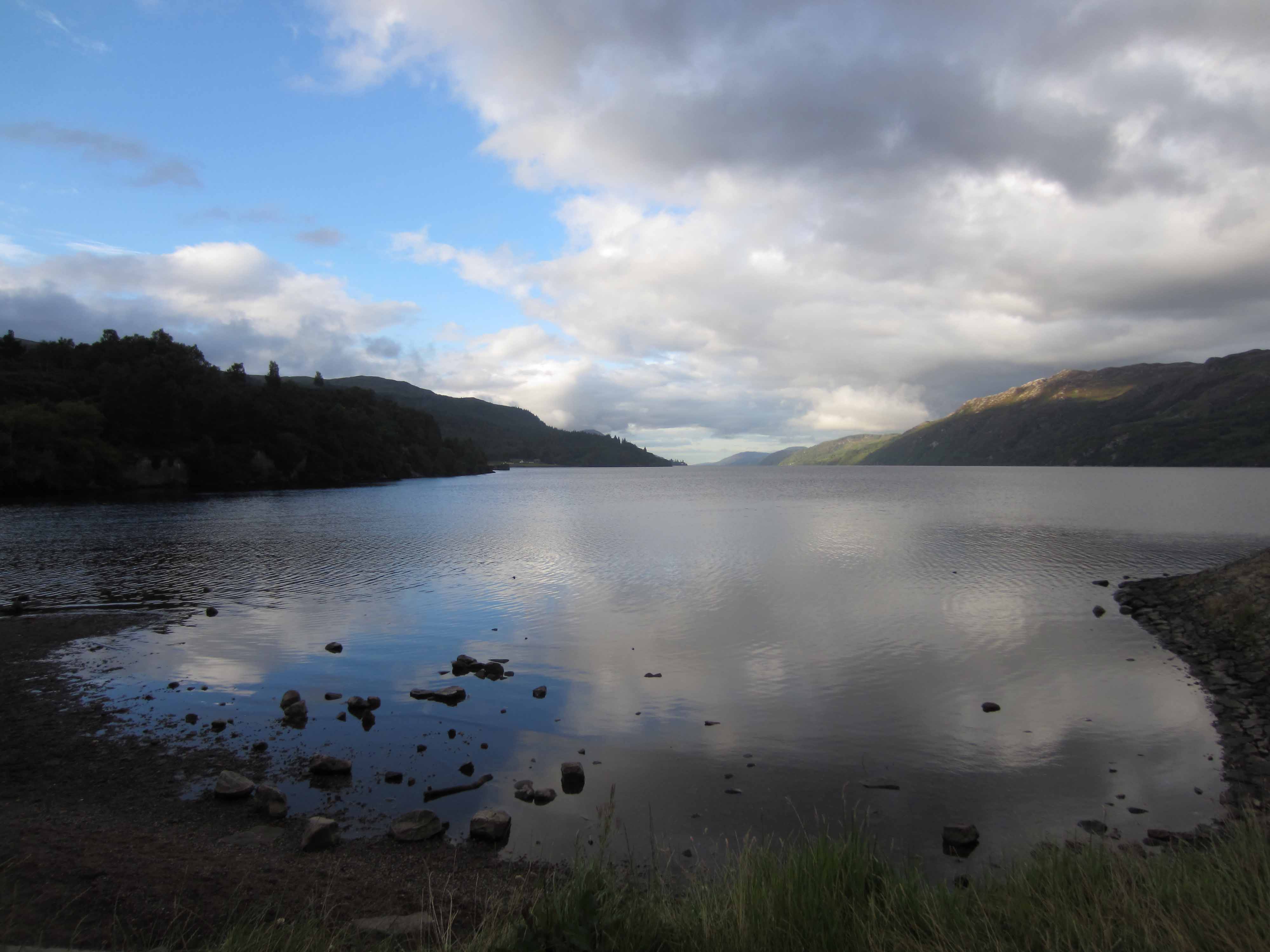
The quiet waters of Loch Ness on the evening of our arrival in Fort Augustus.

The quiet waters of Loch Ness on the evening of our arrival in Fort Augustus.

The wind disappeared and as twilight slowly dimmed the sky we walked down the main street past the locks to the edge of Loch Ness. The lake lay glimmering quietly in the cold air. In the distance sunshine brightened a slash of high hills. A friendly calm wrapped itself around us. After half an hour of silence reluctantly we turned away and returned to our lodgings for a long night’s sleep.

Boats queue to enter the locks behind me at Fort Augustus. At 7.00 pm the temperature has fallen to around ten degrees. Ah... summer in Scotland.

Boats queue to enter the locks behind me at Fort Augustus. At 7.00 pm the temperature has fallen to around twelve degrees. Ah… summer in Scotland.

The forbidding splendour of Rannoch Moor: We complete the West Highland Way (sort of)

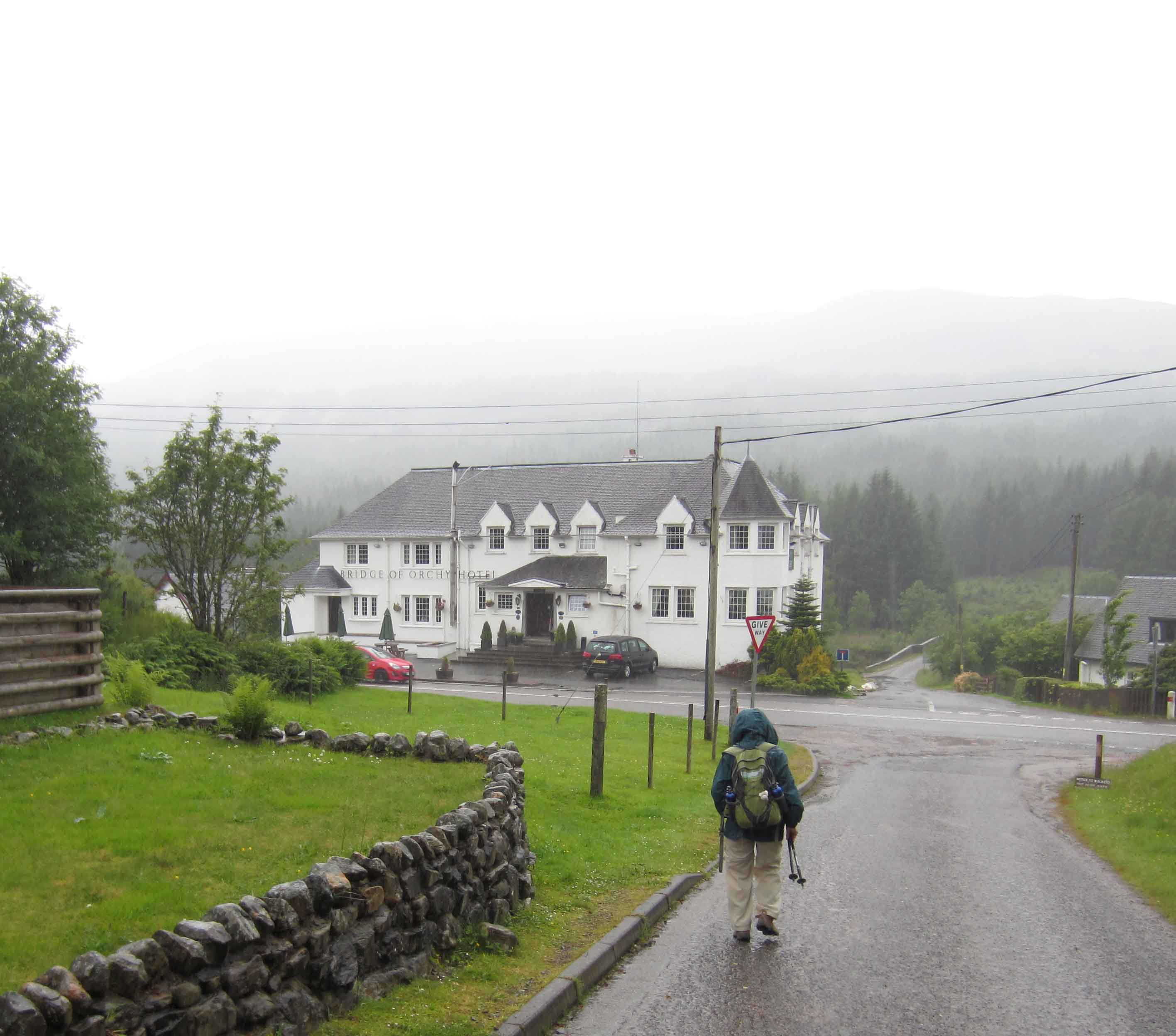
The anceient Bridge of Orchy (with two walkers on it) and behind it the Bridge of Orchy Hotel, a busy oasis for West Highland Way walkers.

The ancient Bridge of Orchy (with two walkers on it) and behind it the Bridge of Orchy Hotel, a busy oasis for West Highland Way walkers.

A grey Scottish gloaming was settling over the Bridge of Orchy Hotel as we pushed open the front door marked “Walkers Welcome”. In the dimly lit lobby a black-bearded head rose from behind the reception counter.

“Ah, Mister George,” it said in a thick east European accent, “you booked a queen room, no?”

“No, I booked a standard double or twin room.”

“Hah? No, you wrong, Mr George.” He placed a dog-eared piece of paper before me. “You book a queen room, see?”

It took a while to explain that my name was George Quinn, and “Quinn” was not the same as “queen.” The receptionist looked doubtful but eventually he handed over a room key. We grabbed it and headed upstairs to our comfortable but slightly shabby twin room.

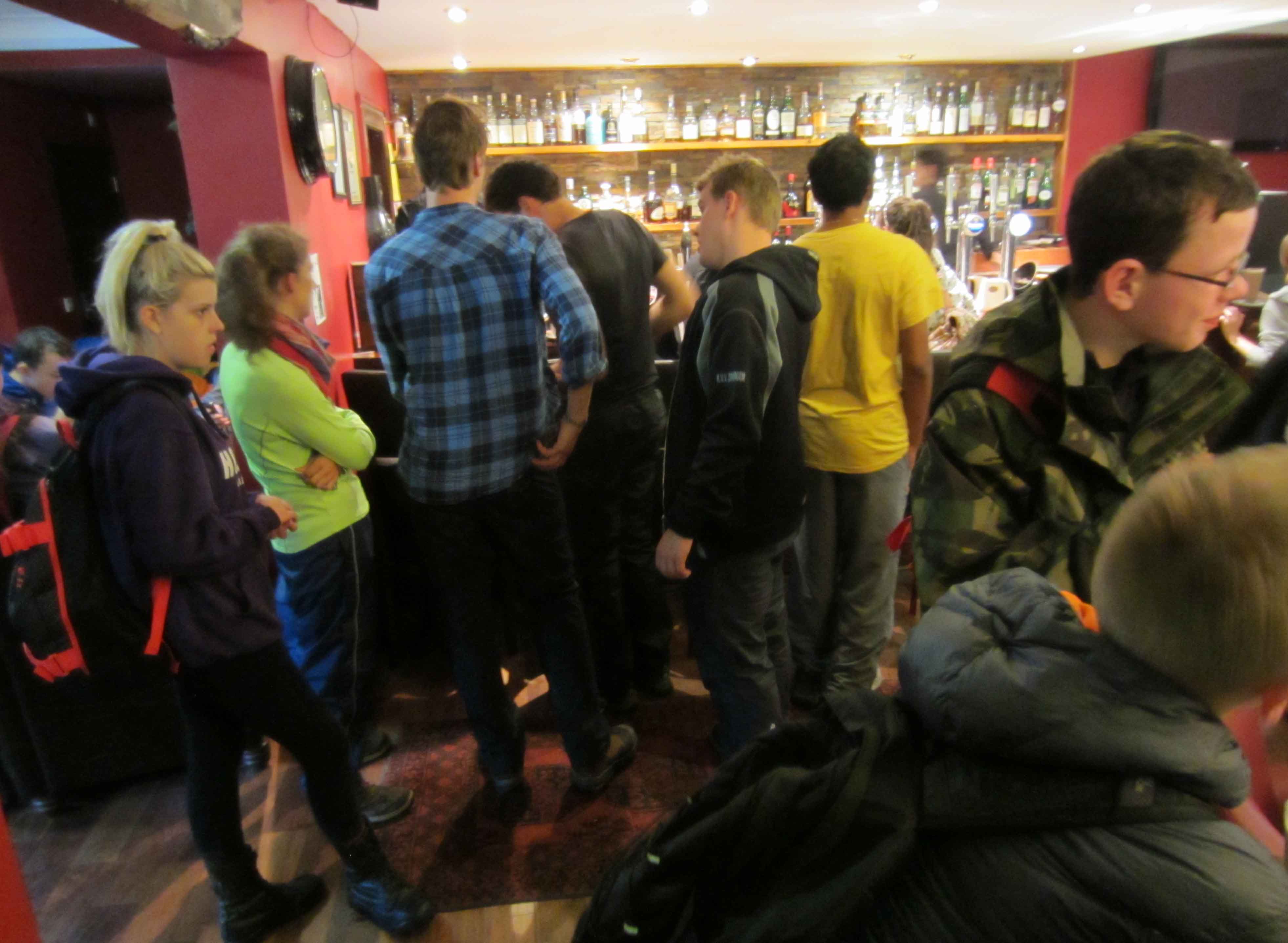
Bridge of Orchy consists of one hotel – quite a substantial two storey building – about six cottages and their outbuildings, a tiny usually unstaffed railway station, a mini fire station, and an ancient arched stone bridge. But for the single night we stayed there the hotel and village surged with visitors. The hamlet is remote but it is an oasis for walkers. The following day as Emmy and I sat killing time in the bar I estimate well over one hundred sodden souls shuffled through the hotel’s warmth in the space of about two hours. They downed coffees and slices of thickly iced carrot cake or put weighty lumps of steaming pizza into their mouths, babbling through the crumbs in a hundred different languages.

In the Bridge of Orchy Hotel walkers crowd the bar at 11.00 in the morning.

In the Bridge of Orchy Hotel walkers crowd the bar at 11.00 in the morning.

The previous night I had ordered a serving of Scotland’s national dish, Haggis Neeps and Tatties. I had no idea what to expect. I knew that haggis was made from shredded beef and mutton bound with oatmeal, spiced with who-knows-what, and boiled inside a sheep’s stomach. When you’ve eaten chicken brains, and witchetty grubs, and dog meat (as I have) this sounds almost ho-hum. But neeps and tatties?

The waiter explained – wrangling his Romanian vowels into the corral of English – that neeps comes from “turnips” and tatties was the Scottish word for “potatoes”. Afraid that I might be disappointed to be served such proletarian fare he added:

“The chef gives it a good splash of whisky.”

Haggis Neeps and Tatties

Haggis Neeps and Tatties

In the event Haggis Neeps and Tatties was neither memorable nor forgettable. A grey mound arrived squatting in the middle of a plate anointed with gravy. It certainly didn’t look appetising, but I dug my fork into it anyway and discovered that most of it was mashed potato with an orange-yellow layer of turnip on it topped with some brownish organic matter. The brownish organic matter was (presumably) haggis. I raised a forkful to my mouth. Hmmm… not bad. It tasted quite nice in a bland savoury way. There was no hint of whisky though. It took me only a few minutes to devour it, and I have to say, I enjoyed it. When the waiter returned he seemed surprised.

“All gone, eh. That was quick.” I got the impression diners were not always as enthusiastic as I had been.

Emmy and I were customers of the Glasgow-based company Macs Adventure. To crank ourselves up (but not too suddenly) to the level of fitness required for the walk along Loch Ness to the other side of Scotland we had chosen an initial one-week package called “West Highland Way Rail and Hike”. This alternated sections of rail travel with sections of hard hiking up the length of the West Highland Way from Glasgow to Fort William and (as a bonus) on to Mallaig. Macs Adventure booked our accommodation for us – mostly in pubs and B&Bs – and transferred our suitcases from lodging to lodging using a “safari” service. All we had to do was walk or ride. We carried a small back pack – small-ish, actually, because each morning our backpacks had to be stuffed with a first aid kit, at least a litre of water, a rain jacket and water-proof leggings, fruit and sandwiches for lunch, spare socks, sunscreen and insect repellent, walking poles, maps, and a trowel for the possible emergency of trackside poos. I have to report that, as I write these words in Mallaig at the end of the Rail and Hike package, Macs Adventure have done a reliable and thorough job.

Back to Bridge of Orchy. At 2.00 pm on the rainy afternoon of August 1st we found ourselves on the platform of the Bridge of Orchy station looking across the rails and over a fence at walkers labouring, heads down under their ponchos and hooded raincoats, along the adjacent West Highland Way. One of them turned into the station and flung her backpack down beside us.

“Zo, ver are ze banks?” she said accusingly in a thick German accent, her eyes glaring up and down the station platform.

“Banks?” If there was a bank in the tiny deserted railway station I felt pretty sure I would have noticed it. But I remained open-minded and cautious. “I don’t think there is a bank here.”

“No no no no,” she said, presuming she was dealing with the village idiot. “Banks! Banks for sleeping!” She pressed her palms together, laid them against one cheek and tilted her head.

“Oh… bunks.” Behind me I saw a small printed notice taped to the inside of a window: “West Highland Way Sleeper Reception. Open 5.00 pm.” The young German was busy hammering on doors and rattling door knobs. When she saw the notice she yanked a mobile phone from her pocket and began jabbing at it. About fifteen minutes later a rotund Scottish gentleman strolled on to the platform and explained to her that the station bunkhouse would not be accessible until after five o’clock.

Apparently some railway stations in remote places are now providing limited but bookable and very cheap dormitory accommodation for walkers. The Scottish gentleman suggested she walk down to the Bridge of Orchy Hotel and wait in the bar until the bunkhouse opened at 5.00 pm. She protested.

“I have paid twenty-five pounds for a bunk this evening. I want to access it now so that I can claim a bottom bunk.”

Suddenly her outrage turned to pathos. There were tears in her eyes but the beginnings of a rueful laugh too.

“I can’t climb up on to a top bunk,” she whispered. “I can’t do it. I am hurting too much.” And she slumped on to a platform bench.

At this moment our train arrived for the journey to Spean Bridge. Emmy and I leaped aboard and from our comfortable, dry, warm seats, through a big window spotted with raindrops, we saw the girl sitting alone on the platform staring ahead unseeing, absently turning her mobile phone over and over in her hands.

We headed out of the station into the wilderness of Rannoch Moor. I was in for a surprise. The austere splendour of the landscape was far beyond what I had expected. The train sped over vast grass slopes between lakes and twisting rivers with huge knobs of mountain on the horizon. It was wild, open, wind-swept, empty country darkened in places with stands of forest. Crooked scribbles of water sliced vertically down the green hillsides. In the distance sinews of snow were still stencilled on the steep-sided mountains, clamped over their peaks like white spiders legs. As we raced towards Tulloch station in the centre of the moor a column of startled deer jumped away from the rail line and bounded off to suddenly evaporate in the green expanse of the plain. Somewhere inside I felt a knot of emotion. Several times goose-bumps crept across my skin. This was not an intimate, or friendly, or merely picturesque landscape. It was forbidding yet grippingly, emotionally beautiful.

A hardened walker: Emmy strides that path between Spean Bridge and Fort William.

A hardened walker: Emmy strides the path between Spean Bridge and Fort William.

After a comfortable night at the Distant Hills guest house in Spean Bridge, the following morning we hoisted our backpacks on to our backs and strode down the main street, the first yards in an eighteen kilometre stretch west into the centre of Fort William. It was a warm, silent Sunday. We walked into a small refreshing breeze under a cloudy sky flecked with blue. The walking was easy. It was possible for once to look left and right and enjoy the countryside. We walked through fields awash with daisies and clover, foxgloves and ragwort, thistles and shiny orange toadstools. Reeds grew in muddy profusion at the path side, jostling with dense sheaves of grass, bracken and blackberries.

Trackside foxloves, and...

Trackside foxgloves, and…

... a friendly local

… a friendly local, not far from Spean Bridge village.

Part of the path took us through the blasted environment of a commercial pine forest, then, as we approached Fort William, the path veered around a golf course. It took an hour to walk along the suburban fingers of the town to the kilometre-long pedestrian mall that hosts the business centre. Here back-packed crowds wandered from shop to shop. I too stopped at a souvenir shop and bought a tee shirt. Its message read “I walked the West Highland Way.” In my case it wasn’t strictly true, but there was no version of the tee-shirt with explanatory footnotes about trains and rain. And anyway, we had knocked over the last leg from Spean Bridge to Fort William with no trouble at all. I deserved a reward. We had hardened up. We were ready for Loch Ness.

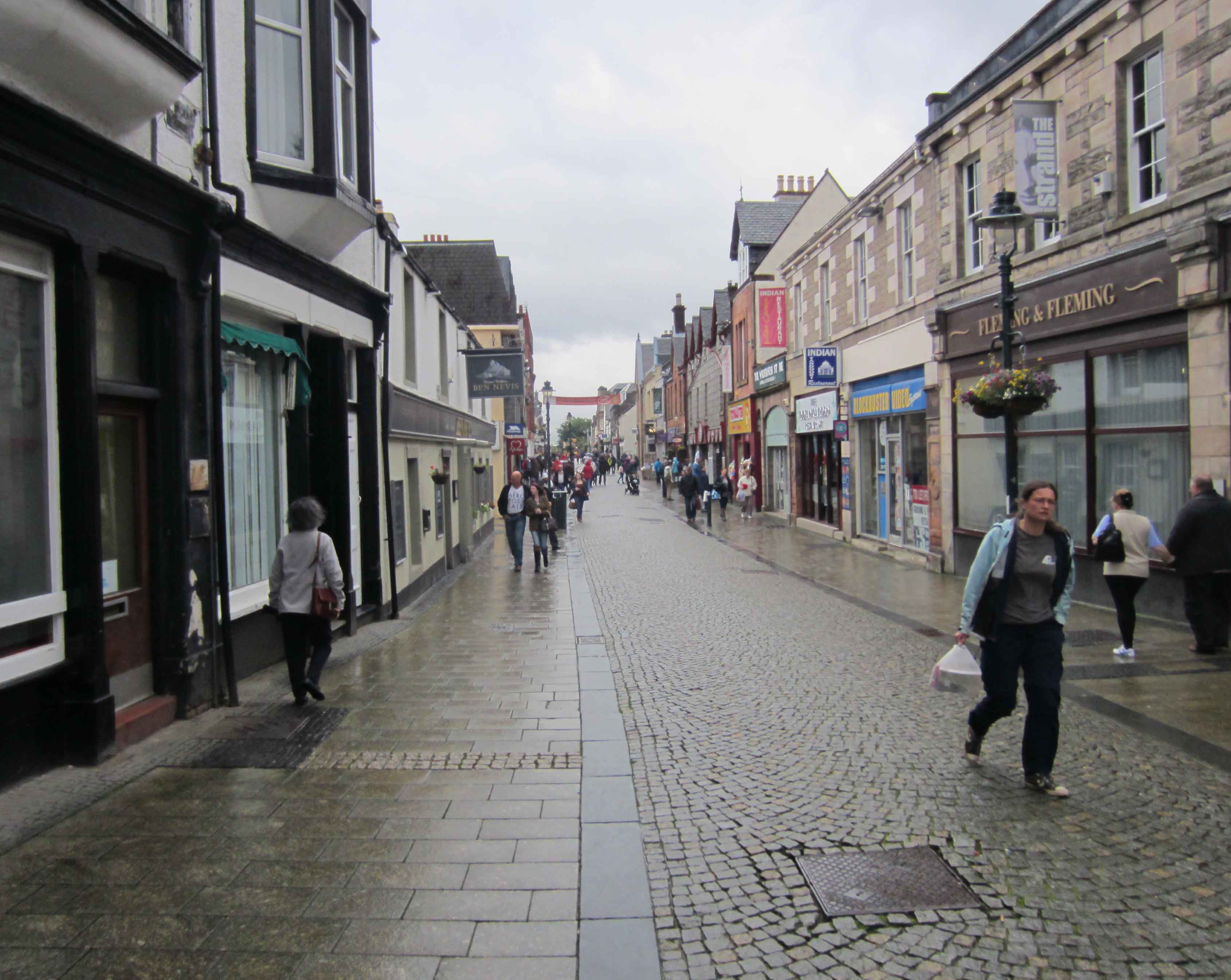
The rain drenched main street of Fort William.

The rain-drenched main street of Fort William. The sky is grey, the air is cool. This is summer 2015 in Scotland.
From train to pain to rain: Glasgow to Bridge of Orchy

We rolled our suitcases into the street from Glasgow’s Carlton George Hotel and pulled them around the corner to the Queen Street railway station. A noticeboard apologised for disruptions to train services but our train for Ardlui on the banks of Loch Lomond left exactly on time. After emerging from a tunnel it cut between lush banks of shrubbery punctuated with brick walls. We saw flashes of Glasgow’s suburbs: naked rows of unlovely tenement strips coated in grey stucco. Grey is a pretty popular colour in the suburbs of Glasgow.

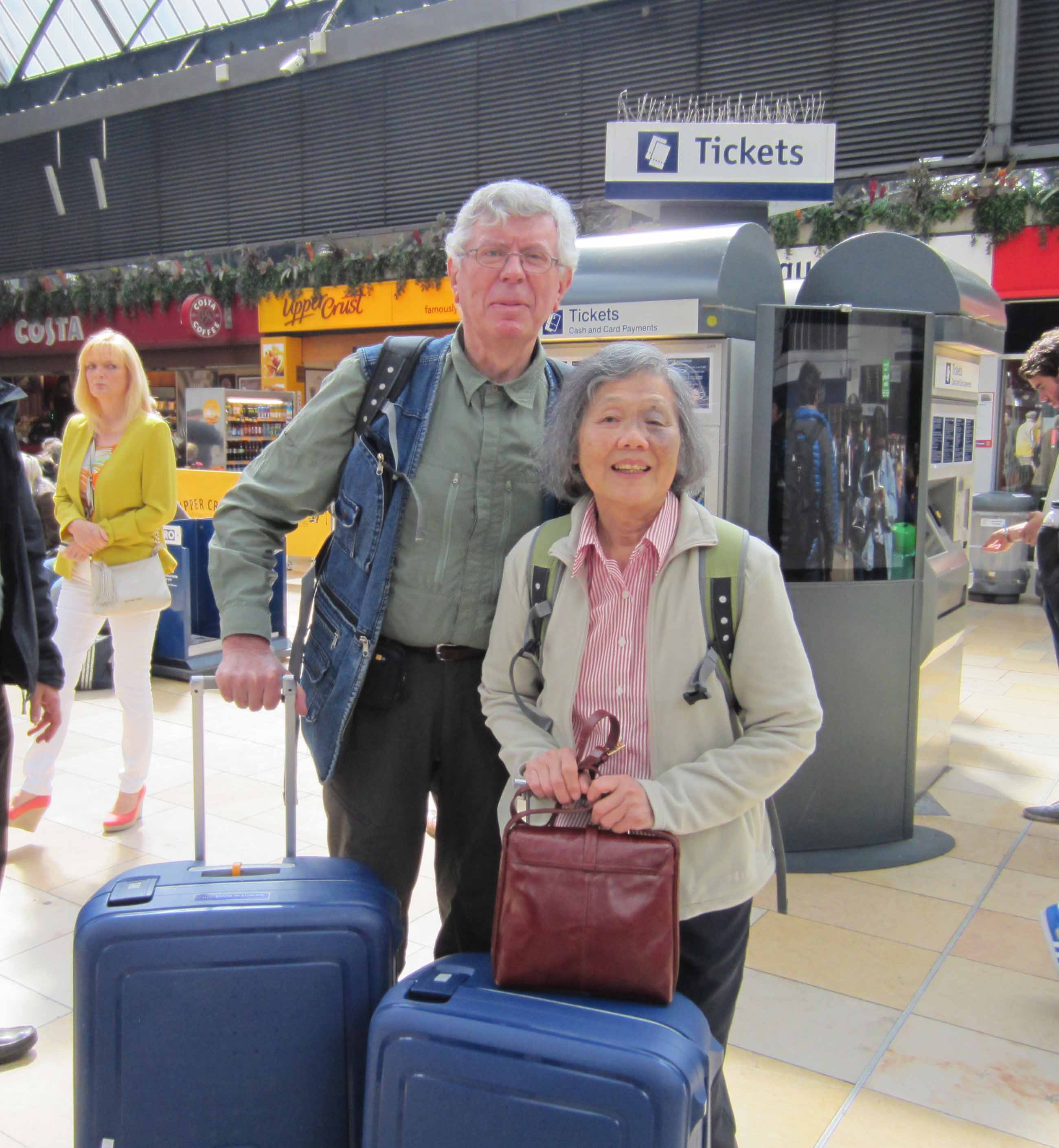
Worry on the left, hope on the right... at Glasgow Queen Street station about to board the train for Ardlui.

Worry on the left, bright optimism on the right… at Glasgow Queen Street station about to board the train for Ardlui.

The weather was warm with sunlight oozing slowly from a sleepy, cloud covered sky. The views folded out into flat vistas of parks and suburbia and eventually to bright green farmland sloping gently into the Clyde River. The track rose into hills, stands of Scottish fir trees appeared framing picturesque glimpses of water below seen through racing green lace-works of leaves.

An hour into the trip and we were edging into a highland landscape. Rugged, steep, stony cliffs loomed. Several bare, grass-covered pyramid peaks marched past above us, and below fingers of water pointed the way into the interior. An overcast sky began to press down.

As the train slid into Ardlui station after an hour of scenic magnificence heavy rain began to fall and the temperature dropped. We had arrived in the Scottish highlands, and the region was determined not to betray its reputation for gloomy weather.

Ardlui is small, scarcely more than a hamlet, but in summer holiday-makers jam its cramped caravan park and camping ground. Bumping on jet-skis or pulled along on water skis they buzz back and forth across Loch Lomond, cutting white scars into the lake as they swerve around yachts and launches idling in the water. Above them the quiet hills rise steep and bright green into the grey sky.

On the morning of Tuesday July 30th we started walking the West Highland Way. It was a reassuring start. A ten minute launch ride took us across the loch to a small, spindly steel jetty a hundred metres from the Way that had already wriggled up to Loch Lomond from the suburbs of Glasgow. “The West Highland Way” is much too grand a name for the foot wide, rock-strewn trail of mud that snaked away before us up into the hills. Our walking poles came out immediately and stayed gripped in our fists for the next five hours. We levered ourselves up through gauntlets of bracken, peering over it at views down Loch Lomond. Again and again we were stopped in our tracks by the vast splendour around us.

At the start of the walk: a narrow trail through a vast landscape.

At the start of the walk: a narrow trail through a vast green landscape.

The going was tough, especially for me. I was not in top shape. Emmy was better prepared and often walked a hundred metres ahead while I puffed and stumbled and found excuses to stop. There were quite a few stiles to cross too. I discovered that age had taken away from me the confident, leg-swinging straddling of stiles and had turned each crossing into a wobbling exercise in keeping balance. We negotiated at least thirty mini-quagmires of mud, rocks and water that days of rain had laid down along the track. Two hours into the walk, and still not halfway to Crianlarich, I was aching and struggling.

I struggle through a

I struggle through a “cow creep” between Ardlui and Crianlarich.

There is something unexpectedly good about walking in remote places. You can’t wimp out. There are no bus stops or taxi stands. There are no snack bars or coffee shops. There are no seats or shelters. No mobile phone connection either. And you’re pretty much on your own (we met only a few fellow walkers who whizzed past us with annoying cheerfulness). So there are no options. You have to plough on into your pain and keep putting foot before foot. It hurts, but because you have to do it you discover that you can do it.

The walk from Ardlui to Crianlarich is not long, about fourteen kilometres. But it is rough, and it took five hours of pain to deliver us to our destination. As we trudged into the centre of the village looking for our accommodation at the Crianlarich Hotel exhaustion tricked me into making a right turn instead of a left turn. We walked to the edge of the village before I realised the mistake. So we had to walk back, adding more than a kilometre to the burning ache under our feet.

A hot shower and an hour’s deep sleep only partly revived me. At 7.00 pm we hobbled grimacing into the hotel dining room. On the walls above the dark wainscoting the remains of meals past looked down – stuffed stags heads and assorted animal skulls, around a dozen of them, were staring down at diners. A waiter with the bullish dimensions of a rugby player greeted us at the door.

“How are we this evening?” he roared in a broad Scottish accent.

“I’m fine,” I said, “but what about you?”

He leaned towards me and lowered his voice.

“To tell you the truth,” he said conspiratorially, “I’d rather be somewhere else.”

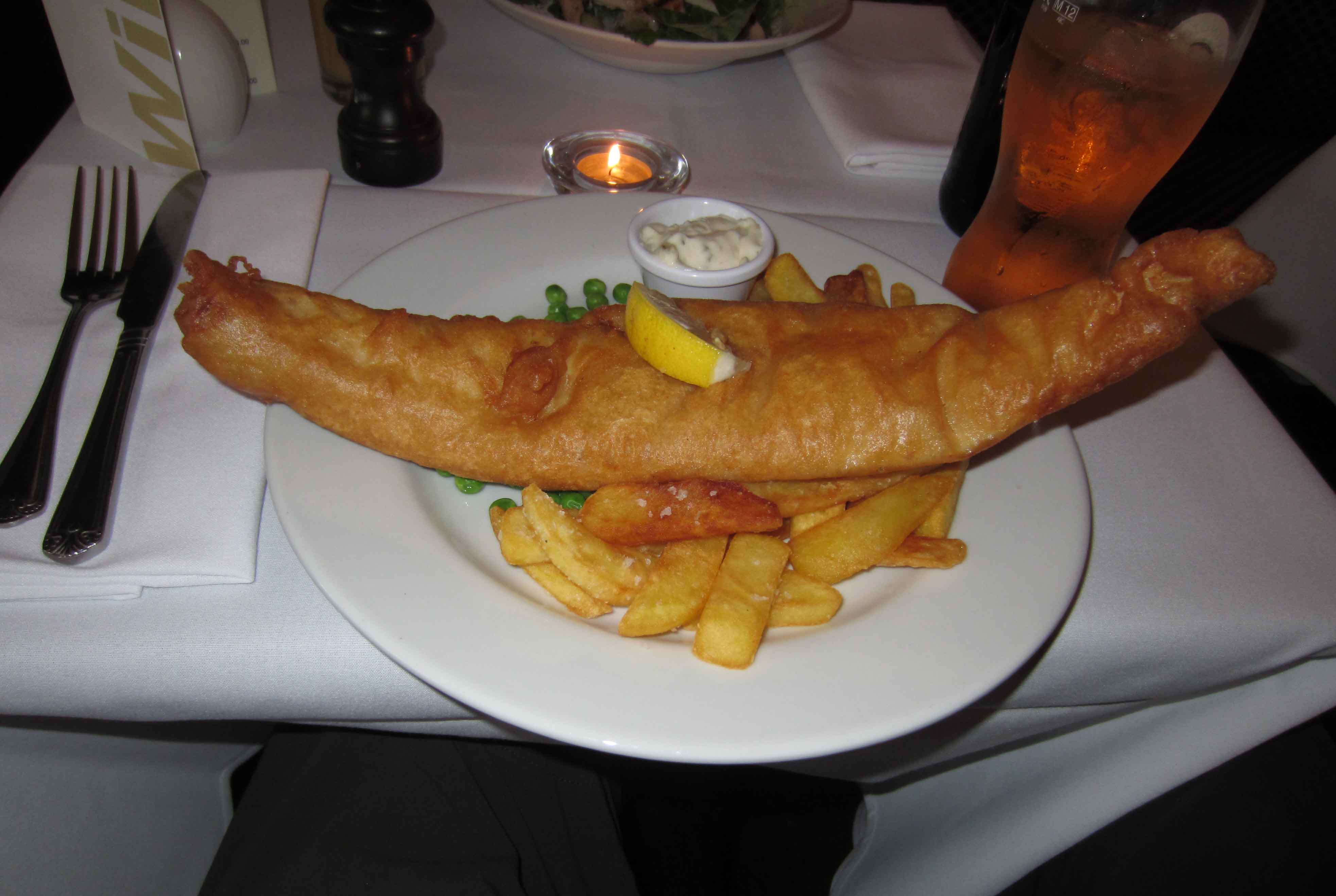
This did not bode well for the evening’s meal. But I needn’t have worried. In the kitchen a hard-working squad of cooks from Romania and Hungary, who clearly were glad not to be somewhere else, were cooking up a storm. When my order of fish and chips arrived I had to look at it, then look up at the waiter, then back at the plate before me, then back at the waiter again. His smirk said “Yes sir, it is your order”.

On the jumbo size plate lay an enormous crescent moon of fish, its two cusps easily jutting beyond the edges of the dish. Under it lay a bed of flat cut, deliciously crisp-looking potato chips lightly sprinkled with grains of rock salt. Healthy, sweet-looking green peas were in attendance too, not to mention what looked like home-made tartare dressing and a juicy wedge of lemon. For a weary walker it was a vision from heaven. Glancing up at the glassy eyes and antlers and skulls above me, I wolfed it down.

Delicious... what more can I say?

Delicious… the best fish and chips I have ever eaten.

After getting hammered on the fourteen kilometre walk from Ardlui to Crianlarich I was dreading the next leg – a twenty-one kilometre slog mostly through forest country to Bridge of Orchy (pronounced /OR.key/). The day dawned cool and overcast with rain clouds scudding from horizon to horizon. For the first few kilometres we weaved through a dripping forest of Scottish fir trees. The path was wet and slippery after overnight rain, and very stony. As always in Britain the forest was wrapped in total silence. We knifed through banks of thick moss and soft green hooks of wet bracken massed at the path side. In the distance steep hills appeared and disappeared behind cowls of misty cloud.

We couldn’t do more than creep forward, jamming our walking poles into the mud and sucking our boots up with each step. Intense weariness clambered aboard and my steps became more and more laboured. At one o’clock, four hours into the walk, we were approaching the village of Tyndrum, still thirteen kilometres from Bridge of Orchy. It didn’t look good.

But the weather saved us. As we plodded into Tyndrum rain began to bucket down, fine but heavy. Tyndrum has two railways stations, a lower station for trains to Oban, and an upper station for trains to Fort William. And the Fort William line passes through Bridge of Orchy. It was a no-brainer. Bent under the downpour we walked as quickly as we could up the hill to the tiny station. Yes, the next train did stop at Bridge of Orchy and it would come by in one hour. Perfect. We sat on the deserted platform munching apples and watching the rain-hooded ghosts of Tyndrum’s hills.

Tyndrum to Bridge of Orchy takes just fifteen minutes by train. We enjoyed every second of the warm, dry carriage. It was raining hard in Bridge of Orchy too, but I had a spring in my step as we headed down the hill towards the hubbub of the bar in the Bridge of Orchy Hotel.

Arrival at the Bridge of Orchy Hotel. Warmth, dryness and a bottle of cider.

Arrival at the Bridge of Orchy Hotel. Warmth, dryness and a bottle of cider beckon.

Glazgeh, the friendly city

[First, a quick apology. Reliable wi-fi is a rare and precious commodity in the Scottish Highlands. After Glasgow we stayed overnight at hotels in Ardlui, Crianlarich and Bridge of Orchy. None of them had a satisfactory wi-fi connection. In fact in Crianlarich we were even outside mobile phone range. But five days into our Scottish odyssey here we are now in Distant Hills Guest House in the village of Spean Bridge where a wi-fi connection is possible but still very slow. So, here goes… my report from Glasgow. Fingers crossed.]

I was standing at the checkout in a Glasgow pharmacy. As the girl at the counter scanned my purchase she asked:

“De oo suidnf smdjd?

“Excuse me, could you say that again?”

She spoke very slowly.

“D’ye have a points card?”

“No.”

“Och… wde fhnsornfk djke ejsxsh?”

“Sorry?”

“Would ye like a points card? It’s free.”

“No thanks.”

She rang up my purchase and money changed hands.

“Whdb jfifk ejeod dkdk?”

“Sorry, I didn’t catch that.”

She must have thought I was hard of hearing, or a typical tourist dullard, so she spoke syllable by syllable, a bit more loudly.

“Would’ye like a wee baggie?”

I could only guess what a wee baggie was but it sounded vaguely illicit and possibly enjoyable so I said “yes”. My purchase dropped into a small plastic supermarket bag.

The famous dialect of Glasgow is indeed a challenge. Emmy and I took a “hop on hop off” tourist bus around the city. The guide on the bus spoke with a broad Glasgow accent. Emmy claimed she understood about 50% of what he said. As a native speaker of English still clinging to the shreds of a Scottish heritage, it was a matter of honour for me to claim I understood everything he was saying but in truth I don’t think I made it past 60%. It was a shock to discover that the guide thought he was speaking standard English, because from time to time he illustrated his anecdotes by dropping into “real” Glaswegian English. And when he did he might as well have been speaking Cantonese. But around me a group of American tourists sat entranced. They almost abandoned their plans to go shopping (almost) just to prolong the pleasure of immersion in our guide’s exotic patter.

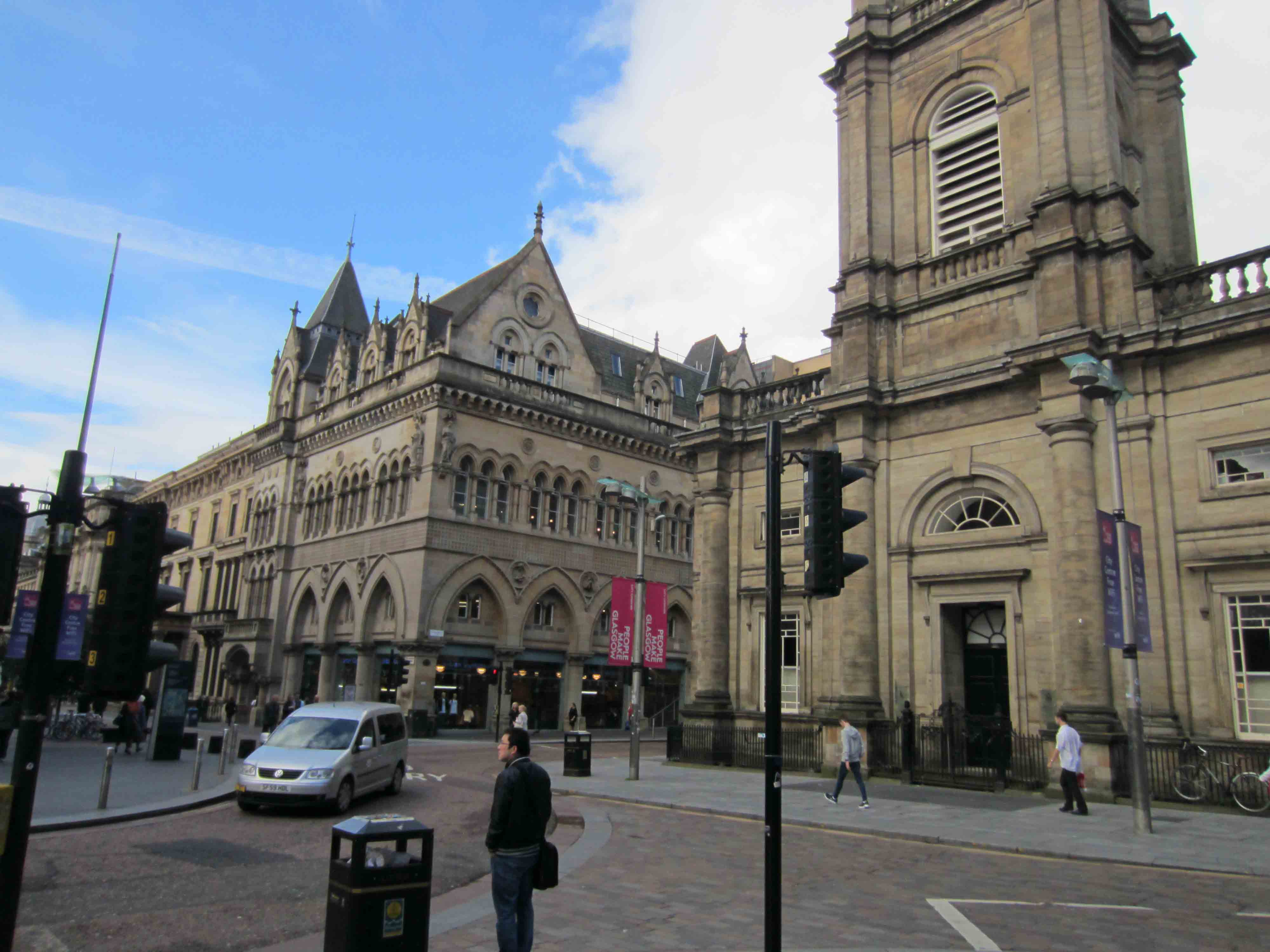
A Glasgow street scene: chunky heritage buildings in the city centre contrast with the ranks of featureless grey townhouses in the suburbs.

A Glasgow street scene: chunky heritage buildings in the city centre contrast with the ranks of featureless grey townhouses that dominate in the suburbs.

Glasgow must be the friendliest city I’ve ever visited. Forget tattooed, crew-cut football hooligans and Irvine Welsh’s foul-mouthed, head butting hard men. The people are wonderfully helpful and friendly but (and I like this) without too much smiling. It started with the immigration officer at Glasgow airport. Somewhat wearily he asked me what the purpose of my visit to Scotland was.

“I’m here to do some long-distance walking.”

I asked him if he had ever done any walking across Scotland. Instantly he brightened.
“No, but I like bike riding. I’ve ridden through the highlands and the lowlands.”

He put down his scanning wand.

“In winter too,” he added. Then he was off. A stream of advice poured over me. “Watch out for the biting midges… they’re ferocious. You should use Tabard repellent. And pack some warm clothes… the weather can change very suddenly. And it will rain at least every second day.”

I could sense restlessness in the queue behind me but he didn’t see it. He had a far-away look in his eyes. He was wandering in lands far beyond the glass walls of his cell. It was a while before he let me through.

Then on the bus into Glasgow I sat beside a Scottish passenger who had flown in on the same flight from Dubai. He quizzed me on our walking plans and (like the immigration officer) had some rich gifts of advice for us. I happened to mention that, at our first stop (Ardlui, north of Glasgow, on the banks of Loch Lomond) we would have to cross the lake by boat to set foot on the West Highland Way walking trail. A look of good-humoured horror spread across his face.

“You’re in Scotland,” he said. “Here, don’t ever say ‘lake’. You’re going to cross the loch.”

The friendliness pursued us into the streets. We were standing on the corner of an intersection waiting for the traffic lights to change. This unusual behaviour attracted the attention of a large beefy gentleman in a tradesman’s brightly coloured yellow jacket.

“Are you all right? Do ye need any help? Are ye lost?”

We assured him we were OK, just two old people waiting for the lights to change. As he turned away he couldn’t conceal his disappointment.

Maybe it’s a hangover from last year’s Commonwealth Games, but I suspect it’s just the way people are. It is strange to say this about a city with Glasgow’s reputation for toughness, but we encountered a kind of innocence here. Maybe they simply haven’t yet had enough foreign tourists squatting on them to besmirch that innocence.

The grave of Glasgow's patron saint St. Mungo underneath the main nave of Glasgow Cathedral.

The grave of Glasgow’s patron saint St. Mungo underneath the main nave of Glasgow Cathedral.

There’s a lot to talk about in Glasgow, but for me the city has a show-stopper that chases all other attractions into the shadows. It is Glasgow Cathedral. It is a big building, one that could only have been built with the ruthless coercive power of medieval religion. Its stone walls, pointed arches and massive fluted columns are darkened in places almost to black. The main nave is a vast vault of air reaching up into an arcade of curving, criss-crossed beams too distant for details of its embellishment to be seen. The space is bookended with palisades of shimmering kaleidoscopically coloured stained glass windows. There is a lower floor too. Here, squeezed among the columns that hold up the massive building lies the tomb of Saint Mungo, the patron saint of Glasgow. It was once an important place of pilgrimage, and on a small scale it still is.

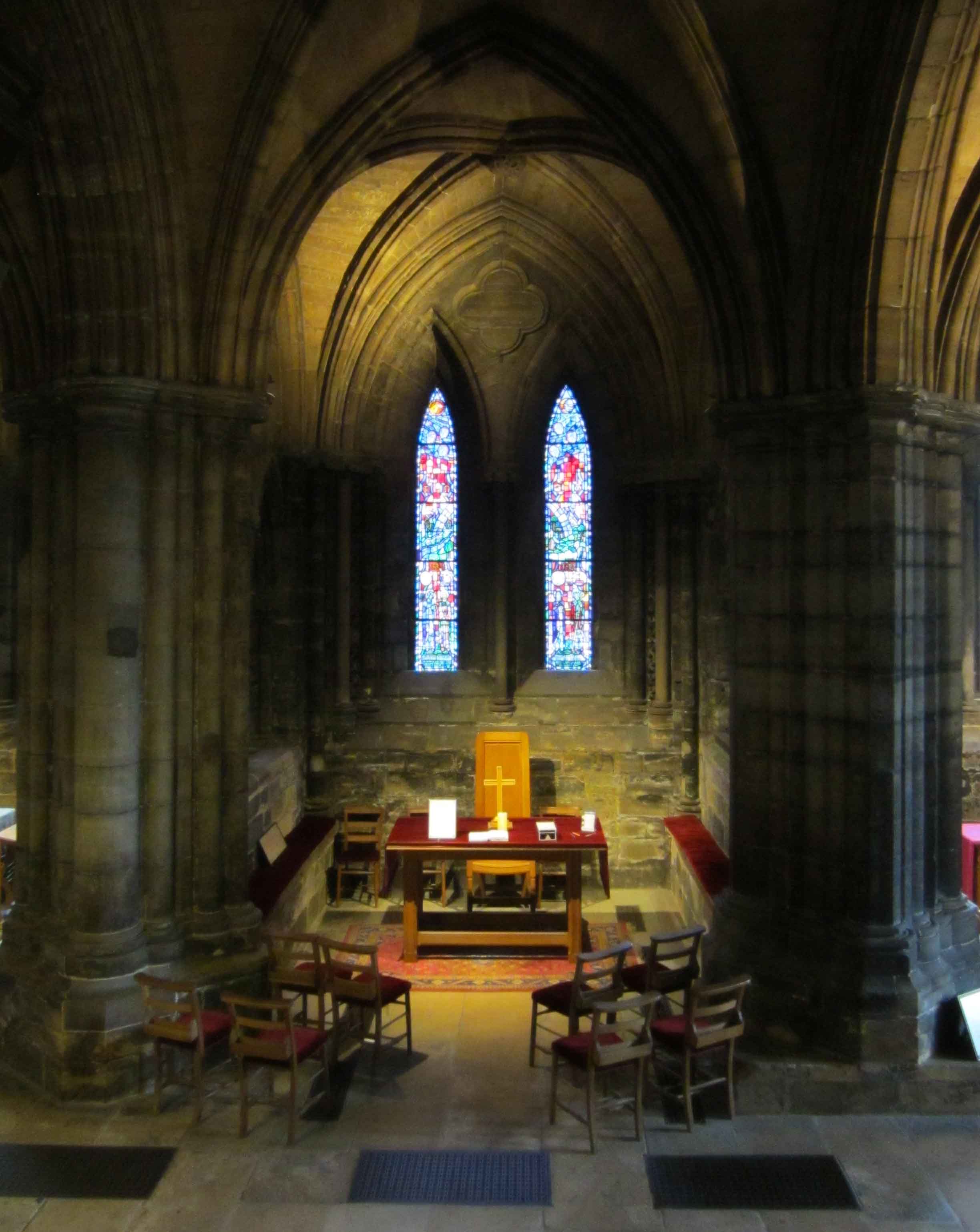
Around the lower level there are several small chapels and softly-lit prayer alcoves. In several of them spectacularly beautiful stained glass windows illustrate extracts from the New Testament. Of course a certain amount of military dross has been stuck on the walls too – several bronze plaques commemorating those who died in Britain’s wars of imperial aggression, plus an engraved marble relief of gallant highlanders charging into ranks of impudent Arabs in the 19th century battle of Tel El Kebir in Egypt. (Not much has changed, has it?) If there is an almighty God, and he has the dreary chore of sitting in judgement on the peccadillos of deceased soldiers, he will probably look sympathetically on the wrecked souls that have been blasted in his direction from Britain’s battlefields. But he may be less considerate of those who used the bullying power of Christian piety to decree death in distant lands for reasons utterly incompatible with – even contemptuous of – Jesus Christ’s teachings. How does this stuff get hung on the walls of a church? Beats me.

A prayer alcove

A prayer alcove, also underneath the main nave.

In the main nave stood a lectern with an enormous Bible on it lying open at the rhetorical magnificence of Job chapters eighteen to twenty-one. As other tourists jostled around me looking for good camera angles I managed to snatch up an impression or two from its pages. According to the Book of Job, travel is morally beneficial.

Have you never questioned those who travel? Have you paid no regard to their accounts that the evil man is spared from the day of calamity, that he is delivered from the day of wrath? Who denounces his conduct to his face? Who repays him for what he has done? He is carried to the grave, and watch is kept over his tomb. The soil in the valley is sweet to him; all men follow after him, and a countless throng goes before him. “So how can you console me with your nonsense? Nothing is left of your answers but falsehood!”

In_prayer_Glasgow_2

Not all the throng in the cathedral were tourists. On the other hand maybe this gentleman was was a tourist, but one who had seen too much.

Opposite the entrance to the cathedral stands the small but interesting Glasgow Museum of Religious Life and Art. It provides a pleasant counter to the Christian grandeur and barbarity of the cathedral. All the world’s major religions – and even “primal” religions – are given exactly equal status in the museum’s displays. It is a nice lesson in open-mindedness and comparative religion, especially right next door to Glasgow Cathedral. Best of all, an endless loop video allows followers of Islam, Christianity, Hinduism, Sikhism and Judaism to talk directly and informally about aspects of their faith. Without exception, they speak with strong Scottish accents.

The Road to Drumnadrochit

“Drumnadrochit.”

Roll this word around in your mouth. Trill the “r” (there are two of them) and gargle the “ch”.

Drrrrumnadrrrrohhhhit.

Thanks to this word, Emmy and I are about to set off on a walking holiday in Scotland and England. (There must be a better word than “holiday” for the grim agony of long-distance walking.) Somehow, the resonance of Drumnadrochit has awakened a memory from a past life. There must be a gene somewhere inside me that has recorded a whisper of my Celtic heritage. Anyway, I want to go there and hear local people say “Drumnadrochit”.

Drumnadrochit is a small village halfway along Loch Ness. We are scheduled to stay the night there on Tuesday, August 11th. And I’m going to report on it at length in this blog. We will be walking the length of Loch Ness – from Fort William in the west to Inverness in the east – in effect from one side of Scotland to the other. For me, the highlight will be Drumnadrochit.

Before reaching this emotional summit, we will be exploring the foreign-language landscape of Glasgow (English is not spoken there, so they tell me). Then we do a combination railway and hiking trip up the west coast through Fort William as far as Mallaig, opposite the island of Skye. From Mallaig we’ll do a one-day excursion to Skye, then back to Fort William for the trans-Scotland trek.

From Inverness we head down to Edinburgh by train for a few Festival events, then on to York and London also by train. After some shows in London and a day at the cricket (Australia tormenting the Poor Old Poms as usual) we’ll finish up with a nine-day ramble along the ancient pilgrim route through the North Downs from Rochester to Canterbury, then for good measure on to Dover.

That’s the plan.

But since we are both now VERY OLD there are opportunities for the plan to come unstuck with every step we take. In fact it’s practically guaranteed to happen. So stick with this blog, dear reader. Sometime in the next six weeks you will be rewarded with a disaster. Disasters are so much more interesting (correction… enjoyable) than nice goals smoothly reached after careful planning.

Don’t you think?

And this is what we are leaving behind. We are swapping Canberra’s wintery Lake Tuggeranong (below) for Loch Ness. You might ask “What’s the difference… the two lakes sorta look the same, don’t they?” Maybe, but being the capital city and seat of parliament Canberra has many, many more monsters than Loch Ness. Most of them are more funny than scary (though a few of them are genuinely scary), but unfortunately they live on the surface or splash around in the shallows. So we’re looking forward to Loch Ness for its silence and its depth. Cold_Canberra_2015b

From Home to Dome and Back: Dispatches from Small Wars in Australian Suburbia (1)

“The suburbs” are right at the centre of contemporary urban culture, especially in the sprawling cities of the US and Australia, so it’s not surprising that suburbia looms large in popular culture. After all, it’s where most people live. But for many, suburbia has a bad name or is seen as problematic. In popular culture the suburbs are a nice soft target. Back in the 1960s Pete Seeger, for example, sang about suburban uniformity and conformity.

Little boxes on the hillside
Little boxes made of ticky tacky
Little boxes, little boxes
Little boxes all the same…

In cinema and on TV the quiet exterior of the burbs hides a seething cauldron of passion and conflict. The (for a time) wildly popular TV show Desperate Housewives depicts the suburbs as a layer of prim and prosperous “make-up” (so to speak) laid on thick over a social complexion blotched by emotional lesions, bruises and scar tissue. In Clint Eastwood’s much praised Gran Torino suburbia is a battleground in America’s culture wars. “Get off my lawn,” Clint snarls down the barrel of his shotgun as the tides of Asian migration lap around him. Australia’s never-ending soap opera Neighbours is set in a suburb of Melbourne. Its characters walk in and out of one another’s houses as if they were members of a single extended family. According to Wikipedia, over the years Neighbours has focussed on many serious problems such as teenage pregnancy, marital breakdown, imprisonment, career problems, pregnancy, abortion, adultery, drug trafficking, stalking, kidnapping, accidental death, murder, incest, sexuality, gambling, surrogacy, and health issues like multiple sclerosis…. all in one street!

If only the quiet suburban street where I live was as interesting.

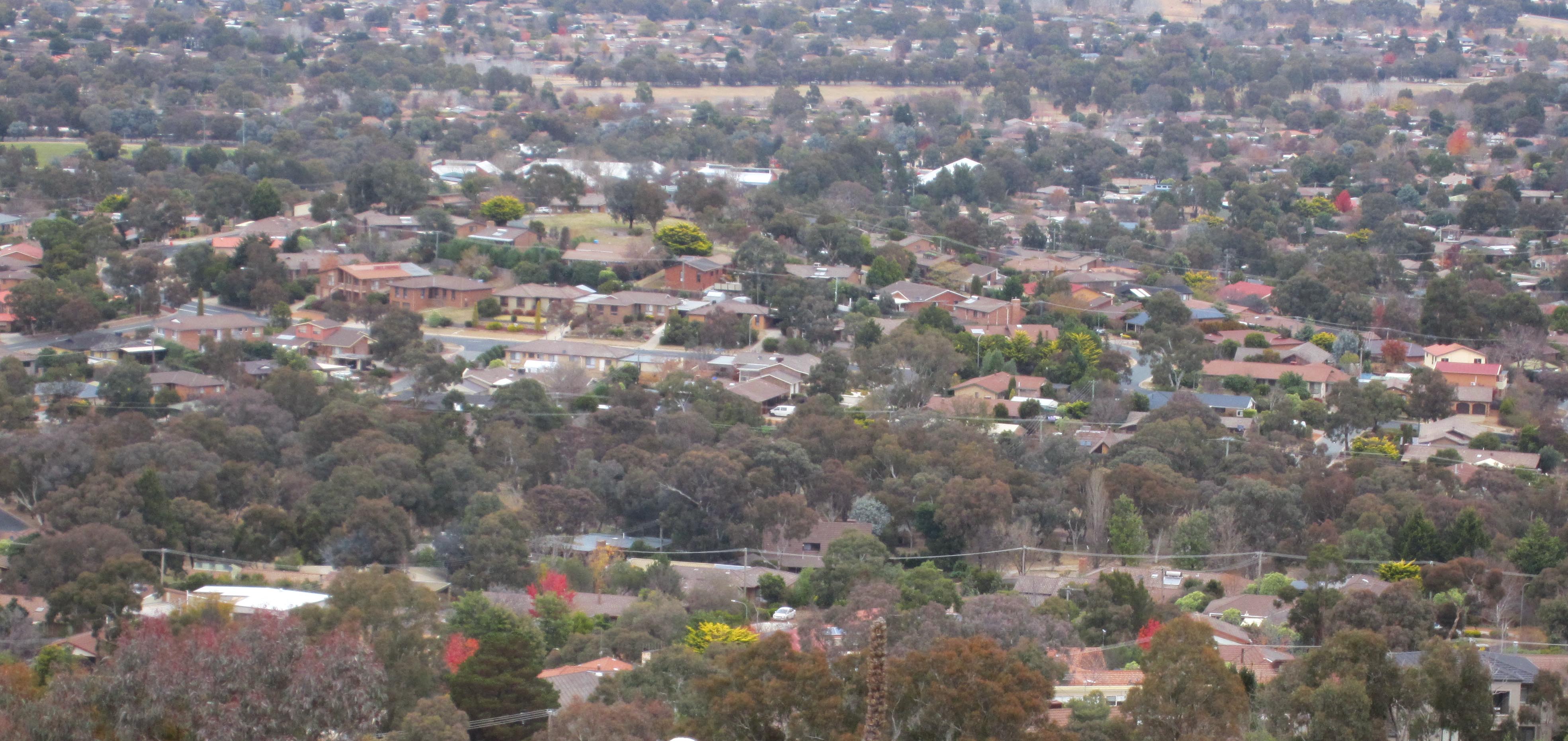
A view over the southern suburbs of Canberra. You can see why it is known as “the bush capital.”

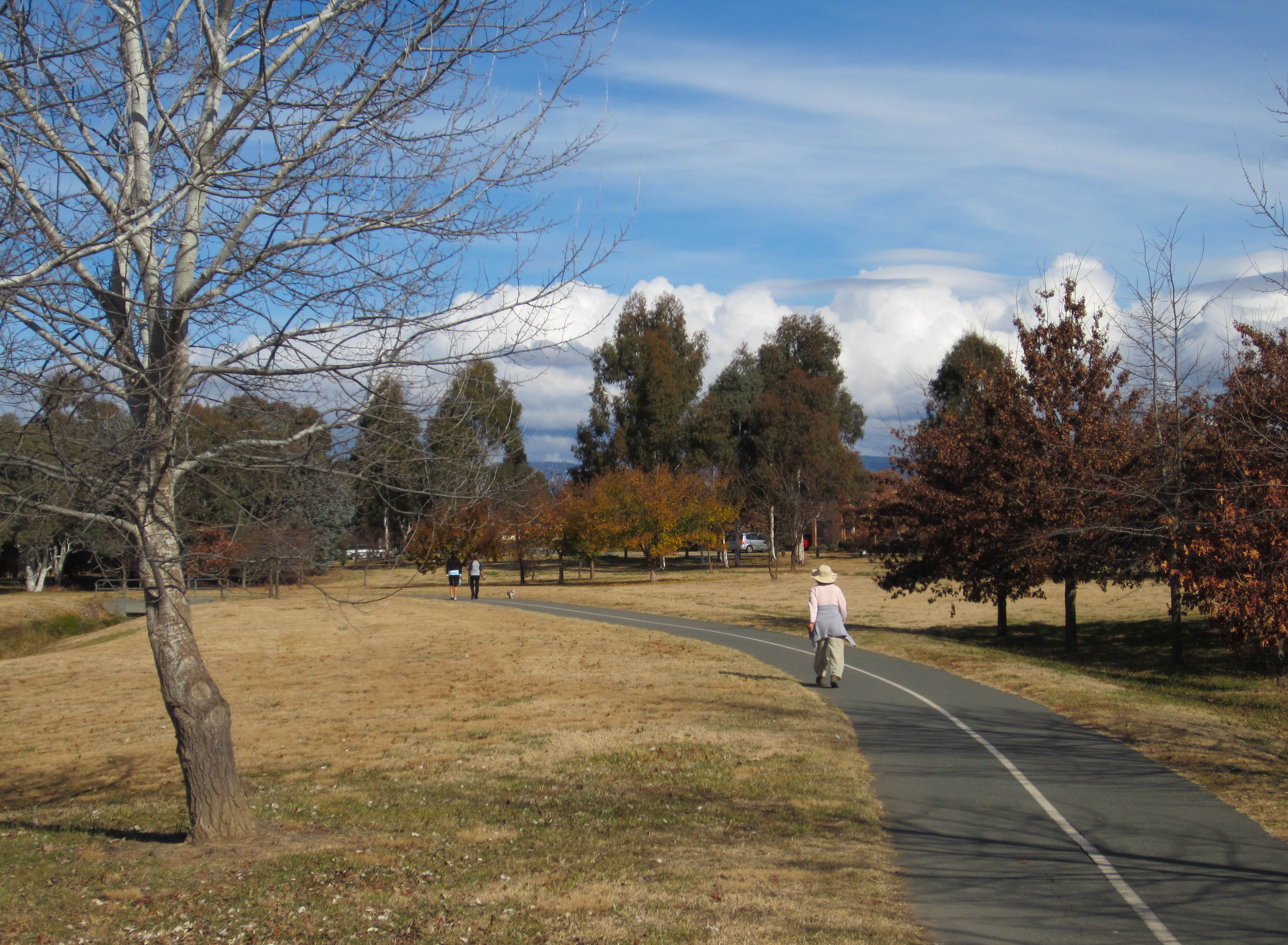
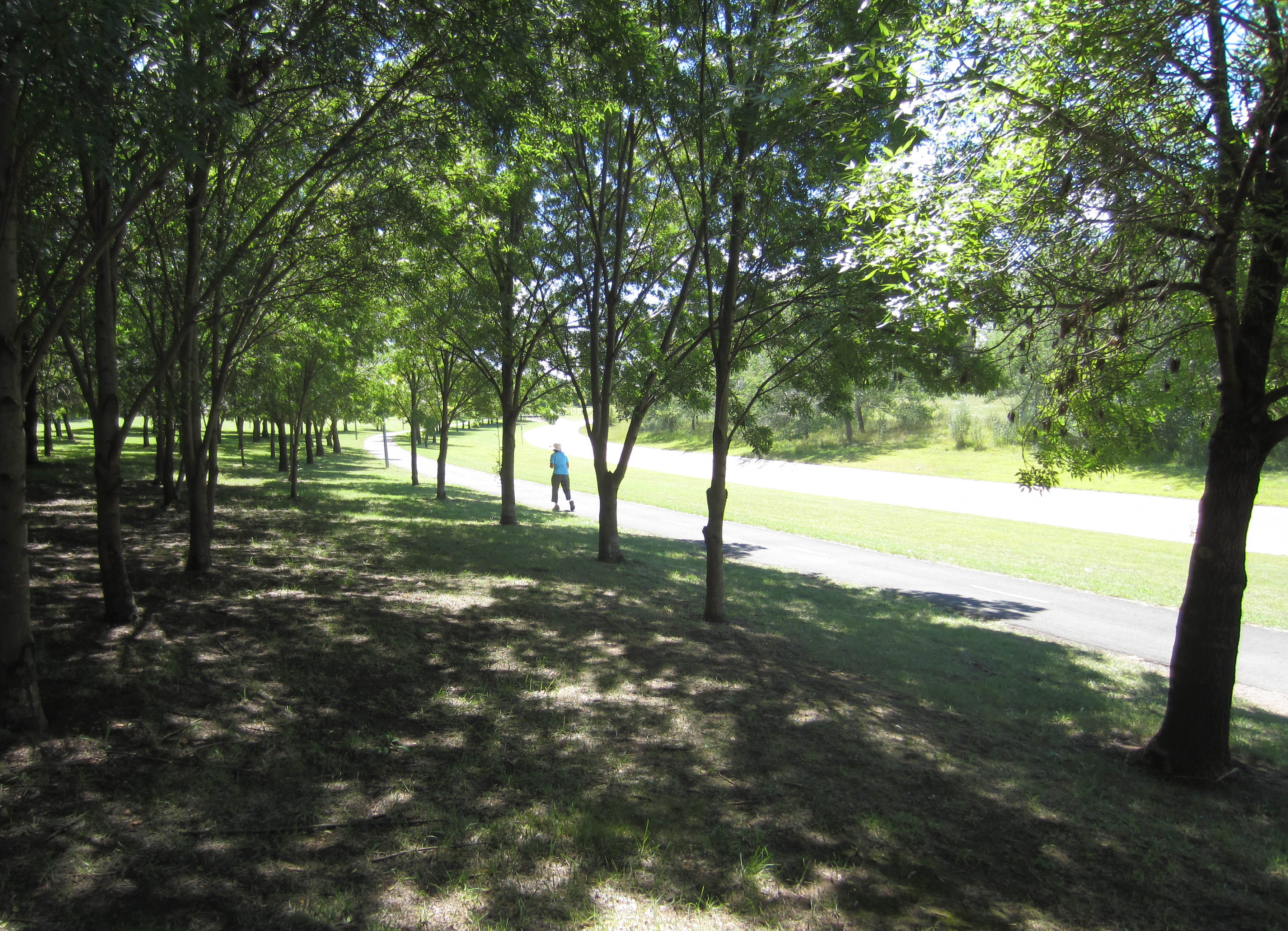
Walking paths like this, shared with cyclists and joggers, criss-cross the suburbs of Canberra.

But wait… maybe my street is as interesting. Not as dramatic or sensational as Neighbours or Gran Torino, of course, but fascinating nevertheless. Even a short walk through the suburbs of Canberra – which is about as “suburban” as you can get – tells us a whole lot about the complexities of local society, even about the highs and lows of life in general. So come along with Emmy and me as we walk from our front door in Gowrie, Tuggeranong, to the Hyperdome shopping mall and back. In its own quiet way this walk twangs with social tension.

From home, our walk snakes through suburbs and parkland for about 17 kilometres. It takes us south through the sleepy streets of Monash, around Lake Tuggeranong, through the Tuggeranong Town Centre (better known to us as “lego-land”) to the Hyperdome, then back home through suburban parkland. It’s a walk we often do, and usually we knock it over in about four hours, including a generous stop for coffee and a big chocolate-topped caramel square in the Hyperdome shopping mall.

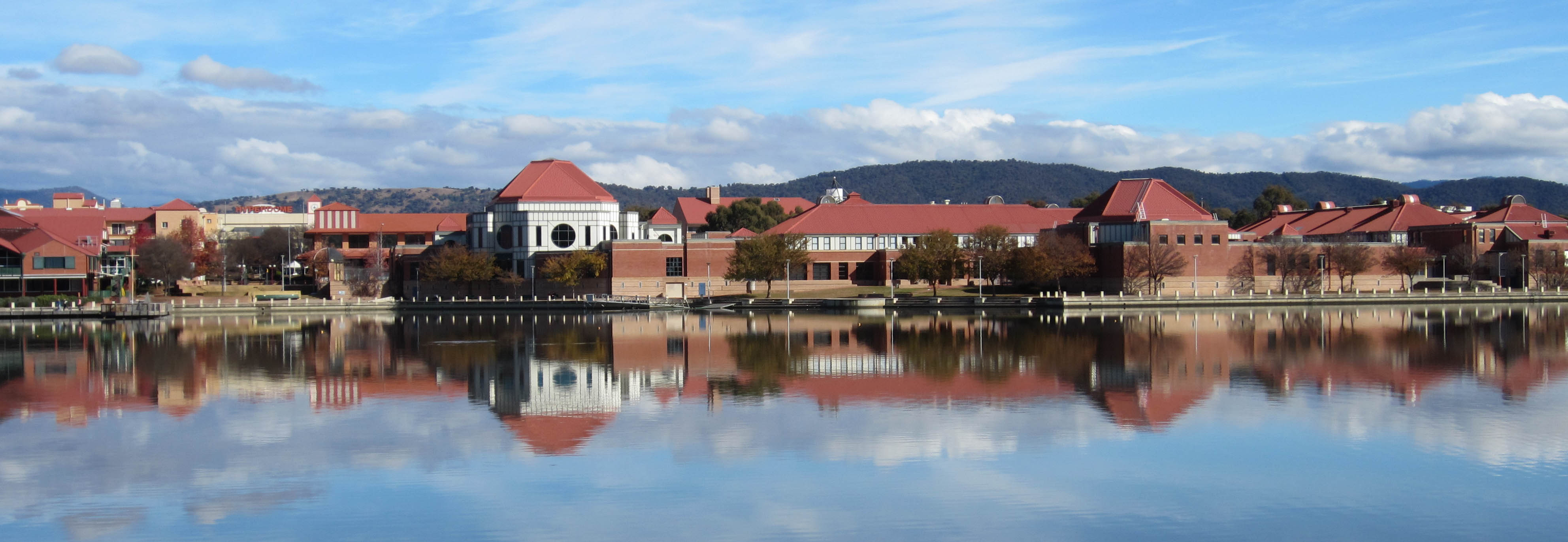
“Legoland”… the commercial centre of Tuggeranong, built in the 1980s, seen from across its adjacent, artificial lake.

Our first landmark, just 500 metres from home, is the Gowrie Primary School (http://www.gowrieps.act.edu.au/), a government school administered by the Department of Education and Training of the Australian Capital Territory. It has about 200 pupils and a total of 20 dedicated staff. The federal government’s My School web site (http://www.myschool.edu.au/) shows that, on the whole, the quality of Gowrie Primary School is good, though in some domains it is struggling to reach the national average by comparison with similar schools across the country.

In 2008 the federal government announced a “stimulus spending” program intended to buoy the economy in the face of the Global Financial Crisis. The money was splurged on education infrastructure – mostly buildings – in a program called Building the Education Revolution. It seems to have worked. As the economies of Europe, the US and many other countries were knee-capped Australia strolled away from the crisis pretty much unscathed. But there was criticism of BER, even ridicule. I had heard vaguely about this, but little did I know that just metres from my front door there was, in effect, a diorama that summed up the criticism beautifully.

Gowrie Primary copped two projects. The first was a multi-purpose building that included two new classrooms, a shared learning area plus community and student facilities. It cost 2.15 million smackeroos. Sounds expensive to me, but what do I know? At least it made some sense in educational terms. But the other project was more problematic. It was “new shade structures” over a small cluster of existing playground equipment. Translation: three fairly small curved iron roofs on stilts. And the cost? $124,000.

The Gowrie Primary School playground as it used to be…

… and $125,000 later, as it is now.

Why build an expensive roof over a few bits of play equipment? To protect children from the serious threat of sunshine, of course. But if a bit of sunshine is so dangerous what’s going to protect the fragile little darlings as they walk along unshaded footpaths? And play on soccer fields? And dig holes in their back yards? Or (the danger! the danger!) build sand castles on the beach in summer?

The playground project was unnecessary and outrageously overpriced. But worse, it was an investment in useless infrastructure at a time when teachers were on their knees begging for training to improve their classroom skills. $124,000 would have gone a very long way towards boosting learning outcomes and teacher morale at a school that is currently a bit below average. But for our politicians and economists and actuaries what was important was the necessity to spend, to “get the money out the door” as one of them said. And being simple-minded creatures, for them new buildings were easier to see and count than improved reading and maths.

Gowrie Primary is a capsule that represents what has happened at thousands of schools across Australia. Its “new shade structures” stands like a memorial to haste, waste and ruthless price gouging by construction companies.

But let’s move on. We step on to a “cycle path”, pad down a gentle slope, and suddenly we are at war. There is a sharp “ding!” behind us and a lycra-clad figure wearing a streamlined helmet and wrap-round sun glasses is bearing down on us at warp speed. Hastily we step off the path and bend away from the quick smack of air he leaves in his wake. “Four more!” comes a shout and four more hunched cyborgs with pumping thighs sweep past. Cautiously I look back, extend a leg over the path, stand on it cautiously, look around again, and resume walking. We survive the ambush, but somehow the pleasure of the walk has been tarnished.

Tilting into the corner, two cyclists bear down on us very fast.

I have to admit, though, that 90% of cyclists are cheerful, considerate and polite, sometimes embarrassingly polite. But the remaining 10% make your teeth grind. They seem to consist of two categories: frustrated Tour de France aspirants, and cycling ideologues. The former treat surburban paths as their personal velodrome. Sometimes they form peletons. They ride very fast. They hate using their brakes. You can’t talk to them, let alone reason with them… they’re too quick. A sweaty flash and a click of gears, and they’re gone. The second category can sometimes be downright nasty. They are pedal-power activists. You can’t reason with them either. For them, riding a bicycle is a statement of concern for the environment and good health. It is the way of the future. A crusade. Anyone who gets in their way – whether a motorist or a walker – is violating their rights and is an affront to their moral superiority.

For over a decade bicycle sales have boomed in Australia, far exceeding car sales. At the same time more and more people are taking up walking as a form of exercise and even (as in my case) a form of meditation. So far the two trends have managed to coexist on the increasingly clogged suburban artery-paths of Canberra. But it is an uneasy peace. At some point in the future someone is going to get injured, the two tribes will go to war, and they may have to be physically separated.

Here are a couple of news reports that illustrate the issue, one from Australia (http://city-north-news.whereilive.com.au/news/story/walkers-on-war-path-over-cyclists/) and another from the US (http://www.dnainfo.com/20100719/upper-west-side/cyclists-spar-with-dog-walkers-riverside-park).

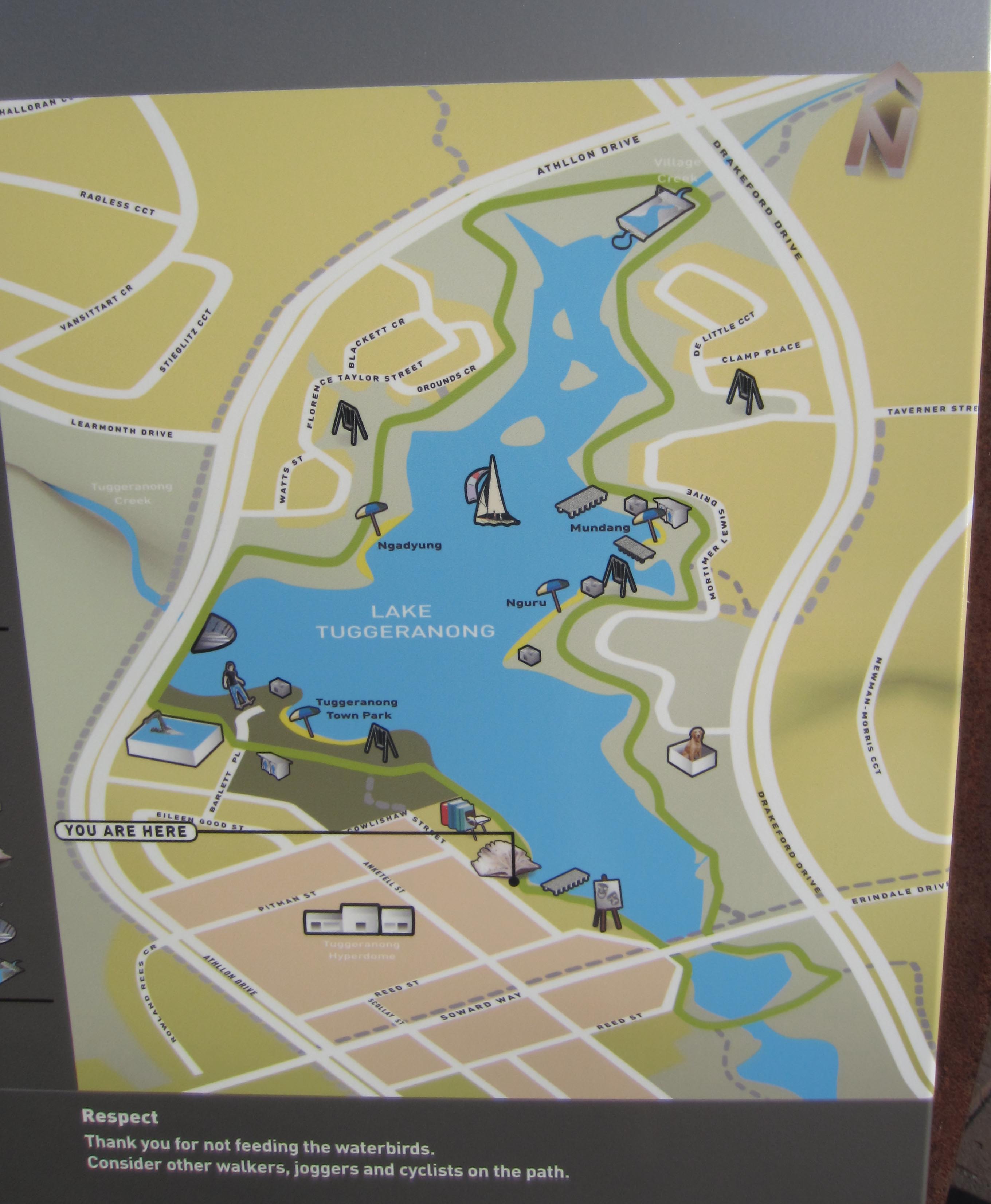
A trackside map of Lake Tuggeranong. Starting from the bottom right corner we normally walk anti-clockwise around the lake following the squiggly green line – a distance of 6.7 kilometres.

So… dodging cyclists we reach the tree-fringed waters of Lake Tuggeranong, about an hour into the walk. We turn right and head north along the eastern bank of the lake. (You can see a photo of Emmy walking this segment of the path above the title of this post at the very top of the page.) Like the other lakes of Canberra, Lake Tuggeranong is an artificial lake (you can see its dam on Google Earth at: 35°24’30.87″S, 149° 3’48.61″E). Perhaps this is why it is difficult to keep it clean. Under its tranquil surface the lake is badly polluted. There are four main kinds of pollutant: storm debris, algae, intrusive fish species and man-made rubbish.

Lake Tuggeranong can be dazzlingly beautiful…

… but close up, its beauty is stained by blue-green algae and other pollutants, a gift to the lake from human life-style and commerce.

When heavy rain thrashes the Canberra region (it doesn’t happen often, but when it does happen it can be biblical) it throws debris into the city’s lakes. Several streams feed into Lake Tuggeranong and the traps at their entry points get overwhelmed. Leaf debris, jagged branches, sewage and mud fill the lake. At other times, especially after long periods of dry weather, algae oozes through the water like green vomit. Contact with it can cause skin irritation, stomach infections and even bleeding in the liver. Like a pin suddenly jabbed into a bureaucratic buttock, algae panics hit the local government several times a year. Lakes are closed, signs erected, edicts issued, and warning fingers are wagged at citizens through the mass media.

But why do these outbreaks occur? Well, blue-green algae is a natural component of fresh-water and marine environments everywhere. The bloom feeds off phosphate compounds that are found naturally. But phosphates are also used in huge quantities on farmland, in household gardens and in some manufacturing processes. These chemicals leach into waterways and end up in Canberra’s lakes. They should be diluted or flushed away by the natural action of rainwater, but climate change has reduced rainfall (Canberra’s last drought – the longest in its history – lasted from 2001 to 2008), and when phosphate use keeps rising, algae blooms banquet on the man-made feast, growing fat and greasy.

There are solutions, of course, but they would cost more money than people are prepared to pay. And most people prefer not to be confronted with the less savoury consequences of their lifestyle choices and profit-spinning enterprises. Environmentalists will cry out for action, conservative governments, commercial interests and “economic rationalists” will resist action. And anyway, efforts to restore degraded rivers and lakes have not been very successful. So the problem will persist and almost certainly get worse until the situation becomes unbearable. Only then will something really decisive be done. (For a short TV report on the issue, see http://www.abc.net.au/news/2012-03-16/lakes-closed/3895324 ).

Perhaps it’s this nutrient-rich orgy that also sustains the non-native fish that have somehow got into the lake, and allows them to grow as big and fat as the blooms of algae. There are two species of foreign fish in particular that flourish: European carp and redfin.

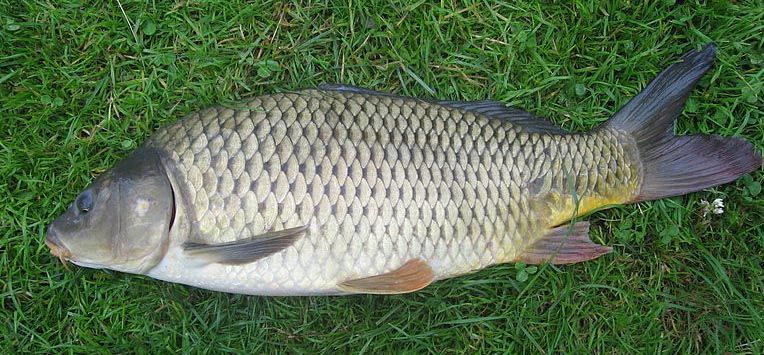
According to Wikipedia, “in Australia, enormous anecdotal and mounting scientific evidence indicates introduced carp are the cause of permanent turbidity and loss of submergent vegetation in the Murray-Darling river system, with severe consequences for river ecosystems, water quality and native fish species. In Victoria, common carp has been declared as noxious fish species, the quantity a fisher can take is unlimited. In South Australia, it is an offence for this species to be released back to the wild. An Australian company converts common carp into plant fertilizer.” Redfin, also called European perch, likewise deplete stocks of native fish and cause turbidity.

The European carp, an abundant pest that takes food from the mouths of native fish and keeps the water of Canberra’s lakes clouded with mud. (Wikipedia image.)

Neither the European carp nor the redfin are considered good to eat. In Australia they are commonly seen as vermin and, by law, they must be killed when caught. In fact every year the Canberra Fishermen’s Club holds a day-long event called the Canberra Carp-Out in which anglers compete to take as much carp and redfin as they can from the city’s lakes, hoping this will free up the lakes for native fish to recover. Some hope. This year almost 1,000 entrants registered. They caught 1,113 “noxious fish” with a total weight of 1,481 kilograms (that’s over one kilogram per fish!). All were sent off to the Australian National University’s environment agency to be recycled into garden compost… an ignominious end for these innocent pests. Yet somehow they thrive. By next year they’ll be back more numerous than ever and the Carp-Out will be an even bigger event. Evidently the war on carp and redfin is not going to be won easily.

The turbid waters of Lake Tuggeranong also stink with rubbish, although as you walk the shores of the lake your stink-meter will go up and down depending on the time of year, the direction of the wind and the corner of the lake you are passing. Most often there will be no smell at all and not much to see. But around the next headland you will gulp and gag as a sour smell gets into your mouth. Trapped in the quiet waters of an inlet you will see milk cartons, plastic bags, beer cans, paper cups from McDonalds and KFC (both chains have branches on the lake shore), clothes, car tyres, plastic bottles, the occasional rusting supermarket trolley, and much more.

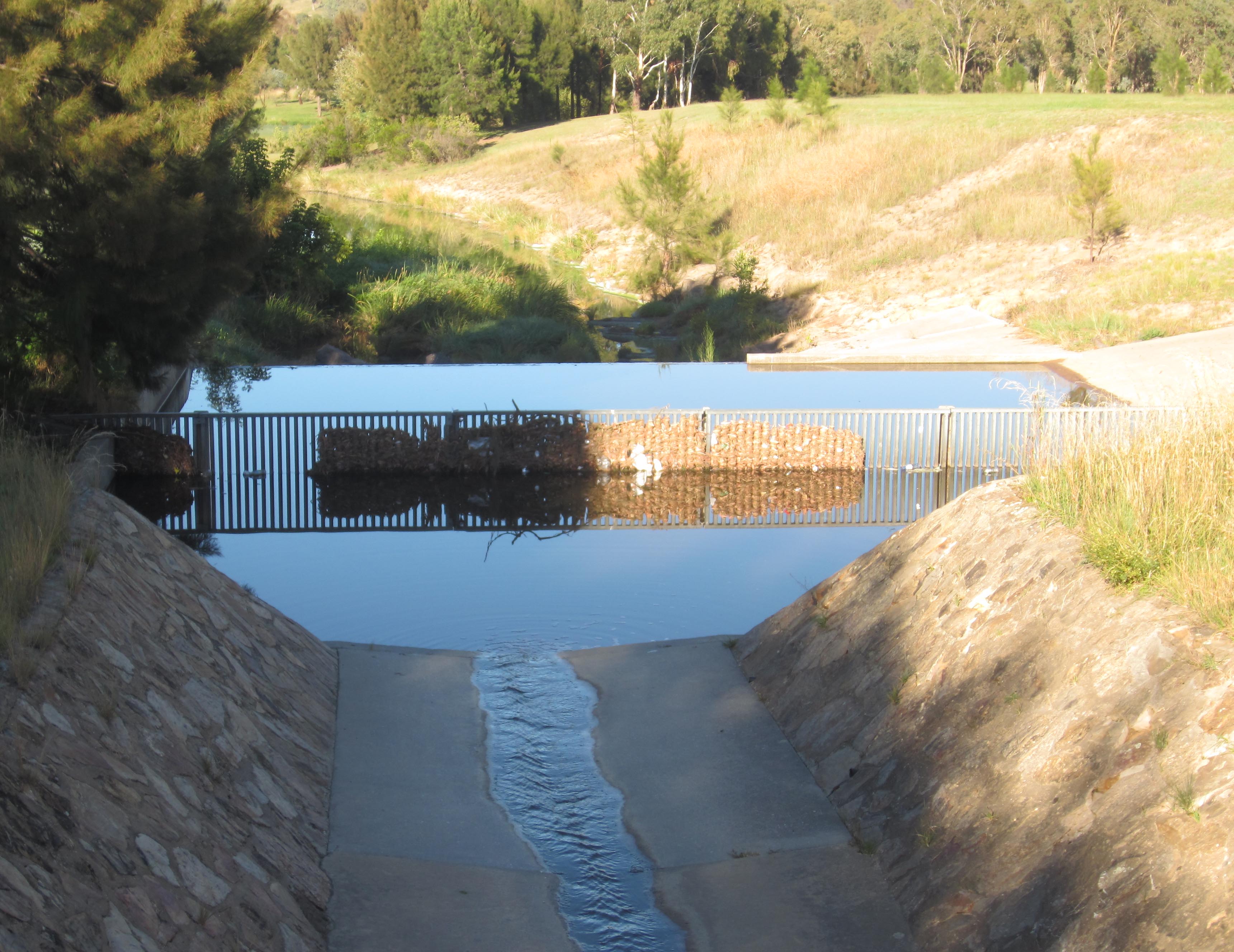
A rubbish trap in one of the streams that flow into Lake Tuggeranong. After rain, these traps fail to stop debris and rubbish from piling up in the lake.

On the annual Clean Up Australia Day hundreds of volunteers hold their noses, steady their stomachs, and fan out through Canberra to clear away a year’s deposit of detritus. In 2011 a total of 160 tonnes of gunk were collected in one day over the whole city, and many scores of these tonnes came out of the city’s three main lakes.

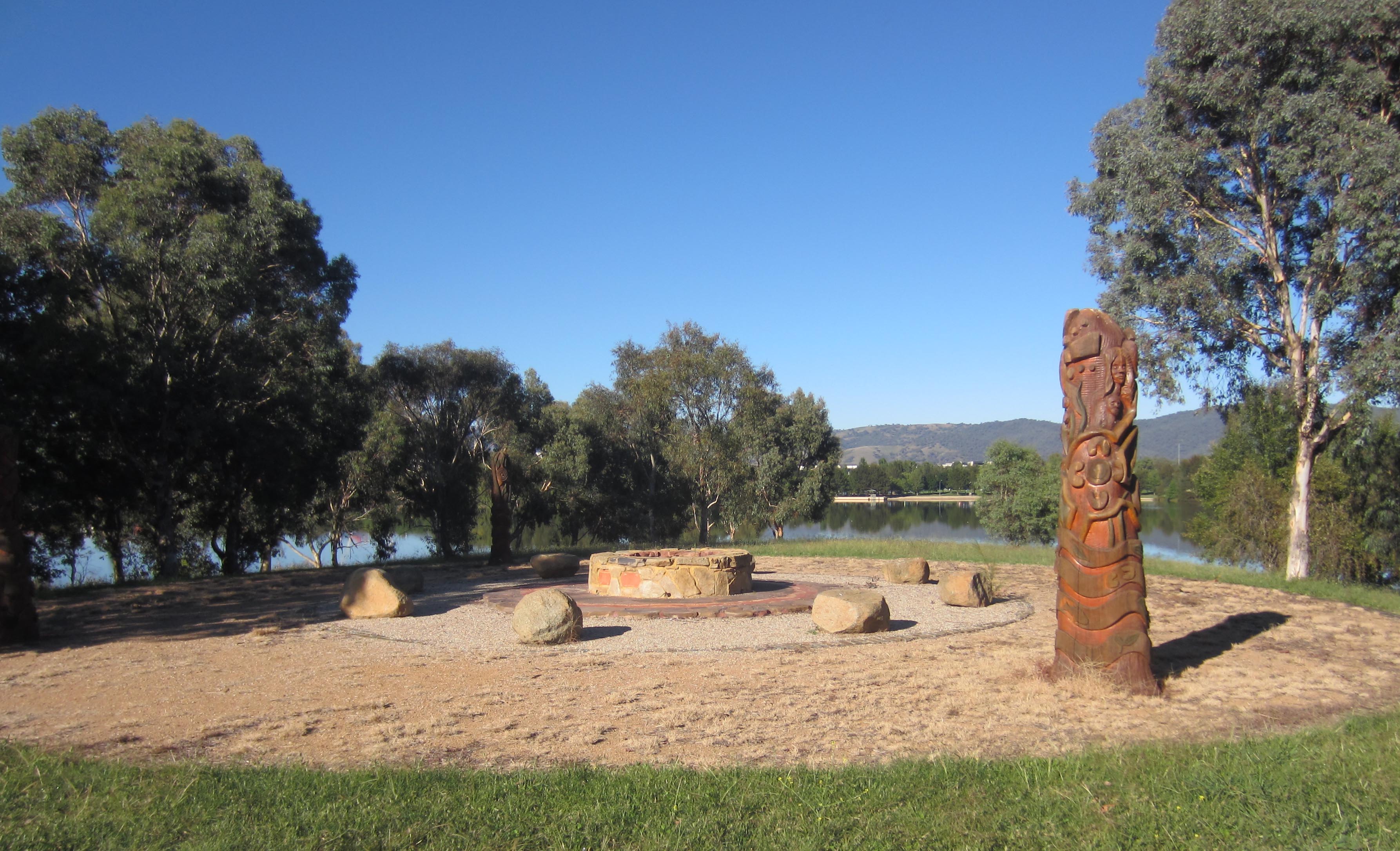
An Aboriginal ceremonial meeting place on the shores of Lake Tuggeranong.

Emmy and I have now reached an aboriginal meeting ground on the lake’s shore (35°24’31.19″S, 149° 4’10.46″E). Here we stop for a few minutes to draw breath and drink. We have covered a little over six kilometers. In my next post we’ll walk past a “Men’s Shed” just 500 metres ahead of us, tuck into some unhealthy food among the fatties of the Hyperdome, and look at two institutions of religious faith along the home stretch of our path.

Update: On May 24th 2012 Lake Burley Griffin in the centre of Canberra was closed by the National Capital Authority because of blue-green algae readings that were said to be 1000 times above safe levels and “potentially fatal.” A big water jet in the middle of the lake was turned off because of fears that it might spread a fine mist of algae laden water that would endanger the public. Read the full news report at: http://www.canberratimes.com.au/act-news/potentially-fatal-levels-of-bluegreen-algae-close-lake-20120524-1z86r.html#ixzz1vs9cbAiH

Refreshing greenery along the path from our home to the Hyperdome shopping mall.