Day 1 on the Camino

Emmy and me in the lobby of our Porto hotel about to take our first steps on the Camino.

Thursday July 14th dawned clear and warm over the cobbled streets and the tattered buildings – packed like upright sardines – of Porto’s antique centre. An army marches on its stomach, and, contrary to popular opinion, so do those claiming (or pretending) to be engaged in spiritual pursuits like pilgrimage. A hungry pilgrim is a distracted pilgrim, so Emmy and I both ate a big breakfast in the dining room of the Vila Gale Hotel. I took on board a writhing snake pit of bacon rashers, a big shipment of chipolata sausages, and two fried eggs in a nest of scrambled eggs. This was followed by a potpourri of fresh fruit starring delicious, sweet and very juicy slices of orange. Emmy tucked in to a small mountain of cornflakes with fruit followed by an assortment of breads, croissants and pastries liberally treated with butter and jam.

After breakfast I did a final check of my backpack.

First aid kit.

Sun screen and lip balm.

Leatherman multi-function folding tool.

Wet weather gear (rain jacket and leggings).

Walking poles.

Maps, guide book and pilgrim passport.

Filled water bottle.

Muesli bars and chocolate.

Yep, I agree… far too much stuff.

We had booked accommodation along the Camino through Follow The Camino, a company headquartered in Dublin that specialises in pilgrim travel for the deluded Catholics of that island, and this company also arranged for the “safari” transport of our two suitcases from point to point. Following the advice given by the “Pope” of Camino pilgrims, John Brierly, in his Pilgrim’s Guide to the Camino Portugues, we decided to make our start from Maia in the northern suburbs of Porto. So, leaving our suitcases at the hotel, we checked out around 9.00 a.m. and headed for the nearby Metro station.
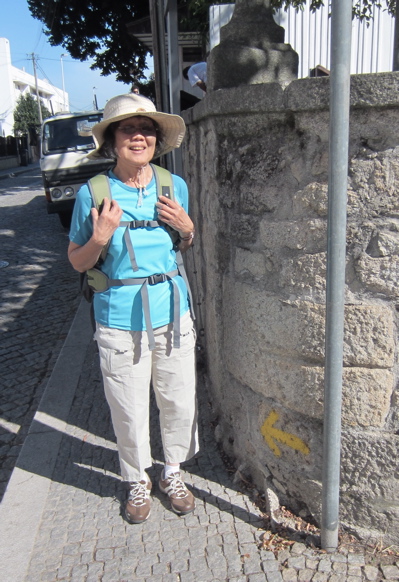
Near Maia church, Emmy was the first to spot one of the Camino´s famous yellow arrows (on the wall beside her knee)

Half an hour later we were standing disoriented in the middle of the modern local centre of Maia. It took a little scouting around before we found what must have once been the focal point of Maia but now passes almost unnoticed on the edge of the town’s hard new heart: the old tile-clad church known to locals by the slightly sinister name (in this age of terrorist bombings) of the Capela de Nossa Senhora do Bom Despacho. This is the local starting point for pilgrims heading north, and right beside the church – much to our relief – we spotted the first of the succession of yellow arrows that are going to conduct us all the way to Santiago de Compostela in the distant north-west corner of Spain.

Now we started walking in earnest. Conditions were perfect, with a temperature of around 22 degrees and a refreshing breeze in our faces. But it wasn’t all easy going. For a start, we walked the whole day on public streets and highways. The highways were busy, traffic travelled fast, and there were no footpaths. The local roads and streets were equally challenging – they were very narrow, stone cobbled, and often without footpaths, or with precariously narrow footpaths.

But it was good to be on the move. Slowly we emerged from the industrial estates of Porto and entered a world of cornfields and whitewashed houses with orange tiled roofs. Some houses were painted light yellow, pink or a beautiful peach colour, others were covered in an exotic façade of tiles with blue motifs on them.

We stopped once or twice to draw breath and drink. Around 1.00 p.m. we had lunch in a small café in the tiny village of Vilar, about 25 kms north of the centre of Porto. Lunch was a “hamburger” (the only item I recognised on the menu). I use the term “hamburger” loosely and
with reluctance because I can’t think of any other term to describe the thing that was put before us with a proud flourish. It consisted of a
very dry slice of cold and tough crumbed chicken, fried schnitzel style, between two halves of a Portuguese pao bread bun (also tough). No salad, no sauce. Its only saving grace was its price, just 1.35 euros (less than  $2.00 Australian).

But somehow we were grateful for the nourishment, and its culinary shortcomings were more than offset by the hospitality of the lady behind the bar. I made the mistake of saying “Bom tard” to her (Good afternoon, I think) which triggered a torrent of Portuguese that broadened into a vast lake of story, complete with (if I understood her gestures correctly) tall-turreted castles with damsels in distress hanging from windows and an army of Don Quixotes galloping to the rescue. (Emmy thinks she might have been talking about something else, but I can’t image what that might have been.)

Country-style hamburgers in Vilar north of Porto

Our accommodation at the end of this first day (where I am writing this now) was the Quinta das Alfaias in the village of Fajozes, about 2 kms off the Camino route. This beautiful colonial-style guest house is built around extensive tree-filled grounds of dazzling green. Just to enter its simple rooms is restful, the water in the bathroom is plentiful and hot, and our hosts Teresa and Joao strike the right balance between an effusive
welcome and the hands-off service that tired walkers need.

In the evening Teresa prepared a memorable meal: an entrée of delicious Portuguese alheira sausage mashed up on a bed of spinach, followed by grilled dourado fish with roast vegetables and a dessert of profiteroles doused in chocolate sauce, all accompanied by local wines that lingered long on the tongue. We ate this banquet in the ornate dining room seated with two other guests around a large dark dining table lit with candles
that glinted on a pair of antique silver biscuit hoppers with fold-down flaps and mysterious doors.

Joao… look after your liver. Teresa… help Joao look after his liver.

(With apologies to readers of this blog for formatting and other technical difficulties I’m having with this posting. Good computers and fast internet connections seem to be hard to come by here in the country areas of northern Portugal.)

Evensong at Westminster Abbey

Approaching 5.00 p.m. on a cool, windy summer afternoon, Emmy and I join a queue filing into Westminster Abbey for the daily Evensong service. Vergers usher us to places in a block of folding chairs at the junction of the nave and transepts (called “the theatre”) under columns of time-polished stone that disappear into the ornate, peaked-arch roof more than 30 metres above us.

Westminster Abbey's interior hushes you and compels you to look upwards. (Wikipedia open-access image)

The ambience imposes a kind of hush. The vergers in black capes with bright red collars stride silently back and forth, pointing, whispering, bobbing. A group of teenagers wearing “I ❤ NY” tee-shirts sits nervously exposed in the front row. One of them pulls the ear bud of an iPod from his ear and hurriedly stuffs it into his shirt pocket. Three tiny Japanese ladies sit with smooth upturned faces, open-mouthed and silent. An old bent woman in a grimy gabardine overcoat comes by pushing a walking frame. A small squad of beefy, crew-cut young men, wearing white dog-collars of the priesthood, point and nod and murmur in German. A young tourist tries to cram her backpack into the space under her chair as if she is settling into an airline seat.

Exactly at five o’clock a very high, thin, scarcely audible note beams like a laser from the organ. Slowly it swells and cascades into a complex glissando. It is joined by a pitchless rumbling from deep in the stomach of the organ, and the space between upper and lower registers is filled in with a quiet but intricate play of melody. The effect is ethereal, an ornate structure of glittering sound filling the air like an audio-abbey.

The theme of the service is Abraham’s unwavering faith. He is a model of the obedient believer, willing to personally sacrifice his own son if God asks this of him. The presiding priest tells the story in a curiously matter-of-fact tone:

And they came to the place which God had told him of; and Abraham built an altar there, and laid the wood in order, and bound Isaac his son, and laid him on the altar upon the wood. And Abraham stretched forth his hand, and took the knife to slay his son. And the angel of the Lord called unto him out of heaven, and said ‘Lay not thine hand upon the lad, neither do thou any thing unto him: for now I know that thou fearest God.

The narrowly avoided sacrifice presages a later sacrifice that goes ahead uninterrupted. The choir celebrates it in a long, complex and beautifully exuberant anthem.

The Paschal Lamb is offered, Christ Jesus made a sacrifice for sin. The earth quakes, the sun is darkened, the powers of hell are shaken, and lo he is risen up in victory.

The fading sun – dyed purple and bright yellow from its passage through distant reaches of stained glass – slants across the congregation. The versicles and responses are intoned in a high, half-spoken half-sung monotone, passing back and forth between the priest and choir.

O Lord save thy people
And bless thine inheritance
Give peace in our time, O Lord
Because there is none other that fighteth for us, but only Thou O God

For once, I’m finding it hard to be unmoved. Evensong at Westminster Abbey is a confusing experience. I cannot be the snarling, sabre-toothed atheist I would like to be.

But equally I cannot quiet the thought that Evensong – with the power of the ambient architecture, the power of the words, the power of the music – is largely (but not entirely) about stifling understanding in the interests of privilege. With a rush of pure beauty the choir sings:

He hath put down the mighty from their seat
And hath exalted the humble and meek.
He hath filled the hungry with good things
And the rich hath he sent empty away.

I look around. Everything in the Abbey contradicts – even mocks – these words. Of the many hundreds of thousands of hands that shaped the stones, painted the windows, chiselled the ornate woodwork and worked high above the ground hanging from flimsy scaffolding, not one is represented, let alone named, in the inscriptions and busts and reliefs that crowd the walls and floors of the building. And this in a building in which the words “he hath exalted the humble and meek” can resound with such mesmerising harmony.

And behind the ancient story of Abraham’s near-miss murder of his son – with its metaphors of unwavering obedience, sacrifice and redemption through death – lies an unspoken, and probably wholly unnoticed, but very modern lesson: fundamentalism, fanaticism, terrorism and war find their deepest roots in stories like this.

Lunch at Auntie’s Tea Shop

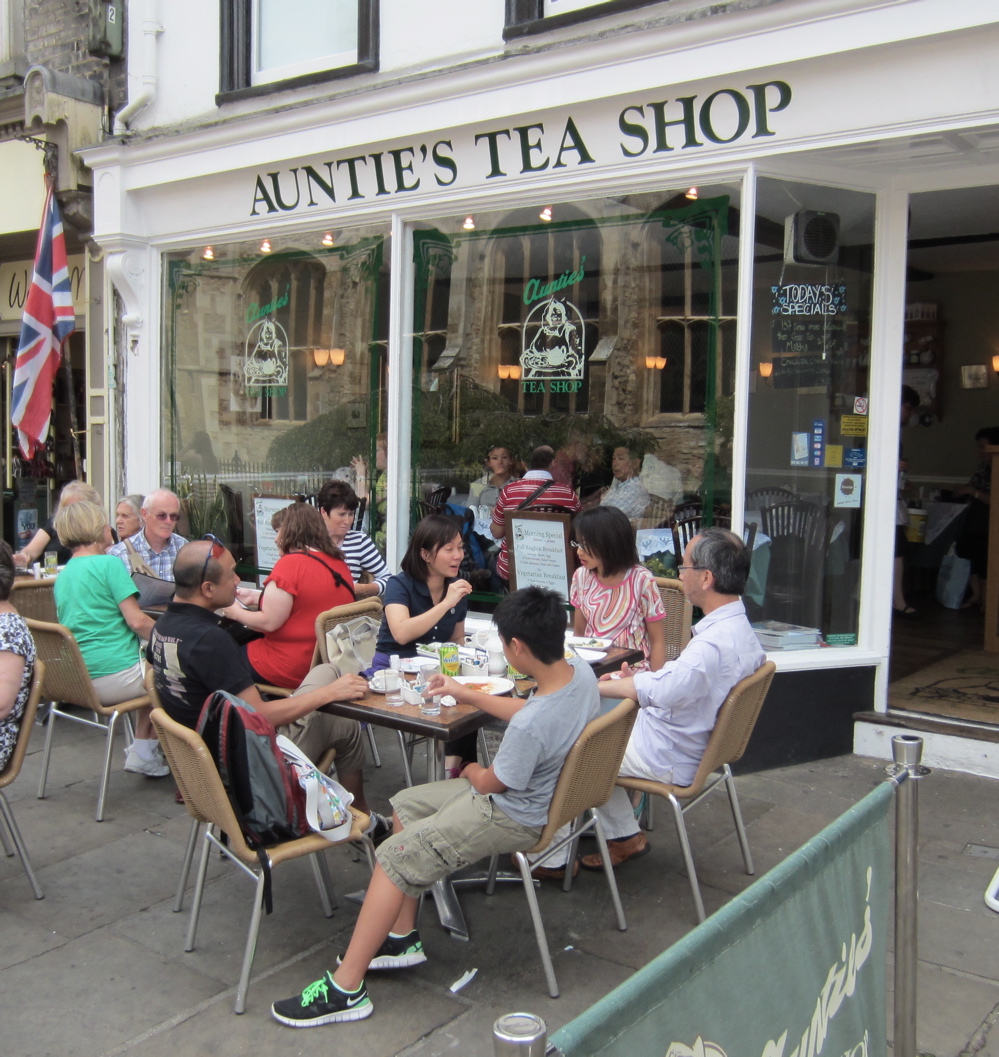
Auntie’s Tea Shop is on St Mary’s Passage just off King’s Parade in the centre of Cambridge. It is only a minute’s walk from the soaring, echoing vastness of Kings College Chapel. After a morning walking around the icons of Cambridge the very name “Auntie’s Tea Shop” was an irresistible relief to Emmy and me. Images of fluffy English scones and delicately flavoured tea had already been disturbing our admiration of the town’s gothic and georgian magnificence.

Auntie's irresistable tea shop

We took a quick look inside. It was very reassuring. Several grey-haired ladies and balding gentlemen were seated primly at smallish tables draped in lace tablecloths. Huge porcelain teapots were being tilted over delicate cups. Waitresses in demure black uniforms with white collars and white pinafores glided between the tables with trays of cakes lying among mini-mountains of whipped cream.

We ordered lunch. I had ham and brie panini, Emmy had a huge chicken salad. The food was good, and naturally we ordered tea – English tea. This too was as delicious and refreshing as we imagined it would be. Peering out the front window over the heads of diners on the footpath, I took in Great St Mary’s Church across the street where Richard III,  Elizabeth I, Cardinal Woolsey, Oliver Cromwell and countless others once rustled their robes over the flagstones of its floor. Tea shop and ancient church… at last, the real England in one glance!

Auntie's huge chicken salad

This reverie was interrupted by a strongly accented voice.

“Sirrr, you like for leetle beet morrr tea?”

The waitress stood deferentially beside our table, her pen poised above a note pad, her gleaming blond hair in two plaits coiled into a bun at the nape of her neck. Polish? Czech? Ukrainian?

As we ordered more tea two young women wearing head scarfs, long black coats and Reebok trainers came into the shop. There was a whispered conversation with another of the waitresses.

“Just for prayers?” we heard the waitress ask.
“Yes, just for prayers”

A moment later five more young Muslim women filed into the shop and headed out to the rear. A short while later they returned, quiet and polite, and filed out again into the sunlight of the street.

In its appearance – like the great Christian monuments of Cambridge – Auntie’s Tea Shop is quintessentially English in the carefully crafted “traditional” sense. But when Muslims pray in tea rooms, and Ukrainian waitresses serve cream scones with jam, we know that something has changed deep down. They have become part of “England” and in becoming English they have deeply changed that “England”.

Inside Auntie's: olde Englishe tea served with eastern European accents

Of course I knew a bit about this new England from statistics, documentaries, Bend It Like Beckham, Zadie Smith, tandoori curries, the Kumars at Number 42 and a million other manifestations and caricatures of England’s migrant culture that have infiltrated into the perceptions of distant Australia.

But I needed an image to hold on to, and at a micro level, Auntie’s Tea Shop in gothic Cambridge is that image. In my mind’s eye – whether accurately or wildly wrong – Auntie’s Tea Shop has now taken up residence as the stereotyped embodiment of today’s England.

24 hours of airline food

The advice was unanimous. If you are flying long distances, eat as little as possible and drink as much as possible. (The last part of this advice was spoiled by a caveat: no alcohol.)

I did the opposite. I ate everything that was put in front of me, and drank only the minimal ration of fluid that came with each meal. This was a mistake. I should have taken the advice. That’s why I arrived in London feeling less than sharp. Not ill exactly, but slightly queasy. And it wasn’t all jetlag and dehydration. More than anything, I think it was the food.

Here’s what I ate, with each meal and snack rated on a scale of one to five.

Chicken and brie focaccia sandwich (Canberra Airport snack bar, midday).  The two slices of focaccia bread were lightly toasted. Between them were pieces of roasted chicken, with brie that had melted under the heat of the toasting process, plus shredded basil leaves. The chicken retained some remnants of moistness. The brie was warm, bright yellow, and runny, but luckily there wasn’t too much of it. What lifted this snack was the sharp and delicious hint of basil. The toasting gave the bread a pleasantly fine veneer of crispness. This snack was well above the average, but from here it was all downhill. ★★★★✩

Ginger muffin (Qantas in-flight snack, mid afternoon between Canberra and Sydney) The flight from Canberra to Sydney takes 40 to 50 minutes, so there is scarcely time for the stewardess to drop a cardboard box in your lap before she is back again, hovering, ducking, leaning, trying to grab back what she has just given you, suggesting you stuff the remnants of your snack into a kind of sick-bag that comes with it. Inside the cardboard box lies a puffed-up tennis ball of cellophane with a brown object inside – a ginger muffin. The muffin is quite moist, very sweet, speckled with tiny currants and carries a strong, almost smellable, flavour of ginger. Edible, but only just. ★★✩✩✩

Vegetarian pasta (British Airways dinner, early evening between Sydney and Bangkok) The main course came with an entrée of coleslaw salad (not bad, fairly crunchy) and a dessert of white mousse (nice and light but ultra sweet). Peeling back the aluminium foil on top of the main dish revealed a mini-swamp of macaroni in white sauce. Green peas decorated the surface, like frogs talking a quick breath before diving, and fragments of red carrot floated here and there like discarded Coke cans. Inserting a plastic fork revealed that the sauce had congealed. You could lift the contents of the dish to your mouth in grainy lumps. The flavour was bland. ★★✩✩✩

Pastrami roll (British Airways snack, served around midnight prior to stopover in Bangkok) The slice of dark pastrami beef – wiped with a blackish mustard – lay between two halves of a bright white, floury-crusted, sourdough bread roll. The meat and mustard tasted OK, though neither looked very appetising. But the bread was a disaster: stale, tough and flaky. ★★✩✩✩

Braised pork with rice (British Airways dinner, served in the small hours of the morning after departure from Bangkok) The pork squirmed at the right hand end of the small dish, jostling with rice in the middle and vegetables to the left. The pork was truly horrible, almost unrecognisable as meat, with a kind of unpleasant, slightly bitter bite in its flavour. The rice was mushy. The vegies were grossly over-cooked. After eating this concoction I reached with gratitude for the dessert, a Kit Kat chocolate bar. And a small bottle of Spanish tempranillo wine was smooth and generous enough to erase the barbaric after-taste of the pork. No stars for the food though. ✩✩✩✩✩

“English breakfast” (British Airways, served at 4.30 a.m. on approach to Heathrow). Two kinds of breakfast were on offer, “Omelette” and “English”. I chose the latter, but glancing surreptitiously around I concluded that the two breakfasts weren’t much different. Mine had a chicken sausage, half a fried tomato and some rather slimy brown lumps which were probably champignons although they had no recognisable flavour. The main component of the meal was scrambled eggs between two slices of ham. The ham was excellent – lightly cooked and quite flavoursome – but the scrambled eggs had been pressed into a block that could be lifted en masse like a small brick. A tiny serving of diced fruit delivered some freshness to the mouth at the conclusion of the meal. ★★★✩✩

So… looking back over my nutritional intake during those long 24 hours, I think I know why I saw Heathrow swaying slightly through a filmy haze.

Morgan Spurlock’s film Super Size Me documents the drastic effects on his physical and psychological health of one month spent eating nothing but McDonald’s food. Morgan… for your next act, try 24 hours locked into an airline diet. The food wasn’t all bad news, but it was mostly bad news.